A sewer backup inside your home is not a simple plumbing spill—it is a certified Category 3 biological emergency loaded with infectious pathogens, toxic gases, and severe structural degradation risks. Here is your definitive engineering and emergency action guide.
Last updated:Reading time:17 minStandards:IICRC S500 Verified
When a toilet overflows with black water or waste surfaces through shower drains, immediately stop all water use, shut off the HVAC system, and evacuate children and pets. Sewage contains pathogenic bacteria (E. coli, Salmonella), Hepatitis A viruses, and toxic endotoxins that aerosolize through air ducts. Attempting DIY cleanup with shop-vacs or household bleach spreads contamination and destroys insurance claim legitimacy. Safe restoration requires immediate IICRC S500 negative-air containment, truck-mounted extraction, porous material flood cuts, and EPA-registered hospital-grade biocides.
The Biohazard Reality: Why Sewage is Category 3 "Black Water"
In the restoration industry, water damage is categorized under the IICRC S500 Standard and Reference Guide for Professional Water Damage Restoration according to the level of biological and chemical contamination present. Understanding this classification is essential because it dictates the legal, health, and structural requirements of your remediation.
Category Level
Contaminant Profile
Typical Sources
Salvageability of Porous Items
Category 1: Clean Water
Sanitary source; no immediate threat to human health.
Medium — carpet pad must be discarded; carpet and baseboards can occasionally be sanitized.
Category 3: Black Water (Biohazard)
Grossly unsanitary; contains pathogenic agents, bacteria, fungal spores, and heavy parasites.
Sewage backups, toilet overflow with feces, municipal sewer surcharges, river/monsoon runoff.
Zero — all saturated porous items (carpet, pad, drywall, insulation, trim) must be demolished and discarded.
IICRC S500 Water Damage Contamination Classifications and Protocol Matrix.
Raw sewage isn’t just dirty water—it is an active biological culture medium. In warm climates like Phoenix, Mesa, and Scottsdale, indoor temperatures between 75°F and 85°F cause bacterial colonies to double exponentially every 20 minutes. A backup that seems contained to a single guest bathroom floor can release millions of airborne microbes into your home's air supply within hours if proper negative air containment is not established.
Pathogenic Bacteria
Escherichia coli (E. coli), Salmonella enterica, Campylobacter, and Shigella cause virulent gastrointestinal cramping, acute dehydration, bloody diarrhea, and systemic bloodstream sepsis upon mucous membrane contact.
Human Enteric Viruses
Hepatitis A, Rotavirus, Norovirus, and Adenoviruses survive for weeks on damp building surfaces and cannot be neutralized by consumer pine or citrus cleaning sprays.
Endotoxins & MVOCs
As gram-negative bacteria die, their cell walls release lipopolysaccharide endotoxins that trigger severe fever, chronic asthma attacks, and respiratory inflammation when inhaled through home air conditioning vents.
To understand the complete medical and long-term immunological risks of unmitigated microbial growth, read our detailed medical review on the health risks of untreated water damage.
The First 15 Minutes: What to Do (and Never Do)
The immediate actions you take in the first quarter-hour of discovering a sewage overflow will dictate both the safety of your household and whether your homeowners insurance carrier honors your claim. Follow this strict containment sequence:
Step 1: Cease All Internal Plumbing Use Immediately
Do not flush any toilets, run washing machines, run the dishwasher, or turn on sink faucets anywhere in the home. In a main sewer lateral blockage, water drained on upper floors will directly pressurize and discharge out of the lowest fixtures in the house—typically ground-floor showers and guest toilets.
Step 2: Shut Down Your Central HVAC Air Handler
Turn your thermostat to "OFF". Running return air ducts will suck aerosolized sewage droplets, odor gases, and microbial spores out of the contaminated bathroom and circulate them into bedrooms, kitchens, and carpeted living areas.
Step 3: De-Energize Electrical Circuits in Affected Rooms
If standing sewage water has reached floor outlets, extension cords, or baseboard heaters, immediately flip the corresponding circuit breakers at your main panel. Black water is highly conductive due to dissolved electrolytes and urine.
Four Dangerous Sewage Cleanup Mistakes That Destroy Homes
Never use a consumer shop vacuum: Standard household wet/dry vacs have non-HEPA exhaust ports that atomize raw sewage bacteria into microscopic plumes, spreading hazardous pathogens throughout the room.
Never walk through wastewater barefoot or in flip-flops: Any microscopic scratch on your foot can contract severe Staphylococcus or leptospirosis infections. Wear rubber boots and heavy nitrile gloves.
Never use standard ceiling or box fans: Blowing high-velocity air across standing raw sewage dries out fecal matter and turns infectious particulate into airborne dust that settles on countertops and upholstery.
Never dispose of sewage-soaked items in standard municipal curbside bins: Contaminated carpets and drywall are biohazard construction waste and must be double-bagged and disposed of in accordance with Maricopa County health codes.
Why Arizona Homes Experience Frequent Sewer Backups
Homeowners in Phoenix, Scottsdale, Mesa, Chandler, and Tucson frequently wonder why sewage backups occur so abruptly in a desert climate without heavy continuous rainfall. The reality is that Arizona's unique combination of desert flora, geology, and historic infrastructure creates a perfect storm for drain line failures:
1Invasive Desert Tree Root Infiltration
In Arizona's arid soil, ornamental trees such as Chilean Mesquite, Sweet Acacia, African Sumac, and Ficus microcarpa develop massive, aggressive root structures that travel over 50 feet searching for moisture vapor. Roots penetrate tiny hair-line fractures in clay pipe joints, expanding until they create an impenetrable root ball that catches toilet paper and solid waste.
2Caliche Clay Soil Shifts & Pipe Shearing
The Valley's sub-surface consists of dense, cement-like caliche layered with expansive bentonite clay. When dry, this soil contracts; when monsoon deluges saturate the ground, it expands violently. This recurring heave shears aged underground sewer laterals, creating pipe bellies where grease and solids pool and cause sudden back-pressure.
3Cast Iron Pipe Channel Rot in Historic Homes
Thousands of homes built between 1950 and 1980 in central Phoenix, Tempe, and Scottsdale feature original cast iron sewer pipes buried under concrete slabs. Over decades, hydrogen sulfide sewer gas corrodes the top of the pipe while wastewater erodes the bottom trough, resulting in structural collapse and chronic slab-level backups. For details on under-slab leaks, see our Arizona slab leaks homeowner guide.
4Monsoon Flash Flood Municipal Surcharging
During intense July and August monsoon cloudbursts, stormwater inundates municipal sanitary sewers through manhole covers and illicit roof drain connections. When the city main surcharges to capacity, wastewater has nowhere to go but backward up residential sewer laterals into low-lying home plumbing fixtures.
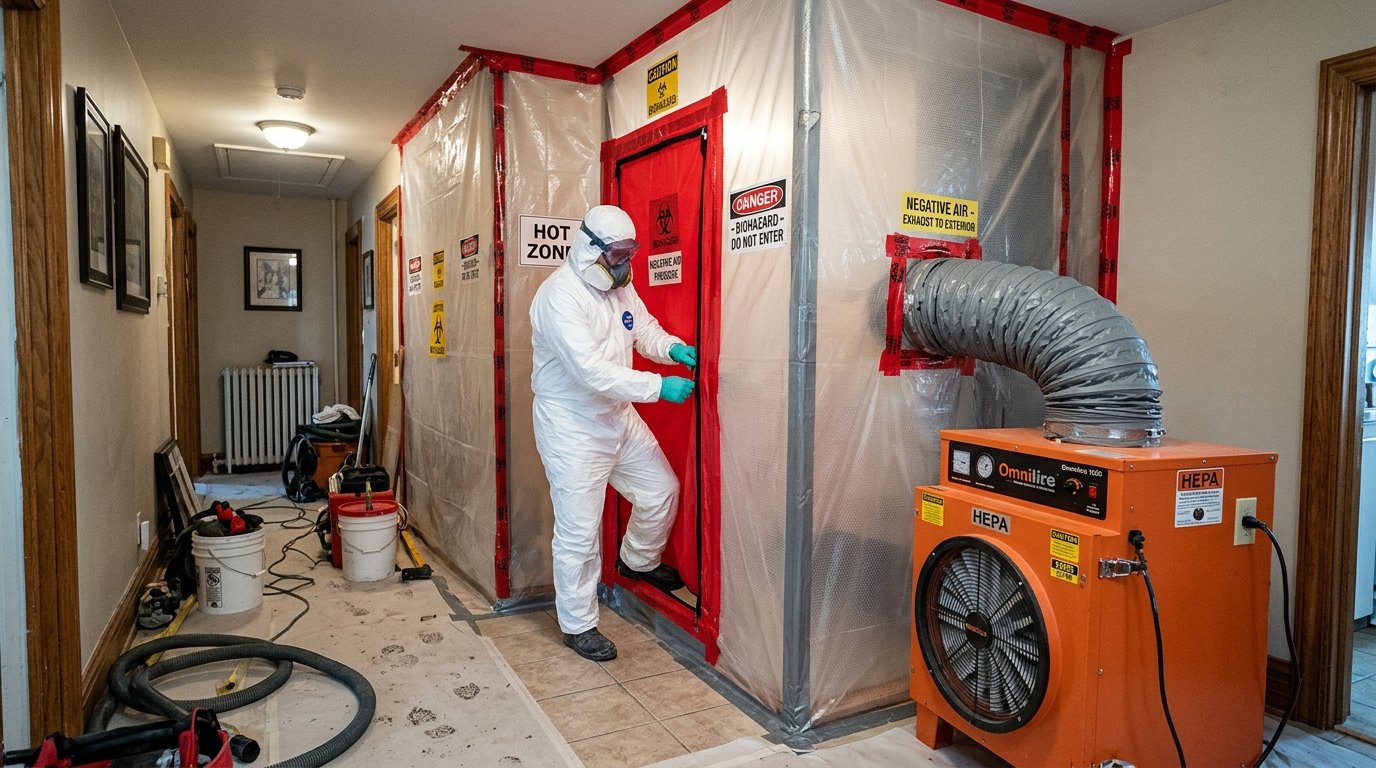
Biohazard ContainmentIICRC S500 sealed containment barrier with negative pressure HEPA filtration prevents hazardous airborne endotoxins and mold spores from migrating into unaffected bedrooms and living areas.
The 6-Step IICRC S500 Professional Sewage Remediation Protocol
Remediating Category 3 black water is an environmental engineering process governed by rigid scientific protocols. When our emergency crews arrive at your property, we execute a documented six-stage decontamination plan:
1Biohazard Isolation & Negative Air Scrubbing
Before removing a single drop of water, technicians construct physical containment barriers using 6-mil flame-retardant polyethylene sheeting and airtight tension poles. We place commercial air scrubbers equipped with certified HEPA filters and activated carbon stages inside the contaminated zone, exhausting air outside the home through flexible ductwork. This creates continuous negative air pressure, preventing airborne odor, bacteria, and spores from cross-contaminating clean rooms.
2Closed-Loop Bulk Black Water Extraction
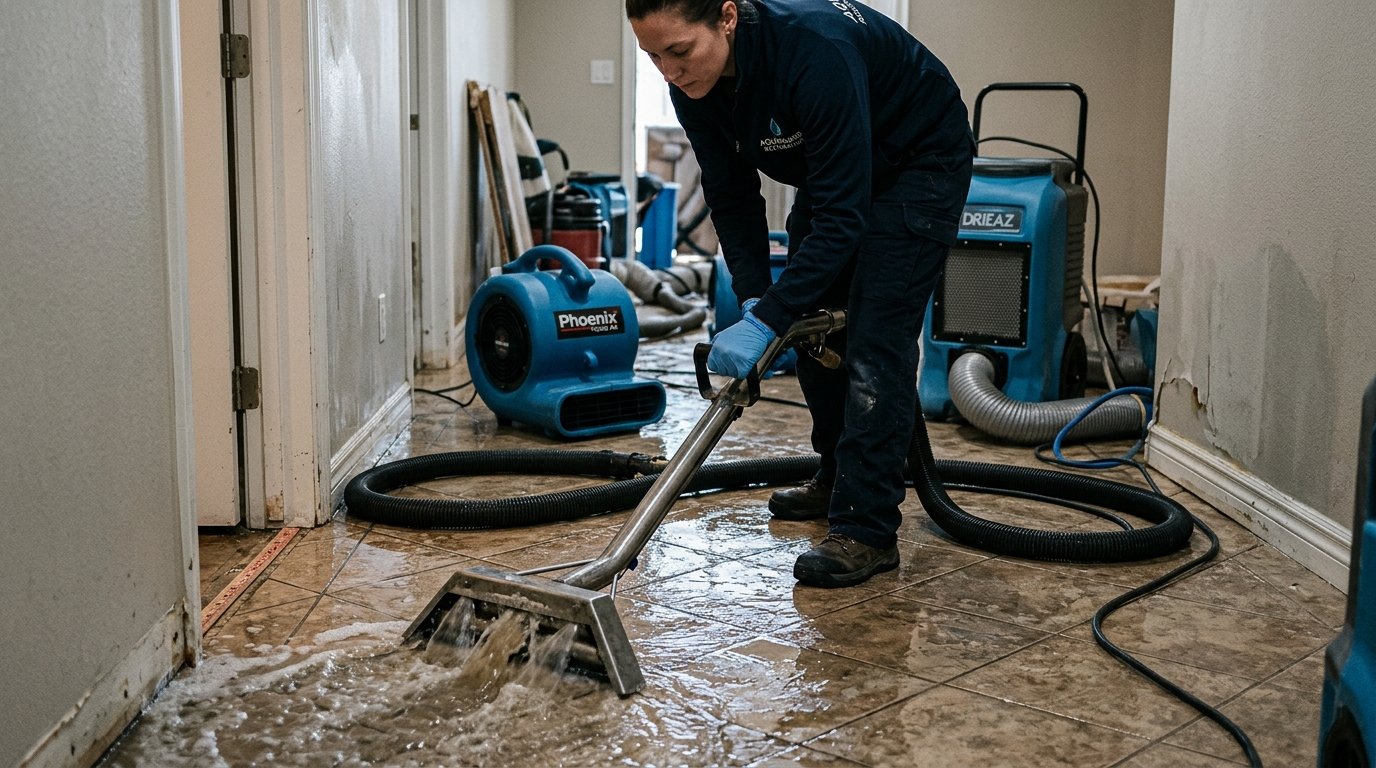
Standing sewage water is extracted using commercial truck-mounted vacuum extraction systems. Heavy-duty wands with weighted extraction heads draw liquids and solids directly through sealed vacuum hoses into our vehicle waste recovery tanks for legal, environmentally compliant municipal disposal. Our specialized units extract up to 15 gallons per minute without permitting aerosol escape.
3Controlled Demolition & Flood Cuts
Because porous building materials absorb bacteria-laden moisture deeply into their cell matrices, they cannot be sanitized in place. Technicians execute precise "flood cuts" into drywall 12 to 24 inches above the highest wet point, removing contaminated gypsum board and saturated wall insulation. Saturated carpeting, tack strips, underlayment foam, and swollen fiberboard vanities are bagged in heavy-duty biohazard plastic and removed.
4Multi-Stage EPA Botanical Antimicrobial Washdown
All remaining framing lumber, exposed concrete slabs, and non-porous floor tiles are thoroughly pressure-washed with biodegradable surfactants and treated with EPA-registered hospital-grade antimicrobials. We use thymol-based botanical disinfectants that eliminate 99.99% of bacteria, Norovirus, and fungal spores without leaving toxic chemical residues harmful to children or pets.
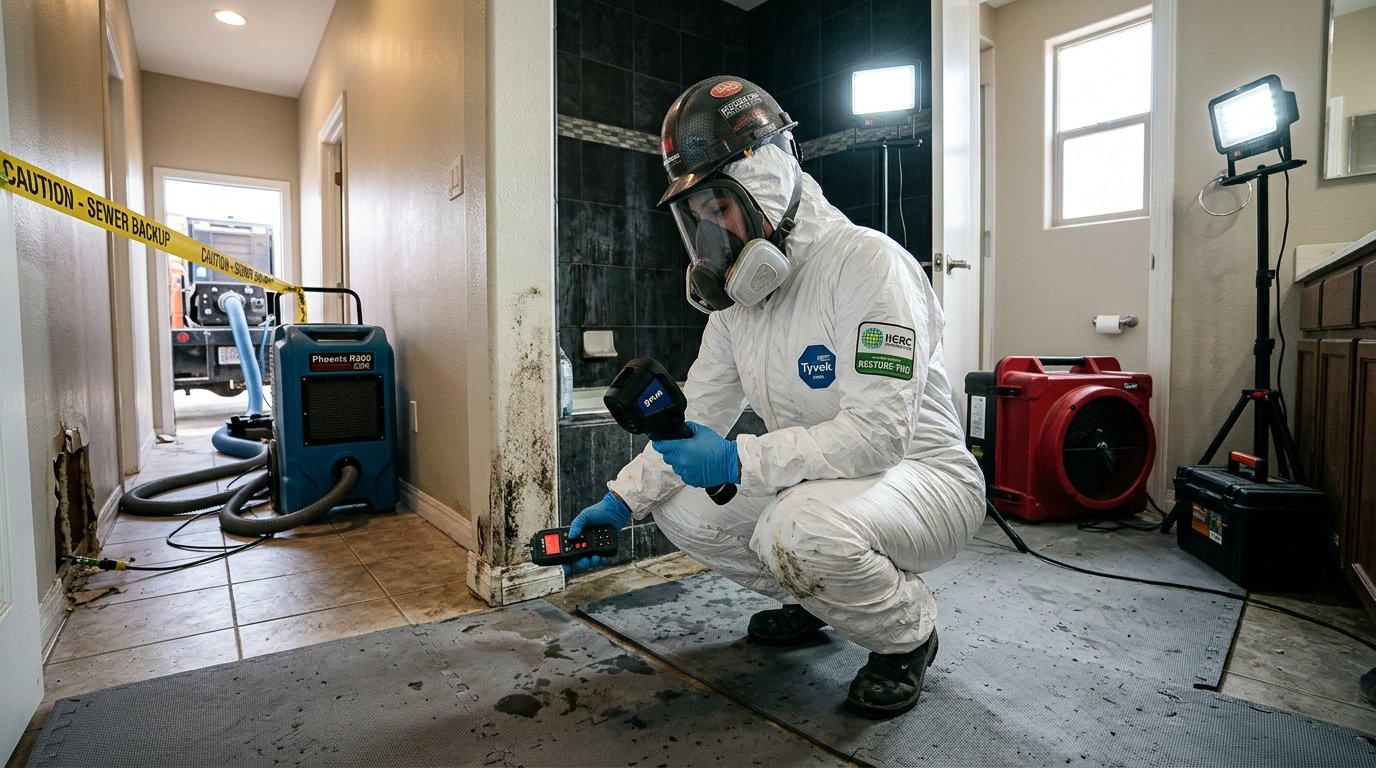
Once biological decontamination is complete, industrial Low-Grain Refrigerant (LGR) dehumidifiers and axial air movers are positioned to extract bound moisture from subfloors, concrete slabs, and wall framing studs. Technicians record daily psychrometric logs (temperature, relative humidity, and grains per pound of air) to ensure structures return to dry standards within 3 to 4 days, preventing post-cleanup mold cultivation. For a technical deep-dive, see our guide on how structural drying equipment works.
Before containment barriers are dismantled, we perform digital Adenosine Triphosphate (ATP) bioluminescence surface swab testing. ATP swabs detect living biological matter in Relative Light Units (RLU). Structural surfaces must achieve medical-grade clean status (<30 RLU), and deep-probe moisture readings must register below 15% Wood Moisture Equivalent (WME) to certify the property ready for reconstruction.
Deep Mechanical ExtractionHigh-volume mechanical extraction removes standing wastewater directly through heavy-gauge vacuum hoses, preventing water from permeating concrete subfloors.
Arizona Homeowners Insurance: What Is Actually Covered?
Insurance coverage for sewer backups is one of the most widely misunderstood aspects of Arizona property ownership. Here is what you need to know to protect your financial interests:
Policy Endorsement
Coverage Scope
Typical Limits
Claim Feasibility
Standard Homeowners Policy (HO-3 / HO-5)
Covers sudden and accidental internal plumbing discharge (e.g., burst supply pipe under sink).
Full dwelling limit (minus deductible).
DOES NOT cover backups originating from sewer lines, drain pipes, or municipal mains.
Water Backup and Sump Overflow Rider
Specific optional endorsement added to policy covering backups through sewers, drains, or sump pumps.
Filing against city (e.g., City of Phoenix, City of Mesa) if city main sewer collapsed or overflowed.
Actual documented damages.
Very difficult to collect: cities assert sovereign immunity unless gross municipal negligence is proven.
Comparative breakdown of sewage backup insurance coverage mechanisms in Arizona.
If your policy includes the Water Backup rider, time is of the essence. You must document the damage thoroughly with timestamped photographs and video before any materials are discarded. At AZ Water Damage Restoration, we compile comprehensive digital damage dossiers using insurance-standard Xactimate estimating software, providing daily psychrometric moisture logs, infrared thermal imaging reports, and itemized disposal manifests directly to your adjuster to ensure 100% legitimate cost recovery.
Sewage Cleanup Cost Breakdown & Timeline in the Phoenix Metro
Homeowners frequently ask what sewage cleanup costs in the Phoenix area. Costs depend on three primary factors: the total square footage affected, whether water traveled through wall cavities or under flooring, and the volume of porous materials requiring surgical demolition and biohazard disposal.
Multi-Room Main Drain Backup (Bath, Hall, Bedroom)
$4,500 – $9,800
3 – 5 Days
Negative air containment, truck-mount extraction, complete carpet & pad disposal, baseboard removal, drywall flood cuts (24"), framing washdown, drying equipment.
Extensive Whole-Home Catastrophic Intrusion
$10,000 – $22,000+
5 – 7 Days
Full-home containment, deep subfloor decontamination, cabinetry demolition, multiple commercial LGR dehumidifiers, HEPA air filtration, full ATP clearance certification.
Average 2026 professional sewage restoration cost ranges across Maricopa and Pima County, Arizona.
For a broader analysis of how water damage restoration pricing is calculated, including equipment rates and labor costs, read our comprehensive breakdown on water damage restoration costs in Arizona.
Five Proven Methods to Prevent Future Sewer Backups
Once your home is safely sanitized and restored, implementing proactive plumbing defenses will safeguard your family from ever experiencing another traumatic sewage flood:
Install an Exterior Backwater Check Valve: A backwater valve is a mechanical flapper installed on your main exterior sewer lateral. It allows household wastewater to flow freely out to the street, but automatically seals shut the moment city sewer mains surcharge, physically blocking sewage from backing up into your home.
Schedule Biennial Sewer Camera Inspections: If your home was constructed before 1995, have a licensed plumber run a high-definition fiber-optic camera through your cleanout every two years. Catching tree root intrusions or caliche soil shifts early allows hydro-jetting or trenchless epoxy pipe lining before a full blockage occurs.
Strictly Enforce the "3 Ps" Rule: Never flush baby wipes, feminine hygiene products, facial tissues, or dental floss—even if labeled "flushable." Only flush toilet paper, urine, and human waste (the "3 Ps"). Flushable wipes do not dissolve; they snag on rough pipe walls and create massive obstructions.
Never Pour FOG (Fats, Oils, and Grease) Down the Kitchen Sink: Hot cooking grease liquefies when hot, but congeals into rock-hard "fatbergs" when it contacts cool underground sewer pipes. Always pour used oils into glass jars or metal cans and discard them in trash bins.
Strategically Manage Desert Trees Near Sewer Runs: When planting desert landscaping, keep aggressive-root species like Chilean Mesquite, Willow, and Ficus at least 30 feet away from your underground sewer line. Opt for low-water, taproot-dominant plants like Palo Brea or Texas Sage near underground plumbing corridors.
When to Call an IICRC-Certified Emergency Restoration Specialist
While an emergency plumber is essential to snake or clear the physical blockage in your sewer lateral line, a plumber is neither licensed nor equipped to remediate the biological health hazard inside your living quarters. Plumbers do not carry commercial HEPA negative air scrubbers, hospital-grade biocides, or low-grain refrigerant structural dehumidifiers.
For true biohazard decontamination, moisture extraction, and licensed reconstruction, you need an IICRC-certified restoration contractor. At AZ Water Damage Restoration, our rapid-response emergency vehicles are stationed across the Phoenix metro area—including Scottsdale, Mesa, Chandler, Gilbert, Glendale, Peoria, and Tucson—standing by 24 hours a day, 365 days a year.
Related Technical Guides
Educational resources for Phoenix & Arizona property owners
Our rapid response units maintain staged equipment yards across Central Phoenix, the East Valley, the West Valley, Pinal County, and Greater Tucson for an average ~42-minute on-site arrival:
Is a sewage backup considered a biohazard in Arizona?
Yes. Under international restoration standards (IICRC S500) and public health guidelines, sewage backups are classified as Category 3 'Black Water.' Raw municipal wastewater contains dangerous live pathogens including Escherichia coli (E. coli), Salmonella, Hepatitis A virus, Rotavirus, Giardia, and gram-negative endotoxins. Unprotected exposure or improper aerosolized vacuuming creates severe gastrointestinal, skin, and respiratory infections.
Does standard Arizona homeowners insurance cover sewage backup?
Standard HO-3 and HO-5 homeowners insurance policies explicitly exclude damage caused by sewer line backups, drain overflows, or municipal main surcharges unless you purchased an optional 'Water Backup and Sump Overflow Endorsement' rider. This rider typically provides between $5,000 and $25,000 in dedicated coverage for emergency extraction, structural decontamination, and drywall replacement.
Can I clean up raw sewage myself with household bleach?
No. The IICRC and OSHA strongly warn homeowners against DIY sewage cleanup. Household chlorine bleach loses sanitizing efficacy rapidly when in contact with gross organic waste, and pouring bleach down drains creates dangerous chlorinated gas fumes. More critically, DIY shop-vacs aerosolize microscopic airborne bacteria directly into your HVAC ducts, contaminating your entire house. Category 3 sewage requires hospital-grade botanical biocides and industrial negative-air HEPA scrubbing.
Why are sewer backups so common in Phoenix, Mesa, and Scottsdale?
Three regional factors drive high sewer backup rates in the Phoenix Valley: (1) Invasive desert root systems from mature Chilean Mesquite, Palo Verde, and Ficus trees seeking pipe moisture through joints; (2) Caliche clay soils that shift and crack aged vitreous clay or cast-iron lines dating back to the 1950s–1980s; and (3) Intense summer monsoon flash floods that overwhelm municipal storm-and-sanitary collection mains.
Which building materials can be saved and which must be removed after sewage intrusion?
According to IICRC S500 standard of care, porous and semi-porous items saturated with Category 3 black water cannot be completely sanitized and must be removed and safely discarded. This includes carpet, carpet padding, drywall (cut 12 to 24 inches above the water mark), insulation, and particle board vanities. Non-porous materials like concrete slabs, ceramic tile, and porcelain fixtures can be completely decontaminated, sanitized, and salvaged.
How fast should emergency sewage extraction begin?
Within 60 to 90 minutes. In Arizona's warm interior climates, bacterial pathogens double every 20 minutes in untreated sewage water, and mold colonies germinate within 24 to 48 hours. AZ Water Damage Restoration maintains an average 42-minute emergency dispatch arrival across Maricopa and Pima counties.
IICRC-certified restoration technicians · Phoenix metro
Written and fact-checked by the licensed crew that runs the trucks — the same technicians who take moisture readings, set drying chambers to the IICRC S500 standard, and answer the phone at 2 a.m. across the Phoenix metro.
Licensed Arizona contractor — AZ ROC #331127 (KB-2)