Discovering mold in your home is stressful enough without navigating complex insurance exclusions, policy sub-limits, and denied claims. Learn the golden rule of 'proximate cause,' when policies pay for remediation, why insurers reject claims for gradual leaks, and how proper technical documentation protects your financial recovery.
Last updated:Reading time:15 minStandards:IICRC S500 Verified
Claims Science · Proximate Cause · Xactimate Insurance Documentation
Table of contents▾
Homeowners insurance covers mold remediation only if the mold is the direct result of a “covered peril” that is sudden and accidental—such as a burst pipe or ruptured water heater. Insurance almost never covers mold resulting from long-term slow leaks, high humidity, or maintenance neglect. Even when covered, standard policies frequently cap mold remediation at between $1,000 and $10,000 unless you carry a specific mold endorsement. Promptly extracting water within 24 to 48 hours fulfills your mandatory “Duty to Mitigate” and protects your coverage.
The Golden Rule: Coverage Depends on the “Proximate Cause”
The most important concept every property owner must grasp before calling their insurance carrier is the legal doctrine of proximate cause.
Standard homeowners insurance policies (such as the standard HO-3 and comprehensive HO-5 forms) are designed to protect against specific sudden, accidental perils. Insurance policies do not insure mold as a standalone hazard. Instead, your adjuster will ask: “What was the initial, unbroken chain of events that introduced water into the property?”
If the proximate cause was a covered sudden peril (e.g., a pressurized copper pipe splitting inside a wall), the resulting water damage, structural drying, and secondary mold cleanup are generally covered up to policy limits.
If the proximate cause was an excluded peril (e.g., a slow shower drain leak dripping for six months, or poor attic ventilation), the insurance company will deny the claim in its entirety.
When Homeowners Insurance DOES Cover Mold (Covered Perils)
If mold growth is caught early following an abrupt, catastrophic water event, your policy will typically pay for certified cleanup. Common covered scenarios include:
1. Sudden and Accidental Plumbing Bursts
A frozen pipe bursting in a wall, a sudden copper pinhole rupture under municipal pressure surges, or a snapped braided stainless-steel toilet supply line. Because these events occur instantaneously and without warning, they meet the policy definition of an accidental discharge. Calling our professional water damage restoration team immediately establishes a verifiable timestamp of prompt mitigation.
2. Catastrophic Appliance Failures
A water heater tank bottom rupturing and dumping 50 gallons of water into your garage or utility closet, a dishwasher solenoid valve blowing out mid-cycle, or a washing machine supply hose splitting.
3. Storm Damage and Roof Punctures
During Arizona monsoon storms, microburst winds exceeding 60 mph frequently lift and displace concrete roof tiles, or falling eucalyptus limbs puncture the roof decking. If driving rain enters through this sudden storm opening and causes mold in the ceiling before repairs can be executed, remediation is covered under storm perils.
4. Firefighter Water Damage
Water pumped into a home by the fire department to extinguish a structural blaze can leave building cavities saturated. Resulting mold that develops during subsequent recovery is considered part of the covered fire loss.
Policyholder DocumentationImmediate visual proof: Capturing timestamped photos and video of standing water and damaged structural materials before cleanup creates indispensable evidence for your adjuster.
When Insurance Companies DENY Mold Claims (Excluded Perils & Neglect)
Insurance carriers employ experienced adjusters whose job is to distinguish between sudden catastrophes and ongoing maintenance issues. Claims are routinely denied under the following exclusions:
1. Gradual Leaks and Deferred Maintenance
This is the #1 reason mold claims are rejected. If a slow P-trap leak under your kitchen sink was dripping for four months, causing particle board to rot and cultivate mold, adjusters cite the standard policy exclusion: “We do not cover loss caused by constant or repeated seepage or leakage of water over a period of weeks, months, or years.”
2. Chronic Humidity and Inadequate Ventilation
Mold growing along bathroom ceilings or in unventilated attics due to shower steam or clogged soffit vents is classified as an uninsurable environmental maintenance issue. As outlined in our guide on Mold Prevention: How to Stop Growth Before It Starts, indoor humidity control is strictly the homeowner’s legal responsibility.
3. Surface Flooding and Groundwater (The Flood Exclusion)
Standard homeowners policies universally exclude water damage originating from outside the home at ground level—such as monsoon flash floods, rising wash waters, or groundwater seeping through foundation stem walls. Flooding requires a separate flood policy through the National Flood Insurance Program (NFIP).
4. Failure to Fulfill the “Duty to Mitigate”
Every homeowner insurance contract contains a mandatory condition requiring you to protect the property from further damage. If you discover a pipe leak on Monday but wait until Friday to call an emergency extraction crew, the insurer may pay for the initial pipe repair but deny the $5,000 mold remediation bill, arguing that the mold was caused by your own delay. Review our emergency checklist on the first 24 hours after water damage to ensure you remain fully compliant.
Policy Coverage Matrix: Covered vs. Excluded Mold Scenarios
Use this reference table to evaluate common residential mold scenarios against standard HO-3 policy terms:
Loss Scenario
Coverage Status
Primary Policy Clause
Recommended Homeowner Action
Upstairs copper pipe burst
Covered (Water & Mold)
Sudden & accidental plumbing discharge
Extract within 24h; log moisture readings to prove sudden timeline.
Slow shower pan grout leak (6 mos)
Denied
Continuous / repeated seepage exclusion
Pay remediation out-of-pocket; rebuild shower pan waterproofing.
Monsoon wind tears roof tiles
Covered (Storm Peril)
Direct physical loss from wind/storm opening
Tarp roof immediately; document fallen tiles before replacement.
Attic AC condensate pan overflow
Conditional (Often Disputed)
Covered if sudden coil rupture; denied if algae clog/rust
Demonstrate annual HVAC maintenance records to adjuster.
Flash flood water entering patio door
Denied (Standard Policy)
Surface water / rising flood exclusion
Requires separate NFIP policy; extract immediately to prevent mold.
Water heater tank rupture (50 gal)
Covered (Water & Mold)
Sudden appliance mechanical breakdown
Replace unit; dry subfloors under commercial dehumidification.
Standard insurance policy determinations for common residential mold scenarios
Remediation ComplianceCarrier compliance standards: Insurance carriers require documented psychrometric drying logs and verified moisture benchmarks before reimbursing remediation costs.
Understanding Mold Caps & Sub-Limits ($1,000 to $10,000)
Even when your insurer agrees that mold resulted from a covered sudden peril, you must navigate policy sub-limits.
Prior to the early 2000s, homeowners insurance covered mold under standard structural dwelling limits. Following massive insurance litigation in Sun Belt states like Texas, Florida, and Arizona, underwriters introduced strict “Limited Fungi, Wet or Dry Rot, or Bacteria Coverage” endorsements.
The Typical Cap: Most standard policies cap mold remediation, testing, and debris removal at $1,000 to $10,000 total per policy year (with $2,500 or $5,000 being the most common limits).
Separating Water Mitigation from Mold Caps: A skilled restoration contractor knows how to bill line items accurately. Emergency water extraction, industrial dehumidifier rental, and structural drywall drying fall under your Dwelling Coverage (Coverage A), which carries your full policy limit (e.g., $400,000+). Only the specialized mold protocols—such as plastic containment chambers, antimicrobial wipe-downs, and clearance testing—are billed against the mold sub-limit.
Step-by-Step: How to Document and File a Successful Mold Claim
To ensure your claim is approved quickly without disputes over gradual damage, execute these five field-proven steps:
Step 1: Shut Off the Water Source and Call 24/7 Mitigation
Immediately isolate the plumbing valve or stop the water source. Call an IICRC-certified restoration firm like ours immediately. Fast response proves to your carrier that you satisfied your Duty to Mitigate and prevented secondary losses.
Step 2: Capture Timestamped Photos and Infrared Thermal Scans
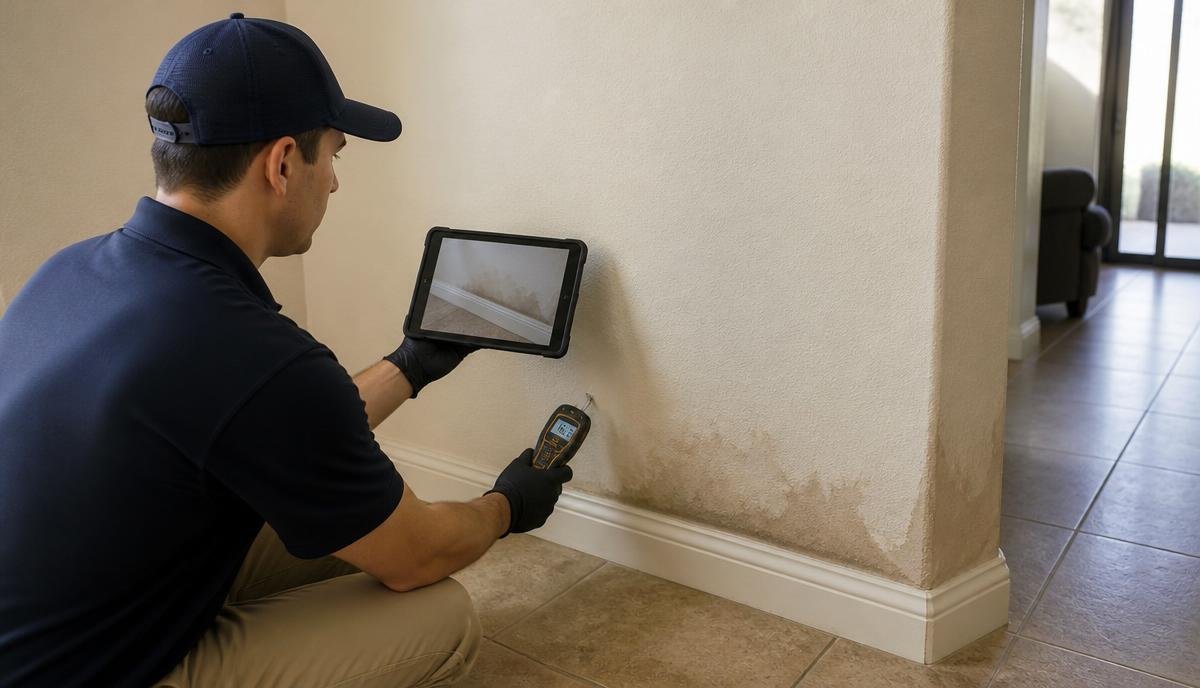
Before any drywall is cut or carpet pulled, document everything. Our technicians capture high-resolution digital images alongside infrared thermal imaging inspection scans. Thermal cameras detect the precise footprint of cold, evaporative water inside wall cavities, providing undeniable scientific proof of the sudden water path for the insurance adjuster.
Step 3: Phrase the Claim Accurately
When you call your insurance company’s first notice of loss (FNOL) desk, accuracy in terminology matters:
❌ What NOT to Say:
“I found a bunch of black mold in my bathroom and I think my pipes have been leaking for a while.”
Result: Immediate denial under the gradual seepage and maintenance neglect clause.
✅ What to Say:
“I experienced a sudden plumbing supply line failure under my vanity that flooded my bathroom. Certified technicians are performing emergency extraction right now.”
Result: Claim opened under covered sudden water damage; secondary mold covered under protocol.
Step 4: Demand Itemized Xactimate Billing
Insurance adjusters reject lump-sum contractor quotes. Your restoration team must provide an itemized scope written in Xactimate, the industry-standard software used by State Farm, Allstate, Farmers, USAA, and Liberty Mutual. Xactimate uses regionally verified labor and material pricing, eliminating pricing disputes and expediting check issuance.
Never allow your remediation company to conduct their own clearance air sampling. An independent licensed mold testing consultant should perform post-remediation clearance testing (PRV) inside the containment zone. Submitting third-party lab results proving normal fungal ecology gives the insurer unimpeachable proof that the loss is resolved, allowing them to release the final depreciation holdback funds for reconstruction and structural repairs.
Key Takeaways
Coverage Follows the Cause: Insurers cover mold only when caused by a covered sudden and accidental water peril (pipe burst, appliance failure, storm breach).
Gradual Damage is Excluded: Slow leaks, high humidity, and deferred maintenance are universally excluded from standard homeowners policies.
Duty to Mitigate is Mandatory: You must extract water immediately. Delaying cleanup gives adjusters legal grounds to deny the resulting mold damage.
Check Your Mold Sub-Limits: Review your declarations page for a Limited Fungi endorsement (typically capping remediation at $1,000 to $10,000).
Document Before Demolition: Infrared thermal images and itemized Xactimate logs provide the undeniable proof needed to get your claim approved.
Under what circumstances does homeowners insurance cover mold remediation?
Homeowners insurance covers mold remediation only if the mold developed as a direct, immediate consequence of a 'covered peril' that is sudden and accidental. Examples include an abrupt burst copper pipe, a ruptured water heater tank, a failed dishwasher supply line, or storm wind tearing roof tiles off during a monsoon. If you act promptly to dry the home, insurers will pay for both water extraction and resulting mold remediation up to your policy limits.
Why do insurance companies frequently deny mold claims?
Insurers deny mold claims primarily by classifying the moisture source as 'gradual seepage,' 'wear and tear,' or 'deferred maintenance.' Because mold requires 24 to 72 hours of persistent moisture to colonize, adjusters often argue that the homeowner should have noticed and repaired the leak earlier. Furthermore, failing to take immediate action to dry wet materials violates your policy's mandatory 'Duty to Mitigate,' giving insurers grounds for denial.
What is a mold sub-limit, and how does it affect my claim?
A mold sub-limit is a specific dollar cap placed on mold remediation and testing within a standard homeowners policy (HO-3). While your total structural dwelling coverage might be $450,000, your policy may cap mold cleanup at $2,500, $5,000, or $10,000. However, emergency water extraction, industrial structural drying, and drywall replacement required due to the initial water loss are usually billed under full dwelling limits, not the mold sub-limit.
What is the mandatory 'Duty to Mitigate' in my insurance policy?
Every standard homeowners insurance policy includes a condition requiring the insured property owner to take all reasonable, immediate steps to protect the property from further secondary damage once a loss is discovered. This means you must turn off the main water valve, call an emergency water extraction team, and prevent standing water from festering. Waiting days to report a leak allows mold to flourish and can forfeit coverage.
Does homeowners insurance cover mold caused by AC condensate overflows?
Coverage for AC condensate mold is contentious. If an evaporator coil suddenly ruptures or an intact drain pan overflows abruptly during a heatwave, insurers may approve the claim. However, if the adjuster discovers that the drain line slowly backed up over several months due to algae and sediment neglect, or that the pan was corroded and rusted through, the claim is almost always denied under the maintenance exclusion.
Does insurance pay for third-party mold testing and air sampling?
Yes, when part of a covered claim, insurance typically reimburses protocol testing and final post-remediation clearance testing (PRV) conducted by an independent certified Indoor Environmental Professional (IEP). To ensure validity and avoid conflicts of interest, testing should always be handled by an independent third party rather than the remediation contractor doing the physical cleanup.
Should I file an insurance claim if mold damage costs under $2,500 to fix?
Generally, no. If the total itemized remediation cost is close to or slightly above your policy deductible (often $1,000 to $2,500), paying out of pocket is usually wiser. Filing a water or mold claim is recorded on your property's CLUE (Comprehensive Loss Underwriting Exchange) report for up to seven years, which can trigger annual premium surcharges or risk non-renewal by your carrier.
How does an IICRC-certified restoration company help with the insurance claim?
Certified restoration companies act as technical advocates for property owners. They capture timestamped infrared thermal moisture maps, record daily psychrometric drying logs, establish a scientific timeline showing sudden loss origin, and submit itemized estimates directly to the insurance adjuster using Xactimate—the standardized estimating software used by all major insurance carriers.
IICRC-certified restoration technicians · Phoenix metro
Written and fact-checked by the licensed crew that runs the trucks — the same technicians who take moisture readings, set drying chambers to the IICRC S500 standard, and answer the phone at 2 a.m. across the Phoenix metro.
Licensed Arizona contractor — AZ ROC #331127 (KB-2)