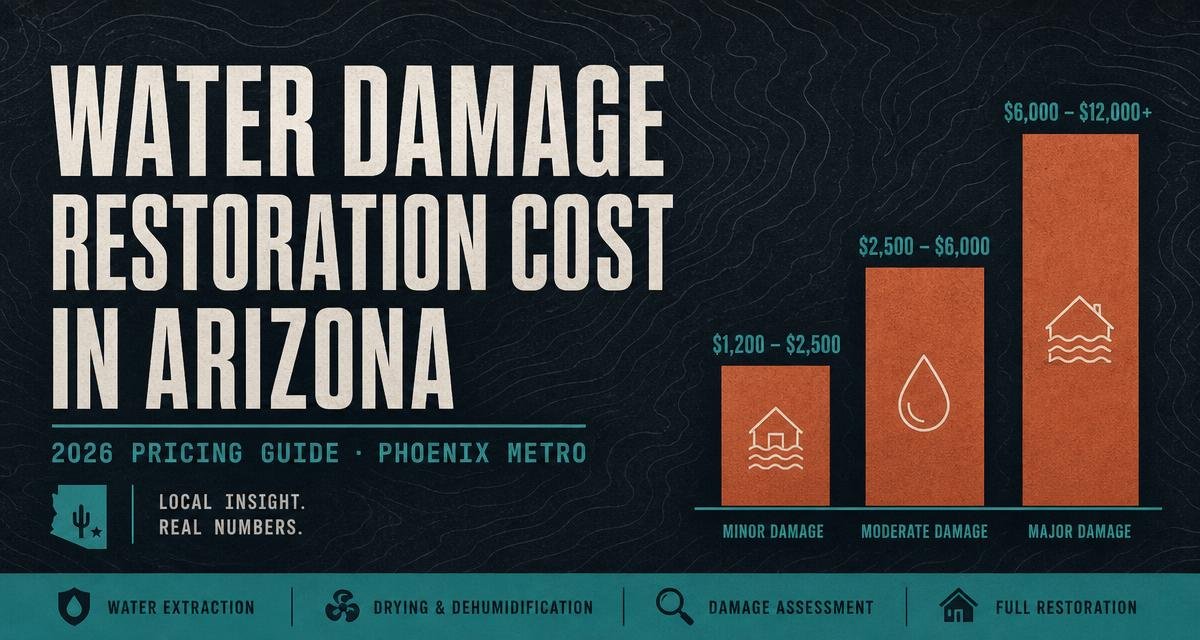
Most Phoenix-area projects land between $2,300 and $4,600 — but the real number depends on the water category, how far it spread, and how fast you called. Here is the full breakdown, line by line.
Last updated:Reading time:13 minStandards:IICRC S500 Verified
Water Damage Restoration Cost · Arizona · 2026 pricing
Table of contents▾
Water damage restoration cost in Arizona typically runs about $1,200 to $7,600, and most Phoenix-area projects land between $2,300 and $4,600. A single room of clean water sits at the low end. Contaminated water across multiple rooms, with reconstruction, sits at the high end. Category of water, how far it spread, and how quickly you called are what move the number.
The Short Answer: Average Water Damage Restoration Cost in Arizona
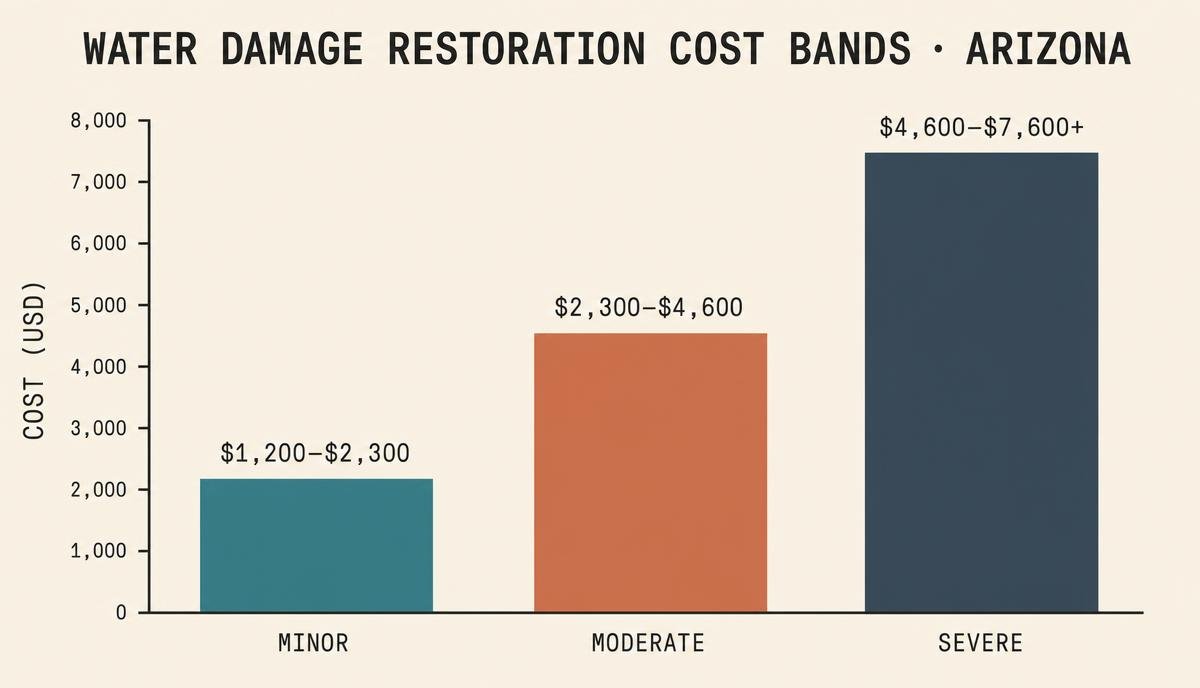
The average cost of water damage restoration in Arizona is roughly $3,400, within a working range of about $1,200 to $7,600. That average is useful for orientation and almost useless for budgeting — the spread around it is the real story.
Severity
Typical cost
What that usually looks like
Minor
$1,200 – $2,300
One room or a hallway, clean water, caught within hours, dried in place with no demolition
Typical / moderate
$2,300 – $4,600
Two or three rooms, some carpet pad and drywall removed, 3–5 days of equipment, light repairs
Severe
$4,600 – $7,600+
Multi-room or multi-level, contaminated water, extensive demolition, mold work, full reconstruction
Water damage restoration cost bands · Arizona / Phoenix metro · 2026
Cost bands / ArizonaMinor, moderate, and severe losses are three genuinely different jobs — not three sizes of the same one.
Why Published Averages Disagree With Each Other
If you've read three cost guides and gotten three different averages, that isn't sloppy pricing — it's usually a scope difference. Some sources quote mitigation only, meaning emergency extraction and drying. Others fold reconstruction into the same number, which can double it.
The other variable is sample mix. A national aggregator averaging thousands of minor one-room surface cleanups will report a lower figure than data tracking comprehensive multi-room structural dry-outs. Neither is wrong. They're measuring different project severities.
Why Water Damage Restoration Costs Vary So Much
Restoration is priced on two technical variables before anything else: the category of the water (how contaminated it is) and the class of the loss (how much material it soaked). Both come from IICRC S500, the industry standard for professional water damage restoration, and both are set on site by the technician — not chosen by the company.
Category: What the Water Is (Clean, Gray, Black)
Category determines cost per square foot more than any other single factor, because it dictates protective equipment, containment, antimicrobial treatment, and how much porous material has to be thrown away instead of dried.
Category
Source
Cost per sq ft
Why it costs more
Category 1 — clean
Supply line, water heater, ice maker, faucet left running
$3.50 – $4.00
Sanitary at the source; most materials can be dried in place
Requires antimicrobial treatment — an EPA-registered product applied to kill microbial growth — plus removal of carpet pad and some drywall
Category 3 — black
Sewage backup, outside floodwater, any water sitting 48–72+ hours
$7.00 – $7.50+
Containment, HEPA filtration, full PPE, and mandatory disposal of affected porous materials
Cost per square foot by IICRC S500 water category · Phoenix market
This is also why response speed is a pricing factor and not just advice. Clean water that sits long enough becomes gray, and gray becomes black. A Category 1 loss that waits two days can get billed at Category 2 or 3 rates through nothing but time. Emergency extraction within the first hours is the cheapest phase of the entire job.
Class: How Far the Water Spread
Class describes how much material absorbed water and how hard it will be to get back out. It drives equipment count and drying days — the labor side of the bill.
Class
What it means
Typical drying/mitigation cost
Class 1
Minimal absorption — a small area, mostly hard surfaces
$150 – $400
Class 2
An entire room; carpet, pad, and wicking up walls under 24 inches
$500 – $1,000
Class 3
Water came from overhead — ceilings, walls, insulation, and subfloor all saturated
$1,000 – $3,000
Class 4
Deep saturation of low-permeability materials — hardwood, concrete, plaster, stone
$20,000 – $100,000+
Water loss class and typical drying cost · IICRC S500 classification
Class 4 looks like a typo next to Class 3. It isn't. Low-permeability materials — concrete slab, hardwood, plaster, stone — release water extremely slowly, so they need specialty drying (desiccant dehumidifiers, injection systems, heat) running for weeks rather than days, plus specialty equipment rental for that whole period. Class 4 jobs are rare in residential work and usually involve historic homes or long-undetected losses.
Other Factors: Size, Materials, Access, and Response Speed
Size of the affected area. More square footage means more equipment and more monitoring visits. Cost scales roughly linearly here, which is the predictable part.
Materials involved. Tile and sealed concrete are cheap to dry. Engineered hardwood over slab, solid hardwood, and carpet over a wood subfloor are expensive — often removal rather than in-place drying.
Access difficulty. Second-story losses, tight condo hallways, stairs, and furniture-heavy rooms all add labor hours before a single air mover turns on.
Response speed. Every 12 hours of delay widens the wet boundary and pushes the water toward the next category. This is the one factor entirely within your control.
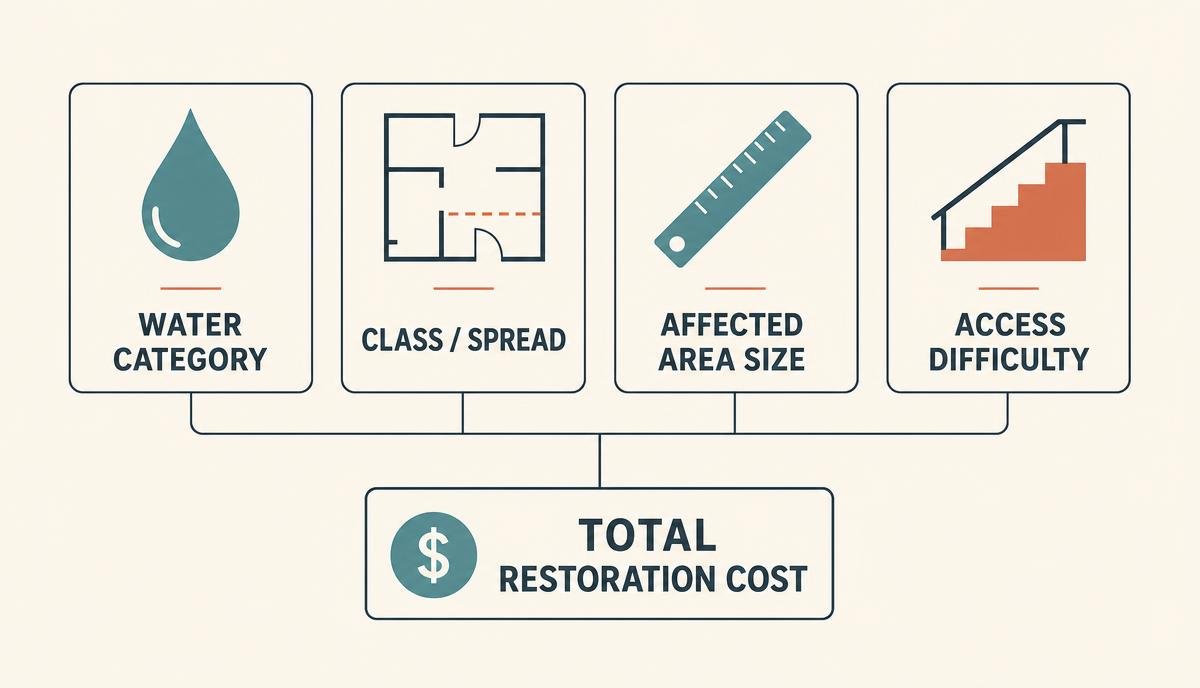
Cost factors / IICRC S500Four inputs set the number before any line item is priced: category, class, area, and access.
Water Damage Restoration Cost by Common Arizona Scenario
Phoenix-area losses cluster around five causes, and each one has a fairly predictable cost profile. These ranges cover restoration only — drying and rebuild — not the plumbing or roof repair that caused the loss.
Scenario
Typical restoration cost
Why it lands there
Burst supply line
$1,500 – $5,000
Clean Category 1 water, but high volume fast; cost tracks how long it ran before shutoff
Slab leak
$2,000 – $6,000
Water rises through the slab into flooring and bottom plates; often undetected for weeks, so wicking is widespread
AC condensate overflow
$1,000 – $3,500
Slow, repeated wetting of ceilings, closets, and drywall — frequently a Category 2 loss with mold by the time it's found
Monsoon roof leak (flat/low-slope)
$2,000 – $7,000
Class 3 from above: insulation, ceiling, walls and flooring all wet; often multiple entry points
Sewage backup
$3,000 – $10,000+
Category 3 — containment, PPE, HEPA filtration, and mandatory removal of porous materials
Restoration cost by common Phoenix-metro cause · excludes plumbing or roof repair
Slab leaks, monsoon roof failures, and condensate overflows are Valley-specific patterns driven by post-tension slabs, flat roofs, and 110°F summers running AC systems continuously. Our Phoenix service page covers how each of those causes typically presents and what response looks like.
Is Slab Leak Repair Included in Restoration Cost? (No — Here's the Difference)
No. Fixing the leaking pipe is a plumbing job with its own bill; water damage restoration is the separate work of extracting, drying, and rebuilding what the leak damaged. This is the single most common billing confusion for Arizona homeowners, and it is worth being crystal clear about before you sign anything.
A licensed plumber locates and repairs the line. A restoration contractor dries the structure and puts it back. Two trades, two scopes, two distinct invoices — ensuring you know exactly what each service costs.
Work
Who does it
Typical Arizona cost
Slab leak detection
Plumber (acoustic / thermal / pressure testing)
$150 – $600
In-slab repair or reroute
Plumber
$500 – $4,500 depending on method, depth, and extent
Whole-home repipe
Plumber
$4,500 – $15,000
Water extraction, drying, reconstruction
Restoration contractor
$2,000 – $6,000 (see scenario table above)
Slab leak repair cost vs. water damage restoration cost · Arizona
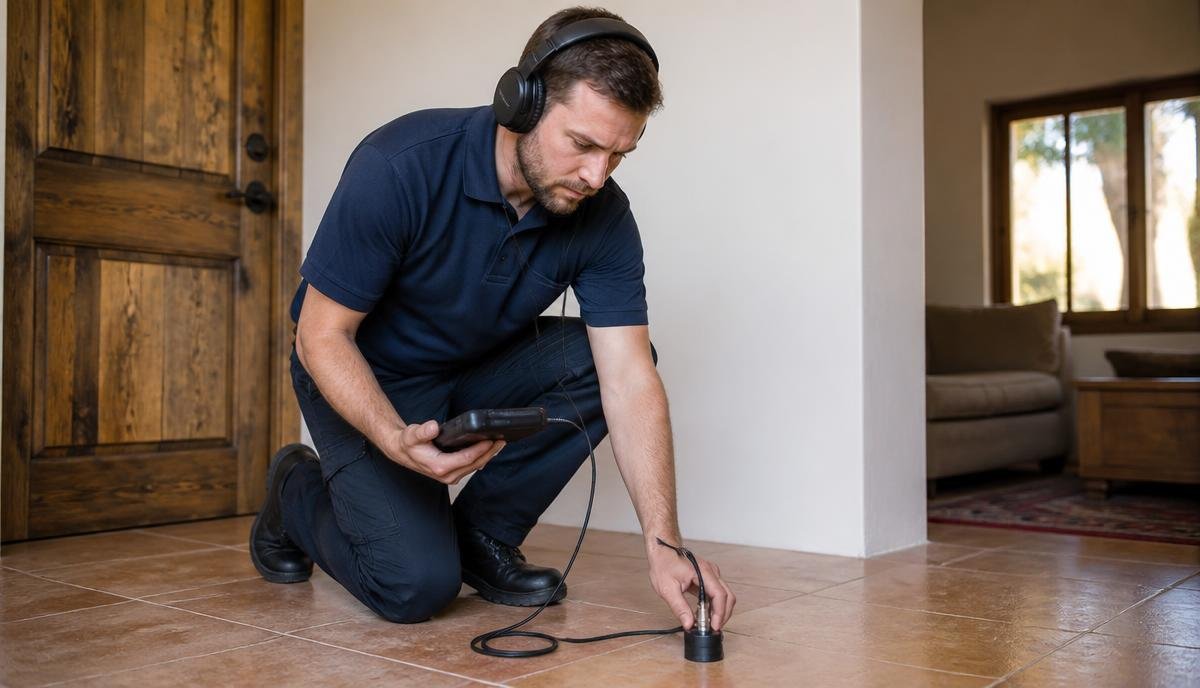
Slab leaks / DetectionAcoustic detection pinpoints the leak before anyone opens concrete — a plumbing scope, billed separately from drying.
An Itemized Look at a Typical Restoration Bill
A legitimate restoration estimate is itemized, not a single lump sum. Reputable Phoenix-area contractors price using standard regional line-item schedules, which is why unit costs look consistent across established companies.
Line item
Typical cost
Notes
Emergency service call & inspection
$0 – $300
Reputable local restorers usually inspect free before any work is authorized
Water extraction
$500 – $3,000
Priced by volume and affected area; truck-mounted units cost more but cut drying days
Drying equipment
$50 – $200 per day
Air movers and LGR dehumidifiers, billed per unit per day for 3–5 days on a typical job
Antimicrobial treatment
$0.20 – $0.50 per sq ft
Applied on Category 2 and 3 losses to prevent microbial growth
Controlled demolition
$200 – $1,200
Flood cuts, baseboard and carpet pad removal, unsalvageable flooring
Drywall & flooring repair
$100 – $1,500+ per area
Reconstruction scope — usually a separate estimate from mitigation
Mold remediation (if found)
$500 – $6,500
Containment, HEPA filtration, and removal; scales with affected square footage
Content pack-out & cleaning
$500 – $3,000
Optional; common on larger losses where furnishings need off-site storage
Typical itemized water damage restoration estimate · Phoenix metro
Does Monsoon Season Affect Restoration Cost?
Yes — a July-through-September loss usually costs more than an identical loss in February. Monsoon humidity slows evaporation, which means more equipment-days, more monitoring visits, and more technician hours for the same square footage.
The mechanism is psychrometrics — the relationship between air temperature, humidity, and how fast water leaves a material. Dehumidifiers work by pulling moisture out of the air so materials can keep releasing more. When outdoor dew points climb during monsoon season, that job gets harder, and a four-day dry-out can stretch to six or seven.
Call volume also spikes. When a single storm cell floods dozens of homes across the Valley in an afternoon, equipment inventory tightens across the whole market. That's a scheduling problem more than a pricing one, but it's another reason the first call matters.
Direct Customer Pricing: Why Transparent Itemized Scopes Protect You
Transparent direct pricing protects property owners from arbitrary markups, hidden fees, and unneeded demolition. Every reputable restoration plan should be anchored in an upfront, written, line-item scope before high-powered extraction and drying equipment is placed.
Extraction & Pumping Volume: Itemized by gallons removed and equipment hours required.
Drying Equipment Units: Specific counts of commercial LGR dehumidifiers and high-velocity centrifugal air movers.
Antimicrobial Application: EPA-registered botanical sanitization for Category 2/3 water.
Separate Rebuild Scope: Clear distinction between emergency dry-out and finish reconstruction.
Avoiding Unnecessary Demolition Costs
Unscrupulous operators often rush to tear out entire walls and cabinets without verifying whether the structure can be dried in place. In Arizona's dry desert climate, modern specialized injection drying systems (such as floor mat extractors and cavity drying units) can frequently save expensive hardwood and drywall when deployed within the first 24 to 48 hours.
We perform $0 on-site thermal inspections across Phoenix to provide you with clear, itemized written pricing and objective moisture logs before any work begins.
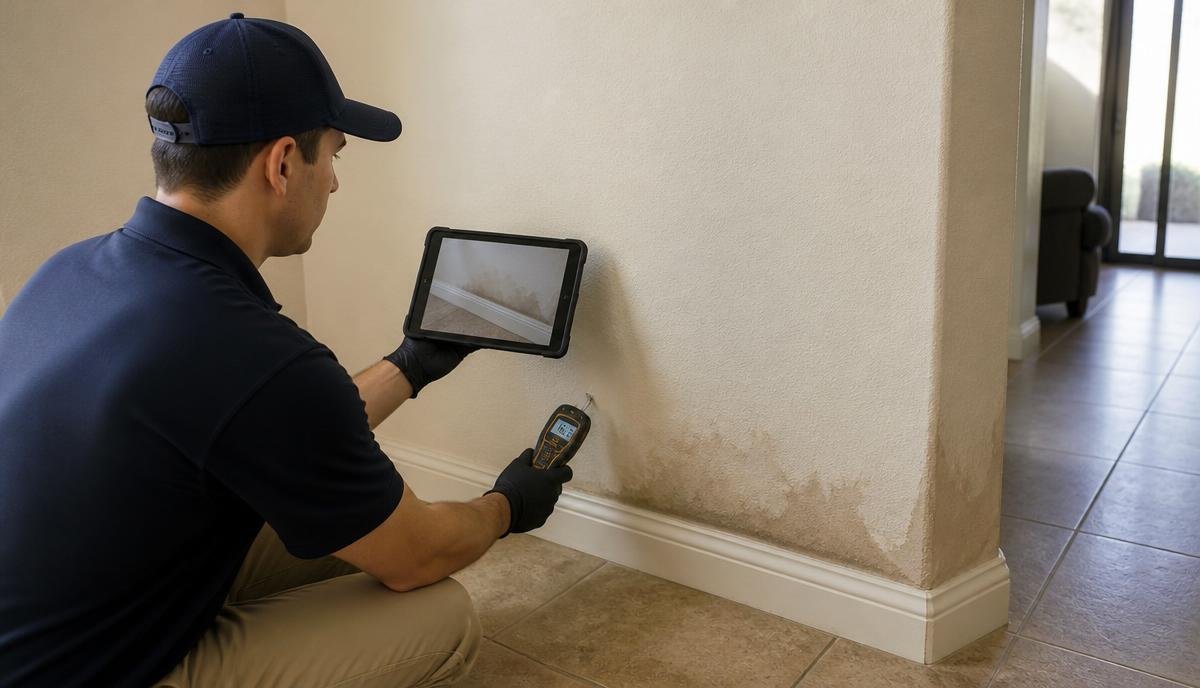
Direct Pricing / InspectionPhotos, moisture readings, and psychrometric logs from day one — the documentation that ensures total pricing transparency.
Hidden Costs That Surprise Homeowners
Most "surprise" costs aren't hidden fees. They're scope that couldn't be seen from the driveway. Here's where the number typically moves after the first estimate.
Mitigation and repair were always two bills. A Goodyear homeowner budgeting $3,000 for a slab leak dry-out finds out the plumber's spot repair isn't viable once the slab is opened, and a $9,000 repipe lands on top — a plumbing cost, not a restoration one, but it's still money out the same week.
Hidden moisture found after the estimate. Water tracks along framing and under cabinets. A wall that read dry on day one can read wet on day two as moisture migrates outward, and that adds equipment and days.
Mold discovered mid-project. Growth can begin within 24–48 hours. If it's inside a wall cavity, remediation becomes a new scope with containment and HEPA filtration.
Contaminated-water sanitizing. If the category is upgraded on site, the per-square-foot rate changes and porous materials that would have been dried are removed instead.
Content pack-out and storage. Not every job needs it, but when furniture has to leave the house it's a real line item.
How to Lower Your Water Damage Restoration Cost
The cheapest version of your job is the one that starts soonest and is documented best. Everything else is negotiation around the edges.
Call immediately, even at 2 a.m. Delay is the only factor that raises both the category and the class. Twelve hours can be the difference between drying carpet and replacing subfloor.
Shut off the water and the power to affected areas if you can do it safely.
Photograph everything before anyone touches it — wide shots of each room, close-ups of damaged materials, and the source itself.
Ask for moisture readings, not opinions. A real scope cites moisture content percentages and a documented dry standard, and repeats those readings daily.
Require mitigation and reconstruction to be itemized separately. It makes quotes comparable and stops scope creep.
Don't run your own fans and open windows during monsoon season. Household fans move air but remove no water, and humid outside air slows the drying chamber down.
For larger losses or high-deductible situations, financing options are increasingly available through third-party lenders in the restoration industry. It's worth asking about if the deductible is the obstacle — nothing more than a factual note.
How to Choose a Restoration Company (Cost-Conscious Checklist)
IICRC certification. It means technicians are trained to S500 standards for categorization, drying, and psychrometric documentation.
Proper Arizona ROC licensing and contractor liability. Verify their active Registrar of Contractors license.
Upfront, itemized direct pricing. Eliminates surprises and provides clear line-item scopes before any demolition or equipment deployment.
Transparent, itemized estimates. Line items with quantities and rates — not a single number on a business card.
Documented daily monitoring. Moisture logs are the proof the job actually finished, not just that the equipment left.
Phoenix-area experience. Slab leaks, flat-roof monsoon failures, and AC condensate overflows behave differently than the burst-pipe-in-winter losses national crews are trained on.
24/7 response with a real dispatcher. Answering services that "pass along the message" cost you hours you can't get back.
That's the same checklist we'd hand a friend. If you want a second opinion on an estimate you already have, send us the details and photos and we'll tell you honestly whether it looks reasonable.
Key Takeaways
Arizona water damage restoration cost runs roughly $1,200 to $7,600, with most Phoenix jobs between $2,300 and $4,600.
Category and class set the price before anything else: about $3.50–$4.00/sq ft for clean water, up to $7.50+/sq ft for Category 3.
Slab leak repair is a plumbing cost ($150–$600 detection, $500–$4,500 repair, $4,500–$15,000 repipe) and is not part of restoration pricing.
Mitigation and reconstruction are usually two separate scopes — the main reason quotes look inconsistent.
Monsoon humidity adds equipment-days, which adds cost to an otherwise identical loss.
Calling within hours is the most effective cost control available to any homeowner.
How much does water damage restoration cost in Arizona?
Most Arizona water damage restoration projects fall between roughly $1,200 and $7,600, with the typical Phoenix-area job landing between $2,300 and $4,600. A single wet room from a clean supply-line break is usually the low end; a Category 3 loss across several rooms with reconstruction is the high end. Pricing is driven by water category, how far the water spread, and how quickly the call came in.
How does transparent direct pricing work for water damage restoration?
We provide an itemized written estimate based on actual thermal moisture mapping and square footage before any equipment powers on. Emergency mitigation (extraction, LGR dehumidification, air movers) and reconstruction are itemized as separate scopes so you never pay for unneeded demolition.
How much does mold remediation cost after water damage?
Mold remediation cost in Phoenix generally runs about $500 to $6,500, depending on how much material is affected and whether containment and HEPA filtration are required. A small contained patch of drywall is a few hundred dollars; mold inside wall cavities, subfloor, or HVAC ductwork climbs quickly. Mold is a separate scope from drying, so it appears as its own line on the estimate.
Slab leak detection typically costs about $150 to $600, and the in-slab repair itself usually runs $500 to $4,500 depending on whether the plumber spot-repairs, reroutes the line, or opens the slab. A full repipe of an older Phoenix home generally runs $4,500 to $15,000. None of that is water damage restoration cost — the plumbing repair and the drying and rebuild are two separate bills.
Can I lower my water damage restoration cost?
Yes, and the single biggest lever is how fast you call. Water that sits migrates into more material and can move from Category 1 to Category 2 or 3, which changes both the per-square-foot rate and how much material has to be removed. Documenting everything before cleanup, and asking for mitigation and reconstruction to be itemized separately, also protects you from paying for scope you never agreed to.
How do I know my estimate won't have surprise demolition fees?
A professional IICRC-certified restorer uses calibrated moisture meters to establish exact dry standards. We only remove non-restorable materials (like swollen baseboards or soaked Category 3 drywall), keeping the scope tightly controlled and fully itemized in writing upfront.
How much does water damage restoration cost per square foot?
In the Phoenix market, clean Category 1 water generally runs about $3.50 to $4.00 per square foot, gray Category 2 water about $5.25 to $6.50, and black Category 3 water about $7.00 to $7.50 or more. The jump between categories reflects PPE, containment, antimicrobial treatment, and disposal of material that cannot be salvaged — not a higher hourly rate.
Is emergency mitigation billed separately from repairs?
Almost always, yes. Mitigation is the emergency dry-out — extraction, equipment, monitoring, controlled demolition. Reconstruction is putting the drywall, flooring, paint, and cabinetry back. They are usually two scopes with two estimates, which is the most common reason two quotes look wildly different when a homeowner compares them side by side.
About the author
AZ Water Damage Restoration Team
IICRC-certified restoration technicians · Phoenix metro
Written and fact-checked by the licensed crew that runs the trucks — the same technicians who take moisture readings, set drying chambers to the IICRC S500 standard, and answer the phone at 2 a.m. across the Phoenix metro.
Licensed Arizona contractor — AZ ROC #331127 (KB-2)