A plain-language explanation of what restoration actually involves — the process, the standards behind it, what it costs, and when a homeowner genuinely needs a professional.
Last updated:Reading time:16 minStandards:IICRC S500 Verified
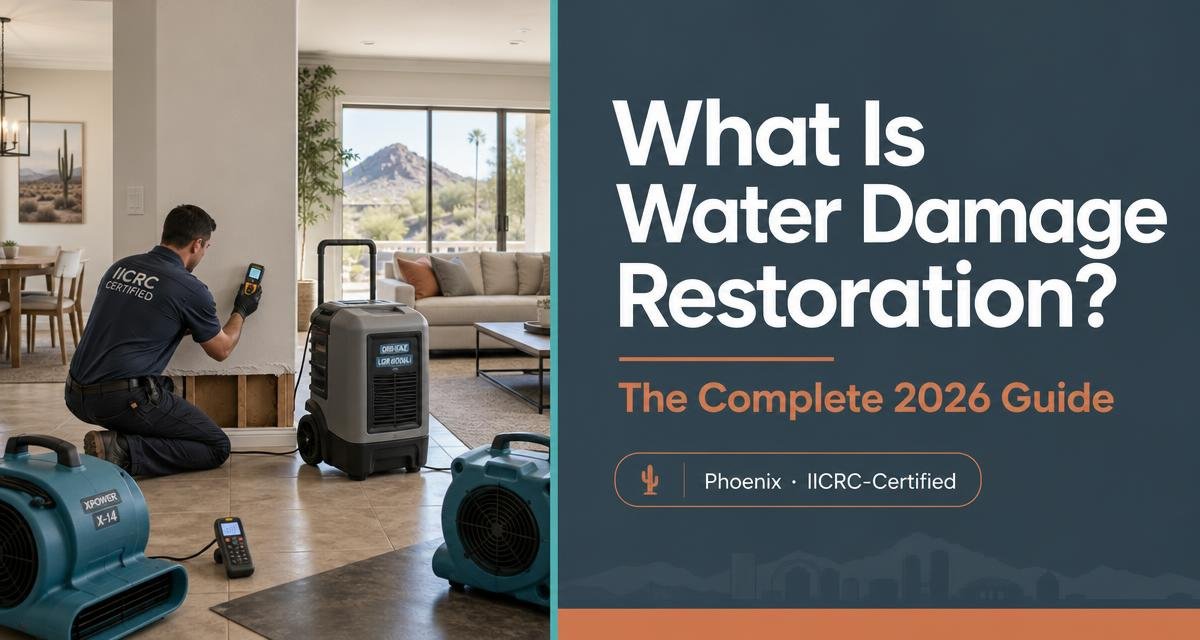
What Is Water Damage Restoration? · The Complete 2026 Guide · Phoenix metro
Table of contents▾
Water damage restoration is the professional process of removing water from a building, drying the structure to a documented moisture goal, cleaning and disinfecting affected materials, and repairing everything the water damaged. It follows the IICRC S500 standard — the industry rulebook for how water losses are categorized, dried, and verified — and it ends when instruments say the structure is dry, not when it looks dry.
What Is Water Damage Restoration?
Water damage restoration is the full return of a water-damaged building to its pre-loss condition — physically, structurally, and hygienically. It is not mopping and it is not "letting it air out." It is a measured process where a technician records how wet each material is, engineers a drying environment, and documents the moisture coming back down to a target value.
The reason it takes equipment and training is that water does not stay where you can see it. Within minutes it wicks up drywall, travels under baseboards, soaks carpet pad, and pools in wall cavities and under cabinet toe kicks. A floor can feel dry to a bare foot while the bottom plate of the wall behind it is at 40% moisture content.
IICRC — the Institute of Inspection, Cleaning and Restoration Certification — is the nonprofit body that writes the standards restoration technicians are trained and certified against. Its S500 standard for water damage is what separates a defensible, verified drying plan from an uncalibrated guess.
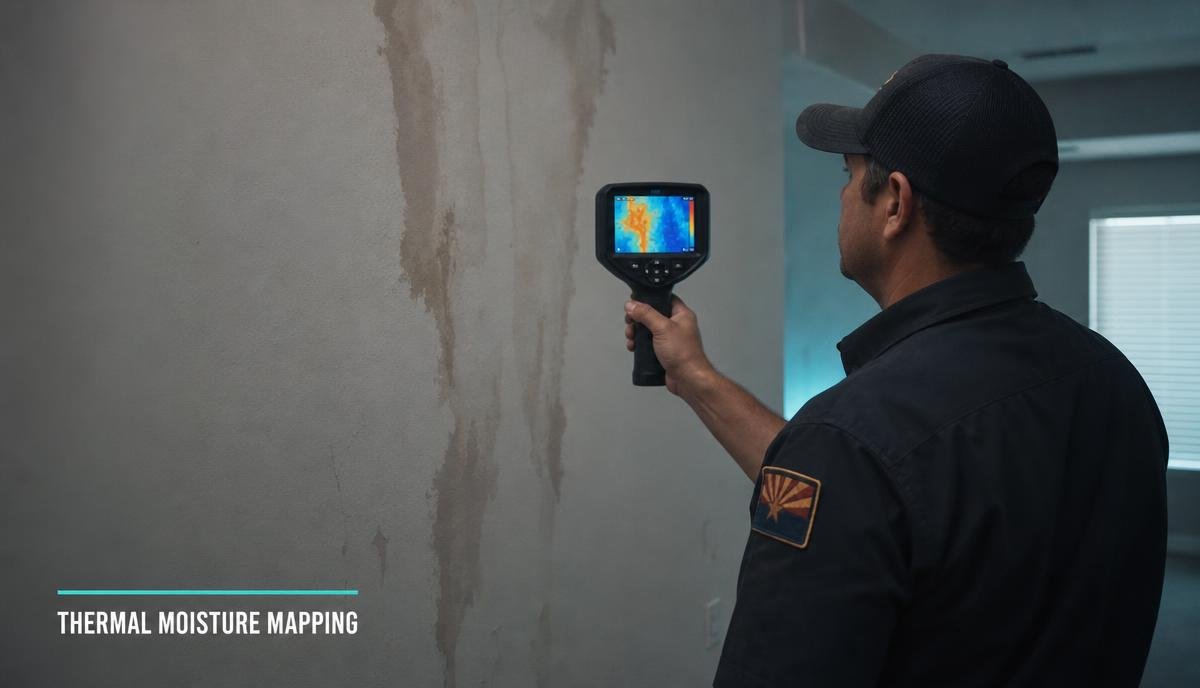
Inspection / Moisture mappingThermal imaging reveals the temperature differences that flag moisture trapped behind drywall — before anything gets opened up.
Water Damage Restoration vs. Water Mitigation vs. Remediation
Mitigation stops the loss from getting worse, remediation removes contamination, and restoration rebuilds what was lost. Most real jobs contain all three, in that order.
Cleans, disinfects, HEPA-filters, and removes contamination such as mold or sewage residue
Overlaps drying, once contamination is identified
Make the space hygienically safe again
Restoration
Rebuilds drywall, insulation, flooring, trim, paint, and cabinetry
After the structure passes dry standard
Return the property to pre-loss condition
Mitigation vs. remediation vs. restoration
Two practical consequences: insurers frequently treat mitigation and reconstruction as separate line items, and a company that only does one of them will hand you off mid-job. We handle both, which is why our emergency extraction and drying team and our rebuild crews work off the same file.
What Causes Water Damage?
Most water damage comes from inside the building, not from weather. Plumbing and appliances cause the majority of residential claims.
Sewer and drain backups — always contaminated, always a professional job.
HVAC condensation — clogged condensate drains and rusted-through pans.
Storms and wind-driven rain — water entering above the flashing line.
Human error — overflowed tubs, disconnected hoses, unnoticed running fixtures during a trip.
Common Causes of Water Damage in Phoenix & Arizona Homes
Arizona homes fail differently than homes in wetter climates. Slab-on-grade construction, hard water, flat and low-slope roofs, and 115°F summers create a short list of causes we see again and again across the Valley.
Monsoon wind-driven rain. Storms push rain sideways into places a vertical rain never reaches — flat roof parapets, tile valleys, and the roof penetrations cut for evaporative coolers. Roofs that shed a normal shower fine will leak in a haboob.
Slab leaks. Phoenix hard water corrodes copper supply lines running through and under the slab. The first sign is often a warm spot on the floor, an unexplained water bill, or the sound of running water with everything off.
AC condensate overflow. During extreme heat an air handler can produce gallons of condensate a day. A clogged drain line or rusted pan sends it straight into a ceiling or a hallway closet wall.
Swamp cooler failures. Roof-mounted evaporative coolers combine standing water, a float valve, and a roof penetration. When the float sticks, water runs down the duct chase into the house.
Pool auto-fill and backwash failures. A stuck auto-fill valve or a misdirected backwash line can saturate the soil against a slab edge for days before anyone notices.
Every water loss gets two grades: a category describing how contaminated the water is, and a class describing how much material is wet and how hard it will be to dry. Together they determine what can be saved, what protective equipment is required, and how long drying takes.
Category 1, 2, and 3 Water (Clean, Gray, Black)
Category describes contamination, and it escalates with time. Clean water left sitting becomes gray water; gray water left sitting becomes black water.
Category
Typical sources
Risk level
What it means for you
Category 1 — Clean
Supply lines, water heaters, ice makers, tub overflow with no additives
Low
Most materials are salvageable if drying starts quickly
Category 2 — Gray
Washing machine and dishwasher discharge, toilet overflow with urine only, aquariums
Moderate — significant contamination
Carpet pad and some porous materials are typically removed; surfaces are disinfected
Containment, PPE, and removal of porous materials are mandatory; no DIY
Water categories per IICRC S500
A Category 1 loss can degrade to Category 2 in roughly 24–48 hours in warm conditions — and Phoenix interiors are warm. That single fact is why response time changes the scope of a job. Contaminated losses are handled through our sewage and Category 3 cleanup service.
Class 1–4 Water Loss
Class measures evaporation load: how much wet material there is and how readily it gives up moisture. It drives how much equipment goes in the house and how many days it stays.
Class
Extent of saturation
Typical drying difficulty
Class 1
Least amount of water; minimal absorption into porous materials, under ~5% of the area
Fastest — often 2–3 days
Class 2
Large area affected; water wicked up walls under 24 inches; carpet and pad saturated
Moderate — typically 3–5 days
Class 3
Water from overhead; ceilings, walls, insulation, and subfloor saturated
Heavy equipment load, 4–7 days
Class 4
Deeply bound water in low-porosity materials — hardwood, plaster, concrete, stone
Specialty drying, often 7–10+ days
Water loss classes per IICRC S500
The Water Damage Restoration Process, Step by Step
The water damage restoration process runs in six steps: emergency contact and inspection, extraction, drying and dehumidification, cleaning and antimicrobial treatment, repairs and reconstruction, and a documented final inspection. The steps do not change with job size — only the scale does.
1. Emergency Contact & Inspection
The first call establishes safety (power, structural risk, contamination) and gets the source shut off. On arrival, the technician identifies the water category, then performs moisture mapping — reading every affected material with meters and scanning for hidden water with a thermal imaging camera — and writes a drying plan with a target moisture content taken from unaffected material in the same building.
2. Water Extraction
Water extraction is the physical removal of standing and absorbed water, and it is the highest-leverage step in the entire job. Every gallon extracted mechanically is a gallon that does not have to be evaporated later, which is why extraction saves days of drying. Crews use truck-mounted or portable extractors, weighted extraction tools on carpet, and submersible pumps where water is deep. See how our extraction crews work.
3. Drying & Dehumidification
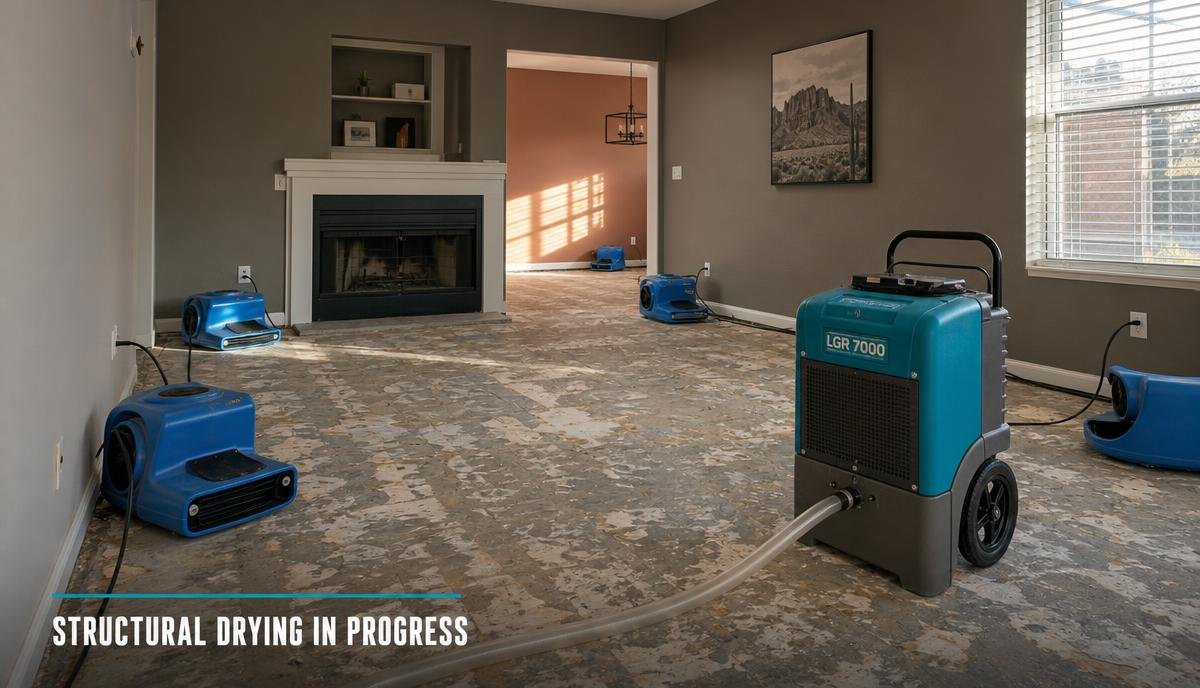
Structural drying converts remaining bound moisture into vapor and pulls that vapor out of the air. Air movers push high-velocity air across wet surfaces to speed evaporation, while LGR (low-grain refrigerant) dehumidifiers remove the resulting humidity so the air can keep absorbing more. Technicians balance temperature, humidity, and airflow — a discipline called psychrometry, the science of how air holds water — and log readings daily until every material hits the drying goal. For a deeper look, read our guide on how structural drying equipment works.
4. Cleaning, Sanitizing & Antimicrobial Treatment
Once materials are dry, affected surfaces and salvageable contents are cleaned. Where the water category warrants it, technicians apply an antimicrobial — an EPA-registered product that kills or inhibits bacteria and mold — and run air scrubbers with HEPA filtration to capture airborne particulate. Category 2 and 3 losses add containment barriers and negative air so nothing migrates into clean parts of the house.
5. Repairs & Reconstruction
Reconstruction puts the building back: drywall and insulation replacement, baseboard and trim, flooring, texture and paint, cabinetry, and any affected fixtures. On small losses this is a day or two. On a Class 3 loss with a removed ceiling, it can be several weeks and may involve permits.
6. Final Inspection & Documentation
The job ends with final moisture readings confirming the structure met dry standard, a walkthrough, and a documentation package: initial and final readings, daily psychrometric logs, equipment placement, and photos throughout. That documentation package confirms that structural dry standard was verified — protecting your home value if moisture questions surface later.
Extraction completed, unsalvageable porous material removed, air movers and dehumidifiers set, containment if needed
Days 2–5
Equipment runs continuously; daily moisture readings logged; adjustments to equipment placement; antimicrobial applied where required
Day 5+
Dry standard confirmed and equipment pulled; reconstruction scheduled; final documentation issued for the claim
Typical residential restoration timeline
Step 3 / Structural dryingAir movers move moisture out of materials; the LGR dehumidifier pulls it out of the air. Placement is calculated, not guessed.
How Long Does Water Damage Restoration Take?
Structural drying usually takes three to five days, and full restoration — including reconstruction — typically takes one to three weeks. Drying finishes when moisture readings hit the goal, not on a fixed schedule, so any company quoting an exact number before taking readings is guessing.
Factor
Shortens the timeline
Extends the timeline
Response time
Called within hours of discovery
Days of undetected wicking
Water category
Category 1 clean water
Category 3 requiring containment and removal
Materials affected
Tile, vinyl, painted drywall
Hardwood, plaster, concrete, dense insulation
Extent (class)
Class 1, small contained area
Class 3–4, multiple rooms or overhead water
Access
Open floor plan, equipment can be placed freely
Cabinet toe kicks, wall cavities, crawl spaces
Rebuild scope
Cosmetic repairs only
Cabinetry, permits, custom flooring lead times
What changes a restoration timeline
How Much Does Water Damage Restoration Cost?
Most residential water damage restoration jobs cost between roughly $1,300 and $6,400, with severe or heavily contaminated losses running $16,000 or more. Broken into phases, mitigation commonly runs about $3–$7.50 per square foot and reconstruction about $20–$37 per square foot. These are general 2026 market ranges, not quotes — pricing depends entirely on what the inspection finds.
Scenario
Typical range
What's driving it
Category 1, Class 1 — small clean-water loss, one room
$1,300 – $3,000
Extraction and 2–3 days of drying, minimal rebuild
Category 1–2, Class 2 — supply line or appliance failure, multiple rooms
$3,000 – $6,400
Carpet pad removal, larger equipment load, drywall and trim repair
Category 2–3, Class 3 — overhead water or contaminated loss
Water category — contamination adds PPE, containment, disposal, and material loss.
Square footage and number of rooms — more wet material means more equipment-days.
How long the water sat — the single largest multiplier on any job.
Materials involved — hardwood, natural stone, and plaster cost more to dry or replace.
Structural demolition — flood cuts, insulation removal, and cabinet removal.
Contents — pack-out, storage, and specialty cleaning of furniture or documents.
Reconstruction finish level — matching a custom tile or cabinet line costs more than builder-grade.
Direct Customer Pricing & Scope Transparency
Transparent direct pricing protects property owners from unexpected fees, arbitrary markups, and unneeded demolition. Every reputable restoration plan should be anchored in an upfront, written, itemized scope before commercial extraction and drying equipment powers on.
Extraction & Pumping: Clear gallonage and equipment-hour metrics for standing water removal.
Structural Drying Setup: Itemized counts of commercial LGR dehumidifiers and high-velocity air movers.
Sanitization & Antimicrobial Treatment: EPA-registered botanical sanitization for Category 2 and 3 water.
Separated Rebuild Estimates: Drywall, flooring, and paint restoration quoted independently from emergency dry-out.
Protecting Your Property & Budget
Insist on a written scope upfront: Never allow demolition to begin without a clear explanation of which materials are non-salvageable.
Request daily psychrometric logs: Technicians should record daily relative humidity, temperature, and material moisture percentages.
Verify $0 on-site inspections: An ethical restorer inspects and maps the damage at zero cost before presenting you with firm pricing.
Prioritize rapid response: Immediate extraction within the first 24 hours prevents structural rot and costly secondary mold remediation.
Health Risks of Untreated Water Damage
Untreated water damage creates three problems: microbial growth, degraded indoor air quality, and structural weakening. The health risk scales directly with the water category and with how long the material stayed wet.
Mold Growth Timeline
Mold can begin growing on damp porous material within 24–48 hours, and visible colonies often appear within a week. Spores are already present in every building; moisture is the only missing ingredient. Once growth establishes inside a wall cavity, the fix moves from drying to containment-based mold remediation, which costs substantially more.
Risks by Water Category
Category
Primary health concern
Category 1
Low direct risk, but mold and bacterial growth begin if drying is delayed
Category 2
Bacteria and detergent residues; can cause illness on contact or ingestion
Category 3
Pathogenic bacteria, viruses, and fungi; serious illness risk — requires PPE and containment
Health risk by water category
Anyone with asthma, allergies, a compromised immune system, or respiratory illness should stay out of affected areas until drying and cleaning are finished, regardless of category.
Can I Do Water Damage Restoration Myself? (DIY vs. Professional)
You can handle a small, clean-water spill you caught immediately. Everything beyond that needs metered drying, because the failure mode of DIY isn't the water you can see — it's the moisture you can't.
When DIY Might Be OK
Clean (Category 1) water only, from a known, stopped source.
Caught within minutes, not hours.
Small area on a non-porous surface — tile, sealed concrete, vinyl plank.
No water under cabinets, into wall cavities, through a ceiling, or near electrical.
No carpet pad, hardwood, laminate, or drywall involved.
Common DIY Mistakes
☐ Stopping at surface-dry. Dry to the touch means nothing; only a moisture meter reading against a dry-standard target does.
☐ Not checking behind walls or under flooring. Water travels along the bottom plate and under planks far past the visible edge.
☐ Using box fans without dehumidification. That just relocates humidity into other wall cavities and speeds mold growth.
☐ Missing hidden Category 2 or 3 contamination, especially from washing machine discharge or a toilet supply behind a wall.
☐ Leaving wet carpet pad in place. Pad almost never dries adequately in situ and is cheap to replace.
☐ Painting or sealing over a stain before the substrate is dry, which traps moisture and guarantees a repeat.
☐ No documentation, leaving no proof that moisture behind structural cavities was completely eliminated.
Common Water Damage Restoration Misconceptions
Myth
Fact
A little water will just dry on its own.
Even small leaks can seed mold within 24–48 hours if the material underneath isn't properly dried and verified.
Direct pricing means hidden fees.
Reputable IICRC restorers provide line-item written scopes with $0 thermal inspections and zero surprise demolition fees.
Mitigation and restoration are the same thing.
Mitigation stops the damage and dries the structure; restoration rebuilds what was removed. They're separate phases, often separate line items on a claim.
If the carpet is dry, the room is dry.
Carpet dries first and fastest. Pad, subfloor, baseboards, and the bottom plate of the wall hold moisture long after the surface feels fine.
Bleach solves mold.
Bleach doesn't penetrate porous material and can add moisture. Remediation removes the material and the moisture source.
Turning the equipment off at night is fine.
Drying is cumulative. Shutting equipment down overnight can add days to the job and risk secondary damage.
Myth vs. fact
How to Choose a Water Damage Restoration Company
The right water damage restoration company can prove three things before work starts: certification, licensing, and how they'll document the job. Ask for all three on the phone.
IICRC certification for the technicians actually on site — WRT for water restoration, ASD for applied structural drying, AMRT for mold.
Proper state licensing and contractor liability — in Arizona, an active ROC license for the reconstruction side.
Detailed documentation and a moisture log you receive, not just an invoice.
Genuine 24/7 emergency response — a live dispatcher, not an answering service that calls back in the morning.
Local experience with your region's specific failure modes — a company that has never diagnosed a slab leak or a swamp cooler overflow will be learning on your house.
A written scope of work before demolition begins.
For what it's worth on that list: our technicians are IICRC-certified, we dispatch 24/7, we provide comprehensive documentation, and Arizona-specific causes — monsoon roof intrusion, slab leaks, AC condensate, swamp coolers, pool overflow — are what we work on every week. You can review our credentials and licensing or reach us through the contact page if it isn't an emergency. Property managers and business owners can start with our commercial restoration services; homeowners can start with residential restoration.
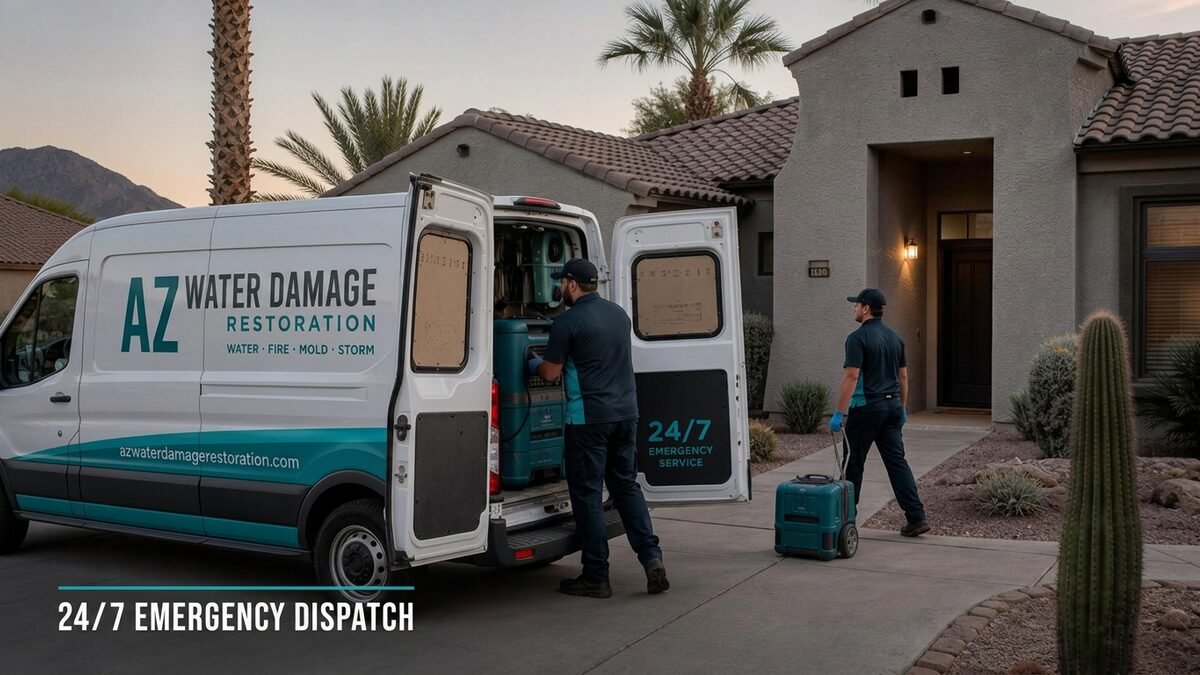
Response / Phoenix metro24/7 dispatch across the Phoenix metro — trucks stocked with extraction, drying, and containment equipment before we arrive.
Key Takeaways
Restoration is a measured process — extract, dry, clean, rebuild — that ends when instruments confirm dry standard.
Speed is the variable you control. Most Category 1 losses become Category 2 problems in 24–48 hours.
Category and class determine scope, cost, and how much of your home is salvageable.
Budget roughly $1,300–$6,400 for a typical residential job, more for contaminated or overhead losses.
Direct pricing and written scopes protect your budget; calibrated moisture logs verify the dry standard.
DIY is fine for a small clean spill caught immediately — and a false economy for anything else.
Water damage restoration is the professional process of removing water from a building, drying the structure to a documented moisture goal, cleaning and disinfecting affected materials, and repairing what the water damaged. It follows the IICRC S500 standard, which defines how water losses are categorized, dried, and verified.
What's the difference between water mitigation and water restoration?
Mitigation stops the loss from getting worse — shutting off the source, extracting water, removing unsalvageable materials, and drying the structure. Restoration is the rebuild that follows: drywall, flooring, paint, trim, and cabinetry. Mitigation is measured in hours; restoration is measured in days or weeks.
Most residential jobs land between roughly $1,300 and $6,400, with severe or Category 3 (black water) losses running $16,000 or more. As a rule of thumb, mitigation runs about $3–$7.50 per square foot and reconstruction about $20–$37 per square foot. Water category, affected square footage, and how long the water sat drive the number more than anything else.
How does direct transparent pricing work for restoration?
Direct pricing is based on calibrated square footage, water category, and equipment hours. You receive an upfront written scope itemizing emergency extraction, dehumidification, and structural drying separately from any rebuild work, with zero surprise demolition fees.
How quickly should water damage restoration begin?
Within hours, not days. Porous materials wick water continuously, and mold can begin colonizing damp material in 24–48 hours. A loss addressed the same day is usually a drying job; the same loss addressed three days later is usually a demolition job.
How long does the drying process take?
Structural drying typically takes three to five days for a contained residential loss, confirmed by daily moisture readings rather than by the calendar. Dense materials like hardwood, plaster, and concrete can push drying to seven to ten days or longer.
Can mold grow after water damage?
Yes. Mold spores are present in virtually every building and only need moisture, a food source such as drywall paper or wood, and time. Growth can start within 24–48 hours on damp porous material, which is why drying to a verified moisture content — not just a dry surface — is the whole point of professional restoration.
A small, clean-water spill on a hard surface caught within minutes is a towel-and-fan job. Anything involving standing water, wet carpet pad, water inside wall cavities, contaminated water, or a loss more than a few hours old needs professional extraction and metered drying. The expensive failures are almost always hidden moisture, not visible water.
About the author
AZ Water Damage Restoration Team
IICRC-certified restoration technicians · Phoenix metro
Written and fact-checked by the licensed crew that runs the trucks — the same technicians who take moisture readings, set drying chambers to the IICRC S500 standard, and answer the phone at 2 a.m. across the Phoenix metro.
Licensed Arizona contractor — AZ ROC #331127 (KB-2)