In Arizona's post-tension slab-on-grade homes, pressurized copper pipes buried in concrete foundations face a hostile combination of abrasive expansive clay soil, hard water mineral friction, and high water pressure. Learn the telltale signs of a slab leak, non-invasive acoustic detection, overhead PEX re-route strategies, and foundation drying protocols.
Last updated:Reading time:15 minStandards:IICRC S500 Verified
Slab Leak Diagnostics: Ultrasonic Acoustic Detection & Thermal Foundation Moisture Mapping · Phoenix Metro
Table of contents▾
A slab leak occurs when a pressurized water pipe ruptures beneath or within a concrete foundation slab. In Arizona, the most common warning signs are isolated hot spots on flooring, the sound of rushing water when no taps are open, a spinning water meter indicator, and damp or buckling floorboards. Because over 95% of Phoenix homes are built on concrete slabs, underground leaks saturate the foundation and wick upward into flooring and walls. Modern restoration avoids destructive jackhammering by utilizing non-invasive acoustic/thermal detection, performing an overhead PEX pipe bypass through the attic, and executing certified IICRC Class 4 structural slab dehumidification before structural mold colonizes subfloors.
8 Telltale Signs of an Active Slab Leak in an Arizona Home
Because water escapes beneath inches of poured concrete, slab leaks rarely look like sudden surface geysers. Watch for these 8 critical warning signs:
1Warm or Hot Spots on Flooring
A noticeable localized patch of warm tile, laminate, luxury vinyl, or carpet under bare feet. Hot water escaping from a ruptured line under 60+ PSI heats the concrete slab and radiates directly upward.
2Sound of Rushing or Hissing Water
Hearing faint running, hissing, or bubbling water inside quiet rooms when every faucet, shower, and appliance in the house is completely turned off.
3Spinning Water Meter Flow Indicator
The low-flow leak detection star or triangle on your municipal water meter spins continuously with all household valves closed, confirming pressurized water is escaping somewhere in the plumbing loop.
4Sudden Surge in Municipal Water Bills
An unexplained jump of $100 to $500+ on your monthly city water bill. A pinhole leak discharging just 2 gallons per minute wastes over 86,000 gallons of water in 30 days.
5Darkened Grout, Damp Tile & Squishing Vinyl
Moisture migrating through the slab creates darkened grout lines, loose ceramic tiles, or squishing sounds beneath luxury vinyl plank (LVP).
6Warped, Cupping Hardwood Flooring
Solid or engineered wood planks expanding and cupping at the edges as bottom wood fibers absorb rising moisture from the concrete foundation.
7Drywall Baseboard Moisture & Musty Odors
Water wicks upward into perimeter MDF baseboards and lower wall drywall, creating yellow water stains, peeling paint, and musty mildew odors along interior partition walls.
8Foundation Cracks & Soil Heaving
Hairline or expanding diagonal cracks in floor slabs, exterior stucco, or drywall corners. In severe cases, expansive clay soil under the home heaves upward, lifting partition walls and jamming interior doors.
Why Arizona Homes Suffer More Slab Leaks Than Any Other Region
Understanding the unique engineering and geological factors behind Arizona slab leaks explains why older copper plumbing fails so frequently in the Valley:
Soft Copper Cast in Concrete: During the building booms of the 1970s through early 2000s across Phoenix, Scottsdale, Mesa, and Tempe, plumbers laid soft Type M and Type L copper tubing directly in gravel beds before pouring concrete over them. Over decades, thermal expansion causes copper to expand and contract against rough concrete aggregate, wearing thin spots into the pipe wall.
Expansive Desert Clay Soils: Much of Maricopa County rests on clay soils that exhibit high shrink-swell potential. When groundwater levels fluctuate or localized irrigation soaks the soil, the earth shifts underneath the slab, putting bending shear stress on rigid copper fittings.
Extreme Water Hardness & Chemical Corrosion: Phoenix groundwater contains 15 to 25+ grains per gallon (GPG) of dissolved calcium, magnesium, and chlorides. High velocity flow through undersized 1/2-inch copper pipes erodes the internal protective patina, creating galvanic pinhole pitting corrosion from the inside out.
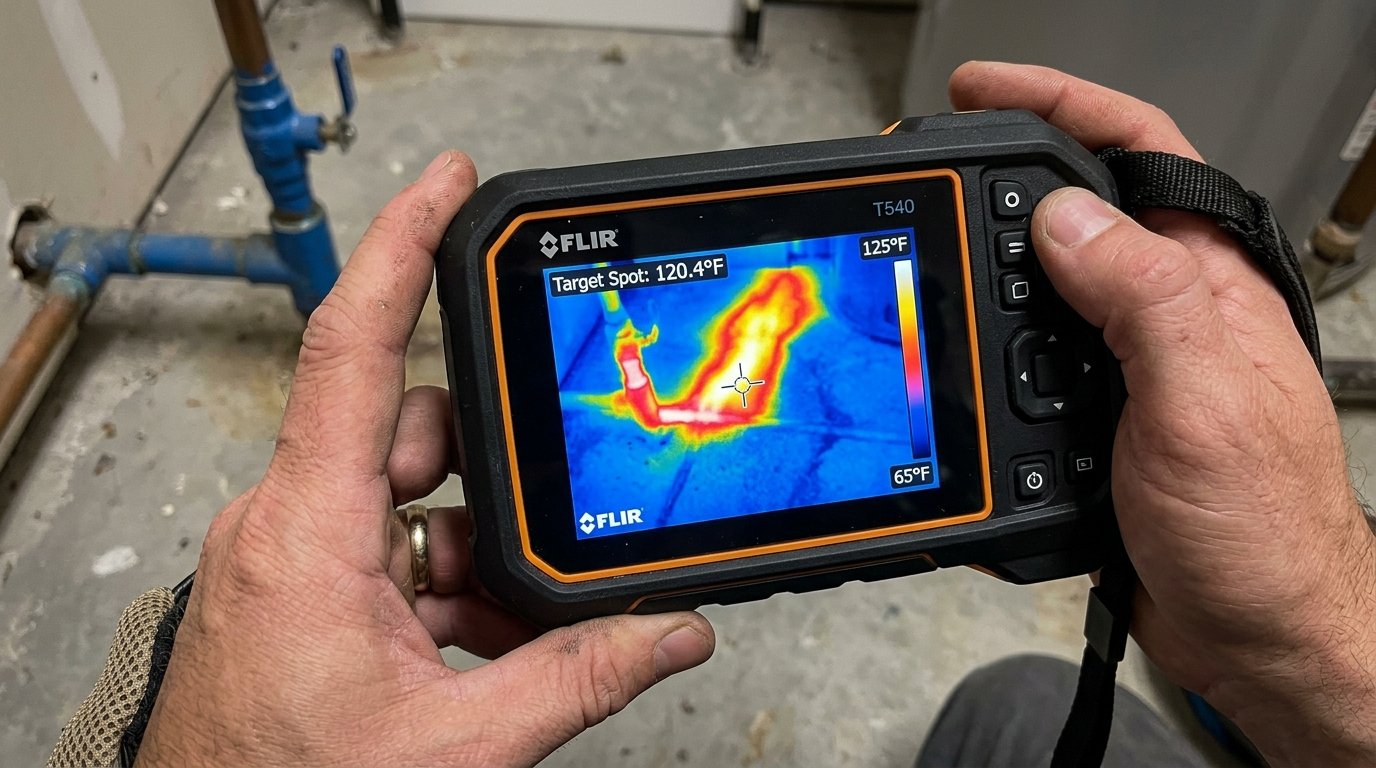
Non-Invasive Diagnostics / Thermal ScanThermal Heat Mapping: FLIR infrared cameras display the radiant heat signature of leaking 120°F water warming the concrete slab, eliminating exploratory demolition.
Non-Invasive Diagnostic Technology: How Pros Find Hidden Leaks
Gone are the days when plumbers had to randomly jackhammer multiple trenches across your living room to find a leak. Today, certified technicians use advanced non-destructive technology:
1. FLIR Infrared Thermal Imaging
Thermal cameras instantly identify the radiant heat bloom of hot water leaking under concrete, displaying a distinct bright orange/red thermal signature beneath tiles or flooring.
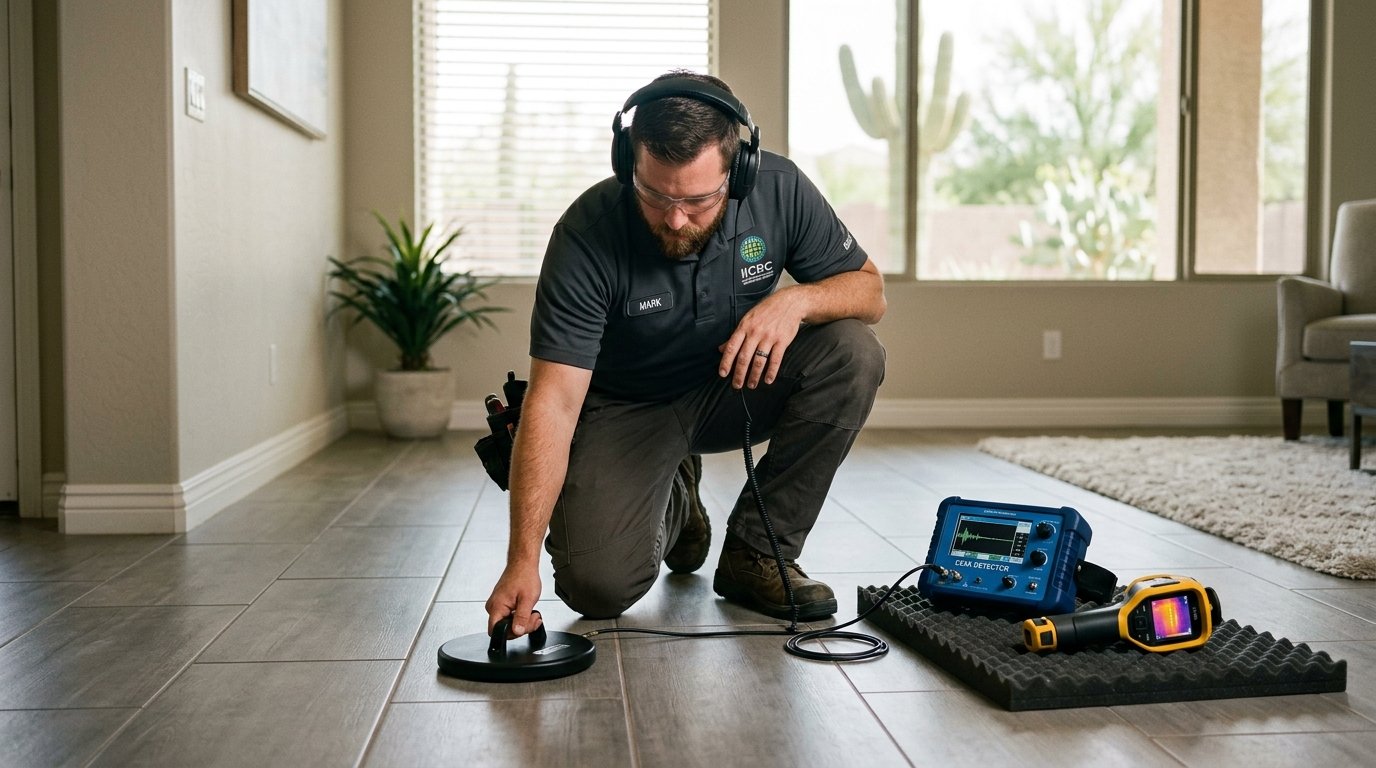
2. Ultrasonic Acoustic Ground Microphones
Pressurized water escaping through a pinhole breach creates a distinct high-frequency hiss. Acoustic listening discs filter out ambient room noise to pinpoint the loudest underground sound within a 6-inch radius.
3. Pressure Decay & Tracer Gas Testing
Technicians isolate plumbing zones and perform hydrostatic pressure decay tests. For complex cold water leaks, a safe, non-toxic helium/nitrogen gas mixture is introduced into the line, and sensitive gas detectors trace the gas escaping through the slab.
Slab Leak Repair Methods: Overhead PEX Re-Route vs. Direct Jackhammering
Once the leak is located, homeowners have two primary plumbing repair options:
Repair Method
Process Description
Pros & Advantages
Cons & Risks
Arizona Recommendation
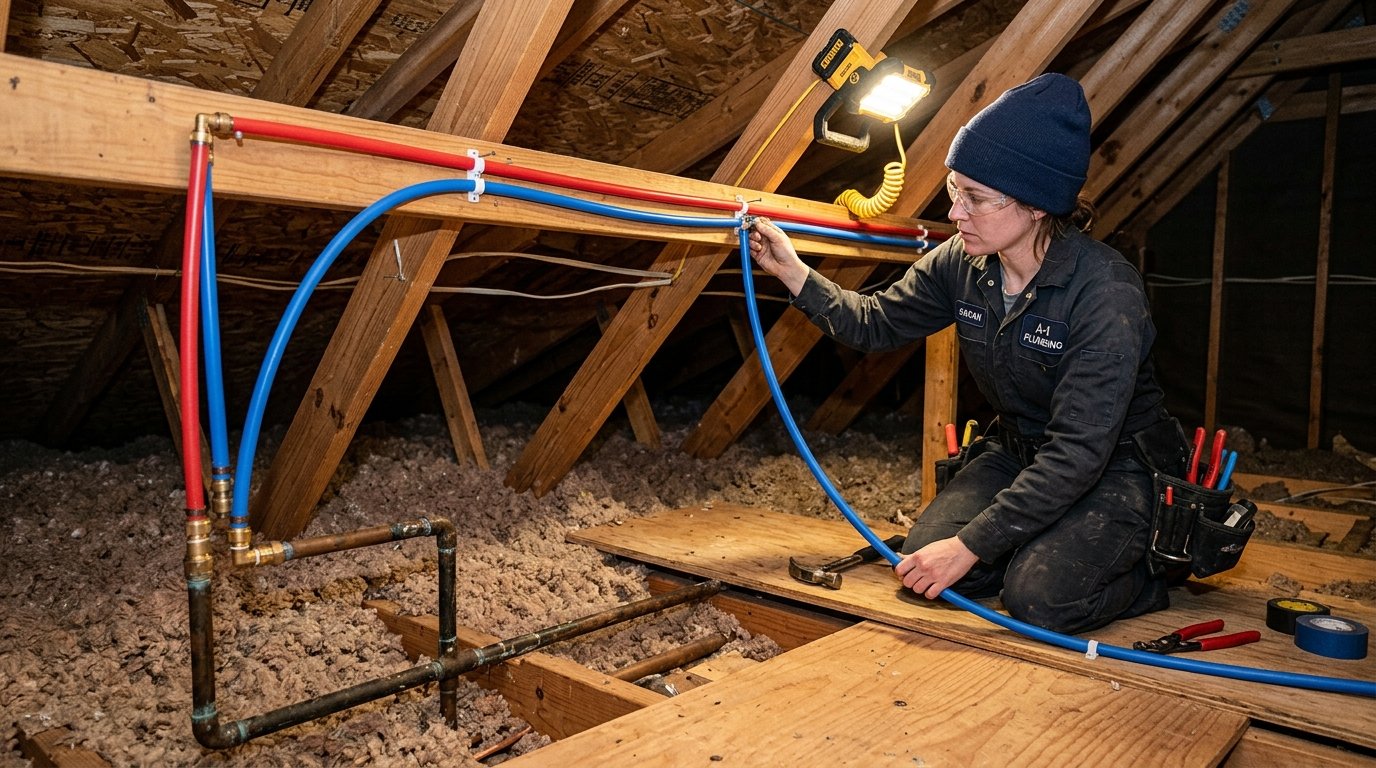
Overhead PEX Re-Route (Attic / Wall Bypass)
Abandon the leaky sub-slab copper line entirely. Route flexible, corrosion-proof PEX tubing through attic and wall cavities to reconnect fixtures.
Zero concrete demolition; preserves expensive tile/hardwood; eliminates future sub-slab leaks on that line; 25+ year PEX lifespan.
Requires small drywall access cuts behind cabinets or closets (easily patched).
Strongly Recommended (Gold Standard in Arizona)
Direct Slab Penetration (Jackhammer Spot Repair)
Break through the concrete foundation with a jackhammer, excavate dirt, cut out the leaking copper section, and solder in a new copper splice sleeve.
Fixes the specific leak point without running new lines through the attic.
High risk of cutting post-tension cables; destroys flooring; remaining 30-year-old copper under the slab remains vulnerable to future leaks.
Only recommended for single-story homes where attic access is impossible.
Epoxy Pipe Lining (Trenchless In-Place Coating)
Blow an epoxy resin coating through the interior of the copper line to seal pinholes.
No floor or drywall destruction.
Expensive; difficult on small 1/2" residential residential lines; temporary fix in shifting soils.
Rarely recommended for residential copper in Phoenix.
Plumbing Repair Comparison: Overhead PEX Bypass vs. Direct Slab Jackhammering in Arizona
Plumbing Engineering / Repair MethodsRepair Strategy Matrix: Overhead PEX reroutes bypass damaged under-slab copper through the attic with zero foundation disruption and lifetime corrosion resistance.
The Structural Restoration Process: Drying the Concrete Slab
Fixing the plumbing pipe is only half the battle. Concrete is porous and absorbs hundreds of gallons of water. Under IICRC S500 Class 4 specialty drying protocols, certified restoration technicians execute a systematic dry-out:
Flooring & Underlayment Excision: Saturated carpet pad, delaminated laminate, or wet foam underlayment must be lifted to expose the bare concrete foundation.
Industrial LGR Dehumidification: Commercial Low-Grain Refrigerant (LGR) dehumidifiers create high grain depression, pulling bound moisture vapor out of the concrete pores and timber framing.
Antimicrobial Sanitization: EPA-registered botanical antimicrobials (Benefect Decon 30) are applied to slab surfaces and framing to prevent mold germination.
Scientific Moisture Clearance: Technicians monitor concrete relative humidity using in-situ probes until regional equilibrium standards (<12% WME) are verified.
What to Do Right Now: 5-Step Homeowner Triage Sequence
If you suspect an active slab leak in your home, take these immediate containment steps:
Confirm with the Water Meter Flow Test: Turn off all taps and inspect the water meter flow dial to confirm continuous flow.
Isolate the Hot Water Supply (If Floor Is Warm): If stepping on a warm floor spot, turn off the cold inlet valve on top of your water heater. This stops the hot water slab leak while leaving cold water functional for basic needs. If cold, shut off the main water meter valve.
Extract Surface Water & Remove Floor Coverings: Vacuum surface water and move rugs, furniture, and valuables away from damp floor areas.
Dispatch Non-Invasive Leak Detection: Have technicians pinpoint the leak with acoustic and thermal imaging before authorizing any demolition.
Call 24/7 IICRC Certified Structural Drying: Dispatch restoration specialists to map moisture migration and begin structural slab dehumidification.
24/7 Valley-Wide Emergency Response for Slab Leaks
When an underground pipe ruptures beneath your foundation, immediate action prevents structural shifting and ruined flooring. Our IICRC-certified crews arrive within 30 to 45 minutes across the entire Valley:
A slab leak is a rupture or pinhole breach in the pressurized copper water supply lines (or sewer drainage lines) embedded within or routed directly beneath a home's concrete foundation slab. Because the pipe is buried beneath 4 to 6 inches of concrete and soil, water escapes invisibly, saturating the ground, undermining the foundation, and migrating upward into flooring and drywall.
Why are slab leaks so uniquely common in Phoenix and across Arizona?
Three geological and construction factors make Arizona a hotspot for slab leaks: (1) Over 95% of homes are built on concrete slab-on-grade foundations with soft copper lines cast directly into the concrete or sub-slab gravel; (2) Phoenix soil contains high concentrations of expansive clay that swells when wet and contracts in summer droughts, creating friction that grinds copper against abrasive rocks; (3) Arizona's hard water (15–25+ GPG) and high municipal water pressure (often 80–110+ PSI) create internal turbulence, causing galvanic pitting corrosion from the inside out.
What is the most obvious sign of an active hot-water slab leak?
An isolated warm or hot spot on your floor tiles, luxury vinyl plank, or carpet. Because hot water supply lines constantly radiate heat into the concrete slab, stepping on a noticeably warm patch with bare feet is the single most common homeowner indicator of an underground hot water copper pipe breach.
Should I jackhammer the floor or re-route the pipes through the attic?
In modern Arizona restoration practice, an overhead PEX re-route is almost always the superior, recommended approach. Jackhammering through a post-tension concrete slab risks severing high-tension steel structural cables, destroys expensive finished flooring, and leaves the remaining 30-year-old underground copper vulnerable to another leak next month. An overhead re-route abandons the leaky sub-slab pipe and runs durable, corrosion-proof PEX tubing through attic and wall cavities with minimal disruption.
Does homeowners insurance cover slab leak repair and restoration in Arizona?
Standard homeowner insurance policies (HO-3) generally cover the 'access' (cutting drywall or concrete to locate the leak) and all resulting structural water damage (flooring removal, concrete drying, drywall replacement, and mold remediation). However, insurance policies typically exclude the actual plumbing pipe repair or re-route itself (often $1,500–$3,500), which is classified as standard plumbing maintenance. Our team provides comprehensive itemized insurance documentation.
How do technicians locate a slab leak without destroying the floor?
Restoration specialists and leak detection plumbers use non-invasive electronic diagnostics: (1) FLIR infrared thermal cameras to visualize radiant heat plumes beneath floors; (2) Ultrasonic acoustic ground microphones to amplify the high-frequency hiss of pressurized water escaping through pinhole pipe splits; (3) Pressure decay testing and helium/nitrogen tracer gas detection.
Can a slab leak cause structural foundation damage in Phoenix?
Yes. In the Valley's expansive clay soils, thousands of gallons of water escaping under the slab cause localized soil expansion, creating 'heaving' that lifts foundation sections and cracks interior walls. Conversely, chronic leaks can wash away soil compaction, leading to foundation settling, sinking, and structural cracks.
How long does it take to dry a concrete slab after a slab leak?
Under certified IICRC S500 Class 4 specialty drying protocols, drying a saturated concrete slab typically takes 4 to 7 days using commercial Low-Grain Refrigerant (LGR) dehumidifiers and high-velocity axial air movers. Relative humidity probes and calcium chloride tests verify dry standards before new flooring is laid.
IICRC-certified restoration technicians · Phoenix metro
Written and fact-checked by the licensed crew that runs the trucks — the same technicians who take moisture readings, set drying chambers to the IICRC S500 standard, and answer the phone at 2 a.m. across the Phoenix metro.
Licensed Arizona contractor — AZ ROC #331127 (KB-2)