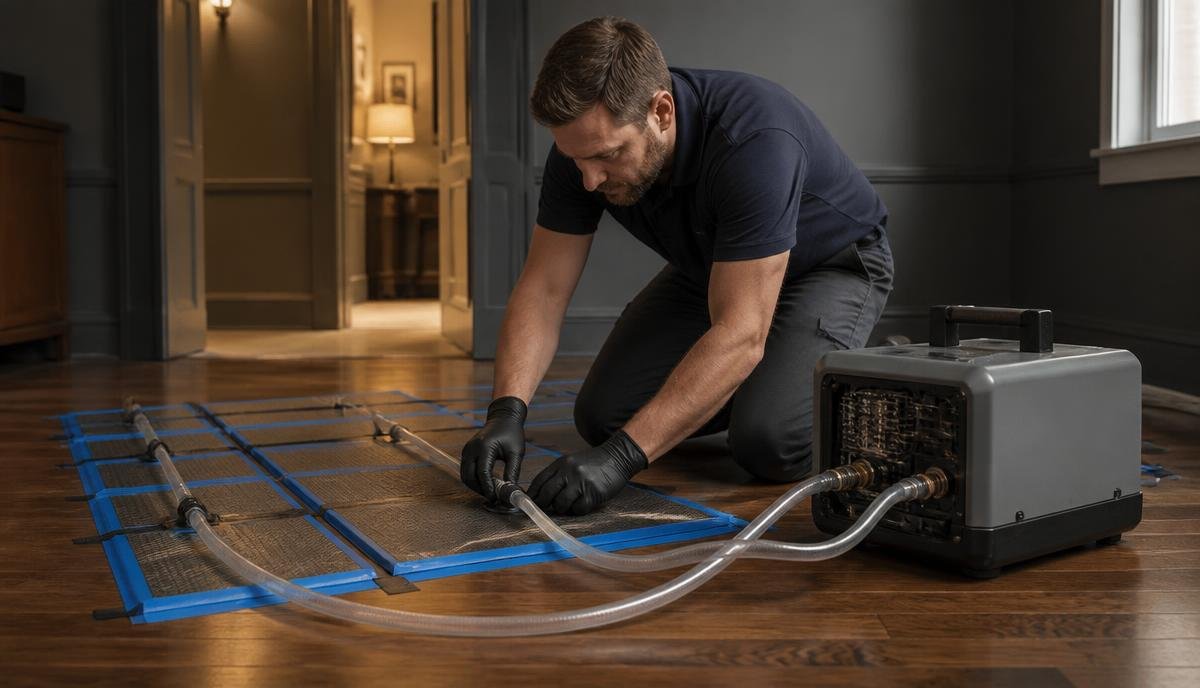
Walking across a warped, cupping, or damp hardwood floor is heartbreaking. Before assuming your entire flooring investment must be demolished and replaced, discover how modern IICRC S500 vacuum mat drying systems salvage up to 85% of water-damaged hardwood floors in Arizona.
Last updated:Reading time:14 minStandards:IICRC S500 Verified
Hardwood Floor Salvage: Vacuum Rescue Mat Extraction & Moisture Equilibrium Monitoring · Phoenix Metro
Table of contents▾
Yes, water-damaged hardwood floors can almost always be saved if professional extraction and specialized negative-pressure vacuum mat drying begin within 24 to 48 hours of clean water exposure. Solid oak, maple, hickory, and quality engineered hardwoods expand across their cell grain when wet, resulting in cupping (raised plank edges). As long as boards have not buckled completely off the subfloor and water is clean (Category 1), commercial drying equipment extracts trapped subfloor moisture, allowing boards to contract back to their flat equilibrium without costly replacement.
The Anatomy of Wood Distortion: Cupping vs. Crowning vs. Buckling
Wood is a hygroscopic, cellular material that acts like a bundle of tiny straws. When exposed to moisture, hardwood absorbs water and expands primarily across its tangential width rather than its length. Understanding how wood distorts reveals whether your floor is actively drying or suffering severe structural failure:
1Cupping (The Classic Water Damage Reaction)
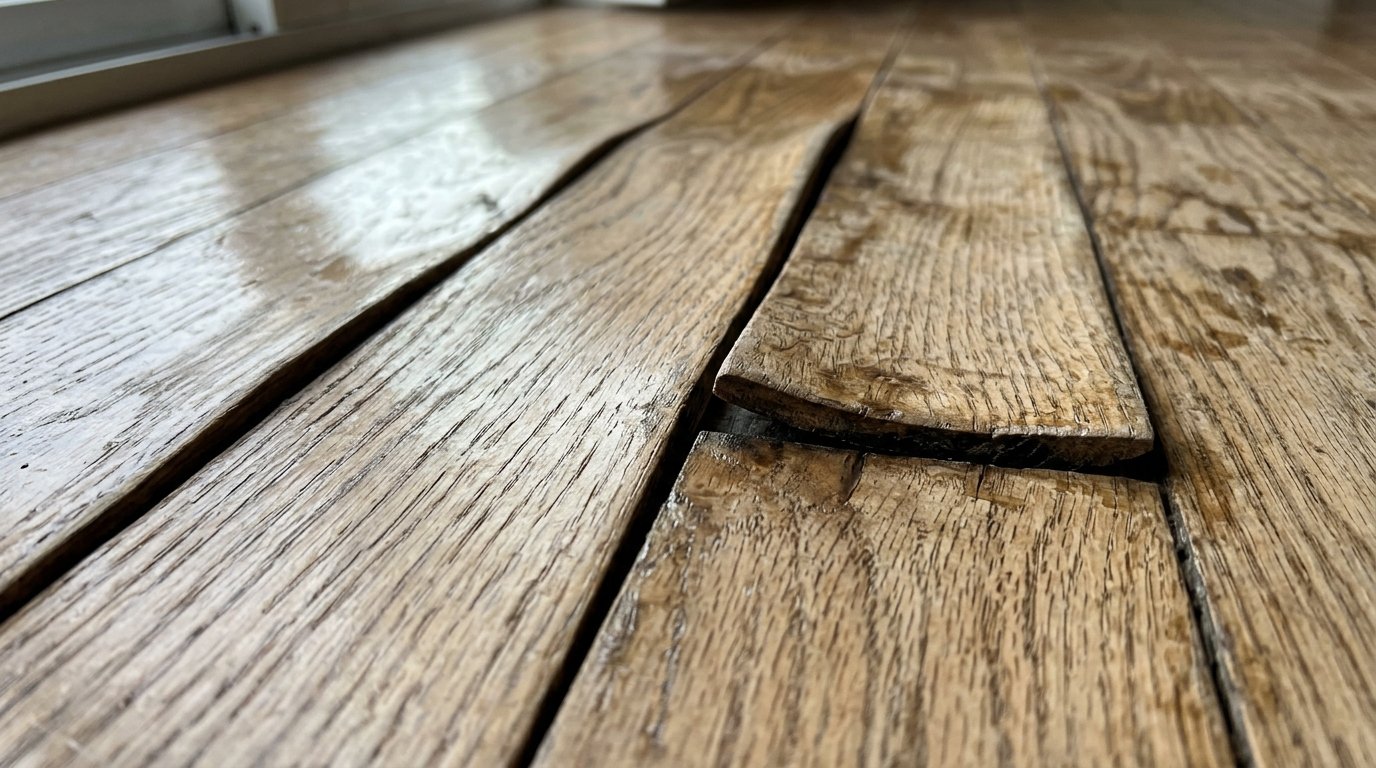
What it looks like: The edges of individual wood planks curve upward while the center dips down, creating a washboard or concave surface. The Cause: The underside of the plank (touching the wet subfloor or slab) is holding significantly more moisture than the top surface exposed to indoor air. The bottom wood cells expand faster, forcing the edges to curl up. Salvage Outlook:High (80%–90% Salvageable). As negative-pressure vacuum mats draw water out of the subfloor, the moisture gradient balances and boards flatten.
2Crowning (The Result of Premature Sanding)
What it looks like: The center of each plank arches upward into a convex ridge while the edges sit lower. The Cause: Crowning almost always occurs when an inexperienced contractor or homeowner sands down a cupped floor before it has completely dried. When the bottom finally dries and shrinks, the top (which was sanded flat while swollen) shrinks further, leaving a permanent convex hump. Salvage Outlook:Difficult. Often requires complete floor re-sanding or board replacement.
3Buckling (Extreme Hydrostatic Expansion)
What it looks like: Entire sections of the floor lift 2 to 6 inches off the subfloor in a steep, tent-like ridge, separating completely from fasteners and adhesives. The Cause: The wood has absorbed massive volumes of water with nowhere to expand laterally against walls, shearing tongue-and-groove nails or breaking adhesive bonds. Salvage Outlook:Low. Buckled sections must be excised and re-nailed/glued after the subfloor is fully dried.
Wood Deformation / Cupping AnatomyCupping in Progress: As moisture saturates the subfloor beneath the planks, bottom wood fibers expand faster than top fibers, causing plank edges to curl upward.
Hardwood Floor Salvage Decision Matrix
Whether your flooring can be dried in place or requires controlled replacement depends on four key variables: wood species, subfloor construction, water category, and response speed.
Flooring & Scenario Type
Subfloor Construction
Water Contamination Grade
Salvage Probability
Recommended Restoration Protocol
Solid 3/4" Hardwood (Oak, Maple, Hickory)
Plywood Subfloor over Joists
Category 1 (Clean supply pipe, ice maker)
85% – 95% (High)
Negative-pressure rescue mat drying + under-floor crawlspace/cavity airflow
Solid 3/4" Hardwood (Glued down)
Concrete Slab (Phoenix standard)
Category 1 (Clean tap water)
75% – 85% (High)
Top-down vacuum mat extraction + LGR dehumidification to draw slab moisture
High-End Engineered Hardwood (Thick wear layer)
Concrete Slab or Plywood
Category 1 (Clean tap water)
70% – 80% (Moderate-High)
Rescue mat drying; verify cross-ply core has not delaminated
Laminate / MDF Core Flooring
Any Subfloor
Any Water Category
0% (Non-Salvageable)
Tear-out required: Particle board and MDF swell permanently and cannot dry flat
Any Hardwood (Submerged >72 Hours)
Any Subfloor
Category 2 or 3 (Grey / Black Water)
10% (Very Low)
Excision and disposal: Microbial mold growth on wood backing and slab requires remediation
Decision Matrix: Evaluating Hardwood Floor Salvageability by Material, Subfloor, and Contamination
The Science of Vacuum Rescue Mat Drying (Injectidry Technology)
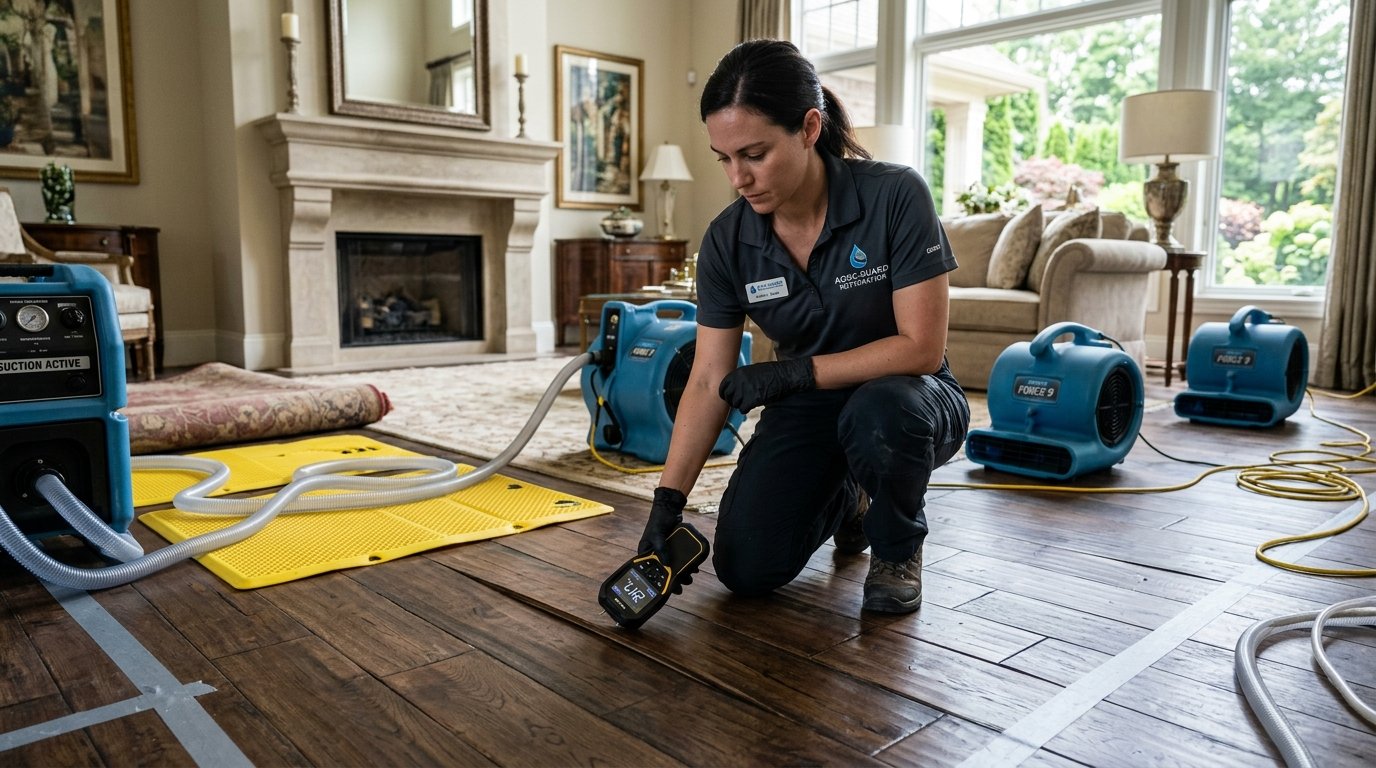
In the past, water-damaged hardwood was almost always ripped out with pry bars. Today, IICRC-certified restoration technicians use advanced psychrometric engineering and high-pressure suction mat systems:
Engineering Technology / Injectidry SystemHigh-suction vacuum rescue mats create an airtight seal across plank joints, forcing dry ambient air through wood pores and pulling water vapor out from the underlying concrete slab.
1. Hermetic Vacuum Sealing Across Tongue-and-Groove Joints
Drying panels are placed across the wet floorboards with closed-cell foam gaskets creating an airtight perimeter. Commercial blower units pull high negative pressure (suction) through the mat ports.
2. Pulling Bound Water from Concrete Slabs and Subfloors
The vacuum creates a strong vapor pressure differential. Instead of trying to force air downward against dense hardwood, the system pulls moisture vapor upward from the concrete slab, through the tongue-and-groove joints and cellular wood grain, and exhausts it directly into commercial LGR dehumidifiers.
3. Psychrometric Moisture Equilibrium Tracking
Technicians use deep-probe slide hammer pin meters to measure moisture content at the top, middle, and bottom of the wood planks, as well as non-invasive radio frequency meters for the subfloor. In Arizona's arid climate, hardwood is dried until it reaches regional Equilibrium Moisture Content (EMC) of 6% to 9% Wood Moisture Equivalent (WME).
Extract Surface Water Immediately: Use a wet/dry shop-vac, rubber squeegees, and dry towels to remove standing water pools before they seep deeper into floor seams.
Pry Off Baseboards & Shoe Molding: Carefully remove baseboards along the walls of the wet room. Hardwood requires room to expand as it swells. Removing trim prevents severe buckling and allows dry air to enter the perimeter expansion gap.
Never Apply Direct Heat: Do not point space heaters, hair dryers, or hot air guns at the floor. Rapid, uneven surface heating causes case hardening — the surface wood shrinks and cracks severely while moisture remains trapped underneath.
Call 24/7 Professional Restoration: Dispatch a certified team with vacuum rescue mats before 24 hours elapse.
Cost Comparison: Salvage Drying vs. Complete Replacement (2026 Arizona)
Restoring your existing hardwood floor through non-destructive vacuum drying is dramatically faster and more cost-effective than a total demolition and rebuild:
Restoration Scope & Action
Average Cost (Phoenix Metro)
Project Timeframe
Disruption Level
Non-Invasive Vacuum Mat Drying (Injectidry + LGR Dehumidifiers)
$2,200 – $5,500
4 – 7 days
Low: Furniture shifted, home remains livable during drying
Minor Spot Refinishing / Screening (If needed after drying)
$600 – $1,800
1 – 2 days
Minimal: Light topcoat blending
Total Demolition, Slab Grinding, New Solid Hardwood & Finish
$12,000 – $28,000+
3 – 6 weeks
Extreme: Furniture moving/storage, dust containment, family relocation
Cost & Disruption Analysis: In-Place Hardwood Salvage vs. Full Flooring Replacement in Arizona
24/7 Emergency Hardwood Floor Rescue Across the Valley
Time is the single most critical factor in saving water-damaged hardwood. Our IICRC-certified crews are stationed throughout Maricopa County with dedicated hardwood rescue mat trailers ready for immediate 30- to 45-minute dispatch:
Can water-damaged hardwood floors really be saved without tearing them out?
Yes. In the vast majority of clean water losses (Category 1), solid hardwood and quality engineered hardwood floors can be completely salvaged if professional structural drying begins within 24 to 48 hours. Using commercial vacuum rescue drying mats (such as Injectidry systems) and Low-Grain Refrigerant (LGR) dehumidifiers, technicians pull bound water out from beneath the planks and concrete slab without tearing out the flooring.
What is the difference between cupping, crowning, and buckling in hardwood floors?
Cupping occurs when the bottom of the wood plank is wetter than the top, causing the board edges to curl upward and creating a concave washboard surface. Crowning is the inverse, where the center of the plank bulges higher than its edges (usually caused by prematurely sanding a wet cupped floor). Buckling is severe catastrophic failure where expanded planks completely lift off the concrete slab or plywood subfloor.
Why should you never sand a cupped hardwood floor while it is still wet?
Sanding a cupped floor while it is wet permanently ruins the wood. When the edges are sanded flat while swollen with water, the bottom of the plank eventually dries out and contracts. This causes the once-flat boards to invert into severe 'crowning' (sunken edges with a peaked center) that cannot be repaired without replacing the floor.
How long does it take to dry wet hardwood floors with professional equipment?
Under IICRC S500 commercial drying protocols using negative-pressure vacuum extraction mats and industrial LGR dehumidifiers, hardwood floors and their underlying subfloors typically take 4 to 8 days to reach Arizona's Equilibrium Moisture Content (EMC) of 6% to 9% Wood Moisture Equivalent.
Can engineered hardwood be saved after a water leak?
Engineered hardwood with a thick natural wood wear layer can often be saved if the glue binding the cross-ply layers has not delaminated. However, inexpensive engineered planks or laminate flooring with MDF/HDF particle board cores swell irreversibly when wet and must be replaced.
Does homeowners insurance cover hardwood floor water damage in Arizona?
Yes, standard homeowner insurance policies cover sudden and accidental water discharges (such as a burst refrigerator line, dishwasher overflow, or broken supply pipe). Policies typically exclude long-term neglected leaks. Our team provides daily psychrometric dry-down logs and thermal moisture reports to substantiate claim coverage with your adjuster.
How much does it cost to restore vs. replace water-damaged hardwood floors?
Specialized vacuum mat extraction and structural dehumidification typically costs $2,200 to $5,500. By contrast, completely tearing out, hauling away, prepping concrete slabs, and installing high-end hardwood runs $12,000 to $28,000+. Salvage drying saves homeowners and insurers 60% to 80% on overall costs.
What should I do immediately after water spills onto my hardwood floors?
Immediately shut off the water source, extract standing water with a wet-vac or mop, remove baseboards and shoe molding to allow perimeter wood expansion, keep your air conditioner running at 72°F to reduce humidity, and call a certified restoration professional within hours.
IICRC-certified restoration technicians · Phoenix metro
Written and fact-checked by the licensed crew that runs the trucks — the same technicians who take moisture readings, set drying chambers to the IICRC S500 standard, and answer the phone at 2 a.m. across the Phoenix metro.
Licensed Arizona contractor — AZ ROC #331127 (KB-2)