Water is a master of disguise. In Arizona's dry climate, surfaces can feel completely dry to the touch while structural wall cavities and subfloors remain 95% saturated. Discover the advanced scientific toolkit certified restoration professionals use to track, map, and verify hidden moisture without tearing your home apart.
Last updated:Reading time:15 minStandards:IICRC S500 Verified
Professional moisture detection relies on a combination of non-destructive diagnostic technologies: high-resolution FLIR infrared thermal cameras that detect evaporative cooling patterns, non-invasive radio-frequency (RF) pinless meters that scan beneath surfaces, penetrating electrical resistance pin probes that deliver exact quantitative Wood Moisture Equivalent (WME) percentages, and acoustic listening discs for subterranean leaks. In the Arizona desert, low ambient humidity dries surface paint rapidly, creating a dangerous false sense of security while hidden moisture continues to rot structural framing and breed toxic mold colonies behind drywall. Certified IICRC S500 moisture mapping establishes the true perimeter of water travel, protects structural integrity, and provides undeniable documentation for insurance claims.
When a pipe bursts or an appliance overflows, what you see on the surface represents only a fraction of the actual water loss. Water obeys the fundamental laws of physics: it follows gravity, takes the path of least resistance, and travels through porous building assemblies via capillary action.
In an Arizona home, water that spills across a kitchen tile floor or laundry room does not stay there. It slips beneath baseboards, wicks up the paper facing and gypsum core of drywall, saturates sill plates, soaks into fiberglass batt insulation, and migrates under tile or laminate subfloors.
Because Arizona’s dry outdoor air (often 10%–15% relative humidity) rapidly evaporates moisture from the outer surface of paint, a homeowner running their hand across a wall will often conclude that the room is “dry.” Meanwhile, inside the dark, unventilated wall cavity, relative humidity remains locked at 95%+. Within 24 to 48 hours, active fungal colonization begins, destroying framing and contaminating indoor air.
This comprehensive guide explains the scientific instruments and methodologies certified restoration technicians use to see through walls, track water travel, and verify structural drying without destructive demolition.
The 4 Core Technologies Professionals Use to Find Hidden Moisture
Professional restoration contractors never guess where water went. They deploy four complementary diagnostic technologies to uncover concealed water intrusion:
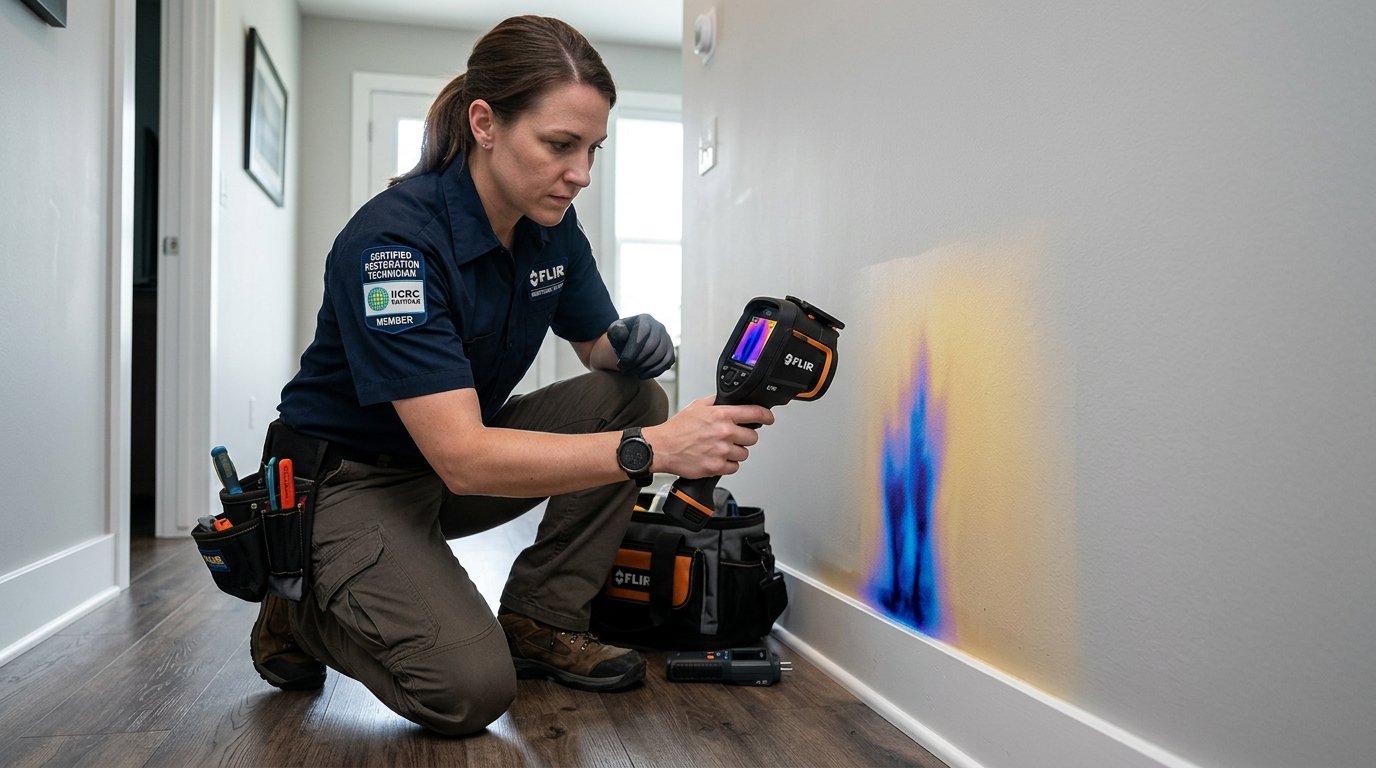
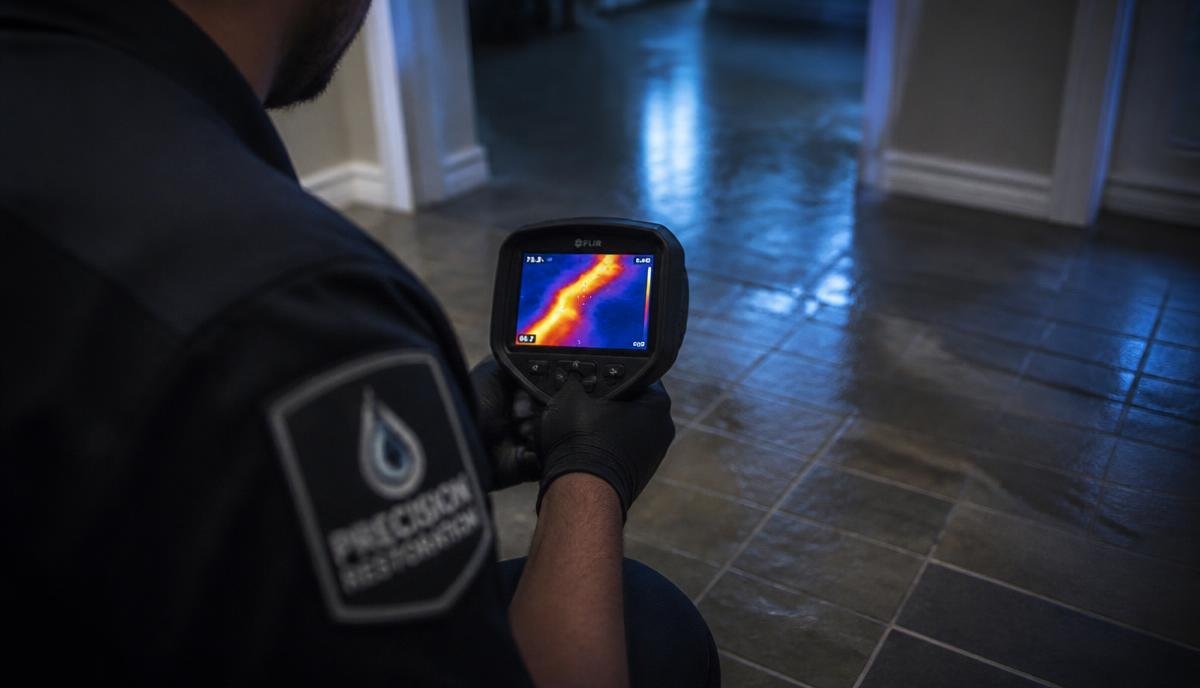
Thermal imaging is the primary reconnaissance tool in professional water restoration. Contrary to popular belief, thermal cameras do not have “X-ray vision.” They measure emitted infrared radiation (surface temperature) and convert thermal signatures into high-definition visible color palettes.
The science behind thermal moisture detection is evaporative cooling:
As liquid water inside a wall or subfloor slowly evaporates through the surface, it absorbs latent heat, making the wet area significantly cooler than adjacent dry materials.
Industrial-grade thermal cameras (such as FLIR T-Series and E-Series) feature thermal sensitivity ratings down to 0.05°C (50 millikelvins), allowing thermographers to clearly visualize the shape, boundaries, and migration pathways of water plumes hidden behind walls, ceilings, and flooring.
Thermal cameras allow an inspector to scan an entire 2,500-square-foot house in 30 minutes, identifying pockets of water trapped inside ceiling joists or under custom cabinets that would otherwise remain hidden.
While thermal imaging identifies anomalies, it cannot prove that a cool spot is actually water (a cold spot could also be caused by missing insulation or an air duct leak). That is why thermography is always paired with capacitance-based pinless moisture meters (such as the Tramex ME5 or Protimeter Aquant).
These handheld instruments emit a high-frequency electromagnetic radio signal up to 3/4 inch to 1 inch deep into building materials. Because water has a much higher dielectric constant than dry drywall, wood, or concrete, the meter instantly measures the relative electrical impedance, providing an immediate digital reading without leaving a single mark or puncture hole on your paint or finished tile.
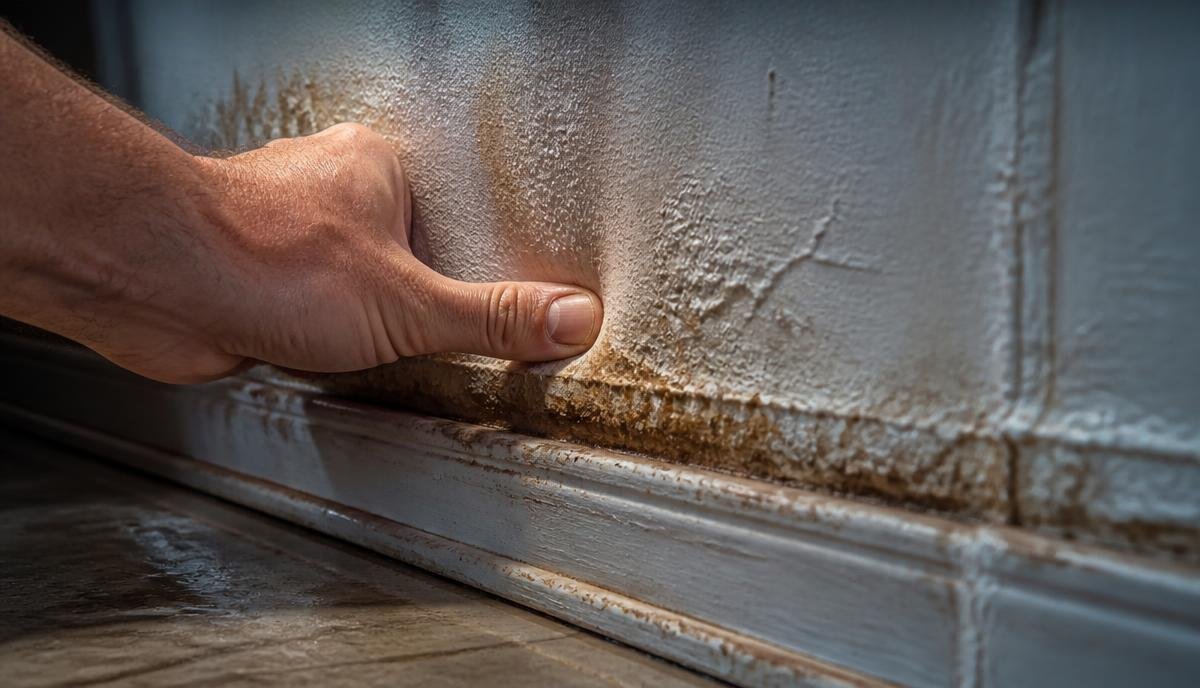
Physical tactile and pin moisture diagnostics: Spongy baseboards and soft drywall indicate prolonged hidden moisture entrapment requiring professional structural cavity drying.
When exact, legally defensible quantitative data is required—especially for insurance claims and IICRC drying logs—technicians use penetrating pin meters (such as the Delmhorst BD-2100 or Protimeter Surveymaster).
These meters insert two sharp insulated steel electrode pins directly into the material (drywall, baseboard, wood studs, or subflooring). The instrument passes a micro-amperage electrical current between the pin tips and measured electrical resistance. Since water conducts electricity vastly better than dry cellulose, lower electrical resistance directly correlates to higher moisture content.
In Arizona restoration projects, a drywall reading exceeding 16% Wood Moisture Equivalent (WME)triggers immediate dehumidification protocols; readings above 20% WME indicate structural saturation where microbial germination is imminent.
4. Acoustic Listening Discs & Pipe Locators
For water supply lines concealed beneath 4 to 6 inches of steel-reinforced concrete slabs, moisture may take days to migrate to the surface. When an underground pressurized supply line fractures, it generates a distinct ultrasonic acoustic vibration (hiss) as it collides with surrounding soil. Highly sensitive piezoelectric microphones amplify and filter this acoustic signal through headphones, allowing technicians to pinpoint the subterranean rupture to within a few inches.
Infrared thermography: High-resolution thermal cameras capture subtle evaporative cooling patterns, exposing the exact boundaries of concealed moisture migrations.
Professional Moisture Detection Technology Comparison
The table below details how certified technicians choose the proper diagnostic instrument for each building material:
Diagnostic Instrument
Operating Principle
Depth of Detection
Ideal Applications
Potential False Positives
FLIR® Infrared Camera
Measures surface evaporative cooling delta-T via infrared radiation.
Surface reading reflecting cavity conditions
Rapid whole-room scanning, ceiling water tracks, radiant slab leaks.
Missing insulation batts, cold air duct leaks, reflective foil surfaces.
Chemical wood treatments, salts from hard water efflorescence.
Acoustic Ground Microphone
Piezoelectric amplification of ultrasonic fluid escape vibrations.
Through 4"–12" concrete slabs and sub-base
Concealed hot and cold copper slab leaks beneath tile or concrete.
Ambient traffic noise, operating refrigerators, running pool autofills.
The IICRC S500 Moisture Mapping Protocol
Locating water is only the first step. Under the IICRC S500 Standard and Reference Guide for Professional Water Damage Restoration, certified technicians execute a rigorous, five-step scientific mapping protocol:
Step 1: Establishing the “Dry Standard” Baseline
Before testing the flooded area, the technician enters an unaffected room on the same floor of the home. Using calibrated pin and pinless meters, they record baseline moisture levels of dry drywall, dry baseboards, and dry flooring.
In the Arizona desert, normal drywall typically reads between 6% and 9% Wood Moisture Equivalent (WME), while structural 2x4 framing reads between 8% and 11%. This unaffected reading becomes the official benchmark for the entire project.
Step 2: Defining the Boundary of the Loss
The technician conducts a full-room thermal survey, using the infrared camera to trace the moisture boundary. Using low-tack blue painter’s tape, they mark the edge where evaporative cooling transitions back to ambient temperature.
Step 3: Recording Quantitative Depth Readings
Using penetrating pin probes, the technician takes numerical readings at regular 2-foot intervals along baseboards and wall studs:
Normal / Dry: <12% WME (No action needed).
At Risk: 13%–16% WME (Requires monitored drying to prevent fungal colonization).
Saturated: >17%–35%+ WME (Requires active industrial extraction and structural cavity drying).
Step 4: Psychrometric Ambient Profiling
Drying is not just about heat; it is about moisture vapor pressure. Using a digital thermo-hygrometer, the technician measures three critical environmental metrics:
Ambient Temperature (°F): Thermal energy driving evaporation.
Relative Humidity (RH%): The percentage of moisture the air holds relative to saturation.
Grains Per Pound (GPP): The exact physical weight of water vapor in each pound of dry air (7,000 grains = 1 lb of water). In Arizona, unaffected indoor air often measures 30–45 GPP; in an active water loss, GPP spikes to 80–120+ GPP.
Step 5: Daily Monitored Moisture Logging
Throughout the drying process, technicians return every 24 hours to re-test the exact same test points, documenting the downward trajectory of moisture content until all structural materials reach within 2% to 4% of the original Dry Standard.
Common Concealed Moisture Traps in Arizona Homes
Certain architectural features common in Phoenix and Scottsdale homes act as hidden water reservoirs:
Sub-Cabinet Kitchen Voids: Dishwashers and under-sink RO systems leak beneath cabinets. Water pools in the hollow toe-kick cavity, trapped beneath heavy granite countertops where standard air cannot reach. Read our guide on dishwasher leaks and sub-cabinet moisture containment.
Post-Tension Concrete Slabs: Water escaping beneath a slab migrates along the gravel sub-base, traveling 20 to 30 feet before surfacing at a wall plate. Learn more about non-invasive detection in our slab leak detection and restoration guide.
Attic Ceilings Below AC Air Handlers: Condensate drain line clogs allow water to pool in attic insulation. The insulation holds water like a sponge against ceiling drywall while the top side remains hidden. See our attic mold causes and prevention guide.
Shower Pan Weepholes: Clogged weepholes in tiled walk-in showers trap water in the mortar bed, slowly rotting adjacent bedroom wall studs.
Why Professional Moisture Mapping Protects Your Insurance Claim
When you file a water damage insurance claim, the adjuster’s primary goal is to determine two things: (1) Was the water loss sudden and accidental? and (2) What is the exact physical scope of affected materials?
Without certified scientific moisture logs:
Adjusters may classify the damage as “gradual seepage” or “deferred maintenance,” leading to total claim denial.
Insurers may refuse to pay for necessary commercial dehumidifiers or wall cavity injection systems, claiming the home “looks dry.”
Contractors might prematurely close up walls before framing is completely dry, trapping moisture that triggers catastrophic toxic mold growth months later.
An IICRC-certified moisture report—featuring paired visible/infrared photographs, quantitative WME logs, and psychrometric drying curves—provides undeniable scientific evidence that validates your claim. Learn more in our detailed homeowners insurance water damage and mold claims guide.
Key Takeaways
Touch is Deceiving: Drywall paint can feel bone-dry in Arizona while interior insulation and structural studs remain 90%+ saturated with water.
Thermal Imaging Visualizes Evaporative Cooling: FLIR cameras detect minute temperature differentials (0.05°C) to map the exact boundary of hidden water plumes without cutting holes.
Acoustic Pinpointing for Slabs: Pressurized subterranean copper pipe ruptures are located through concrete slabs using ultrasonic piezoelectric ground microphones.
Act Within 24–48 Hours: Concealed moisture breeds toxic mold colonies in as little as 24 hours. Certified moisture mapping and commercial structural drying prevent structural decay.
How can a wall be completely soaked with water if it feels dry to the touch?
In Arizona's arid desert climate, ambient relative humidity is often below 15%. This rapid surface evaporation causes latex paint and the outer paper face of drywall to feel completely dry within hours of water exposure. However, water travels downward and inward via capillary action, saturating the interior gypsum core, wooden wall studs, fiberglass batts, and subfloor assemblies. Trapped inside the unventilated wall cavity, moisture remains above 80–90% relative humidity, creating an invisible, ideal incubator for toxic mold spores.
How does thermal imaging see moisture behind walls without cutting holes?
Infrared thermal cameras do not see 'through' walls like X-rays. Instead, they detect micro-variations in surface temperature emitted as infrared radiation. When moisture is present inside a wall cavity, it undergoes continuous evaporative cooling. Because water has a high thermal capacity and cools the surrounding building material as it evaporates, the wet area appears significantly cooler than dry adjacent drywall. High-resolution FLIR cameras detect temperature differentials as minute as 0.05°C, rendering a precise visual heat map of water migration.
Can infrared thermal cameras detect water leaks underneath a concrete slab?
Yes, particularly for hot water lines. When a pressurized hot water pipe ruptures beneath a foundation slab, thermal heat radiates upward through the concrete, creating a glowing thermal heat bloom on infrared cameras that pinpoints the leak's epicenter. For cold water supply lines, technicians use electro-acoustic ground microphones and correlation sensors to listen for the distinct ultrasonic hiss of escaping pressurized water beneath the concrete.
What is the difference between a pin and pinless moisture meter?
Pinless meters use non-invasive electromagnetic radio-frequency (RF) signals to measure relative impedance up to 3/4 to 1 inch beneath surfaces without puncturing paint, tile, or hardwood. They are ideal for rapid scanning and locating moisture boundaries. Pin-type meters use dual electrical resistance probes inserted directly into the material (drywall, wood studs, subfloor) to deliver an exact, quantitative Wood Moisture Equivalent (WME) percentage to establish IICRC drying compliance.
What is a 'Dry Standard' in professional water damage restoration?
A 'Dry Standard' is the baseline moisture content of an unaffected, structurally sound building material in your specific home. Under IICRC S500 standards, technicians test materials in unaffected rooms (e.g., dry drywall reading 8% WME) to establish a baseline. The water-damaged room is then dried with commercial dehumidifiers and air movers until its moisture readings return to within 2–4% of that documented dry standard.
Can thermal imaging cameras see mold through drywall?
No. Thermal imaging cameras only detect temperature anomalies—they cannot detect mold spores or biological pathogens directly. However, mold colonies cannot grow without active moisture. By pinpointing cool thermal anomalies caused by water leaks, thermographers reveal the exact damp conditions where mold colonies are actively incubating inside wall cavities.
How do acoustic listening devices pinpoint buried plumbing leaks?
Pressurized water escaping from a pinhole in copper or PEX creates a high-frequency acoustic hiss as it collides with surrounding soil, aggregate, and concrete. Professional leak detectors use specialized piezoelectric acoustic listening discs and ground microphones equipped with frequency filters to amplify and isolate these sonic vibrations through tile and concrete slabs.
Why do insurance adjusters require professional moisture mapping logs?
Insurance carriers will not approve structural drying or reconstruction claims based on visual claims alone. Certified restoration companies provide date-stamped moisture logs, dual-spectrum thermal and visual photographs, and daily psychrometric readings (GPP, RH%, temperature) that objectively prove the presence of sudden water, the boundaries of saturation, and the necessity of commercial drying equipment under IICRC guidelines.
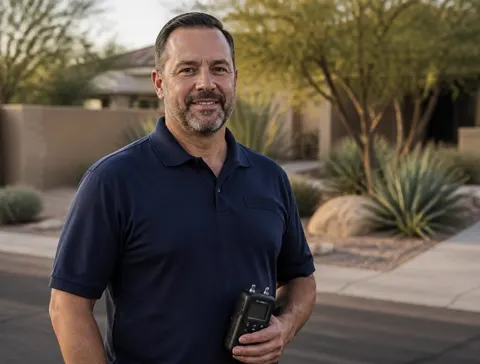
IICRC-certified restoration technicians · Phoenix metro
Written and fact-checked by the licensed crew that runs the trucks — the same technicians who take moisture readings, set drying chambers to the IICRC S500 standard, and answer the phone at 2 a.m. across the Phoenix metro.
Licensed Arizona contractor — AZ ROC #331127 (KB-2)