In Arizona's desert climate, attics reach blistering temperatures of 140°F to 160°F. When extreme heat collides with chilled air conditioning ductwork, clogged condensate lines, or misdirected bathroom exhaust fans, your attic becomes a high-speed incubator for mold. Discover the 5 primary causes, critical warning signs, and IICRC S520 remediation protocols.
Last updated:Reading time:14 minStandards:IICRC S500 Verified
Attic mold is primarily caused by air conditioning condensate overflows, bathroom exhaust fans venting directly into the attic, monsoon roof leaks, and blocked soffit ventilation. In desert climates like Phoenix and Scottsdale, extreme attic heat (140°F–160°F) colliding with chilled 45°F AC ductwork creates massive condensation. Warning signs include dark sheathing stains, rusted roofing nails, musty odors from air vents, and ceiling water rings. Prevention requires direct-venting exhaust fans through roof caps, maintaining AC condensate drain lines, and ensuring unobstructed 1:300 soffit-to-ridge airflow.
Why Attics Are Prime Incubators for Mold (The Heat & Moisture Collision)
Most homeowners rarely open their attic scuttle hatch, assuming that in the dry desert of Arizona, attic mold is virtually impossible. In reality, residential attics across the Phoenix Valley experience extreme thermodynamic conditions that make them highly vulnerable to fungal colonization.
Mold requires only three ingredients: a porous carbon food source (the cellulose in wooden roof trusses and plywood sheathing), darkness, and moisture. In an Arizona attic during summer:
The 140°F–160°F Heat Chamber: Unconditioned roof cavities superheat under direct desert sun. While high heat slows certain molds, warm temperatures between 75°F and 95°F accelerate fungal enzyme digestion once moisture is present.
The Chilled Air Collision: Most Southwest homes house their central air handling units (AHUs) and vast networks of flexible ductwork directly in the attic. Chilled air at 45°F to 55°F moving through a 150°F attic creates extreme dew point differentials. Any minor tear in outer duct insulation causes cold metal surfaces to “sweat,” dripping gallons of condensate into blown-in insulation.
Convective Moisture Migration: Warm household air carrying humidity from showers, cooking, and laundry rises toward the ceiling and slips through unsealed can lights, bypasses, and attic access doors into the attic cavity.
5 Primary Causes of Attic Mold Growth
Decades of field restoration experience reveal that over 90% of attic mold cases trace back to one of five distinct mechanical or structural failures:
1. Improperly Vented Bathroom and Laundry Exhaust Fans
This is arguably the most common building error found during residential home inspections. Builders or previous DIY homeowners frequently run flexible exhaust ducting from the master bathroom ceiling fan and simply lay the open duct end on top of attic insulation, or aim it toward a screened soffit.
Every 15-minute hot shower discharges roughly 1 to 2 pints of vaporized water into the air. When vented directly into the attic, that hot steam strikes cooler roof decking, condensing into liquid water. Within months, thick black mold colonies of Cladosporium and Penicillium spread across the plywood sheathing directly above the bathroom.
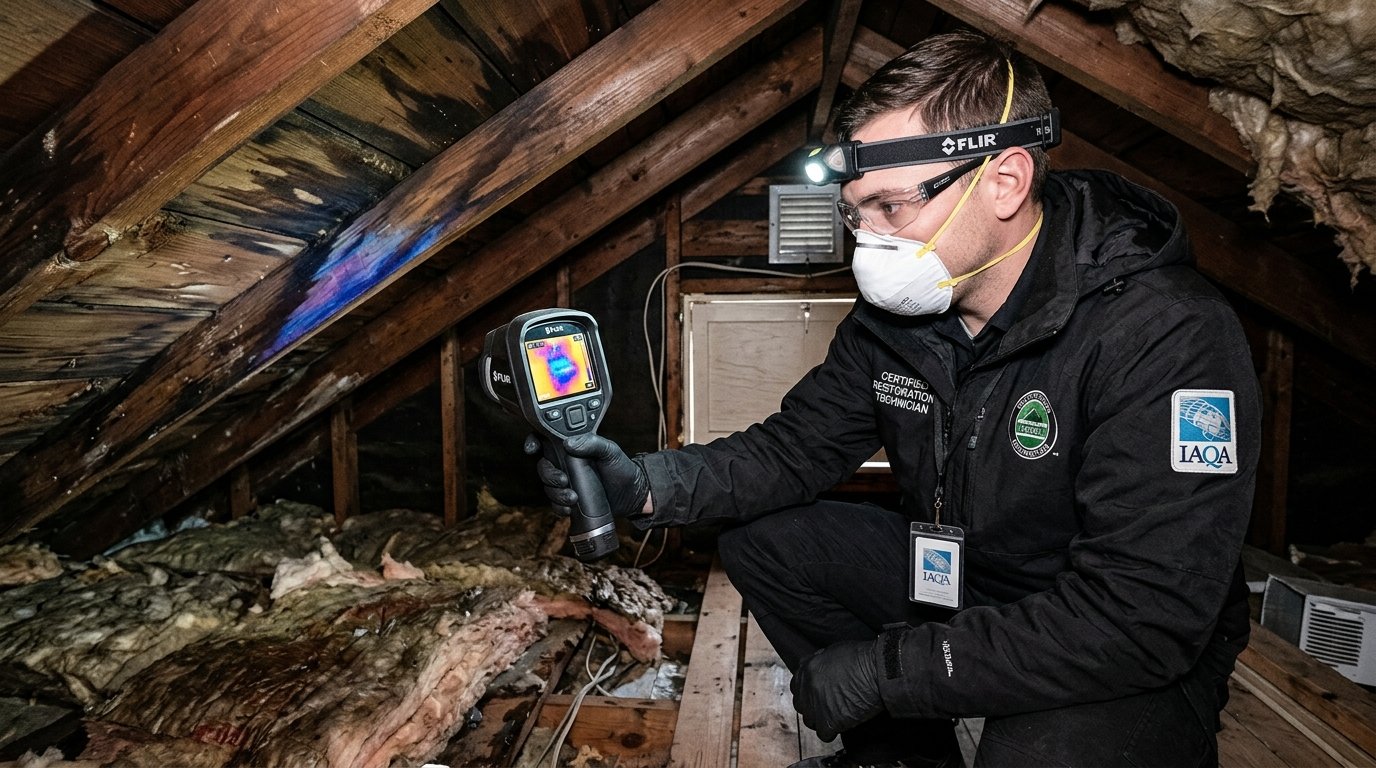
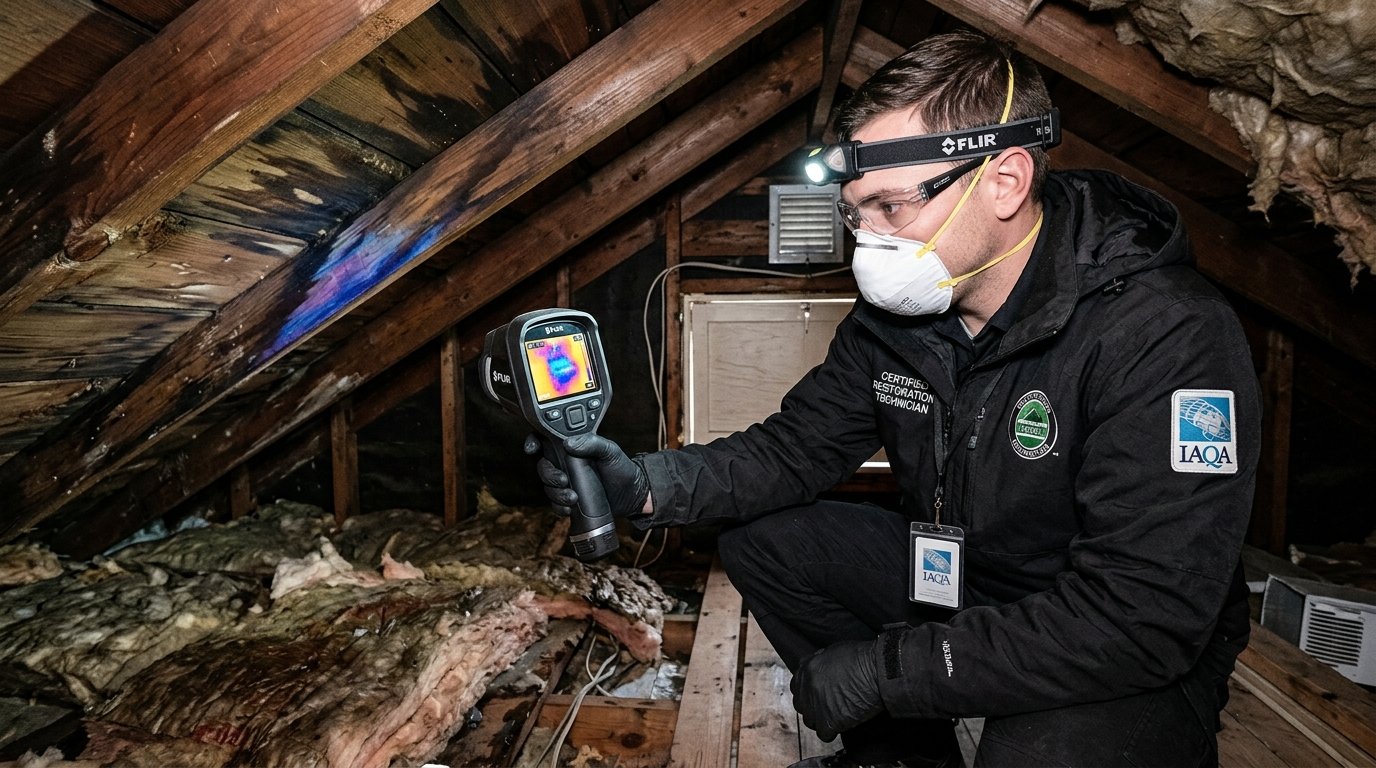
Thermal Diagnostic VerificationInfrared thermography: Certified technicians use thermal cameras to identify hidden moisture pockets behind insulation before fungal colonies spread.
2. AC Condensate Drain Line Clogs & Overflowing Secondary Pans
In hot climates, central air conditioning units run up to 16 hours a day, wringing 10 to 20 gallons of moisture from indoor air daily. That water drains through a 3/4-inch PVC condensate pipe.
Dust, algae, and calcium carbonate scale thrive in warm condensate lines, forming gelatinous clogs. When the primary line blocks, water fills the indoor evaporator coil basin and spills into the secondary metal drain pan underneath. If that secondary pan lacks an electronic safety float switch, or if the pan has rusted through, water overflows into the blown-in insulation and ceiling framing below. If your ceiling is actively sagging or bubbling, review our emergency guide to ceiling water damage causes and signs.
3. Roof Breaches, Flashing Failures, and Cracked Tiles
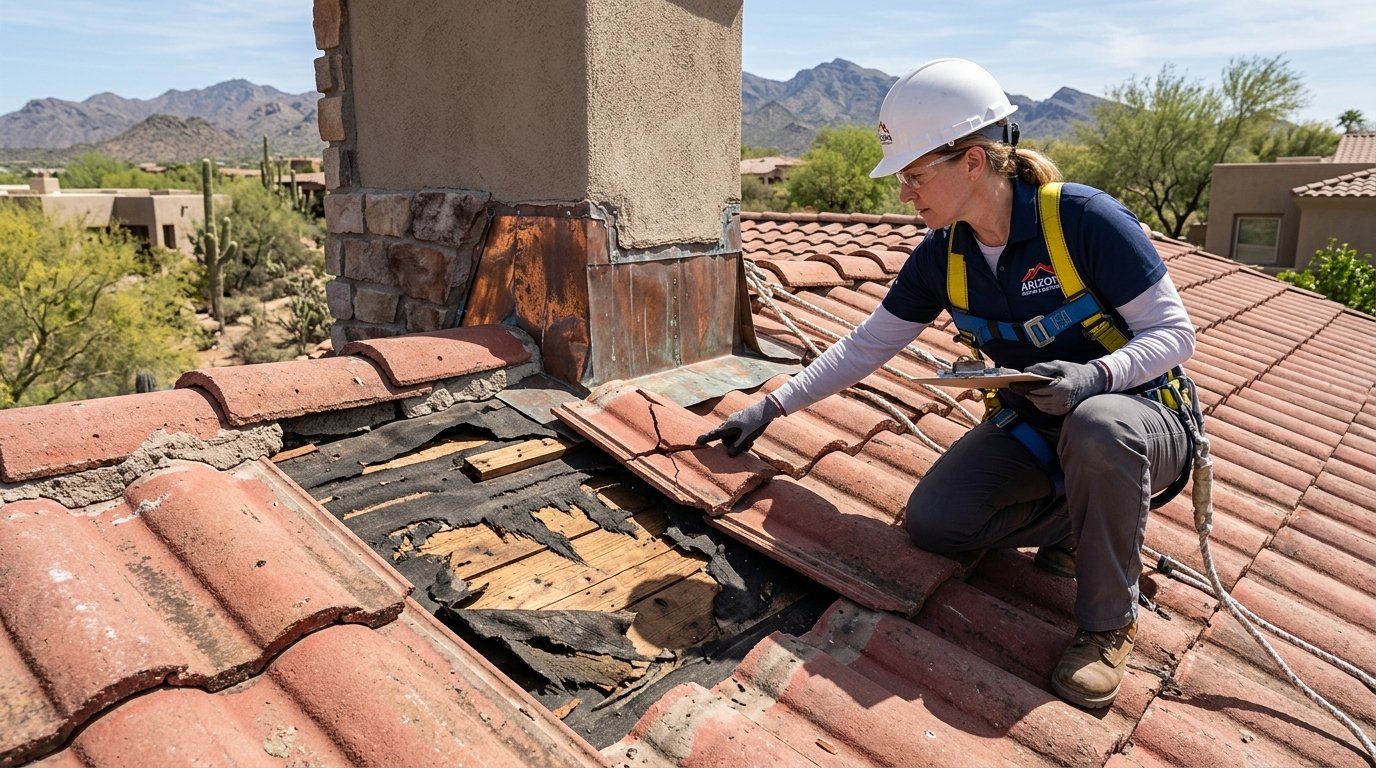
Arizona’s intense monsoon storms bring high-velocity microburst winds, driving rains, and occasional hail. Concrete and clay roof tiles can crack or shift, exposing the underlying asphalt-saturated organic felt underlayment.
Under years of extreme desert baking, underlayment turns brittle and tears. Water enters around plumbing vent flashings, valley pans, and chimney saddles, soaking into roof decking and truss framing. For full triage protocols, consult our 2026 roof leak repair guide.
Roof Underlayment BreachBrittle, torn underlayment beneath concrete tiles allows driving rainwater to penetrate roof sheathing, creating hidden mold in the attic below.
4. Inadequate or Blocked Attic Ventilation
Building codes require balanced attic ventilation—typically following the 1:300 ratio (1 square foot of net free ventilating area for every 300 square feet of attic floor space, divided equally between low intake and high exhaust).
Common ventilation failures include:
Blocked Soffit Vents: Blown-in fiberglass or cellulose insulation installed without cardboard or foam baffles covers the eave vents, choking off intake airflow entirely.
Inadequate Ridge Exhaust: Hot, humid air remains trapped at the roof peak with no path to escape, creating stagnant, high-humidity microclimates.
5. Ceiling Air Leaks and Unsealed Bypasses
Every penetration through your home’s drywall ceiling—recessed lighting cans, bathroom ceiling exhaust housings, electrical junction boxes, and attic access scuttle panels—acts as an open chimney. Warm, humid air from your living space is continuously driven into the attic by convective stack pressure, depositing moisture onto cold roof sheathing during winter mornings.
6 Warning Signs You Have Mold in Your Attic
Because homeowners rarely enter attics, microbial colonies can flourish undetected for years. Watch for these telltale warning signs:
Dark Discoloration on Roof Sheathing: Black, dark gray, or greenish-brown staining spreading across plywood or OSB roof decking, especially concentrated near roof valleys, chimneys, or above bathrooms.
Rusted Roof Nails (“Shiner Nails”): Roofing nails protruding through the underside of the roof deck that are coated in rust or actively dripping condensation water.
Musty Smells When the AC Cycles On: A distinct earthy, damp odor circulating through room supply vents whenever your central air conditioning blower kicks on.
Ceiling Staining in Upper Rooms: Brown or yellow water spots, peeling paint, or swollen drywall tape along second-floor ceilings.
Compacted or Matted Insulation: Blown-in insulation that looks sunken, clumped, or discolored directly beneath ductwork or roof valleys.
Unexplained Chronic Indoor Allergies: Family members experiencing persistent congestion, coughing, or sinus headaches that worsen indoors, caused by attic spores leaking into return air ductwork.
Attic Mold Diagnostic Matrix
Use this quick reference table to diagnose under-roof symptoms and determine the proper corrective action:
Observed Condition
Underlying Root Cause
Urgency Level
Corrective Action Protocol
Black stains on sheathing above bathroom
Exhaust fan discharging humid air into attic
High
Re-route duct to exterior roof cap with backdraft damper; media-blast sheathing.
Water pooling in secondary AC drain pan
Primary condensate drain line blocked with algae/scale
Urgent
Flush PVC line with vinegar; install electronic float switch; dry ceiling joists.
Rusted, dripping roof nail shiners
Winter moisture condensation due to blocked soffits
Moderate
Install rafter baffles to clear soffit vents; seal ceiling light bypasses.
Torn outer vapor barrier on duct / inadequate R-value
High
Mastic-seal all duct connections; replace damaged outer insulation sleeves.
Diagnostic framework for identifying attic moisture sources and microbial damage
How to Prevent Attic Mold Before It Starts
True prevention requires addressing both air circulation and mechanical moisture sources. Follow these field-proven prevention standards:
1. Direct-Vent All Exhaust Fans Outdoors
Never allow bathroom or laundry exhaust ducts to terminate inside the attic, near soffits, or under ridge vents. Every exhaust fan must be hard-ducted using smooth, rigid metal or insulated flex duct connected to a dedicated exterior roof cap or gable vent fitted with a gravity backdraft damper. Insulate the entire duct run with minimum R-6 wrap to prevent moisture from condensing inside the pipe before it exits the roof.
2. Bi-Monthly AC Condensate Maintenance & Float Switches
During active cooling months (May through October in Arizona):
Vinegar Flush: Pour 1 cup of distilled white vinegar into the condensate drain access T-pipe every 60 days to dissolve algae and mineral deposits.
Install an Inline Float Switch: Ensure your attic air handler has an electronic safety float switch mounted on the secondary drain pan or condensate line. If water backs up, this sensor instantly cuts power to the AC compressor, halting water generation before an overflow occurs.
3. Mastic-Seal and Insulate All Attic Ductwork
Inspect duct joints and plenum connections. Seal all seams with fiberglass mesh tape and UL-181 approved water-based mastic paste (never standard duct tape, which dries out and peels within two years in attic heat). Ensure all flex duct runs have intact outer foil vapor barriers with a minimum insulation rating of R-8.
4. Maintain Balanced Attic Ventilation
Inspect soffit vents from inside the attic. Ensure that cardboard or molded foam rafter baffles (such as AccuVent or Durovent) are installed at every rafter bay. Baffles prevent blown-in insulation from clogging the eave vents, maintaining continuous natural airflow from soffit intake to ridge exhaust.
5. Air-Seal Ceiling Bypasses
Seal gaps around ceiling electrical boxes, plumbing vent stacks, and recessed light housings from above using expanding polyurethane foam or fire-rated caulk. Weatherstrip the perimeter of your attic access hatch and glue rigid foam insulation board to the top side of the hatch door.
Professional Attic Mold Remediation (IICRC S520 Protocol)
If inspection confirms active fungal colonization covering more than 10 square feet of roof sheathing or trusses, building codes and health guidelines require professional remediation under the certified mold remediation standard:
Containment & Negative Air: The attic access hatch is sealed with zippered polyethylene airlocks. Commercial HEPA air filtration scrubbers are ducted to the exterior to maintain negative air pressure, preventing spores from entering your home.
Insulation Extraction: Contaminated blown-in insulation is vacuumed directly out of the attic into exterior collection bags using heavy-duty vacuum trucks.
Abrasive Media Blasting: Technicians blast roof decking and trusses with dry-ice pellets or baking soda under high pressure. The abrasive media physically strips embedded fungal hyphae down to clean, bare wood without damaging the structural timber.
HEPA Vacuuming & Antimicrobial Encapsulation: All framing is vacuumed with certified 99.97% HEPA units and coated with an EPA-registered fungicidal wash, followed by a breathable antimicrobial sealant that permanently resists future mold attachment.
Re-Insulation: Once independent clearance testing confirms normal fungal ecology, fresh clean insulation is blown in to verified R-38 or R-49 energy standards.
Key Takeaways
Heat Alone Doesn’t Stop Mold: 140°F attic heat combined with AC condensation or roof leaks creates an accelerated fungal incubator.
Never Vent Bathrooms to Attics: Direct-venting exhaust fans through dedicated roof caps prevents steam from soaking roof sheathing.
Maintain AC Drain Lines: A bi-monthly vinegar flush and an inline float switch prevent catastrophic ceiling overflows.
Remediate Under Containment: Spraying bleach on rough rafters fails; effective decontamination requires abrasive media blasting and EPA-registered encapsulation.
Can mold in the attic make you sick inside the main living areas?
Yes. While attics are physically separated by ceiling drywall, homes operate under convective pressure dynamics. Air conditioning return ducts, ceiling light cans, attic access hatches, and HVAC air handlers located in the attic often have minor air leaks. When the central blower runs, negative pressure draws attic air containing microscopic fungal spores, volatile organic compounds (MVOCs), and fiberglass dust directly into your indoor breathing air.
How can I tell if attic mold is active or just an old water stain?
A visual inspection alone cannot confirm microbial viability. Active mold has a fuzzy, powdery, or velvety three-dimensional texture and continues to spread. Old historical water stains are typically flat, discolored rings in the wood grain. Certified restoration technicians verify active growth by measuring wood moisture content (active mold requires >16% to 19% Wood Moisture Equivalent) and collecting bio-tape surface samples for laboratory spore identification.
Why is AC condensation such a severe attic mold hazard in Arizona?
In the Phoenix metro area, summer attic temperatures frequently exceed 140°F to 160°F. Air handlers and flex ductwork located in the attic circulate air chilled to 45°F to 55°F. This massive 100°F temperature differential causes chilled evaporator coils to produce gallons of condensation daily. If the primary condensate drain line clogs with dust and algae, or if the secondary drain pan overflows, water quickly soaks into attic insulation and ceiling drywall below.
Does attic mold remediation require replacing all blown-in insulation?
Not necessarily all of it, but any insulation directly contaminated by water or visible fungal spores must be removed. Porous blown-in cellulose and fiberglass batts act like filters that trap millions of settled spores. In contaminated zones (such as under an AC overflow or below a roof leak), commercial HEPA vacuum trucks extract the wet insulation down to the bare ceiling joists so wood can be sanitized before clean insulation is blown in.
Can I just spray bleach or paint over moldy attic roof rafters?
Never use bleach on rough wooden rafters or plywood sheathing. Chlorine bleach cannot penetrate the microscopic cellular pores of dimensional lumber; the chlorine stays on the surface while water carrier soaks into the wood, inadvertently feeding the fungal root system (hyphae). Painting over mold simply seals active moisture inside, accelerating structural wood rot. Remediation requires abrasive HEPA media blasting followed by an EPA-registered antimicrobial encapsulant.
Why is venting a bathroom exhaust fan into an attic so damaging?
Bathroom exhaust fans discharge air that is near 100% relative humidity. Dumping that warm, humid air directly into an attic—or pointing the duct loosely toward a soffit vent—causes water vapor to strike cooler plywood roof sheathing, especially in winter or early morning hours. Over months, this continuous steam injection saturates the wood decking, creating dense black mold colonies directly above the bathroom.
How much does attic mold remediation cost in Arizona?
Attic mold remediation costs depend on square footage, roof pitch clearance, and whether insulation extraction is needed. Localized surface decontamination (such as around a single roof vent or minor AC leak) typically ranges from $1,500 to $3,200. Whole-attic remediation involving containment, dry-ice media blasting of all trusses, HEPA vacuuming, and complete insulation replacement ranges from $4,500 to $9,500.
Does homeowners insurance cover attic mold removal?
Coverage depends strictly on the root cause. If attic mold developed as a direct, immediate consequence of a covered sudden peril—such as storm wind tearing off roof tiles or a sudden AC coil rupture—insurance typically covers structural drying and remediation up to your policy's mold limit ($1,000 to $10,000). If the mold resulted from long-term roof underlayment neglect or a bathroom fan venting into the attic for years, the claim is almost always denied under the wear-and-tear exclusion.
IICRC-certified restoration technicians · Phoenix metro
Written and fact-checked by the licensed crew that runs the trucks — the same technicians who take moisture readings, set drying chambers to the IICRC S500 standard, and answer the phone at 2 a.m. across the Phoenix metro.
Licensed Arizona contractor — AZ ROC #331127 (KB-2)