In a hospital, surgical center, or clinical care facility, water intrusion is a medical emergency with zero margin for error. A single uncontained mold spore can prove fatal to an oncology patient, while regulatory non-compliance triggers Joint Commission survey citations and CMS funding loss. Here is your clinical engineering guide.
Last updated:Reading time:18 minStandards:IICRC S500 Verified
Healthcare Facility Stabilization · ICRA Infection Control & Environmental Compliance · Phoenix Metro, AZ
Table of contents▾
The Healthcare Facility Director's Executive Summary
Managing water intrusion in healthcare environments is governed by clinical infection control rather than conventional property drying. Uncontained water damage creates catastrophic risks for immunocompromised patients from airborne opportunistic fungi like Aspergillus and waterborne bacteria like Legionella. Regulatory compliance requires adherence to ASHE/CDC ICRA Class IV containment protocols, continuous digital negative-pressure manometer monitoring (-0.020 in. w.g.), strict HIPAA patient privacy safeguards, and independent Certified Industrial Hygienist (CIH) air clearance before rooms can be released by the hospital Infection Control Committee.
The ICRA Framework: Infection Control Risk Assessment in Healthcare Water Loss
In healthcare facilities, remediation contractors cannot simply walk into an affected department and start cutting drywall. Before any physical work begins, facility leadership and the Infection Preventionist (IP) must perform an Infection Control Risk Assessment (ICRA) in accordance with ASHE (American Society for Health Care Engineering) and CDC Healthcare Infection Control Practices Advisory Committee (HICPAC) guidelines.
The ICRA process cross-references the Patient Risk Group occupying the adjacent areas with the Work Activity Type to determine the mandatory Level of Infection Control Precautions (Class I through Class IV):
Patient Risk Group
Clinical Departments & Patient Types
Water Damage Activity Level
Required ICRA Precaution Class
Group 1: Low Risk
Administrative offices, central sterile storage, staff breakrooms, executive suites.
Type B / C: Small drywall cuts, localized extraction, carpet drying.
Class II: Active dust suppression, HEPA vacuuming, minimal air disturbance.
Group 2: Medium Risk
Outpatient physical therapy, radiology/imaging suites, general admission waiting rooms.
Type C: Demolition of drywall & baseboards under 30 linear feet.
Class III: Sealed poly containment, negative air machine venting outside, sticky walk-off mats.
Group 3: High Risk
Emergency Department (ED), pediatric units, post-anesthesia care (PACU), surgical step-down.
Type C / D: Major extraction, flood cuts, removal of casework and ceiling tiles.
Class III / IV: Rigid containment, dedicated negative-air anteroom, continuous manometer logging.
Group 4: Highest Risk
Oncology, Bone Marrow Transplant (BMT), NICU, Operating Rooms (OR), Burn Intensive Care, Dialysis.
Any Water Intrusion (Type A, B, C, or D) — Zero Tolerance Zone.
Class IV: Critical isolation, dual-chamber anteroom, DOP-certified HEPA, zero air leakage, CIH testing.
For details on how clinical microbial risks compare to commercial and residential properties, explore our medical review on the health risks of untreated water damage.
The Clinical Threat: Opportunistic Fungi & Hospital Pathogens
While healthy adults can tolerate moderate environmental mold spore exposure without clinical infection, in immunocompromised patients with neutropenia or severe immunosuppression, opportunistic airborne fungal spores are lethal pathogens:
Aspergillus fumigatus & flavus
Aspergillus conidia measure 2 to 3.5 microns—small enough to penetrate deeply into alveolar spaces. In oncology, transplant, and NICU patients, conidia germinate into angioinvasive hyphae, causing Invasive Pulmonary Aspergillosis (IPA) with reported hospital mortality rates ranging from 50% to 90%.
Legionella pneumophila
Stagnant water in hot water recirculation loops, dead legs, and cooling tower backups can amplify Legionella bacteria. Aerosolized droplets during plumbing repairs or pressurized water line bursts can spread Legionnaires' disease across entire hospital wings.
Pseudomonas aeruginosa & Acinetobacter
Gram-negative waterborne bacteria thrive in damp hospital sinks, drain traps, and wet drywall. Multi-drug resistant strains colonize catheter sites, ventilator tubing, and surgical wounds, creating severe nosocomial bloodstream infections.
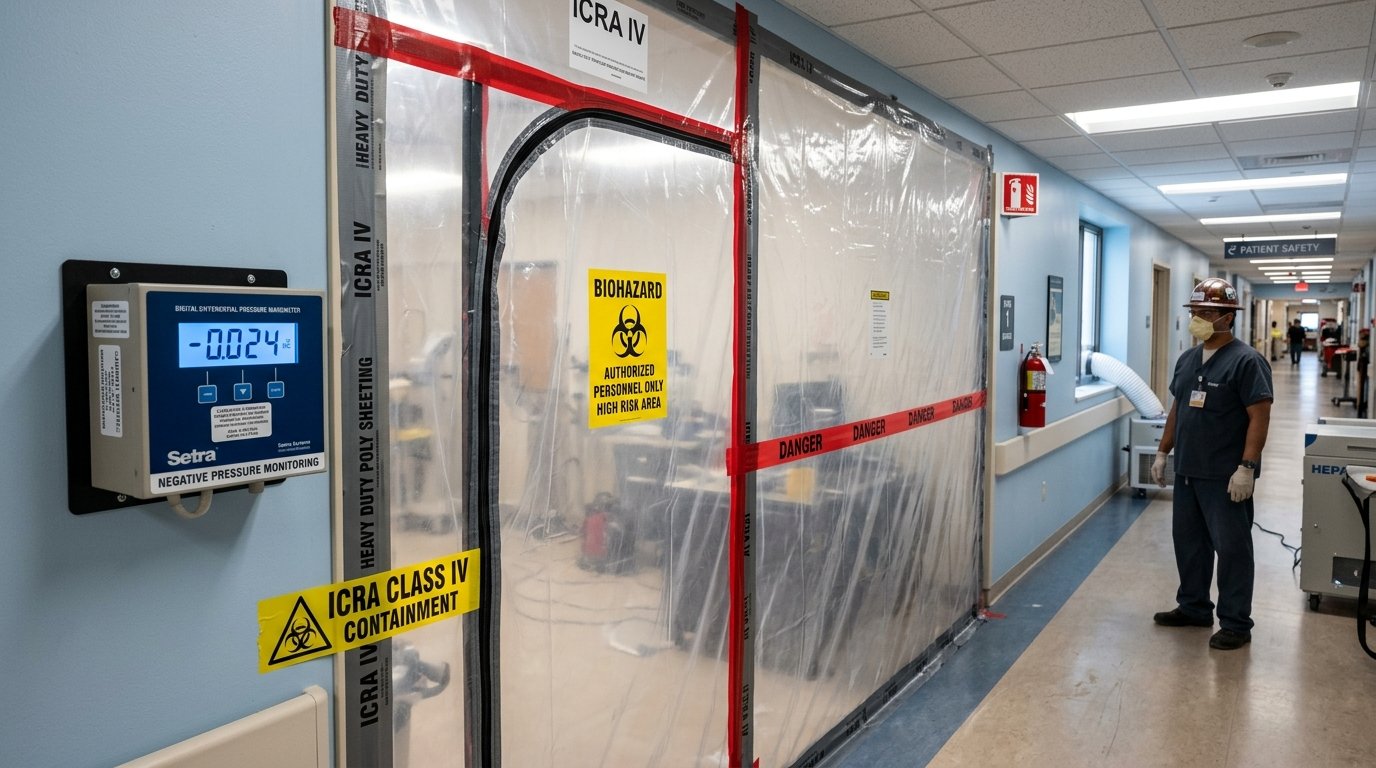
Class IV ContainmentRigid ICRA Class IV isolation anteroom equipped with digital differential pressure manometer (-0.024 in. w.g.) and DOP-certified HEPA filtration prevents fungal spores from escaping into adjacent patient care corridors.
Healthcare facility restoration introduces strict data security obligations under the Health Insurance Portability and Accountability Act (HIPAA). Contracted restoration personnel operating on active clinical floors will inevitably pass patient rooms, nurse stations, and diagnostic chart displays. Failure to enforce HIPAA compliance can result in Office for Civil Rights (OCR) financial penalties exceeding $50,000 per violation:
Strict Smartphone & Photographic Restrictions
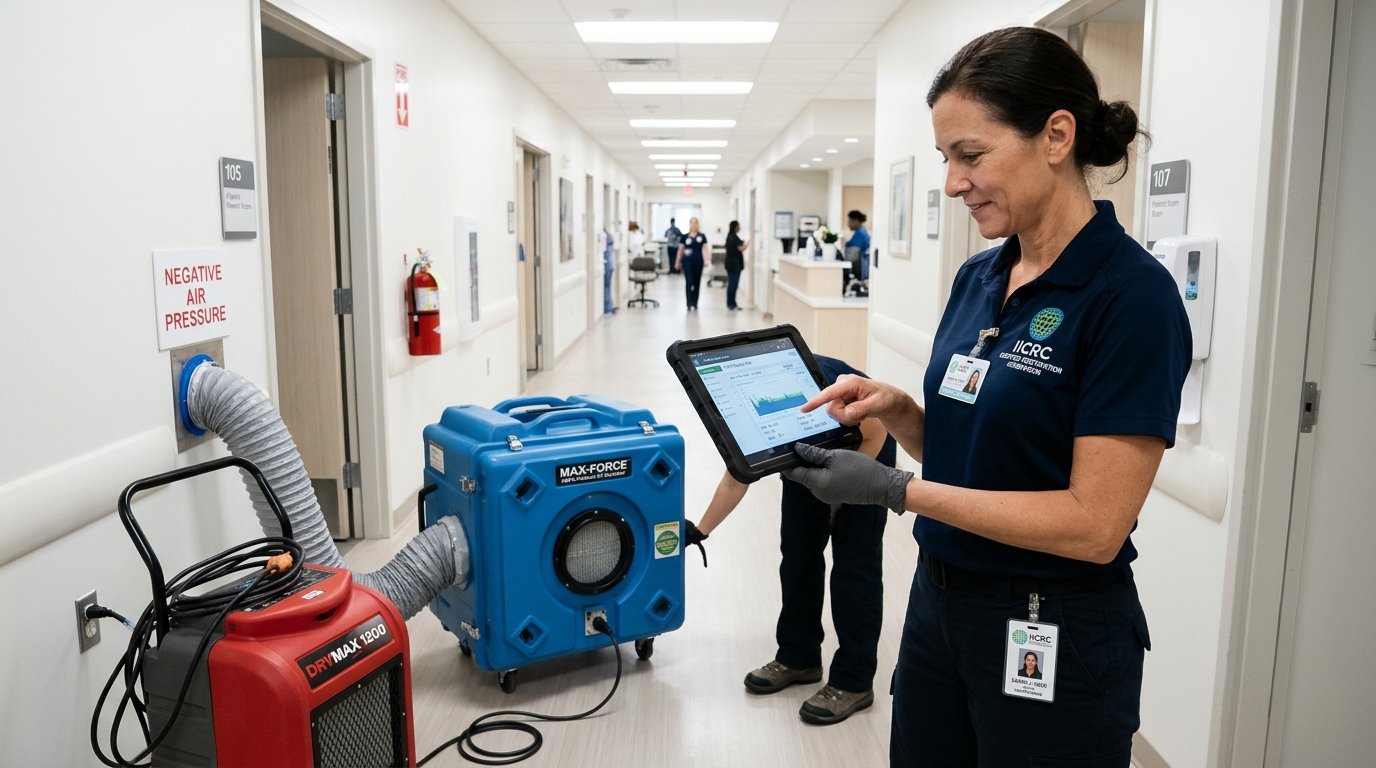
Technicians are prohibited from using personal smartphones in clinical zones. Diagnostic photos required for insurance documentation must be captured solely on encrypted company tablets with lenses aimed strictly at building components, guaranteeing zero capture of patient faces, medical wristbands, electronic health record (EHR) screens, or room numbers.
Visual & Acoustic Patient Shielding
Containment barriers erected in patient-visible corridors must utilize 100% opaque, flame-retardant materials. Restoration teams deploy sound-baffled low-noise drying machinery and conduct voice-disciplined operations to ensure confidential physician-patient consultations in neighboring rooms cannot be overheard or disturbed.
Workforce Credentialing & Background Clearances
In compliance with Arizona Department of Health Services (ADHS) and hospital vendor management systems (Symplr, Vendormate), all deployed technicians have verified criminal background clearances, 10-panel drug screenings, up-to-date immunizations (TB, Hepatitis B, MMR, annual influenza), and hospital safety orientation certificates.
Joint Commission (TJC) Environment of Care & CMS Life Safety Codes
Unplanned water intrusion jeopardizes an institution's accreditation status under The Joint Commission (TJC)and compliance with Centers for Medicare & Medicaid Services (CMS) Conditions of Participation:
Accrediting Standard
Regulatory Mandate
Water Damage Impact
Required Mitigation Documentation
TJC EC.02.06.01
Maintain an indoor environment free of biological hazards, dust, and excess moisture.
Water intrusion creates immediate risk of fungal amplification within 24 to 48 hours.
Manage risks associated with clinical utility and plumbing distribution systems.
Backflow cross-contamination; failure of clinical vacuum or RO dialysis water supply lines.
Backflow prevention certificates; water quality testing logs; plumbing repair work orders.
CMS Life Safety Code (NFPA 101)
Maintain rated smoke and fire compartment barriers in healthcare egress corridors.
Containment walls crossing corridors cannot block fire exit signage, fire pull stations, or egress doors.
Flame-retardant NFPA 701-certified containment poly; fire marshal emergency pathway approvals.
TJC IC.01.05.01
Hospital implements an infection prevention plan based on prioritized biological risks.
Failure to isolate water damage creates secondary nosocomial infection outbreaks.
Signed Infection Control Risk Assessment (ICRA) permits; HEPA DOP challenge test certificates.
Key Healthcare Environment of Care (EC) Accreditation Standards & Verification Metrics.
To understand how commercial institutional facilities manage complex property damage and multi-entity coordination, review our comprehensive operational guide on water damage restoration for property managers.
The 6-Step IICRC S500 / ICRA Healthcare Restoration Protocol
Remediating water loss in a hospital requires a surgical, contaminant-controlled procedure that blends IICRC S500 drying science with hospital infection prevention:
1Multidisciplinary ICRA Risk Permitting & Utility Isolation
Prior to setting a single piece of equipment, restoration leadership reviews the affected department with the facility director, clinical nurse manager, and infection preventionist. An ICRA permit is signed, identifying containment boundaries, equipment travel routes, and required negative pressure settings (-0.020 in. w.g.).
2Rigid Hardwall / Poly Anteroom Construction
Crews construct airtight containment using flame-retardant 6-mil polyethylene or modular reusable aluminum/polycarbonate hardwall systems. A two-stage zippered or magnetically sealed anteroom is established where technicians don and doff protective Tyvek coveralls, boot covers, and N95/P100 respirators. Tacky walk-off mats trap particulate at anteroom thresholds.
3Negative Air Pressure & In-Line DOP-Tested HEPA Filtration
Industrial air scrubbers equipped with medical-grade HEPA filters (99.97% efficiency at 0.3 microns) are positioned inside containment, ducting clean exhausted air directly outside the facility building envelope. All HEPA units receive on-site Dispersed Oil Particulate (DOP) challenge testing to verify zero filter bypass or gasket leakage. Digital manometers record differential pressure continuously, maintaining at least 12 air changes per hour (ACH).
Standing water is extracted using closed truck-mounted extraction wands directly into sealed waste holding tanks. When saturated drywall or vinyl flooring must be removed, technicians lightly mist materials with hospital-grade disinfectant and use HEPA-shrouded oscillating tools to eliminate dust generation. Waste materials are double-bagged in 6-mil poly bags, wiped clean in the anteroom, and transported in sealed rolling carts along approved service routes.
High-velocity open-air blowers are strictly prohibited on healthcare floors to prevent aerosolizing settled particulate. Instead, technicians utilize low-profile directed airflow ducted beneath equipment and high-capacity LGR or desiccant dehumidifiers operating within the negative envelope. Psychrometric drying logs (temp, RH, GPP, and moisture content) are updated every 12 hours.
6Zero-VOC Botanical Antimicrobial Washdown
Conventional antimicrobial biocides emit harsh chemical fumes that trigger respiratory distress in cardiac or pulmonary patients. We utilize EPA-registered hospital-grade disinfectants emitting zero Volatile Organic Compounds (VOCs)—such as hydrogen peroxide or pharmaceutical-grade thymol formulas. These achieve a 6-log (99.9999%) reduction of bacteria, Norovirus, and fungal spores without off-gassing chemical vapors into supply air ducts.
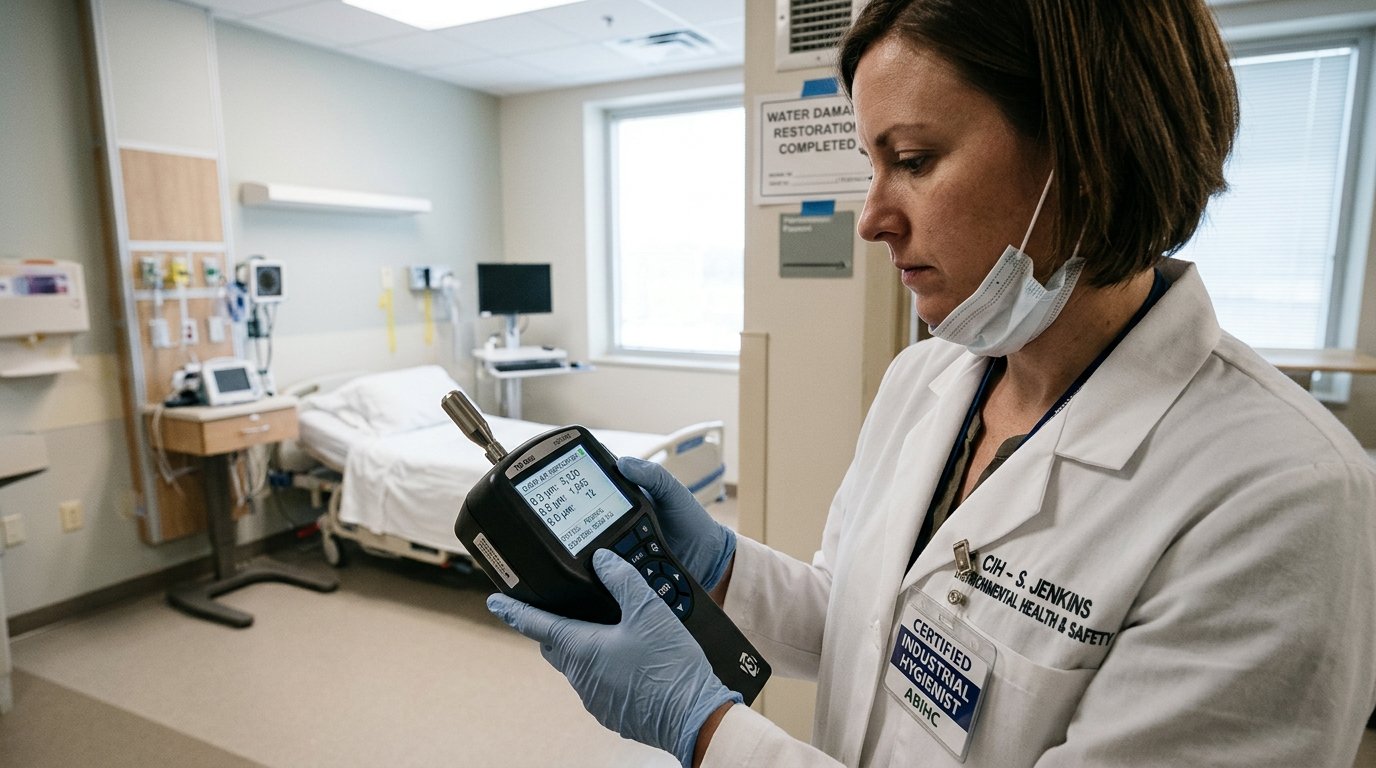
Particle ClearanceReal-time laser optical particle counting verifies that airborne particulate counts meet ISO Class 7 or Class 8 cleanroom specifications before containment walls are decommissioned.
Independent CIH Environmental Air Clearance & Room Release
In healthcare facilities, containment barriers can never be removed until an independent Certified Industrial Hygienist (CIH) completes rigorous environmental testing and delivers a passing clearance report:
Optical Laser Particle Counter Validation: Real-time laser particle counters measure airborne particulate concentrations across six optical channels (0.3 µm, 0.5 µm, 1.0 µm, 2.5 µm, 5.0 µm, and 10.0 µm). Air quality inside the remediated room must meet or exceed baseline particulate standards for clinical care zones (ISO 14644-1 Class 7 or Class 8).
Non-Viable Spore Trap Air Cassette Analysis: Air-O-Cell cassette samples (75 liters total volume) are analyzed via direct optical microscopy by an AIHA-accredited laboratory. Total indoor fungal spore concentrations must be statistically lower than outdoor reference samples, with zero presence of opportunistic indicator species (Aspergillus, Stachybotrys, Chaetomium).
Surface ATP Bioluminescence Swabbing: Stainless steel medical fixtures, vinyl wall surfaces, and floor tiles are swabbed using digital ATP luminometers. Surfaces must score below hospital medical-clean thresholds (<10 Relative Light Units).
Final Infection Control Committee Release: The comprehensive clearance dossier—including CIH laboratory reports, continuous manometer pressure logs, and psychrometric drying charts—is submitted to the hospital Infection Control Committee and Risk Management for formal sign-off and patient re-admission.
Why Arizona Hospitals Partner Under Commercial Healthcare PSAs
When an overhead 4-inch chilled water loop ruptures above an emergency department or surgical prep suite at 3:00 AM, hospital facility engineers cannot afford delays. Leading medical centers across Phoenix, Scottsdale, Mesa, and Tucson maintain an active Healthcare Priority Service Agreement (PSA) with AZ Water Damage Restoration.
A healthcare PSA delivers:
Guaranteed 45-Minute Emergency Mobilization: 24/7/365 priority dispatch with pre-staged ICRA hardwall and negative-air equipment.
Pre-Credentialed Clinical Workforce: Pre-registered vendor credentials, background checks, and annual immunizations on file.
Dedicated Large-Loss Incident Command: Experienced restoration supervisors fluent in hospital incident command systems (HICS) and Joint Commission Environment of Care compliance.
Related Technical Guides
Educational resources for Phoenix & Arizona property owners
Our rapid response units maintain staged equipment yards across Central Phoenix, the East Valley, the West Valley, Pinal County, and Greater Tucson for an average ~42-minute on-site arrival:
What is an ICRA (Infection Control Risk Assessment) and why is it mandatory for healthcare water damage?
An Infection Control Risk Assessment (ICRA) is a clinical engineering framework developed by the American Society for Health Care Engineering (ASHE) and the CDC to prevent healthcare-associated infections (HAIs). In healthcare water damage emergencies, an ICRA is legally required before any physical mitigation or drying begins. It matches the facility's Patient Risk Group (Low, Medium, High, or Highest Risk like Oncology and NICU) against the physical work Type to mandate exact containment levels—typically requiring ICRA Class III or Class IV controls, negative-pressure anterooms, continuous digital manometer monitoring, and certified DOP-tested HEPA filtration.
Which patient populations face the highest mortality risk from fungal spores after water damage?
Severely immunocompromised patients—including those in Bone Marrow Transplant (BMT) units, hematology-oncology wards, neonatal intensive care units (NICU), solid organ transplant recovery, and burn trauma intensive care—face extreme mortality risks. In these patients, inhalation of even low concentrations of opportunistic fungal spores (Aspergillus fumigatus, Fusarium, Rhizopus) can cause Invasive Aspergillosis or fungal pneumonia, which carries a clinical mortality rate exceeding 50% to 80%.
How are HIPAA patient privacy regulations enforced during emergency restoration?
Under HIPAA Privacy and Security Rules (45 CFR Part 160 and Part 164), restoration contractors working in clinical zones are classified as Business Associates or workforce extensions. Compliance mandates: (1) Absolute prohibition of non-diagnostic smartphone camera usage in clinical zones; (2) Opaque, visual floor-to-ceiling privacy containment walls shielding treatment areas from view; (3) Acoustic dampening to prevent disclosure of protected health conversations; and (4) Signed HIPAA Business Associate Agreements (BAAs) and workforce training verification.
What Joint Commission (TJC) Environment of Care standards govern hospital water intrusion?
The Joint Commission mandates strict compliance under the Environment of Care (EC) and Emergency Management (EM) chapters. Key standards include EC.02.06.01 (maintaining a physical environment free of biological hazards and dampness), EC.02.05.01 (managing clinical utility risks and preventing sewage cross-contamination), and EC.02.01.01 (implementing written Infection Control Risk Assessments). Failure to document immediate mitigation, negative air pressure logs, and industrial hygiene clearance results in immediate accreditation survey deficiencies or Condition-level findings.
How are air pressure differentials monitored during clinical drying projects?
Restoration crews install continuous digital differential pressure manometers (e.g., Setra or Omniguard systems) equipped with data-logging micro-sensors. Containment zones must maintain a constant negative pressure of at least -0.010 to -0.025 inches of water gauge (-2.5 to -6.2 Pascals) relative to adjacent occupied patient corridors. Units feature local audible alarms and cellular telemetry that alerts facility directors and project managers immediately if containment pressure breaches.
How fast can an ICRA-certified commercial crew mobilize to an Arizona healthcare facility?
AZ Water Damage Restoration operates a dedicated commercial rapid-response dispatch fleet averaging 42 minutes across the Phoenix metro area, 24/7/365. Vehicles carry pre-staged ICRA hardwall barrier systems, DOP-tested negative air machines, digital manometers, and hospital-grade EPA List N antimicrobials for immediate deployment in Banner Health, HonorHealth, Dignity Health, and independent surgery centers.
IICRC-certified restoration technicians · Phoenix metro
Written and fact-checked by the licensed crew that runs the trucks — the same technicians who take moisture readings, set drying chambers to the IICRC S500 standard, and answer the phone at 2 a.m. across the Phoenix metro.
Licensed Arizona contractor — AZ ROC #331127 (KB-2)