A water heater holds 40 to 80 gallons of scalding, pressurized water under 60–90 PSI. When a tank fails in a Phoenix garage, utility closet, or attic, it can dump hundreds of gallons across your home within hours. Learn the warning signs of impending tank failure, emergency shut-off protocols, and structural dry-out steps.
Last updated:Reading time:14 minStandards:IICRC S500 Verified
Water Heater Flood Mitigation: Emergency Power Isolation & Structural Drying · Phoenix Metro
Table of contents▾
If your water heater is actively leaking, immediately shut off its power supply (circuit breaker or gas valve) and turn off the cold water inlet valve on top of the tank to stop incoming pressure. In Arizona, extreme water hardness (15–25+ GPG) causes rapid mineral sediment accumulation that corrodes internal steel tanks in just 6 to 10 years. While small valve or supply line leaks can be repaired, water leaking from the tank base indicates catastrophic internal rust-through that requires full tank replacement and immediate IICRC structural moisture extraction before drywall wicks water into adjacent living areas.
6 Warning Signs Your Water Heater Is About to Fail
Water heaters rarely fail without giving subtle warning signs weeks or months in advance. Inspecting your unit for these 6 indicators can prevent catastrophic indoor flooding:
1Popping, Rumbling, or Kettle Sounds
A loud popping or deep rumbling noise when heating. In Phoenix, calcium and lime build up into a dense 2- to 4-inch layer of hard sediment at the tank bottom. Water trapped beneath this mineral crust superheats and boils violently, creating steam pockets that pound against the steel shell.
2Rusty or Metallic-Smelling Hot Water
If hot water runs reddish-brown or smells metallic while cold water runs crystal clear, the internal sacrificial anode rod has completely dissolved and water is actively oxidizing the tank's steel cylinder. Rust-through failure is imminent.
3Moisture or Mineral Crusting Around the Base
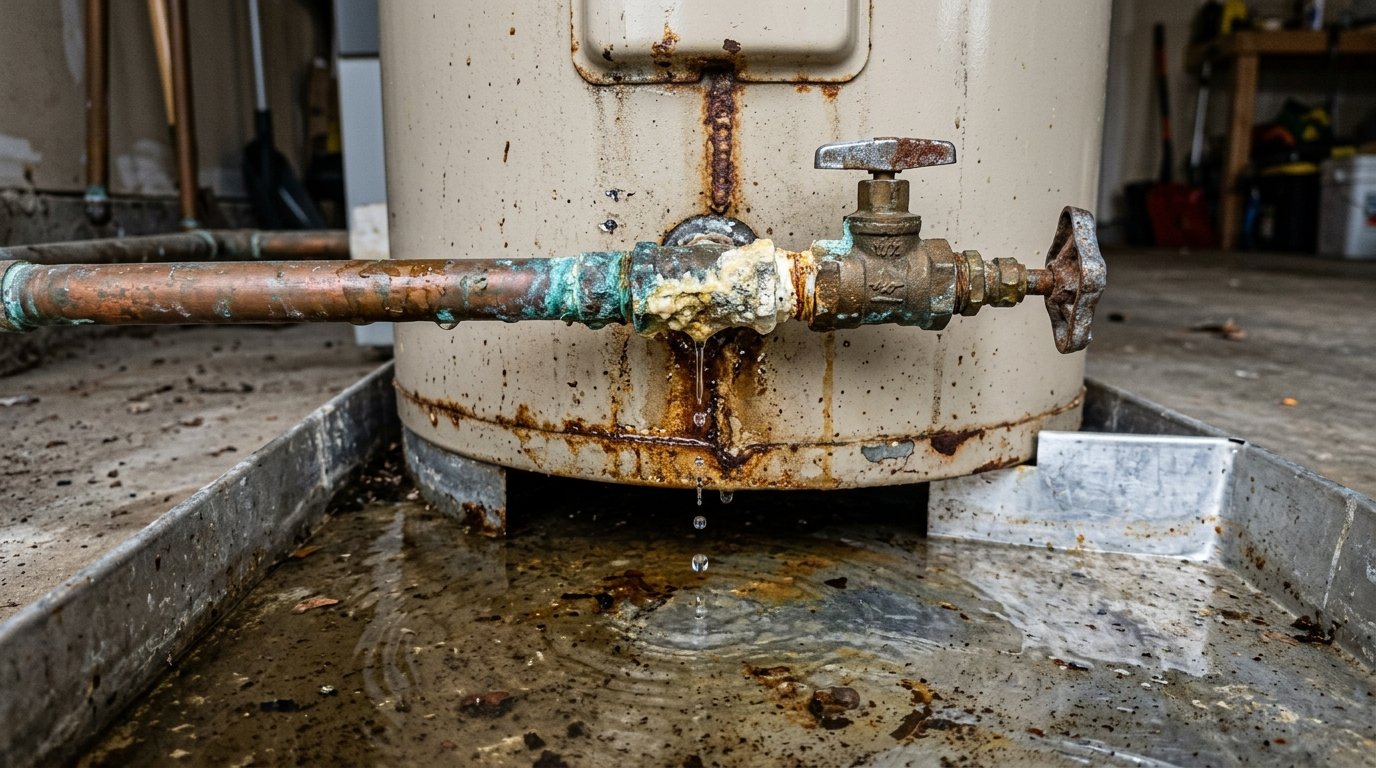
Standing puddles, dampness in the metal drain pan, or white crusty calcium efflorescence around the base of the tank jacket. Microscopic pinhole leaks expand rapidly once thermal expansion cycles flex the steel.
4Weeping Temperature & Pressure (T&P) Valve
Water dripping steadily from the copper or CPVC discharge pipe connected to the T&P safety valve. This signals dangerous excessive internal pressure (often >150 PSI) or extreme overheating (>210°F), or a mineral-clogged valve seat.
5Corrosion on Top Water Connectors
Green verdigris or white flaky corrosion where flexible stainless or copper lines connect to the tank nipples. Galvanic reaction between dissimilar metals degrades the rubber internal gaskets, creating spray leaks that drip down the tank jacket.
6Tank Age Exceeding 8 to 10 Years
Check the manufacturer serial number tag. If your water heater was installed over 8 years ago in the Phoenix metro area, the tank is living on borrowed time. Proactive replacement prevents an emergency flood.
Diagnosing the Leak Source: Repairable vs. Unfixable
Before assuming you need an entire new water heater, identify precisely where the water is originating:
Leak Location
Common Underlying Cause
Severity & Hazard Level
Required Action
Tank Base / Underneath Jacket
Internal steel tank rust-through due to hard water sediment
Critical (Risk of sudden catastrophic rupture)
Unfixable: Complete water heater replacement required
T&P Safety Relief Valve
Thermal expansion, pressure spike (>150 PSI), or failed valve
High (Scalding water discharge risk)
Repairable: Replace T&P valve and install thermal expansion tank
Top Cold/Hot Flex Lines
Degraded dielectric union, dried rubber washer, or loose nut
Cracked plastic gate valve or sediment lodged in gasket
Moderate (Slow continuous drip into pan)
Repairable: Replace with full-port brass ball drain valve
Thermal Expansion Tank (Above)
Internal butyl diaphragm ruptured and filled with water
Moderate (Causes water hammer and T&P weeping)
Repairable: Replace expansion tank and recharge to match street PSI
Diagnostic Matrix: Identifying Water Heater Leak Points, Severity, and Repairability
Plumbing Diagnostics / Failure AnatomyDiagnostic Anatomy: Water heater leak origins. Top fittings and T&P valves are usually repairable, while bottom tank rust-through requires complete replacement.
The Arizona Hard Water Factor: Why Valley Tanks Fail Faster
Municipal tap water in Phoenix, Scottsdale, Mesa, Chandler, and Gilbert contains 15 to 25+ grains per gallon (GPG) of dissolved calcium carbonate and magnesium. Understanding the chemistry explains why tank maintenance is so vital:
Sediment Blanket Effect: Every time water heats up, minerals precipitate out of solution and settle to the bottom. In gas water heaters, this 30- to 50-lb blanket acts as an insulating barrier between the burner flame and the water, superheating the steel floor to over 400°F and deteriorating the internal protective glass enamel.
Sacrificial Anode Rod Depletion: Water heaters contain a magnesium or aluminum rod designed to corrode first to protect the steel tank. Arizona's mineral-heavy water consumes this anode rod in just 3 to 4 years. Once the rod is gone, the steel tank begins rusting internally.
High Water Pressure Spikes: Water pressure in newer East Valley and West Valley subdivisions frequently exceeds 80 to 110 PSI. Without a working Pressure Reducing Valve (PRV) and thermal expansion tank, pressure spikes continuously stress tank welds.
What to Do Right Now: 5-Step Emergency Triage Sequence
If you discover water actively leaking or pooling around your water heater, execute this exact emergency containment protocol:
Step 1: Shut Off Power or Gas (Safety First)
For Electric Heaters: Go to your main breaker panel with dry hands and flip the dedicated double-pole 240V breaker (labeled "Water Heater") to OFF. For Gas Heaters: Rotate the thermostat control dial near the bottom of the tank to "OFF" or "PILOT" to prevent the burner from firing dry.
2
Step 2: Shut Off the Cold Water Supply Valve
Look at the top of the water heater for the cold water pipe (usually on the right). Turn the ball valve handle 90 degrees perpendicular to the pipe, or turn the gate valve wheel clockwise until completely tight. If the valve is stuck or leaking, shut off the home's main water meter valve.
3
Step 3: Relieve Pressure and Drain the Tank
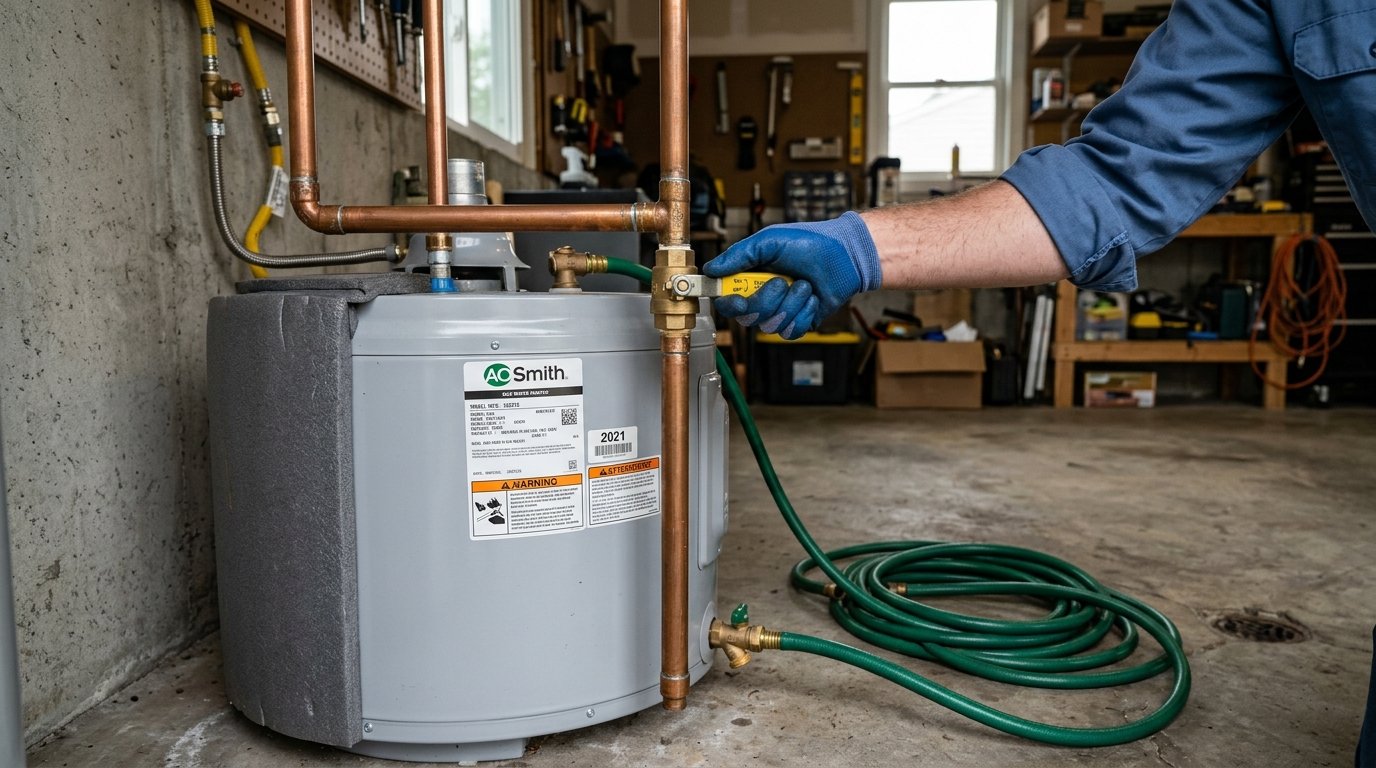
Attach a standard garden hose to the drain valve at the bottom of the tank. Run the opposite end to a floor drain, driveway, or exterior dirt area. Open a hot water faucet inside the house to break vacuum suction, then open the tank drain valve to safely drain the hot water reservoir.
4
Step 4: Protect Garage & Adjoining Living Spaces
Extract standing water with a wet/dry shop-vac. Remove cardboard boxes, stored valuables, and rugs. In Arizona garage installations, water quickly wicks beneath drywall partition walls into adjoining hallways, kitchens, or bedrooms.
5
Step 5: Call 24/7 Professional Structural Drying
Call our 24/7 emergency water restoration team for infrared moisture mapping, wall cavity drying, and industrial LGR dehumidification to prevent toxic mold colonization behind walls and subflooring.
Emergency Containment / Step-by-Step TriageEmergency Containment Sequence: 4-step safety sequence to isolate 240V power, stop incoming street water pressure, and drain the tank reservoir safely.
The Danger of Hidden Structural Water Damage
Even if your water heater is located in a garage, a tank failure rarely stays contained to concrete:
Capillary Wicking into Living Areas: Drywall acts like a wick. Water standing on a garage slab wicks 12 to 24 inches up interior wall drywall, rotting sill plates and framing studs behind finished baseboards.
Floating Floor Ruin: Water travels invisibly under door thresholds and seeps beneath laminate and luxury vinyl plank flooring in adjacent hallways, trapping moisture against the slab.
The 48-Hour Mold Clock: Saturated garage drywall and wet insulation provide ideal breeding conditions for mold spores, creating airborne mycotoxins that enter your HVAC return ducts.
24/7 Valley-Wide Emergency Response for Water Heater Floods
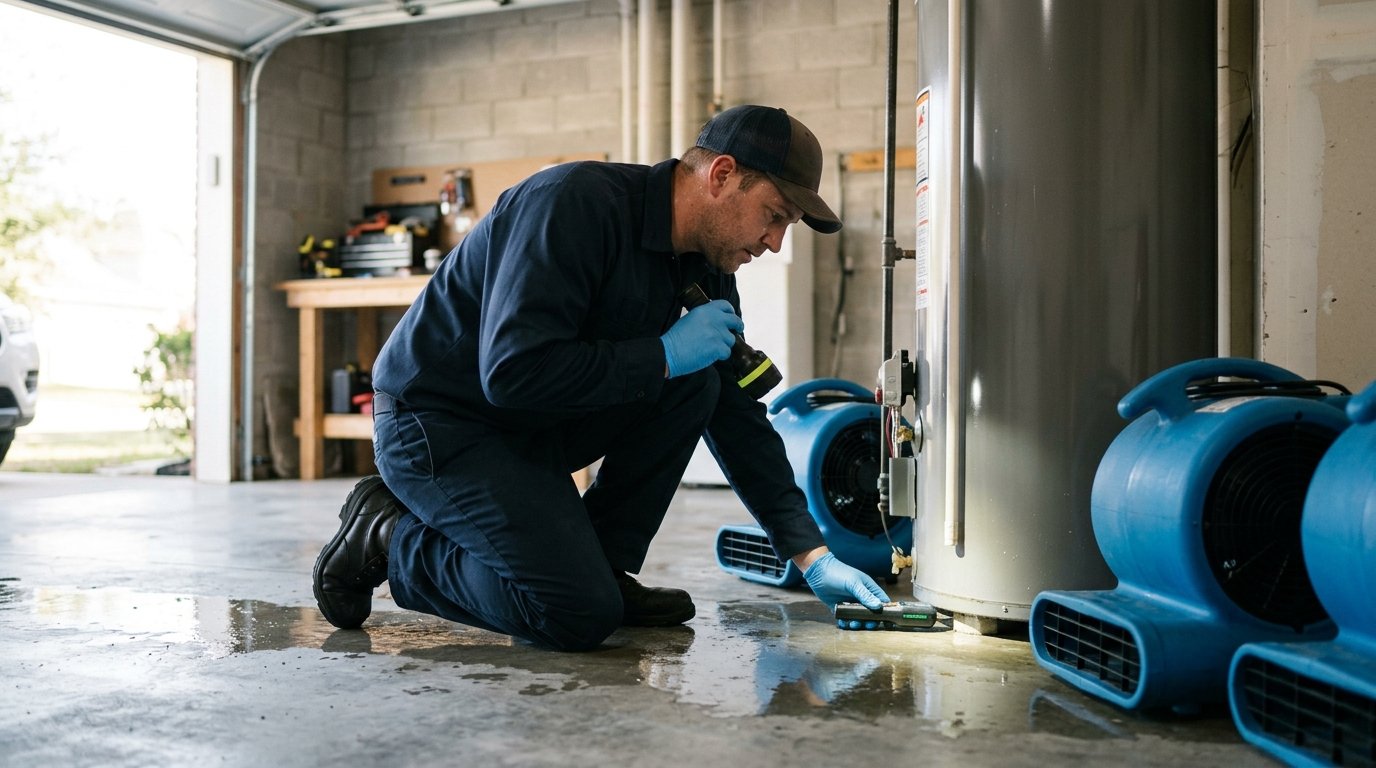
When a water heater bursts at 2:00 AM, immediate action prevents structural mold and ruined flooring. Our IICRC-certified crews arrive within 30 to 45 minutes across the entire Valley:
What should I do first if my water heater is actively leaking?
Immediately take three actions in this exact order: (1) Cut the power source — turn off the double-pole 240V breaker for an electric heater or switch the gas valve knob to 'OFF' / 'PILOT'; (2) Shut off the water supply by turning the cold water inlet valve on top of the tank clockwise (or turn off the home's main water meter if the valve is stuck); (3) Attach a garden hose to the bottom drain valve and run it to a driveway or exterior drain to safely empty the 40–80 gallons of scalding water.
Why do water heaters fail and leak faster in Arizona than other states?
Arizona tap water is among the hardest in the nation, averaging 15 to 25+ grains per gallon (GPG) of dissolved calcium and magnesium. These minerals precipitate into a dense layer of calcified sediment at the bottom of the tank. The sediment traps intense heat against the steel base, deteriorating the glass lining and exhausting the sacrificial anode rod in just 3 to 5 years. Once the anode rod is depleted, galvanic corrosion attacks the steel tank directly, causing rust-through failures within 6 to 10 years.
Can a leaking water heater be repaired, or does it have to be replaced?
It depends on where the leak originates. External component leaks — such as loose flexible supply lines, a faulty Temperature & Pressure (T&P) relief valve, or a cracked plastic drain valve — can easily be repaired by a plumber for $150 to $450. However, if water is leaking from the internal steel tank itself (pooling around the base or leaking through outer jacket seams), the tank has rusted through and cannot be patched; complete unit replacement is mandatory.
What are the warning signs of a water heater about to burst?
Key warning signs include: (1) Popping, rumbling, or knocking noises (steam bubbles violently percolating under bottom sediment); (2) Rusty or metallic-tasting hot water (internal tank corrosion); (3) Moisture, dampness, or mineral crusting in the drain pan; (4) Persistent dripping from the T&P relief discharge pipe; (5) Water taking significantly longer to heat up; and (6) The water heater is more than 8 to 10 years old.
Does homeowners insurance cover water heater leaks and the resulting damage?
Yes, standard homeowner insurance policies cover the 'resulting water damage' caused by sudden and accidental water heater ruptures — including emergency water extraction, drywall excision, structural drying, and flooring replacement. However, policies typically do not pay for the replacement water heater unit itself, which is considered standard appliance maintenance.
What is the danger of an attic-mounted water heater leak in Phoenix?
In many two-story and split-level Phoenix homes, water heaters are installed in attic spaces. When an attic tank ruptures, 50 to 75 gallons of pressurized water soak through attic insulation, collapse ceiling drywall across multiple rooms, ruin upstairs carpeting, and run down interior wall cavities into first-floor living spaces within minutes, creating tens of thousands in structural damage.
How much does it cost to clean up water damage from a failed water heater in Arizona?
Emergency water extraction, baseboard removal, and structural dehumidification typically cost between $1,200 and $3,800 for a contained garage or utility closet loss. If the leak breached finished living areas, hardwood floors, or attic ceilings, full structural mitigation and reconstruction averages $3,500 to $9,500+.
How fast does mold grow after a water heater floods a home?
In Arizona's warm climate, mold spores germinate on wet drywall paper backing, baseboard MDF, and carpet padding in as little as 24 to 48 hours. Immediate industrial extraction and LGR dehumidification are required to stop microbial amplification.
IICRC-certified restoration technicians · Phoenix metro
Written and fact-checked by the licensed crew that runs the trucks — the same technicians who take moisture readings, set drying chambers to the IICRC S500 standard, and answer the phone at 2 a.m. across the Phoenix metro.
Licensed Arizona contractor — AZ ROC #331127 (KB-2)