You step on your floating floor and hear a squishing sound, or notice swollen ridges along plank seams. Learn the critical differences between laminate and luxury vinyl plank (LVP), why 'waterproof' vinyl creates a dangerous hidden mold trap on concrete slabs, and when planks can be saved.
Last updated:Reading time:13 minStandards:IICRC S500 Verified
Subfloor Moisture Diagnostics: Detecting Trapped Water Beneath Floating Vinyl and Laminate · Phoenix Metro
Table of contents▾
When water seeps beneath floating laminate or vinyl flooring, the restoration approach depends entirely on the core material: laminate must almost always be replaced, while luxury vinyl plank (LVP) can often be salvaged if unclicked within 24 to 48 hours. Laminate features a wood fiber (HDF) core that swells permanently when wet. In contrast, vinyl planks are waterproof and do not swell — but they act as an airtight vapor barrier, trapping water against the concrete slab and underlayment foam. If not lifted immediately, this trapped moisture creates widespread toxic black mold across the foundation within 48 hours.
6 Clear Signs of Water Trapped Under Laminate or Vinyl Floors
Because floating floors sit on top of foam underlayment pads with no nails or glue, water can travel 20 to 30 feet beneath the surface before showing obvious damage. Watch for these 6 critical warning signs:
1Squishing or Squelching Sounds
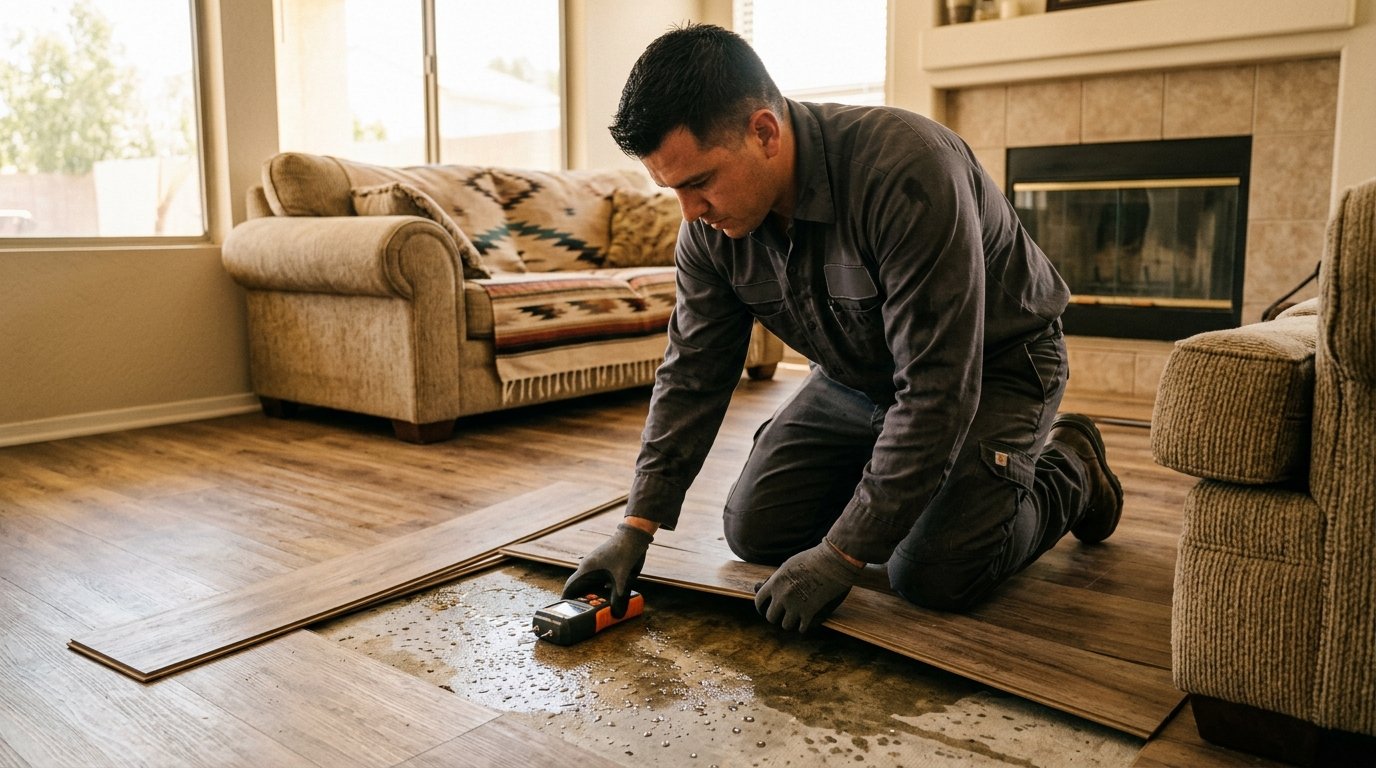
Stepping on planks produces a noticeable spongy, wet squish. The sound is caused by water and air compressing inside the saturated foam underlayment pad beneath your feet.
2Moisture Seeping Through Click-Lock Seams
Water droplets or bubbly froth oozing up between joint seams when pressure is applied. This confirms hydrostatic pressure is forcing trapped water upward through the locking tabs.
3"Peaking" or Swollen Raised Seams (Laminate)
The edges of laminate boards push upward against each other into sharp, raised ridges (peaking). This occurs when water penetrates the unprotected joints and causes the fiberboard core to expand.
4Hollow, Bouncing, or Loose Planks
Floating floors require a stable, dry subfloor. When water breaks down adhesives or causes the foam underlayment to degrade and disintegrate, planks feel springy, loose, or disconnected.
5Musty, Earthy Odors Around Baseboards
A persistent locker-room or damp earth odor emanating from the perimeter of the room, especially near AC vents or under kitchen cabinets. This is the off-gassing of active mold spores beneath the flooring.
6Baseboard Warping & Drywall Discoloration
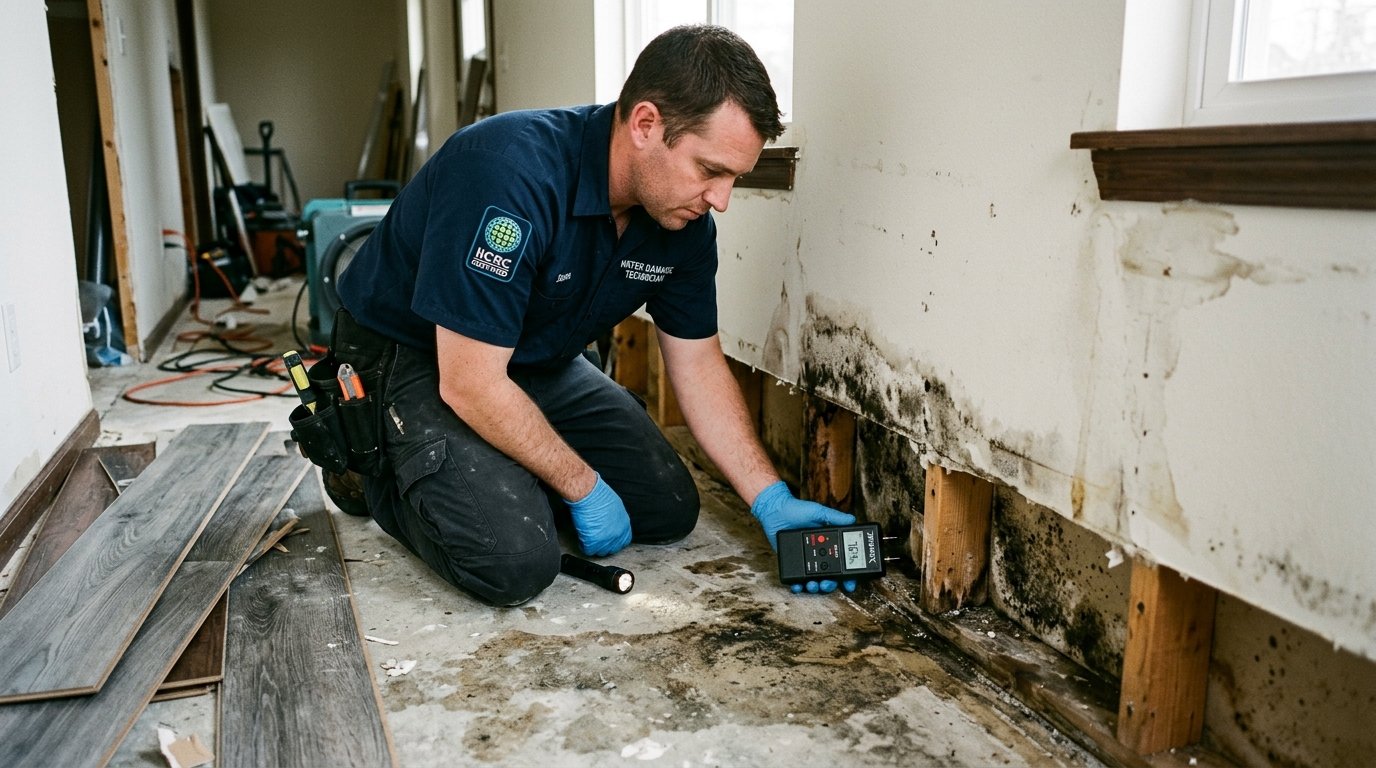
Trapped water naturally wicks upward via capillary action into porous MDF baseboards and wall drywall, causing yellow staining, peeling paint, and visible black mold colonization along the floor line.
Laminate vs. Luxury Vinyl Plank (LVP): Technical Comparison
Understanding what material is installed in your home is essential for determining salvageability, restoration timelines, and insurance replacement scopes:
Feature / Characteristic
Laminate Flooring (HDF Core)
Luxury Vinyl Plank (LVP / SPC / WPC)
Core Material Composition
Compressed Wood Fibers & Resin (HDF/MDF)
Stone Plastic Composite (SPC) or Polyvinyl Chloride
Inherent Material Waterproofing
Water-Resistant Top Wear Layer Only; Core Is Porous
100% Completely Waterproof Through Entire Plank
Reaction to Trapped Subfloor Water
Core absorbs water, swells by 20%–50%, delaminates
Plank does not swell; traps water underneath against slab
Salvage / Drying Potential
Near 0% (Swelling is permanent; must be replaced)
70%–85% Salvageable if unclicked within 24–48 hours
Mold Risk to Subfloor
High (Fiberboard provides organic food source for mold)
Extremely High (Planks create an airtight incubator on slab)
Underlayment Foam Pad Reaction
Must be removed and discarded immediately
Must be removed and replaced with new antimicrobial pad
Average Replacement Cost (Phoenix)
$4.50 – $9.00 per sq. ft. installed
$5.50 – $12.00 per sq. ft. installed
Technical Matrix: Laminate vs. Luxury Vinyl Plank Behavior During Subfloor Water Damage
The Danger of "Waterproof" Vinyl: The Hidden Mold Incubator
Many Phoenix homeowners assume that because their luxury vinyl plank flooring is advertised as "100% waterproof," they can simply wipe up surface puddles with towels and ignore the rest. This is a dangerous misconception.
While water will not damage the synthetic vinyl plank, water that gets under the perimeter expansion gaps or seeps through click-lock seams becomes trapped in the 2mm to 4mm foam underlayment pad between the vinyl and the concrete foundation:
No Evaporation Path: Unlike wood floors that allow some vapor to pass through natural pores, vinyl is a complete vapor barrier. Trapped water cannot escape.
The Perfect Petri Dish: In Arizona homes with indoor temperatures between 72°F and 78°F, the dark, stagnant, high-humidity pocket beneath vinyl planks creates ideal conditions for mold spores to germinate in as little as 24 to 48 hours.
Slab Moisture Migration: Concrete is porous. Trapped moisture soaks deep into the slab and travels laterally under walls into neighboring bedrooms, ruining carpet and breeding mold behind baseboards.
Can Vinyl Plank (LVP) Be Salvaged? The Unclicking & Numbering Technique
If water is clean (Category 1) and addressed immediately, homeowners can save thousands of dollars by salvaging their existing vinyl planks using our certified non-destructive process:
1. Non-Destructive Unclicking Along the Perimeter
Technicians remove baseboards and use specialized pulling tools to carefully unclick the planks without snapping the delicate tongue-and-groove locking profiles.
2. Numbering & Organization with Painter's Tape
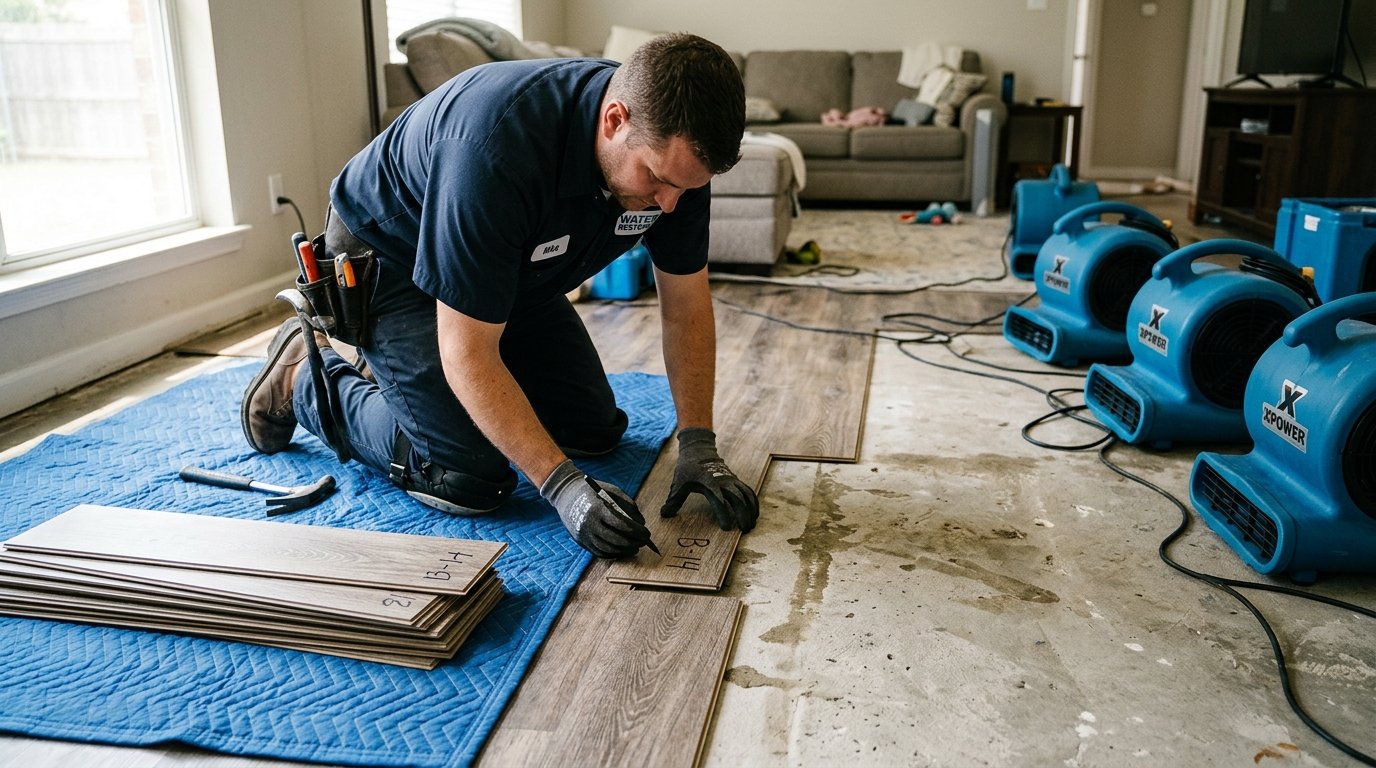
Each board is labeled with blue painter's tape by row and column number. Custom-cut perimeter planks around door jambs, kitchen islands, and corners are kept in exact reinstallation order.
3. Sanitization & Air Drying
Planks are wiped down on both sides with EPA-registered botanical antimicrobials (Benefect Decon 30) and racked in an airy staging area to dry completely.
The wet foam underlayment pad is discarded. Industrial LGR dehumidifiers and high-speed air movers dry the concrete slab to below 12% Wood Moisture Equivalent (WME) equilibrium before any reinstallation begins.
5. Reinstallation with New Vapor Barrier Underlayment
Once the concrete slab passes certified dry clearance testing, fresh antimicrobial underlayment is laid down and the numbered planks are locked back into place — saving 60% to 75% compared to new floor replacement.
Material Science / Salvage MatrixSalvage Engineering: Swollen laminate fiberboard core requires full replacement, while non-destructively unclicked LVP can be numbered, disinfected, and re-laid.
5-Step Emergency Action Plan for Homeowners
If water has just breached your laminate or vinyl flooring from an appliance leak or plumbing burst, take these immediate containment steps:
Extract Surface Water & Remove Floor Coverings: Vacuum puddles with a wet-vac and remove area rugs, runners, and dog beds that trap water against the floor.
Remove Perimeter Baseboards: Carefully pry off baseboards along wet walls using a putty knife and pry bar. This vents trapped moisture and prevents capillary wicking into wall studs.
Do Not Apply Direct High Heat: Never point space heaters or heat guns at vinyl planks. Heat distorts the PVC core, causing permanent warping and curling that ruins the floor.
Call 24/7 Professional Restoration: Dispatch an IICRC-certified team within 24 hours for thermal moisture mapping and slab drying before mold spores colonize.
24/7 Valley-Wide Emergency Response for Flooring Water Damage
Whether your flooring damage is caused by a broken dishwasher line, an overflowing toilet, or a hidden pressurized slab leak, our certified restoration specialists are staged across the Valley for rapid 30- to 45-minute arrival:
If luxury vinyl plank (LVP) is waterproof, why does water underneath still cause damage?
While the vinyl plank itself is 100% waterproof and won't rot, the water trapped underneath has nowhere to evaporate. The impermeable vinyl forms a vapor barrier over the wet underlayment pad and concrete slab. In Arizona's warm climate, this dark, airtight environment becomes an active incubator for toxic black mold (Stachybotrys and Aspergillus) within 24 to 48 hours, while moisture wicks upward into adjacent baseboards and drywall.
Can water-damaged laminate flooring be dried and saved?
Generally no. Laminate flooring features a high-density fiberboard (HDF) or medium-density fiberboard (MDF) core made of compressed wood fibers. Once water penetrates click-lock joints or underlayment, the core absorbs moisture like a sponge, expanding permanently by 20% to 50% ('peaking' at the seams). Even after full dehydration, swollen laminate fibers do not return to their original shape and must be replaced.
Can Luxury Vinyl Plank (LVP) be unclicked, dried, and reinstalled?
Yes, under specific conditions: (1) The water must be clean (Category 1, such as a supply line, dishwasher, or water heater leak); (2) Action must be taken before microbial mold colonizes the backing (within 24–48 hours); (3) Planks must be carefully unclicked without snapping the delicate tongue-and-groove locking tabs, numbered on blue tape, sanitized with EPA-registered antimicrobial, and dried while the underlying concrete slab is brought to equilibrium.
What does it mean when water squishes or bubbles up through vinyl plank seams?
A squishing sound or water oozing through click-lock seams when walked upon indicates that standing water has completely saturated the foam underlayment pad beneath the floating floor. Stepping on the planks creates hydrostatic pressure, forcing liquid through the microscopic seams. The floor must be lifted immediately to prevent concrete foundation saturation and widespread drywall mold.
How do you dry out a concrete slab under laminate or vinyl flooring in Phoenix?
Because floating floors seal moisture inside, technicians must remove baseboards, lift the flooring and discard saturated underlayment foam. Commercial Low-Grain Refrigerant (LGR) dehumidifiers and high-velocity centrifugal air movers are positioned across the bare concrete slab. Moisture levels are tracked using calcium chloride or in-situ relative humidity probes until the slab reaches certified regional dry standards.
Does homeowners insurance cover water damage under laminate and vinyl flooring?
Yes, standard homeowner insurance policies cover sudden and accidental water discharges (such as a burst supply line, leaking ice maker hose, or water heater rupture). They generally exclude slow, chronic leaks or neglected foundation seepage. We provide comprehensive thermal imaging moisture mapping and psychrometric reports to substantiate your claim with your insurance adjuster.
How much does it cost to remove, dry, and repair water damage under floating floors?
Professional extraction, floor removal, antimicrobial sanitization, and concrete slab structural drying typically ranges from $1,500 to $4,200. If luxury vinyl planks are successfully salvaged and reinstalled with new underlayment, total repair costs are 50% to 70% lower than full demolition and new floor replacement ($5,000 to $14,000+).
What causes water to get under floating floors in Arizona homes?
The most common culprits in the Phoenix metro are pressurized slab leaks (hot/cold copper lines routed through the concrete foundation), refrigerator ice maker and dishwasher supply line ruptures, toilet wax ring failures, and attic AC condensate drain line overflows that run down interior wall cavities into the flooring channel.
About the author
AZ Water Damage Restoration Team
IICRC-certified restoration technicians · Phoenix metro
Written and fact-checked by the licensed crew that runs the trucks — the same technicians who take moisture readings, set drying chambers to the IICRC S500 standard, and answer the phone at 2 a.m. across the Phoenix metro.
Licensed Arizona contractor — AZ ROC #331127 (KB-2)