In a Class-A commercial office tower or multi-tenant corporate park, water damage is measured by the hour in lost worker productivity, lease dispute liabilities, and business interruption claims. Here is the property manager's engineering playbook for zero-downtime drying and multi-floor mitigation.
Last updated:Reading time:17 minStandards:IICRC S500 Verified
When water intrudes into a commercial office building, the economic stakes escalate exponentially: employee downtime costs corporate tenants between $15,000 and $75,000 per floor per day, while water cascading down vertical electrical busways threatens mission-critical server infrastructure. Successful restoration requires three disciplined mandates: immediate vertical stack isolation across multi-floor tenant boundaries, 2nd-shift evening extraction and low-decibel daytime drying (<55 dBA) to ensure tenants remain operational, and clear forensic loss allocation between landlord master policies and tenant leasehold improvements (TI).
Vertical Stack Migration: How Water Traverses Multi-Story Buildings
In single-story structures, water flows laterally across a slab. In multi-story commercial office buildings, gravity turns a localized pipe failure on an upper floor into a complex three-dimensional disaster.
When an executive breakroom water filtration line, ice maker supply tube, or bathroom flushometer ruptures on the 6th floor, the water seeks the path of least resistance through building utility penetrations:
Vertical Pathway
Physical Mechanism of Migration
Damage Vulnerability & Risk
Immediate Mitigation Action
Electrical & Data Busways
Water tracks down metal conduit risers, cable trays, and electrical junction boxes.
Short-circuits, tripped main breakers, arc-flash fires, and loss of building server power.
Server Rooms & Mission-Critical Data Center Triage
An office building's most vulnerable asset is its central server room, MDF (Main Distribution Frame), or intermediate distribution closet (IDF). A single drop of water landing on an enterprise rack-mounted server or SAN storage array can destroy years of business records:
Raised Access Floor Plenum Drying
Modern server rooms feature raised access flooring with a 12- to 18-inch plenum beneath. When water pools on the concrete sub-slab, high-voltage electrical feeds and low-voltage Cat6 cables are submerged. Technicians carefully remove perforated floor tiles, vacuum standing water, and direct dehumidified desiccant airflow under the floor without disturbing cable trays.
Anti-Static (ESD) Desiccant Dehumidification
Standard residential drying fans generate static electricity and kick up dust particulate that clogs server intake fans. In data environments, we deploy specialized trailer-mounted desiccant systems with HEPA-scrubbed, static-dissipative canvas ducting, pulling relative humidity strictly between 35% and 45% RH to eliminate moisture without triggering electrostatic discharge (ESD).
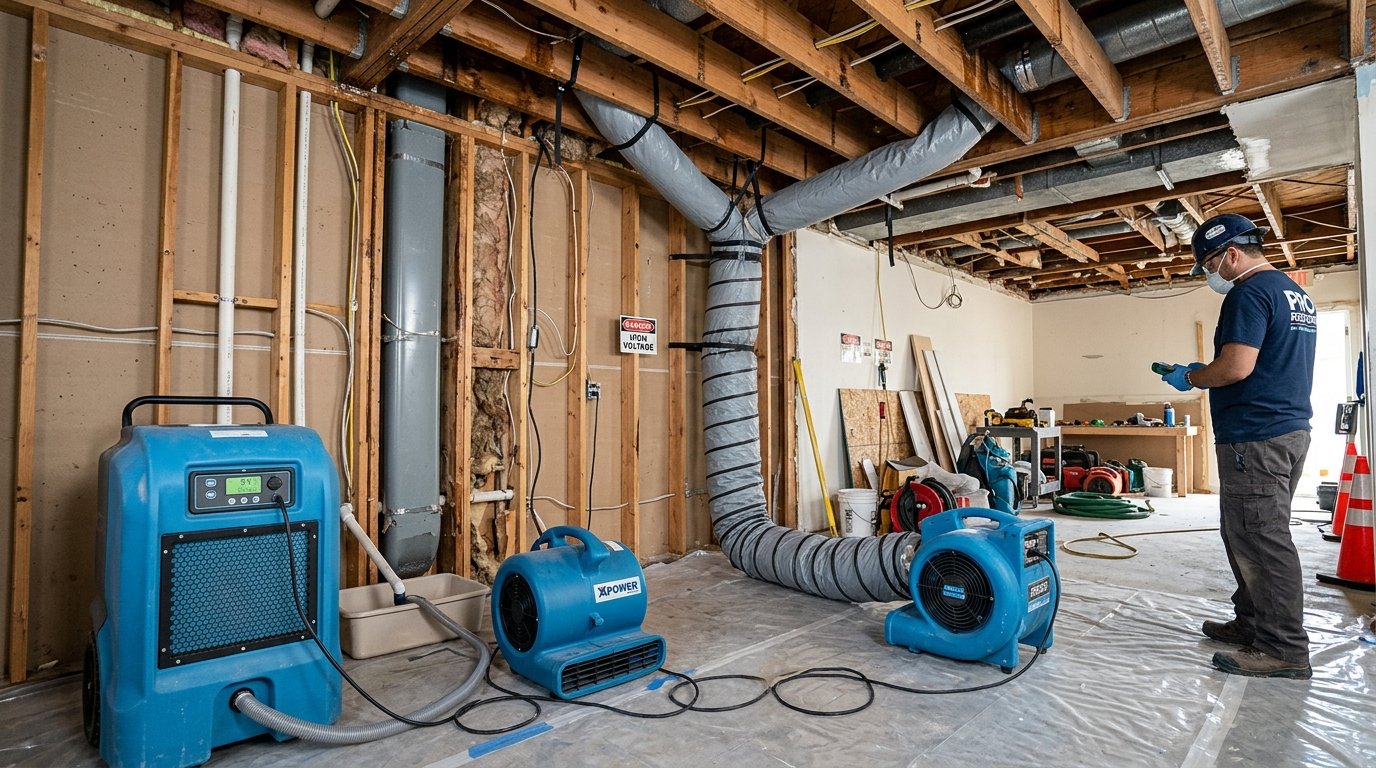
Multi-Floor StabilizationNon-destructive wall cavity drying injects warm, dry air behind baseboards and ceiling plenums, drying building structural framing without tearing out expensive architectural finishes.
Minimizing Tenant Downtime: The "Zero Disruption" Operational Model
Closing an entire office building or sending 500 white-collar professionals home destroys enterprise productivity. Top commercial restoration contractors structure their operations around the tenant's business calendar:
The 72-Hour "Friday Night to Monday Morning" Executive Blitz
When water occurs late Friday, commercial restoration teams mobilize immediately. Over the weekend, 24-hour continuous crews perform heavy extraction, remove damaged acoustic tiles, set up drying equipment, and treat structural framing with botanical disinfectant. By Monday at 7:00 AM, noisy machinery is demobilized or sealed inside soundproofed containment, allowing workers to return on schedule.
Ultra-Quiet Low-Decibel Daytime Drying (<55 dBA)
During standard business hours (8:00 AM – 5:00 PM), loud demolition and high-velocity centrifugal fans are halted. We transition to specialized low-decibel commercial Low-Grain Refrigerant (LGR) dehumidifiers and whisper-quiet axial air movers operating under 55 decibels—comparable to the ambient background hum of a standard office HVAC system.
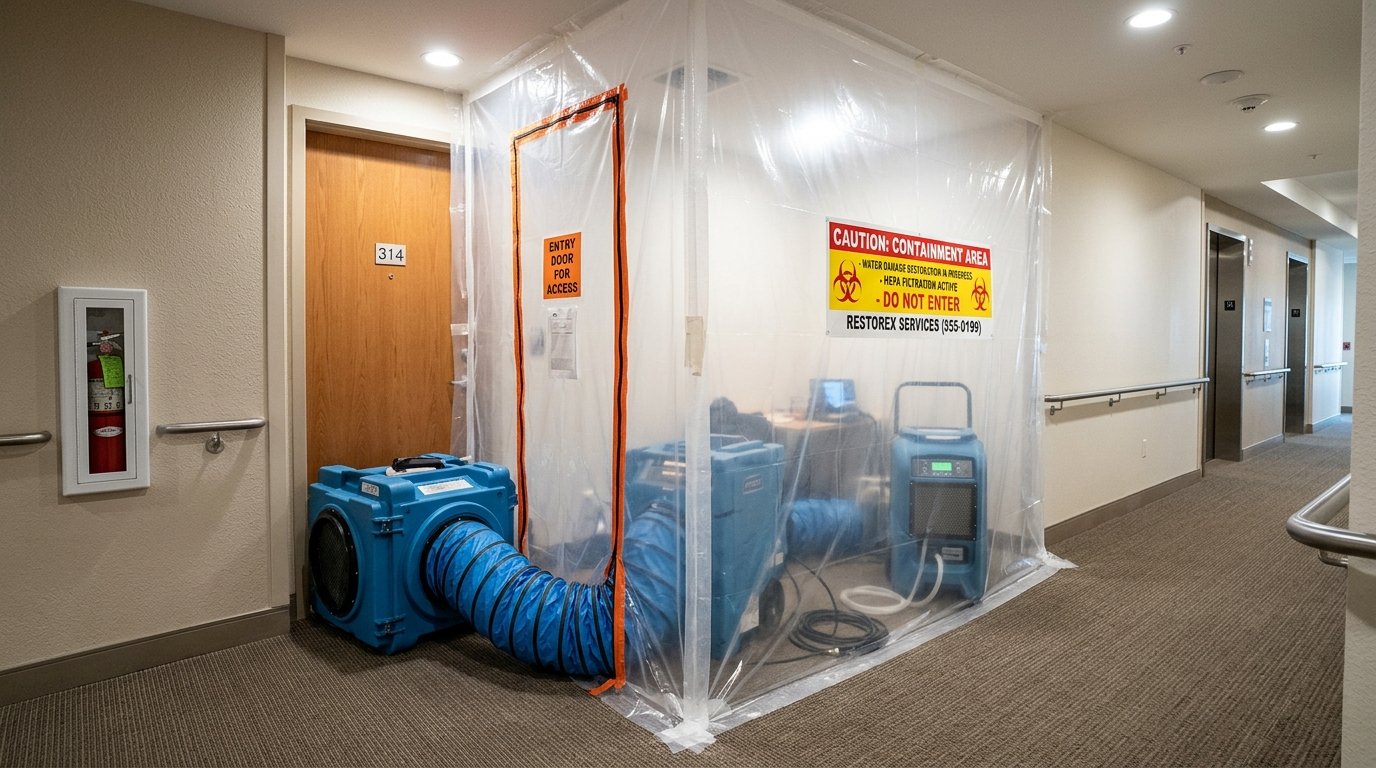
Zoned Opaque Containment Walls
Corridors and elevators used by clients and executives are protected with floor-to-ceiling opaque containment walls. Zippered airlocks and negative-air HEPA scrubbers ensure zero dust, odors, or unsightly work zones are visible to visiting clients.
Insurance Navigation: Landlord Master Policy vs. Tenant Improvements (TI)
One of the greatest sources of friction following an office building flood is determining who pays for what. Commercial leases establish clear legal boundaries of property loss:
IT vendor diagnostic letters, data recovery invoices, replacement server hardware quotes.
Loss Allocation Matrix: Landlord Master Coverage vs Tenant Leasehold Assets.
Thermal DiagnosticsNon-invasive infrared thermal imaging reveals hidden moisture tracking behind electrical panel backboards and executive drywall without requiring exploratory demolition.
Common Area Maintenance (CAM) Billing & Forensic Auditing
Property managers cannot simply present corporate office tenants with a lumped restoration bill. Corporate legal teams and CFOs will audit every line item.
At AZ Water Damage Restoration, we compile forensic documentation tailored for CAM reconciliation:
Room-by-Room Xactimate Estimates: Every affected suite, corridor, and mechanical room is mapped independently, itemizing exact square footages of extracted carpet, linear feet of baseboard removed, and drying equipment hours logged.
Daily Psychrometric Moisture Logs: Timestamped digital logs proving drying equipment was demobilized the moment materials reached dry standard (<15% WME), ensuring tenants are never overbilled for equipment rental days.
Causation Investigation Reports: Photographic documentation pinpointing the exact mechanical point of origin (e.g., a failed braided stainless supply line on a 4th-floor water cooler), providing unambiguous subrogation evidence for adjusters.
Why Commercial Office Towers Maintain Active Restoration PSAs
Class-A commercial office towers across Phoenix, Scottsdale, and Tempe maintain an active Commercial Priority Service Agreement (PSA) with AZ Water Damage Restoration.
A commercial office PSA provides:
Guaranteed 45-Minute Emergency Mobilization: Rapid response fleets rolling 24/7/365 to catch vertical water leaks before they reach lower tenant floors.
Pre-Mapped Building Mechanical Familiarity: Our commercial supervisors pre-walk your facility to map main riser shutoffs, electrical sub-panels, freight elevator access, and server room locations.
Pre-Approved Master Xactimate Pricing: Pre-negotiated commercial labor and equipment rate schedules that eliminate pricing disputes between building owners and corporate tenant insurers.
Direct Adjuster Coordination: Complete end-to-end management of insurance claim dossiers, minimizing administrative burdens for building management teams.
Related Technical Guides
Educational resources for Phoenix & Arizona property owners
Our rapid response units maintain staged equipment yards across Central Phoenix, the East Valley, the West Valley, Pinal County, and Greater Tucson for an average ~42-minute on-site arrival:
How fast does water migrate downward through a multi-story office building?
Under the physics of gravity and hydrostatic pressure, water travels vertically through commercial buildings with alarming speed. A 4th-floor breakroom ice maker line rupture or toilet flushometer failure will penetrate suspended acoustic ceiling tiles, flow through electrical utility chases, seep down structural perimeter columns, and invade lower tenant suites within 15 to 30 minutes. An uncontrolled 25-gallon-per-minute leak running overnight on an upper floor routinely compromises four to eight vertical office suites before morning security patrols discover it.
What is the emergency triage procedure for flooded server rooms and data closets?
Server rooms require specialized mission-critical response: (1) Immediately verify emergency power transfer and de-energize underfloor busways if water enters raised access floor plenums; (2) Remove perforated plenum tiles to inspect low-voltage Cat6 and fiber optic cable trays; (3) Deploy high-capacity desiccant dehumidifiers to drop relative humidity below 40% RH without electrostatic discharge (ESD) risk; and (4) Absolutely prohibit open-air fans or liquid chemical sprays that could deposit conductive aerosols or particulate onto server motherboards.
How can commercial office buildings remain open while drying equipment operates?
Professional commercial restoration contractors use non-disruptive phasing: (1) Heavy water extraction, wet drywall flood cuts, and equipment setup are scheduled between 6:00 PM and 6:00 AM; (2) Saturated areas are sealed with airtight, opaque 6-mil poly containment barriers, preventing dust, odors, and unsightly demolition from reaching client corridors; and (3) Daytime drying utilizes ultra-quiet, low-decibel commercial LGR dehumidifiers (<55 dBA) and sound-baffled air scrubbers so white-collar business operations continue unimpeded.
Can commercial modular carpet tiles be salvaged after an office flood?
For Category 1 clean water losses (such as sink supply lines or clean fire sprinklers), modular carpet tiles can typically be saved in place if extraction begins within 24 hours. Commercial crews utilize high-lift weighted extraction wands to pull water out of the nylon face fibers and closed-cell backing, followed by low-grain refrigerant dehumidification. However, for Category 2 gray water or Category 3 sewage backups, saturated carpet squares and underlying adhesives must be removed and discarded to prevent mold growth on the concrete slab.
How does Common Area Maintenance (CAM) billing impact multi-tenant water remediation?
When water damage originates from a common building infrastructure element (e.g., a roof drain pipe or communal restroom riser), emergency stabilization expenses exceeding the building's commercial deductible are typically allocated through CAM pools or building capital reserve funds. Property managers require forensic, itemized Xactimate estimates with distinct room-by-room loss splits to provide transparent, defensible CAM audit trails for corporate tenant boards.
How fast can commercial emergency restoration crews mobilize in Phoenix and Scottsdale?
AZ Water Damage Restoration maintains commercial rapid-response dispatch units strategically stationed along the Camelback Corridor, Downtown Phoenix, Old Town Scottsdale, Tempe Town Lake, and Chandler Price Corridor. Initial containment and extraction crews arrive on-site within an average of 42 minutes, 24/7/365.
IICRC-certified restoration technicians · Phoenix metro
Written and fact-checked by the licensed crew that runs the trucks — the same technicians who take moisture readings, set drying chambers to the IICRC S500 standard, and answer the phone at 2 a.m. across the Phoenix metro.
Licensed Arizona contractor — AZ ROC #331127 (KB-2)