When water breaches an educational facility, facility directors must balance student respiratory safety, strict background check laws (A.R.S. § 15-512), and zero-disruption class schedules with aggressive structural drying and Risk Trust compliance. Here is your complete engineering and operational playbook.
Last updated:Reading time:17 minStandards:IICRC S500 Verified
Mitigating water damage in K-12 schools, charter networks, and preschools involves heightened legal and public health responsibilities. Because developing children inhale 50% more air per pound of body mass than adults, mold spores and bacterial endotoxins represent severe pediatric liability risks. Successful school restoration demands three mandatory pillars: 100% Arizona DPS Level 1 Fingerprint Cleared personnel, off-hours evening and weekend operational phasing that preserves student instruction, and third-party certified industrial hygiene (CIH) air clearance testing to verify Condition 1 normal fungal ecology before classrooms are re-occupied.
Pediatric Health Vulnerability: Why Schools Require Medical-Grade Protocols
In standard commercial office buildings, minor drywall moisture might simply warrant a dehumidifier and routine air movement. In educational environments, the standard of care is substantially higher due to pediatric biological vulnerability.
According to the U.S. Environmental Protection Agency (EPA) and the American Academy of Pediatrics (AAP), children are uniquely susceptible to indoor air contaminants resulting from damp building envelopes:
Pediatric Factor
Biological Mechanism
Clinical Health Risk in Students
Required Engineering Mitigation
High Minute-Ventilation Rate
Children breathe significantly more air per kilogram of body weight compared to adults.
Higher cumulative dose of airborne mycotoxins and microbial volatile organic compounds (MVOCs).
Zero open air movement in populated hallways; airtight 6-mil poly containment barriers.
Developing Immune System
Immature cellular immune response to fungal antigens (Aspergillus, Penicillium, Stachybotrys).
Allergic fungal sinusitis, chronic rhinoconjunctivitis, and school absenteeism spikes.
EPA-registered botanical antimicrobials (Thymol); zero harsh chlorine or solvent vapors.
High Contact Physical Behavior
Elementary students sit, play, and crawl on carpets and tile subfloors; frequent hand-to-mouth contact.
Dermal contact with damp carpet pad biocides or Category 2/3 wastewater pathogens.
Mandatory disposal of saturated carpets and pads; digital ATP surface bioluminescence verification.
Pediatric Physiological Vulnerability & School Structural Remediation Matrix.
For a deep dive into the physiological mechanisms of damp buildings and mycotoxin exposure, read our clinical review on the health risks of untreated water damage.
Hiring a standard residential contractor for a school emergency can expose school board members, superintendents, and facility managers to severe legal liability. Under Arizona Revised Statutes § 15-512, all contracted personnel who work on school property with access to pupils must complete a criminal history fingerprint records check.
DPS Level 1 Fingerprint Clearance Cards
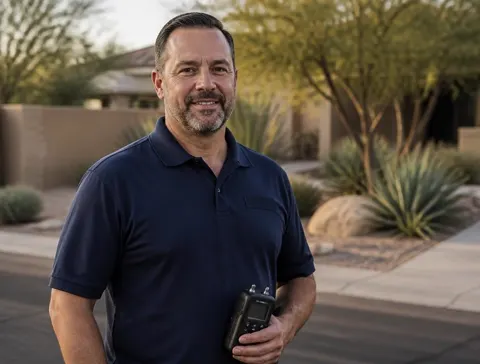
Every technician dispatched by AZ Water Damage Restoration to educational properties holds an active Level 1 Fingerprint Clearance Card issued by the Arizona Department of Public Safety (DPS) following state and FBI criminal background checks.
Campus Security Check-In & Escort Protocols
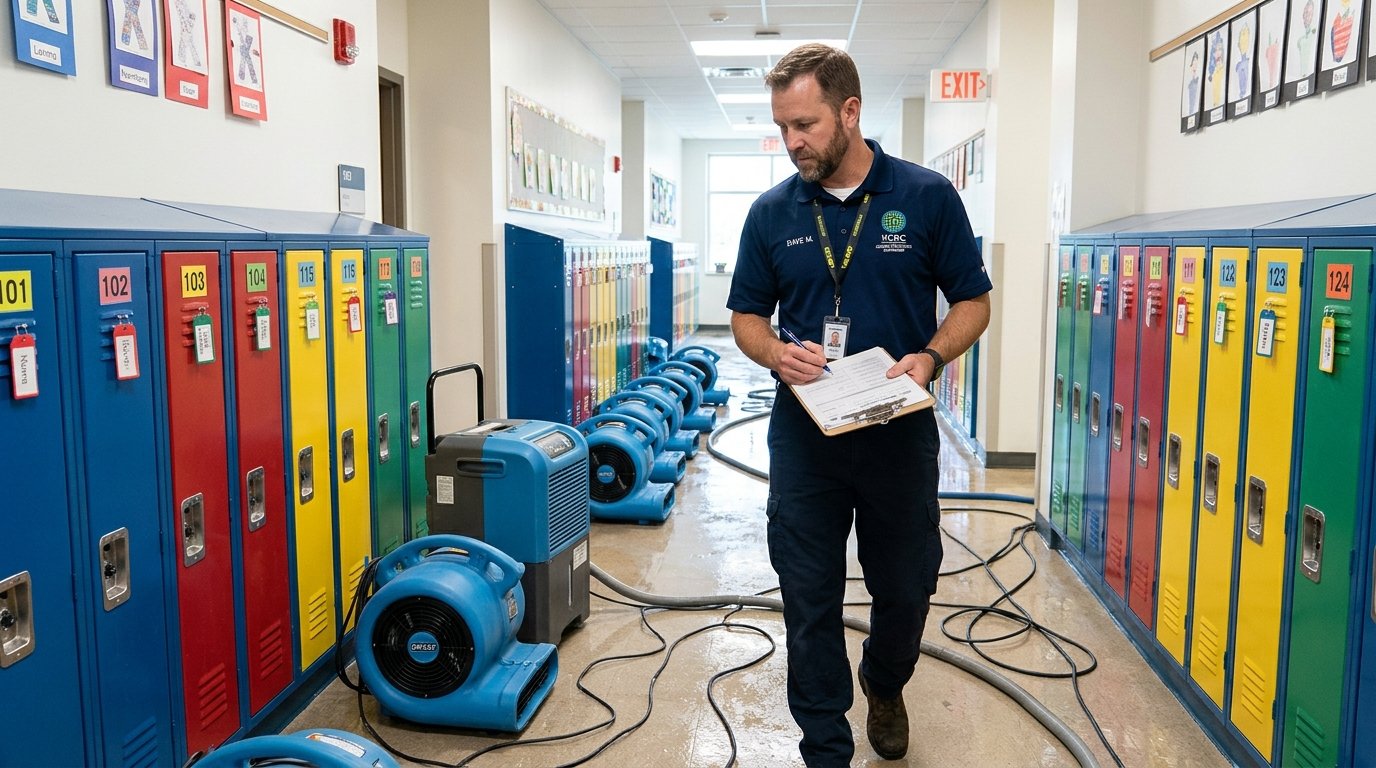
All crew members wear standardized company uniforms with photographic badges, check in at the front administration office to log entry into visitor management systems (Raptor), and remain strictly inside physical containment work zones.
Non-Disruptive Operational Scheduling: Drying Without Canceling School
Canceling school for water damage triggers severe downstream consequences: lost state per-pupil funding (ADA), parent workplace disruptions, and costly makeup days at the end of the school year. Professional commercial restoration firms use disciplined, phased scheduling to ensure school remains open:
When a burst pipe or roof scupper leaks on Friday, our full commercial response fleet mobilizes immediately at student dismissal. Over 60 continuous hours, technicians extract water, execute drywall flood cuts, wash structural framing with botanical biocide, and run high-output desiccant dehumidifiers. By 6:00 AM Monday, equipment is either demobilized or sealed inside sound-dampened containment, allowing classes to resume on schedule.
During ongoing multi-day drying projects, heavy demolition, HEPA vacuuming, and material hauling take place exclusively between 4:30 PM and 5:30 AM after after-school programs conclude. During school hours (7:30 AM – 3:30 PM), ultra-quiet commercial dehumidifiers run continuously behind locked, sound-baffled containment walls without audible classroom disruption.
Complex multi-classroom rebuilds, locker room re-piping, or full gymnasium sports floor restorations are coordinated during Fall Break, Winter Holiday Break, or Spring Break. Pre-staging equipment and materials before break begins allows crews to complete extensive remediation without a single student on campus.
Saving Saturated Gymnasium Hardwood Sports Floors
A school gymnasium floor is one of the district's most valuable physical assets. Replacing a high school competition maple sports floor costs between $120,000 and $250,000 and takes 8 to 14 weeks—disrupting physical education, assemblies, and athletic competitions.
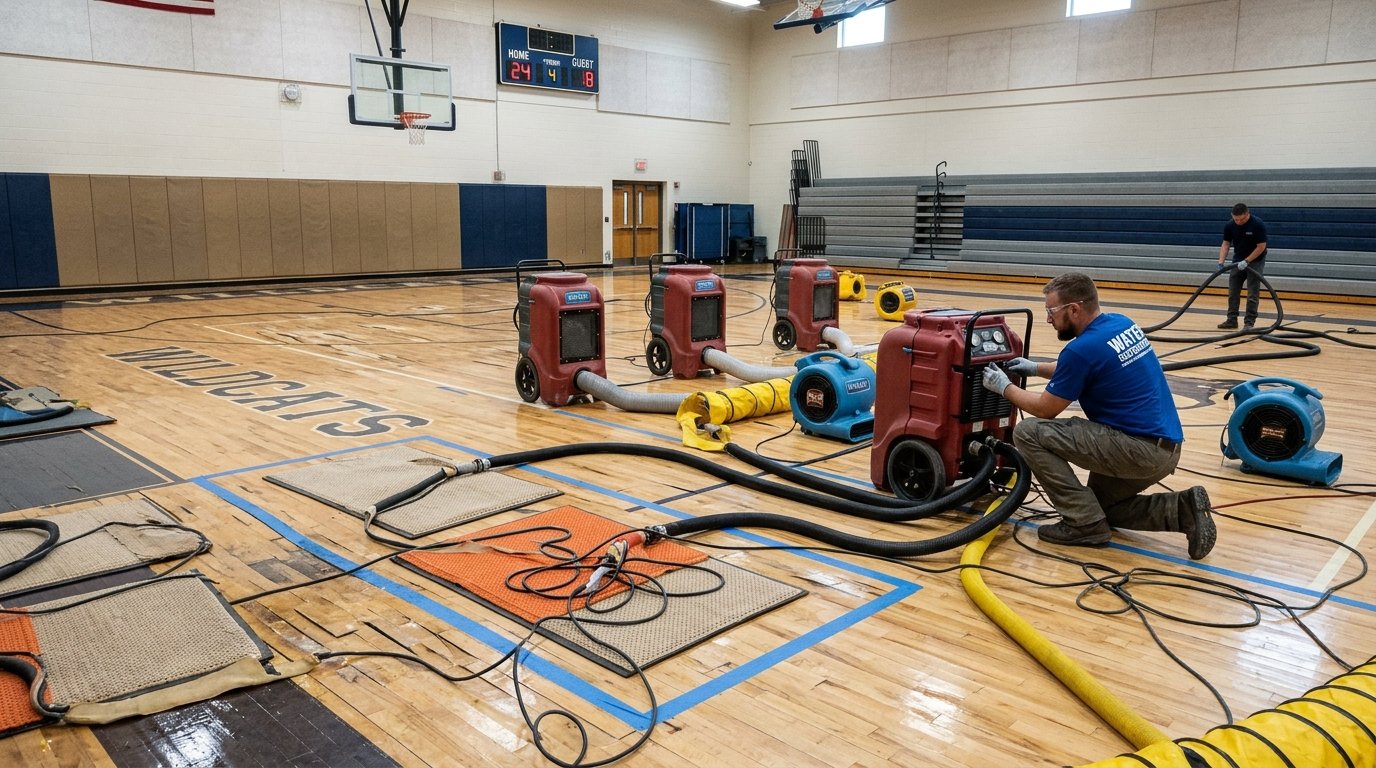
When water breaches a gym from a burst fire sprinkler line or roof leak, immediate deployment of specialized subfloor injection drying mat systems can reverse board cupping and save the floor completely without replacement:
Athletic Floor RescueHigh-pressure vacuum injection floor mats draw moisture out from between maple boards and subfloor sleeper systems, preventing cupping, crowning, and costly full-court replacement.
Restoration Approach
Estimated Direct Cost
Downtime / Facility Closure
Long-Term Performance Impact
Targeted Injection Mat Dehumidification
$8,500 – $22,000
5 – 9 Days (Zero School Disruption)
Preserves original MFMA northern hard maple; restores standard athletic bounce coefficient.
Severe subfloor mold colonization under sleepers; catastrophic warping forces total tear-out.
Economic & Operational Comparison: Gymnasium Floor Drying vs Complete Replacement.
To learn more about the science of wood fiber cellular drying and salvage thresholds, review our dedicated guide on hardwood floor water damage restoration.
Working with The Arizona School Risk Retention Trust ("The Trust")
In Arizona, the vast majority of public school districts and joint technical education districts (JTEDs) are member-owners of The Arizona School Risk Retention Trust ("The Trust"). Navigating Trust property damage claims requires strict procedural discipline:
Compliance with Public Procurement Code: Under Arizona School District Procurement Rules (A.A.C. R7-2-1001 et seq.), districts must verify that emergency restoration services satisfy state emergency procurement exemptions or utilize approved purchasing cooperatives (such as 1GPA, Mohave Educational Services Cooperative, or SAVE).
Forensic Psychrometric Drying Logs: Trust claims adjusters require daily digital psychrometric logs tracking ambient temperature, relative humidity, Grains Per Pound (GPP), and moisture content (% WME) for every affected structural element.
Insurance-Standard Xactimate Line-Item Billing: Estimates must be formatted strictly in Xactimate software using current Maricopa/Pima County published price indices, itemizing labor hours, equipment run times, and disposal dump receipts.
Third-Party Industrial Hygiene (CIH) Air Clearance Testing
No classroom or school library should ever be returned to student use solely on the restoration contractor's word. School districts must maintain complete defensibility against parental concerns and regulatory audits by requiring independent third-party Indoor Air Quality (IAQ) clearance testing:
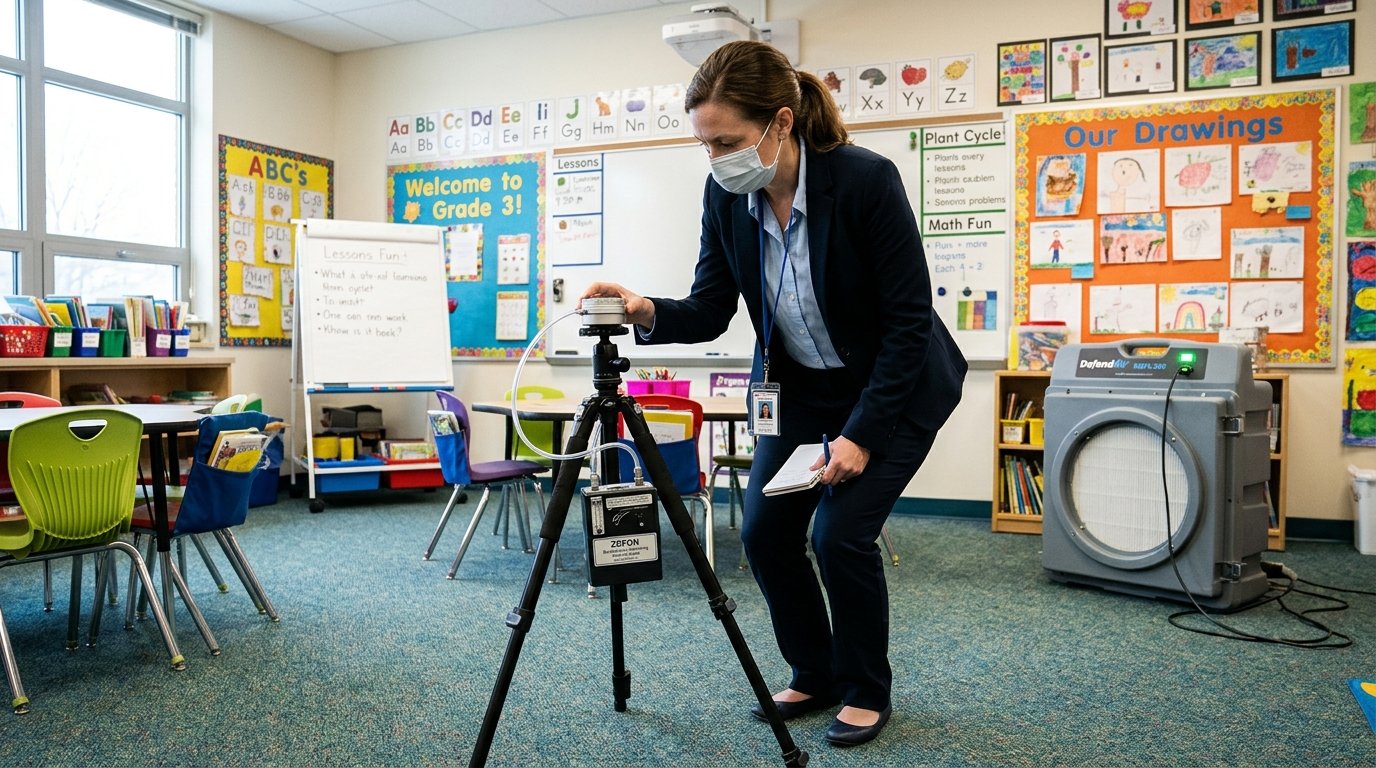
Objective IAQ ClearanceCalibrated spore trap cassette sampling conducted by an independent certified industrial hygienist verifies that indoor airborne fungal spore counts are statistically equal to or lower than outdoor background baselines.
A passing IICRC S520 Condition 1 Clearance Report requires four definitive milestones:
1. Statistical Spore Concentration Balance
Indoor airborne fungal spore concentrations (measured in spores/m³) for common environmental molds like Cladosporium and Alternaria must be statistically lower than concurrent outdoor background controls.
2. Zero Toxic Marker Species Detection
There must be zero presence of toxic marker species that indicate hidden water intrusion—specifically Stachybotrys chartarum, Chaetomium globosum, or active Trichoderma colonies.
3. Structural Moisture Content Below 15% WME
Penetrating pin probes and thermal imaging must verify that all structural wall studs, drywall, subfloors, and ceiling joists have reached equilibrium moisture content (<15% Wood Moisture Equivalent). For diagnostic technology details, see our professional moisture detection guide.
4. White Glove Dust & Particulate Clearance
Visual inspection confirming that all horizontal surfaces (desks, book shelves, computer stations) have received HEPA-filtered vacuuming and damp antimicrobial wipe-downs, leaving zero construction dust or particulate.
Establishing a School District Priority Service Agreement (PSA)
Waiting until a main water line breaks at 2:00 AM on the first day of standardized testing to search for a restoration company is a recipe for operational chaos. Forward-thinking Arizona school districts maintain an active Priority Service Agreement (PSA) with AZ Water Damage Restoration.
A commercial PSA provides your district with:
Guaranteed 45-Minute Emergency Response: Dedicated dispatch units stationed across Phoenix, Scottsdale, Mesa, Chandler, Glendale, Peoria, and Tucson standing by 24/7/365.
Pre-Cleared DPS Fingerprint Personnel: Roster of background-cleared restoration technicians pre-registered with your district safety office.
Pre-Negotiated Cooperative Pricing: Pre-approved pricing that satisfies Arizona school procurement rules without bidding delays.
Direct Risk Trust Coordination: Seamless file transfer directly to Trust adjusters with zero up-front retainers required.
Related Technical Guides
Educational resources for Phoenix & Arizona property owners
Our rapid response units maintain staged equipment yards across Central Phoenix, the East Valley, the West Valley, Pinal County, and Greater Tucson for an average ~42-minute on-site arrival:
Why are school-aged children more vulnerable to water damage and mold exposure?
Pediatric respiratory physiology differs fundamentally from adults. Children breathe up to 50% more air per pound of body weight than adults, and their narrower airways and developing immune systems make them acutely vulnerable to airborne microbial volatile organic compounds (MVOCs), fungal mycotoxins, and bacterial endotoxins. Under EPA 'Indoor Air Quality Tools for Schools' guidelines, unaddressed water leaks are a leading environmental trigger for childhood asthma exacerbations and chronic school absenteeism.
Are restoration contractors required to hold Arizona DPS Fingerprint Clearance Cards?
Yes. Under Arizona Revised Statutes (A.R.S. § 15-512), any contractor or subcontractor personnel who have unsupervised access to pupils on school grounds must possess an active, valid Level 1 Fingerprint Clearance Card issued by the Arizona Department of Public Safety (DPS). Professional commercial restoration teams working in K-12 public districts and charter networks maintain 100% DPS-cleared, background-checked technicians equipped with visible district security badges.
How do restoration teams structure schedules to avoid canceling classes or disrupting students?
Contractors operate under flexible, non-disruptive scheduling models: (1) 2nd and 3rd shift evening operations (4:00 PM to 6:00 AM) when campuses are vacant; (2) Rapid 48-hour weekend mobilization blitzes to extract, sanitize, and stabilize water events before Monday morning arrival; and (3) Planned holiday break blitzes (Fall, Winter, and Spring breaks) for heavy structural demolition or gymnasium floor remediation.
Can water-damaged gymnasium hardwood basketball floors be saved without replacement?
Yes, if emergency response begins within 24 hours. Rather than demolishing and replacing an entire $120,000 to $250,000 maple sports floor, commercial restoration crews deploy negative-pressure injection floor drying mat systems. Industrial vacuum pumps draw air down through the tongue-and-groove planks, extracting trapped moisture from the underlying plywood subfloor and sleeper cushion systems while industrial desiccant dehumidifiers pull ambient humidity below 25% RH to reverse board cupping.
What clearance testing is mandatory before reoccupying a water-damaged classroom?
Arizona school districts require third-party indoor air quality (IAQ) clearance conducted by an independent certified industrial hygiene (CIH) firm. The protocol includes: (1) Air-O-Cell cassette spore trap sampling showing indoor fungal spore counts lower than outdoor baselines with normal biodiversity; (2) Absence of toxic indicator mold species such as Stachybotrys chartarum or Chaetomium; (3) Thermal moisture verification (<15% WME); and (4) Visual inspection certifying zero active particulate under IICRC S520 Condition 1 clearance criteria.
How does the Arizona School Risk Retention Trust ('The Trust') handle property water losses?
The majority of Arizona public school districts procure property and liability insurance through The Trust (Arizona School Risk Retention Trust). The Trust requires strict adherence to public procurement rules, detailed forensic psychrometric drying logs, pre-demolition photographic manifests, and estimates formatted in insurance-standard Xactimate pricing. AZ Water Damage Restoration coordinates directly with Trust adjusters to expedite claim validation without drawing down campus operational capital.
What are the most common sources of water damage in Phoenix school facilities?
The top sources across Maricopa and Pima county schools are: (1) Rooftop HVAC package unit condensate clogs and pan overflows during 115°F summer monsoon storms; (2) Science lab acid-waste sink supply line bursts; (3) Restroom vandalism (toilets intentionally plugged and flushed continuously); (4) Athletic locker room shower manifold leaks; and (5) Flat-roof scupper and parapet drain blockages causing multi-classroom ceiling collapses.
IICRC-certified restoration technicians · Phoenix metro
Written and fact-checked by the licensed crew that runs the trucks — the same technicians who take moisture readings, set drying chambers to the IICRC S500 standard, and answer the phone at 2 a.m. across the Phoenix metro.
Licensed Arizona contractor — AZ ROC #331127 (KB-2)