A water emergency in a multi-unit property isn't just a plumbing failure—it's a high-stakes coordination of tenant habitability laws, multi-stack structural drying, insurance allocation, and asset protection. Here is your operational playbook.
Last updated:Reading time:16 minStandards:IICRC S500 Verified
Field Coordination · Multi-Family Emergency Restoration Protocol · Phoenix Metro, AZ
Table of contents▾
The Property Manager's Executive Summary
When water intrudes into a multi-family or commercial rental property, the clock starts ticking simultaneously against two critical thresholds: 48 hours for microbial colonization and strict habitability timelines under the Arizona Residential Landlord and Tenant Act (A.R.S. § 33-1324). Successful mitigation requires a 30-minute shutoff protocol, immediate stack migration triage, precise separation of commercial master policy versus tenant HO-4 claims, and non-destructive IICRC S500 structural drying that minimizes tenant displacement and vacancy loss.
The 30-Minute Property Manager Emergency Action Plan
In multi-tenant buildings, delayed reaction converts a single-unit $1,200 supply line leak into a $45,000 multi-level disaster. Every on-site property manager, assistant manager, and maintenance technician should follow this disciplined 30-minute sequence from the moment a water call comes in:
1Minute 0–5: Source Shutoff
Immediately isolate water. If the tenant is home and the source is accessible (toilet angle stop or sink valve), guide them by phone. If inaccessible or unattended, maintenance dispatches to the unit sub-shutoff or building riser valve immediately.
2Minute 5–10: Electrical Breaker Isolation
Water pooling inside ceiling drywall or running down hollow electrical conduit can cause electrocution or electrical fires. Shut off panel breakers to wet rooms, ceiling fixtures, and outlets before personnel step into wet carpet or subflooring.
3Minute 10–18: Dispatch Certified Restoration
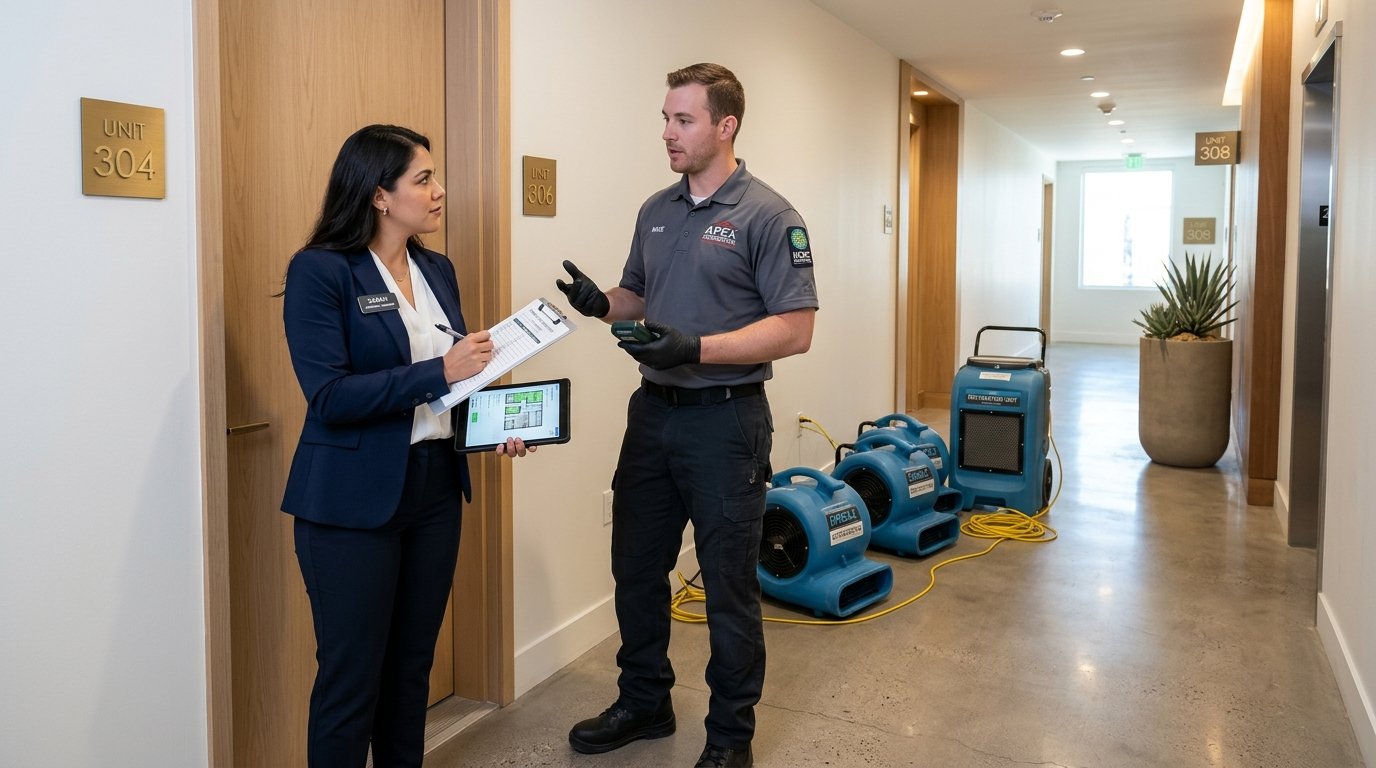
Contact your pre-vetted 24/7 commercial restoration contractor. Provide building number, unit number, water type (clean, grey, or black/sewage), and whether water is penetrating down into lower units. Request extraction rigs and industrial dehumidifiers immediately.
4Minute 18–30: Stack Triage & Notice
Execute emergency right of entry under A.R.S. § 33-1343 to inspect the units directly below and adjacent. Check ceiling drywall, light fixtures, and perimeter walls. Document initial conditions with time-stamped photos before equipment arrives.
If the water source is plumbing-related and you are trying to determine whether to call a plumber or structural restorers first, review our triage guide on when to call a restoration company vs. a plumber. In multi-family scenarios, the restoration team must arrive immediately to begin extraction, even while the licensed plumber finishes replacing the failed mechanical pipe.
Multi-Unit Water Migration Dynamics: Why Apartment Leaks Spread Fast
In single-family homes, water pools horizontally across a slab. But in multi-story residential communities and commercial complexes, gravity turns water into a multi-dimensional threat:
1. Vertical Plumbing Chases & Utility Shafts
Plumbing wet walls and vent stacks create vertical conduits. Water leaking from a 3rd-floor water heater flows down pipe penetrations directly into 2nd and 1st-floor ceiling joist bays, bypassing the 2nd-floor living space completely until it pools on the ground floor ceiling.
2. Gyp-Crete Subfloors and Lightweight Concrete
Most multi-family buildings utilize a poured gypsum-concrete subfloor (Gyp-Crete) over wood framing for soundproofing and fire separation. Gyp-Crete is highly porous and sponge-like. When saturated, it holds vast amounts of moisture that cannot dry through standard vinyl plank (LVP) or carpet without specialized commercial desiccant dehumidification or targeted floor mat extraction systems.
3. Party Wall & Fire Separation Cavities
Demising walls separating tenant units contain dense mineral wool or fiberglass sound batts. Once water enters these wall cavities, the insulation stays damp indefinitely, wickedly elevating humidity and creating hidden mold colonization inside the shared structural wall.
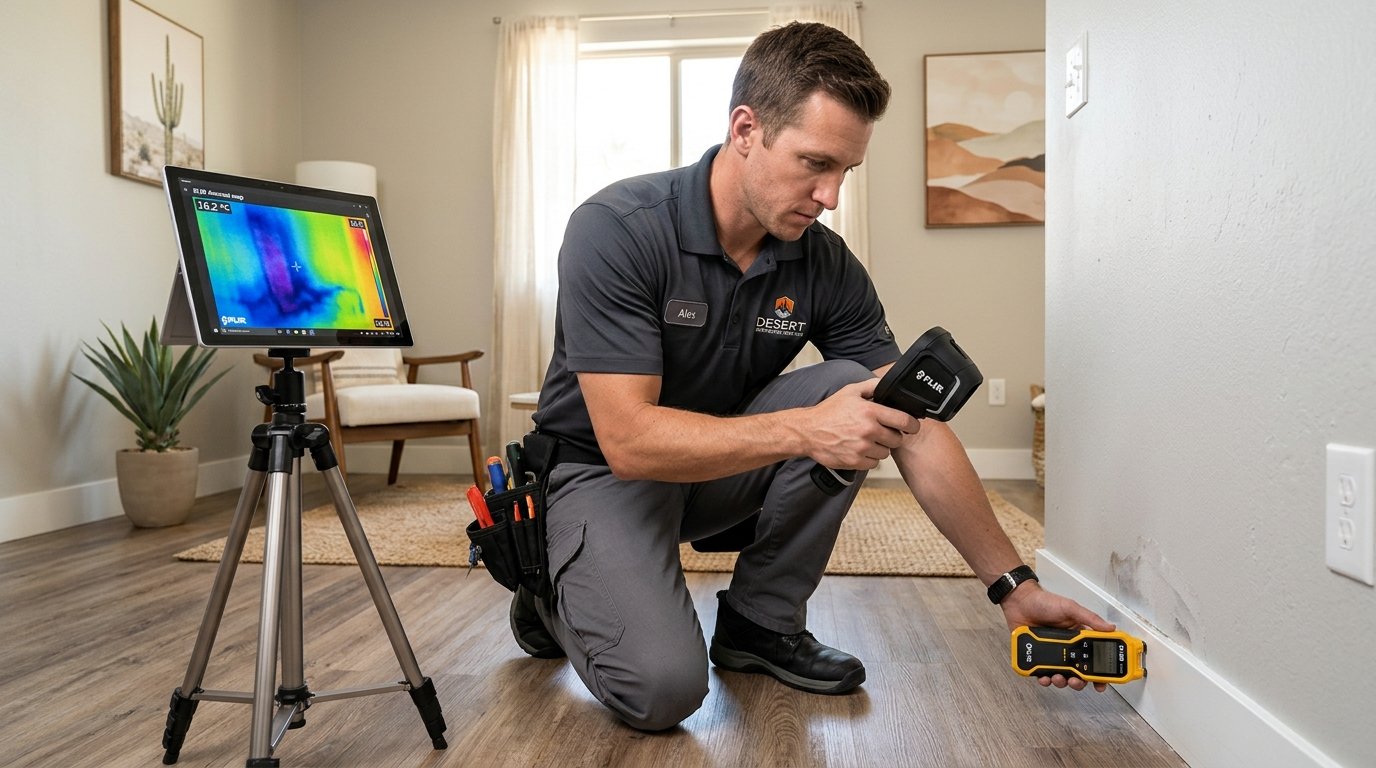
Thermal DiagnosticsNon-invasive infrared imaging reveals hidden water migration traveling through multi-family party walls and Gyp-Crete subfloors without exploratory drywall demolition.
For Arizona property managers, managing water damage is not solely a physical maintenance task—it is an urgent statutory compliance requirement. Arizona law provides tenants with potent legal remedies if water intrusion is not remediated swiftly.
1. The Habitability Mandate (A.R.S. § 33-1324)
Under A.R.S. § 33-1324(A), landlords and their authorized managing agents must:
Comply with requirements of applicable building codes affecting health and safety.
Make all repairs and do whatever is necessary to put and keep the premises in a fit and habitable condition.
Maintain in good and safe working order and condition all electrical, plumbing, sanitary, heating, ventilating, and air-conditioning systems.
Supply running water and reasonable amounts of hot water at all times.
2. The 5-Day and 10-Day Statutory Clock
When water compromises essential services or causes conditions materially affecting health and safety (such as Category 2/3 water, severed plumbing, or mold development), the tenant may serve a formal written notice:
5-Day Health & Safety Breach (A.R.S. § 33-1361(A)): If an active leak or microbial hazard affects the resident's physical safety or health, management has 5 calendar days from receipt to commence remedial action. Failure to act allows the resident to lawfully terminate the lease agreement and demand full return of their security deposit plus prepaid rents.
10-Day Material Noncompliance: If the issue involves non-hazardous cosmetic water damage or secondary trim issues, the tenant may provide a 10-day notice to cure.
Failure to Supply Essential Services (A.R.S. § 33-1364): If water must be shut off to a building for more than a few hours to effect repairs, the landlord must make prompt alternative arrangements, or tenants may procure reasonable substitute housing (hotel rooms) and deduct the actual reasonable cost from rent.
3. Emergency Right of Entry (A.R.S. § 33-1343)
Property managers often hesitate to enter units when tenants are away at work or traveling, fearing trespass claims. However, A.R.S. § 33-1343(C) provides clear protection: "The landlord may enter the dwelling unit without consent of the tenant in case of emergency."An active leak migrating into lower units or threatening electrical infrastructure is legally recognized as an emergency. Always document your entry with a witness, leave an official written Notice of Emergency Entry on the kitchen counter, and take time-stamped video upon entering and exiting.
The Insurance Triad: Coordinating Master, Unit, and Renter's Policies
One of the most complex challenges for property managers during a major flood is navigating who pays what. A clear understanding of policy boundaries prevents costly dispute delays:
Policy Type
Who Holds It
What It Covers
Typical Role in Water Loss
Commercial Master Policy
Building Owner / HOA
Building shell, common areas, structural framing, shared vertical risers, roof, demising walls.
Primary coverage for large structural drying, commercial extraction, and drywall/stud restoration. Often carries high deductibles ($5k–$25k).
Applies in condominium communities where the master policy covers only "bare walls." Interacts with HOA CC&Rs to pay interior finishes.
Renter's Insurance (HO-4)
Tenant / Resident
Tenant's personal belongings (furniture, electronics, clothes), temporary hotel living expenses (Loss of Use), tenant liability.
Crucial for property managers. If tenant negligence caused the leak (overflowing tub), owner's insurer subrogates against tenant's liability.
Operational Best Practice: Ensure that your lease agreements mandate active HO-4 renter's insurance with a minimum of $100,000 in personal liability coverage, naming your management entity as an interested party. This single lease clause protects property owners from paying hotel bills or covering tenant electronics ruined by an unexpected toilet overflow.
Containment Chambers & In-Place Structural Drying: Cutting Vacancy Loss by 70%
Historically, old-school contractors would immediately gut drywall 4 feet high and rip out all flooring across entire apartment units, forcing tenants into hotels for 4 to 6 weeks and costing property managers thousands in lost rent.
Modern IICRC S500 restoration employs targeted engineering controls. In Category 1 and early Category 2 losses, certified technicians utilize:
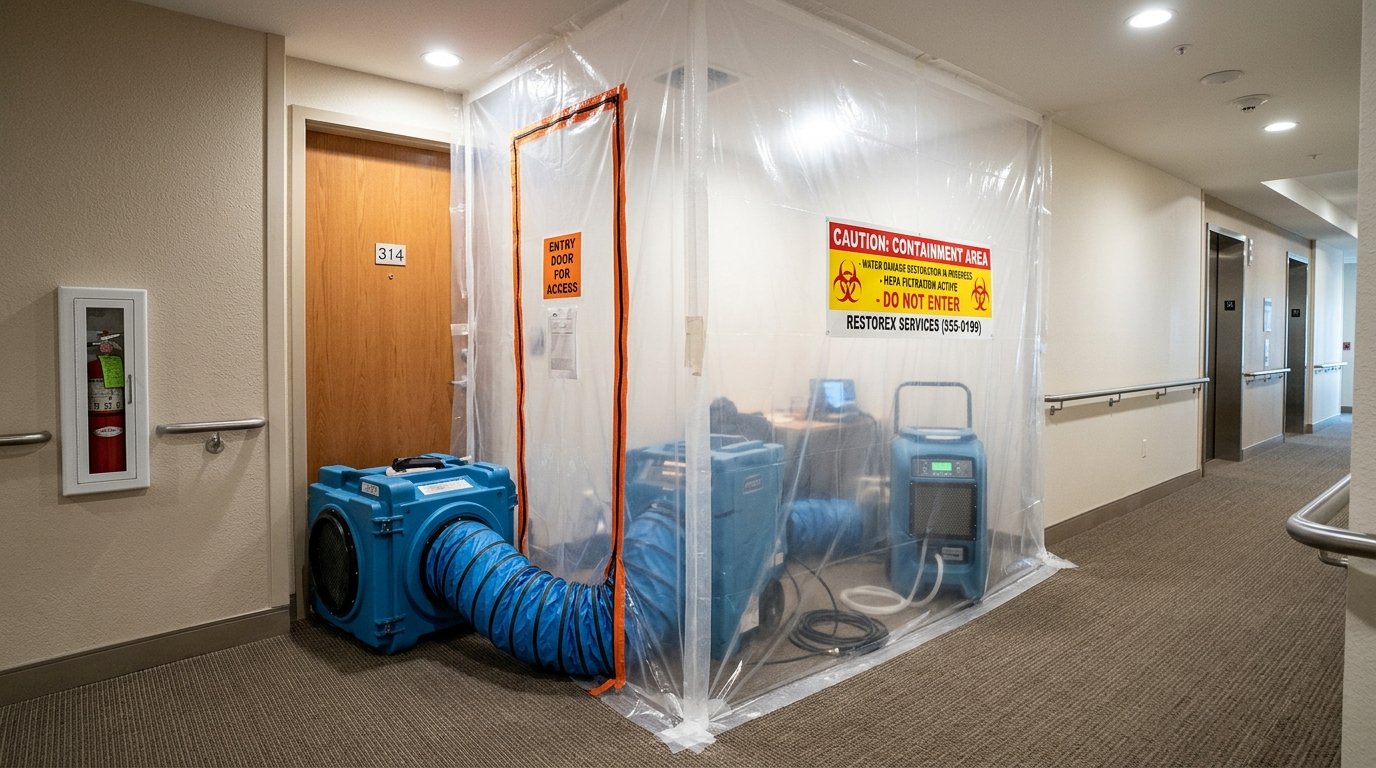
Zippered Negative Air Containment Chambers: Floor-to-ceiling poly barriers isolate the bathroom or utility closet where drying equipment runs, keeping bedrooms and living areas clean, quiet, and dust-free so tenants can remain housed.
Cavity Injection Drying Systems: Specialized floor injector mats and baseboard vent needles push warm, desiccant-dried air into hollow drywall cavities and beneath cabinets without tearing down millwork.
Low-Grain Refrigerant (LGR) Dehumidifiers: Industrial LGR units pull grains of moisture per pound (GPP) down into the 30s, pulling deeply embedded moisture out of concrete subfloors in days rather than weeks.
Engineering ControlsZippered poly containment with negative-pressure HEPA filtration seals off moisture and demolition dust, protecting common corridors and occupied neighboring units.
The Property Manager's Vendor SLA & Documentation Checklist
When presenting water damage scopes to property owners, asset managers, or insurance adjusters, handwritten notes and vague invoices get rejected. Your restoration vendor must deliver standard, court-ready documentation:
The 5 Mandatory Restoration Deliverables
Psychrometric Drying Logs: Daily temperature, relative humidity (RH%), and grains per pound (GPP) tracking demonstrating structural drying to regional dry standards.
Infrared Moisture Mapping: Before-and-after FLIR thermal imaging images proving where water traveled inside wall assemblies and confirming complete cavity dryness.
Itemized Xactimate Pricing: Unit-level line items formatted in standard insurance software (Xactimate) with current regional pricing to eliminate carrier adjusters' disputes.
EPA Antimicrobial Treatment Logs: Verification of botanical or EPA-registered sanitizer application across framing to eliminate bacterial and fungal spores.
Signed Certificate of Completion: Final sign-off certifying structural moisture levels are below 12% Wood Moisture Equivalent (WME), closing your liability file.
To understand the exact cost structures and standard insurance price bands across the Phoenix metro area, refer to our detailed analysis of water damage restoration costs in Arizona.
Multi-Family Water Damage Scenario Triage Matrix
Quickly evaluate your emergency response priorities based on the specific origin of water in your community:
Incident Scenario
Water Category
Tenant Rehousing?
Immediate Operational Action
3rd-Floor Toilet Supply Line Rupture
Cat 1 (Clean) → Cat 2 if delayed
Only if ceiling collapse risk
Shut angle stop. Kill electrical power below. Pinhole water blisters in ceilings to drain water safely into buckets.
AC Condensate Drain Pan Overflow (Attic)
Cat 1 or 2 (Algae / Dust)
Rare (Partial unit containment)
Cut AC power. Clear condensate P-trap. Vacuum soaked blown-in insulation from attic above drywall before mold blooms.
Main Line Sewer Stoppage / Ground Floor Backup
Cat 3 (Black Water / Biohazard)
Yes (Mandatory rehousing)
Order full PPE containment. Issue immediate tenant hotel vouchers. Remove porous carpet and pad. Apply EPA hospital-grade biocide.
Monsoon Storm Parapet Scupper Backup
Cat 2 or 3 (Roof dirt / storm water)
Unit-dependent
Deploy emergency commercial roof tarping. Extract corridor carpeting. Check elevator shafts for water intrusion.
Ground-Floor Slab Leak Under Vinyl Flooring
Cat 1 (Pressurized municipal)
No (Unless pipe reroute requires trenching)
Perform acoustic leak detection. Pinpoint manifold failure. Reroute through attic or overhead to avoid concrete jackhammering.
Preventive Maintenance: The Multi-Unit Water Defense Checklist
The most cost-effective water restoration is the one you never have to file. Add these high-impact audit items to your quarterly turns and seasonal maintenance checklists:
Replace Rubber Hoses with Braided Stainless Steel: Mandate that every washing machine and dishwasher supply line across the community is braided stainless steel with brass nuts. Standard rubber hoses fail catastrophically after 3 to 5 years under Arizona's high water pressure.
Install Float Switches on Secondary AC Pans: Arizona summers push air handlers to run 16+ hours a day. An inline float switch ($25 part) immediately cuts power to the condenser the instant the drain line clogs, preventing hundreds of ceiling leaks annually.
Annual Water Heater Inspections: Tank water heaters in Arizona have an average lifespan of only 6 to 9 years due to hard water mineral calcification. Verify expansion tanks, check T&P relief valves, and ensure pan drains flow freely to exterior stucco terminations.
Pre-Monsoon Roof Scupper & Downspout Clearing: Clean all flat-roof drains and scuppers every May before summer monsoon storms drop 2 inches of rainfall in 45 minutes. For a full seasonal guide, see our monsoon season water damage prevention guide.
Establishing a Commercial Restoration SLA Before Disaster Strikes
Waiting until a main riser bursts at 2:00 AM on a holiday weekend to search for a restoration company is a recipe for disaster. Professional management firms maintain an activePriority Service Agreement (PSA) with a local IICRC-certified restoration contractor.
A commercial PSA provides property managers with guaranteed 60-minute emergency arrival times, pre-negotiated commercial labor and equipment rates, direct adjuster billing, and priority equipment allocation during widespread city-wide monsoon flooding events when uncontracted companies face days-long waiting lists.
Related Technical Guides
Educational resources for Phoenix & Arizona property owners
Our rapid response units maintain staged equipment yards across Central Phoenix, the East Valley, the West Valley, Pinal County, and Greater Tucson for an average ~42-minute on-site arrival:
Under Arizona law, what are a landlord's habitability duties when a rental floods?
Under the Arizona Residential Landlord and Tenant Act (A.R.S. § 33-1324), property managers and landlords are legally obligated to maintain fit and habitable premises, including operating plumbing, running water, and safe electrical systems. If water damage renders a unit uninhabitable or creates an immediate health hazard (such as black water or active microbial growth), tenants can issue a written 5-day breach notice or a 10-day notice under A.R.S. § 33-1361. If emergency mitigation is not commenced immediately, the tenant may terminate the lease or seek statutory rent abatement.
Can a property manager enter a tenant's unit immediately during an active water leak?
Yes. While A.R.S. § 33-1343 typically requires 2 days of advance notice before entering a rental dwelling, the statute explicitly exempts bona fide emergencies. An active, uncontrolled water leak threatening structural integrity or spreading to neighboring units gives management the legal right to enter immediately without advance notice to stop water flow and mitigate loss.
When an upper-floor apartment floods lower units, whose insurance pays?
Liability depends on origin, negligence, and lease terms. If the leak stemmed from landlord-owned plumbing infrastructure (like a failed copper riser or communal drain line), the property's commercial master policy covers structural drying and building repairs. If the tenant caused the leak through negligence (e.g., overflowing bathtub or unapproved washing machine install), the property's insurer may subrogate against the tenant's HO-4 renter's liability insurance. However, the tenant's personal property is never covered by the building owner's policy—tenants must file with their own renter's insurance.
How fast does mold develop in water-damaged rental properties in Arizona?
Despite Arizona's arid outdoor climate, indoor temperatures combined with saturated drywall and ceiling insulation create an ideal microclimate for mold amplification within 24 to 48 hours. In multi-unit properties where water travels through closed wall cavities and chases, mold can rapidly cultivate behind tenant cabinets and baseboards unseen. Rapid commercial water extraction and dehumidification within the first 24 hours are critical to avoiding costly environmental remediation.
Is it always necessary to relocate tenants during water damage restoration?
Not always. For minor or localized Category 1 clean water losses (such as an isolated sink supply line), restoration teams can install zippered plastic containment barriers and negative-pressure HEPA scrubbers, allowing tenants to remain safely in unaffected living areas. However, if the kitchen, primary bathroom, or bedroom is compromised, or if the water is Category 2 or 3 (dishwasher discharge, sewage, or monsoon flood), temporary tenant rehousing or hotel placement is required to meet statutory habitability standards.
What documentation does a property manager need from a restoration contractor?
Property managers require five essential documents for owners and insurance adjusters: (1) Initial infrared thermal imaging moisture inspection report, (2) Daily psychrometric drying logs (temperature, relative humidity, and GPP readings), (3) Detailed photographic evidence before, during, and after extraction, (4) Scope of work written in insurance-standard Xactimate estimating software, and (5) A signed Certificate of Completion and Antimicrobial Application.
What is the fastest way to stop water migration in a multi-story building?
Immediately identify and isolate the vertical riser shutoff valve or building section zone valve rather than searching for individual fixture stops. Concurrently dispatch an IICRC-certified restoration crew equipped with commercial truck-mounted extractors, verify power safety via panel breakers, and inspect the vertical stack of units directly below the leak source to catch downward water migration through subfloors before ceilings collapse.
IICRC-certified restoration technicians · Phoenix metro
Written and fact-checked by the licensed crew that runs the trucks — the same technicians who take moisture readings, set drying chambers to the IICRC S500 standard, and answer the phone at 2 a.m. across the Phoenix metro.
Licensed Arizona contractor — AZ ROC #331127 (KB-2)