In the restaurant industry, water damage is never just a physical mess—it is a race against health code shut-down orders, catastrophic inventory spoilage, lost weekend revenue, and complex business interruption claims. Here is the operational playbook every restaurant owner and kitchen manager needs.
Last updated:Reading time:18 minStandards:IICRC S500 Verified
Commercial Kitchen Stabilization · Health Code Remediation Protocol · Phoenix Metro, AZ
Table of contents▾
The General Manager's Executive Summary
When water breaches a commercial kitchen, the financial threat is two-pronged: immediate regulatory closure by Maricopa County Environmental Services (MCESD) and severe business interruption losses exceeding $8,000 to $25,000 per closed service day. Restoring a food establishment requires far more than extracting water: you must enforce strict FDA Food Code food condemnation protocols, construct airtight negative-air containment barriers to safeguard dining areas, utilize EPA-registered food-contact safe antimicrobials, document inventory losses with unit-cost manifests for adjusters, and verify biological sterility with digital ATP bioluminescence testing to pass re-inspection.
Health Code Realities: MCESD Regulations & Imminent Health Hazards
In Maricopa and Pima counties, commercial food service facilities are governed under strict municipal environmental health codes modeled after the federal FDA Food Code. While a standard office building or retail shop can work through minor water leaks, restaurants operate under an uncompromising standard of consumer public safety.
Under FDA Food Code Section 8-404.11 and county environmental health regulations, restaurant operators are legally mandated to voluntarily cease operations and notify regulatory authorities whenever an "Imminent Health Hazard" occurs. Failing to self-report an active water intrusion event that compromises food safety can result in immediate permit revocation, mandatory public posting of a "Notice of Suspension," and Class 1 misdemeanor health citations.
Water Intrusion Scenario
FDA / MCESD Regulatory Status
Required Operator Action
Mandated Restoration Protocol
Raw Sewage / Floor Drain Surcharge
Imminent Health Hazard (Cat 3 Black Water)
Immediate voluntary shutdown; evacuate all food preparation areas.
Full containment, biohazard PPE, truck-mount extraction, biocide washdown, ATP swab clearance.
Ceiling Leak Over Prep Table / Dish Pit
Critical Violation (Cat 1 or 2 Contamination)
Immediately shut down affected stations; relocate prep to unaffected clean prep rooms.
Tarp food zones, open wet ceiling cavities under negative air, dry structural rafters, apply antimicrobial.
Lack of 100°F Hot Water at Hand Sinks
Critical Violation (Sanitation Non-Compliance)
Cease food prep; no dishwashing or manual sanitation permitted.
Repair commercial water heater or booster pump; sanitize all plumbing lines before service resumption.
Walk-In Cooler Condensate Drain Overflow
Major Equipment Defect & Spoilage Hazard
Log internal ambient temperatures every 30 mins; discard food held above 41°F for >2 hours.
Clear drain obstruction, extract ponding floor water, test insulation core for mold cultivation.
Maricopa County Environmental Services Water Damage Regulatory Action Matrix.
For detailed background on how biological contaminants threaten public health and why food facilities face rigorous scrutiny, review our scientific analysis of the health risks of untreated water damage.
The First 45 Minutes: Kitchen Manager Emergency Action Checklist
The decisions made by your chef, bar manager, or closing supervisor in the initial 45 minutes of a water crisis will determine whether your restaurant is closed for 24 hours or three weeks. Follow this disciplined protocol:
Minute 0–10: High-Voltage Electrical & Gas Safety Isolation
Commercial kitchens are dense industrial power environments with 208V and 480V three-phase electrical circuits powering convection ovens, dishwashers, and reach-in refrigeration. If water is pooling around floor power drops or under counters, do not enter the water. Immediately de-energize the main sub-panel breakers. Concurrently, if a burst pipe impacts gas equipment lines, shut off the gas solenoid emergency stop valve.
Minute 10–20: Shut Off Domestic Water & Protect Clean Ice/Dishware
Isolate the commercial kitchen's main backflow preventer shutoff or municipal meter valve. Cover all exposed clean plate staging racks, sheet pans, and open stainless cookery with clean plastic wrap to prevent aerosolized water droplets from settling. Immediately lock and power down all commercial ice machines to stop contaminated water from entering the freezing grid.
Physically separate potentially contaminated inventory. Take high-resolution, wide-angle and close-up photographs showing the water level relative to food storage shelving (minimum 6 inches off the floor required by code). Create a written inventory log listing food item descriptions, case counts, supplier names, and wholesale unit purchase prices for insurance reimbursement.
Contact an IICRC-certified commercial restoration firm experienced in food safety and health department compliance. Provide the dispatcher with your kitchen square footage, floor finish type (quarry tile, sealed concrete, epoxy), estimated water depth, and suspected water category (clean supply, gray dishwasher rinse, or raw sewage).
Four Critical Mistakes Restaurant Operators Make During Floods
Attempting to sanitize contaminated food packaging with bleach: Wiping down saturated cardboard cases or permeable plastic egg flats does not eliminate bacteria. Moisture wicks into food products within minutes.
Relying on kitchen mop buckets and squeegees for deep water: Mops merely spread grease, biofilm, and bacteria across grout lines. Only high-lift industrial vacuum extraction can pull water from porous grout and concrete.
Discarding spoiled food before insurance adjuster authorization: Throwing out thousands of dollars of steaks, seafood, and liquor without photo documentation and an itemized manifest will result in claim denial.
Running the kitchen exhaust hoods to "dry out" the room: Powerful 4,000+ CFM makeup-air and hood exhaust systems depressurize the kitchen, drawing damp, humid outside Arizona air through back doors and accelerating mold colonization.
Common Commercial Kitchen Water Failure Points in Arizona
Restaurants in Phoenix, Scottsdale, Tempe, and Chandler endure harsh operating conditions. Between intense summer ambient temperatures and extreme commercial kitchen utility demands, plumbing components fail at significantly higher rates than in standard commercial buildings:
Commercial Dishwasher Booster Heater Bursts
High-temp commercial dish machines require 180°F rinse water to achieve chemical-free sanitization under health codes. Electric booster heaters operating under continuous high municipal water pressure (often 75–90 PSI in Phoenix) degrade flexible braided stainless connections, leading to sudden 40-gallon-per-minute scalding water floods when kitchens are unattended at night.
Underground exterior grease traps and indoor hydromechanical interceptors accumulate solidified fats, oils, and grease (FOG). When lines downstream clog with grease calcification, high-volume sink drainage forces gross wastewater and decaying food solids backward through commercial kitchen floor drains—instantly creating a Category 3 biohazard situation. For home and commercial sewer guidelines, see our emergency sewage backup cleanup guide.
Walk-In Evaporator Coil Clogs in Desert Summers
During Phoenix summers with 115°F+ ambient heat, walk-in coolers and freezers operate at 100% duty cycle. High kitchen humidity condenses massive volumes of moisture onto evaporator fins. If the drain line freezes or clogs with algae biofilm, condensation overflows the drain pan, cascading down insulated wall panels and pooling under palletized food inventory.
Soda Fountain & Ice Machine Reverse Osmosis (RO) Leaks
Because Phoenix municipal tap water is notoriously hard (15–25 grains per gallon), restaurants rely on commercial multi-stage Reverse Osmosis systems to feed beverage towers and commercial cube ice makers. Plastic poly-tubing lines operating under continuous vibration and pressure frequently rupture behind bar kickplates and booths, leaking undetected for days into subfloors.
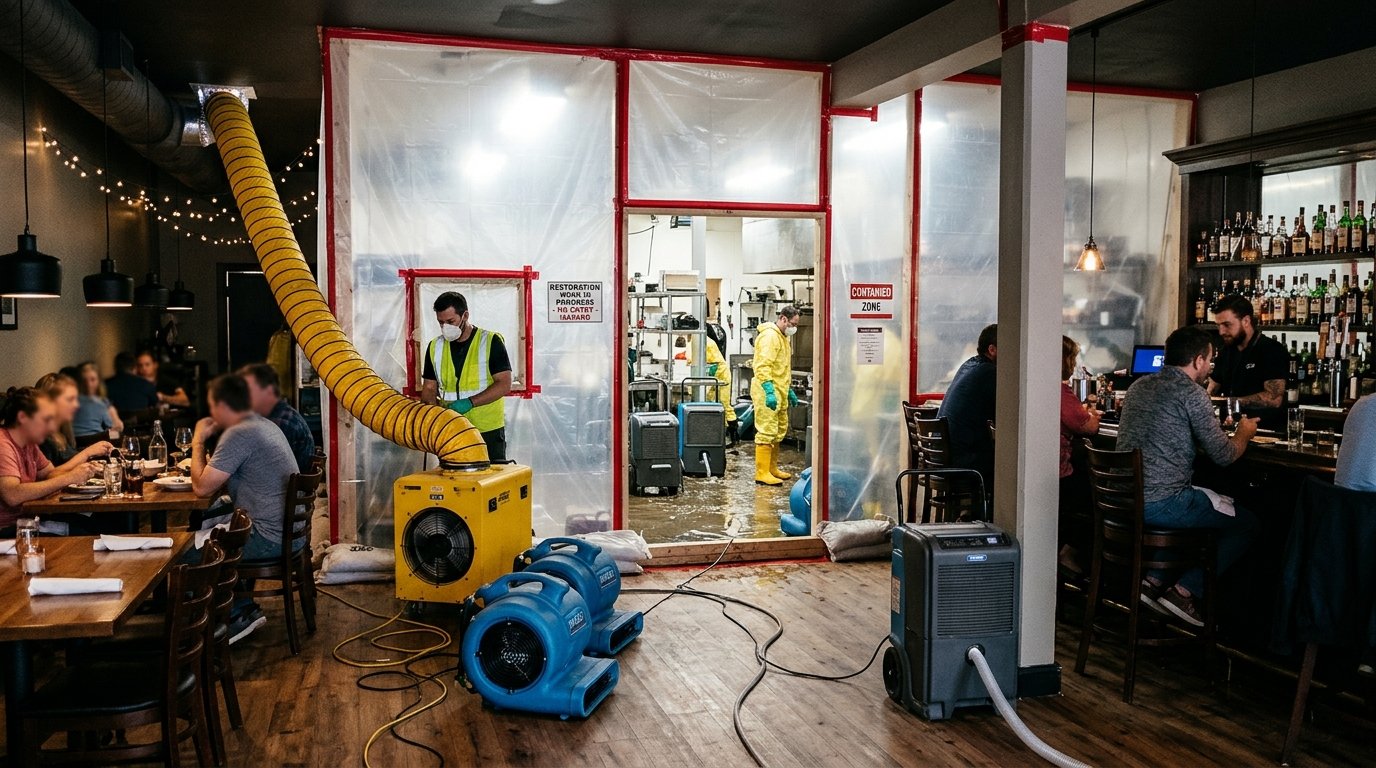
Business ContinuityAirtight negative-air containment barriers allow restaurants to maintain front-of-house bar and dining room revenue while certified restoration crews dry and decontaminate the back-of-house prep line.
Navigating Business Interruption Insurance, Extra Expense & Spoilage
Commercial restaurant insurance policies are far more complex than standard residential homeowners policies. A comprehensive commercial property and casualty package includes distinct coverage components that require precise documentation to maximize your recovery:
Coverage Form
What It Pays For
Critical Policy Nuances & Traps
Essential Documentation Required
Commercial Property (Building & Contents)
Direct physical damage to building structures, kitchen equipment, refrigeration units, booths, and flooring.
Subject to commercial deductible ($2,500–$10,000); requires ACV (Actual Cash Value) vs RCV (Replacement Cost) review.
Itemized Xactimate contractor estimate, manufacturer equipment serial numbers, proof of original purchase.
Business Income (Business Interruption)
Net operating profit lost during the period of restoration, plus continuing payroll, rent, taxes, and supplier contracts.
Usually contains a 48- to 72-hour 'waiting period' deductible before benefits accrue. Requires pre-loss profit margins.
Last 24 months of POS sales reports (Toast, Square, Aloha), profit & loss statements, state sales tax filings.
Extra Expense Coverage
Immediate expenses incurred to avoid or minimize closure time and keep the restaurant partially operational.
No 72-hour waiting period! Covers refrigerated trailer rental, temporary generators, mobile prep stations, overtime labor.
The 6-Step IICRC S500 Food-Service Decontamination Protocol
Remediating a flooded restaurant kitchen requires a sterile, medical-grade approach that meets both international IICRC S500 standards and local public health criteria:
1Airtight Negative Air Containment & Clean Zone Protection
Restoration teams erect temporary 6-mil polyethylene barrier walls using compression poles, sealing off doorways between the kitchen and dining room. Commercial HEPA air scrubbers (filtering 99.97% of particulate down to 0.3 microns) are configured with flexible exhaust ductwork discharging outside via rear alley doors. This establishes continuous negative air pressure, ensuring zero airborne dust, bacteria, or odor molecules enter guest dining or bar areas.
2High-Lift Truck-Mounted Vacuum Water Extraction
Standing water is removed using commercial truck-mounted extraction units operating under 14 inches of mercury vacuum lift. Crews utilize weighted tile wands that compress water out of cracked grout joints, cove base seams, and under heavy refrigeration compressor racks. Waste is pumped directly into sealed truck holding tanks, preventing indoor cross-contamination.
3Equipment Detachment & Sub-Floor Sanitization
Water invariably wicks underneath stainless steel equipment legs, ice machines, and commercial cooking ranges. Technicians safely disconnect quick-connect gas lines and plumbing fixtures, elevating equipment on industrial risers. Trapped grease, food solids, and wastewater beneath equipment are thoroughly power-washed and vacuumed out.
Standard residential biocides containing toxic quaternary ammonium or phenolic compounds cannot be applied indiscriminately in food preparation environments. We utilize EPA-registered, NSF-approved D2-rated food-contact sanitizers (such as stabilized hydrogen peroxide or thymol botanical formulas). These eradicate 99.999% of Listeria monocytogenes, E. coli, and Salmonella without leaving toxic, chemical carcinogen residues on stainless steel prep counters.
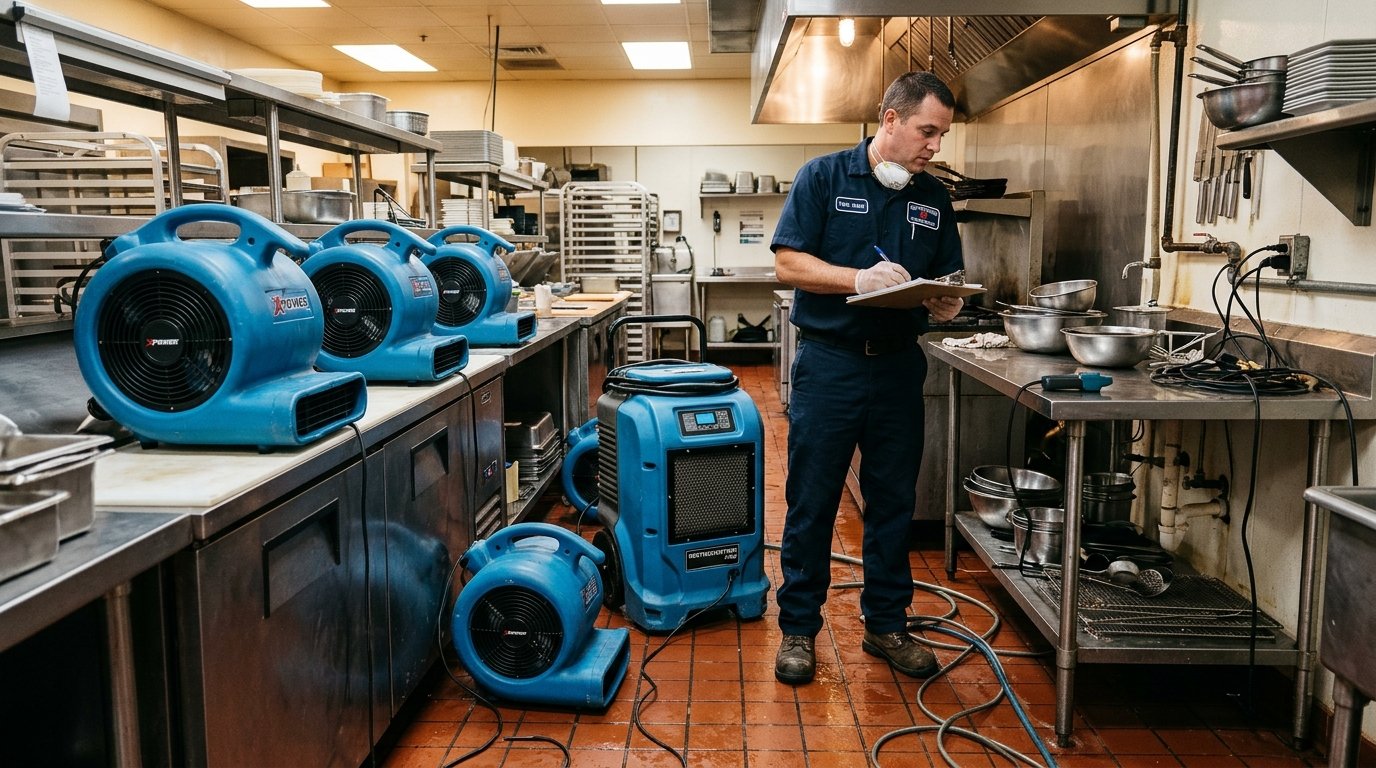
Commercial kitchens present severe drying hurdles: non-porous quarry tiles overlaying saturated concrete slabs, with stainless steel wall flashing trapping moisture behind FRP (Fiberglass Reinforced Plastic) panels. We deploy industrial LGR and desiccant dehumidifiers generating deep vapor pressure differentials (Grains Per Pound < 35 GPP), pulling moisture out through subfloors and wall cavities to return structures to dry equilibrium within 48 to 72 hours.
6Digital ATP Bioluminescence Clearance & Health Certification
Before decommissioning containment, certified supervisors perform digital Adenosine Triphosphate (ATP) bioluminescence surface swab tests across stainless prep lines, cutting tables, cutting boards, and reach-in handles. Results are documented in a formal Certificate of Sanitation and Structural Decontamination, providing verifiable scientific proof for the Maricopa County Health Department inspector.
Hygiene ClearanceATP bioluminescence surface swab testing measures active biological residues in Relative Light Units (RLU), proving food-contact surfaces are sterile and compliant with Maricopa County Environmental Health Code.
Passing the Health Department Re-Inspection & Reopening Checklist
Before you can fire the burners, welcome dining guests, and ring the registers, your local environmental health officer must lift any formal notice of suspension. Ensure your restaurant satisfies every item on this pre-opening audit:
Hot Water Temperature Verification: Verify that your commercial water heating system provides continuous hot water of at least 100°F at all employee handwashing sinks and at least 110°F to 120°F at the 3-compartment pot sink.
Dish Machine Sanitization Validation: For high-temp commercial dish machines, verify final rinse temperatures reach a minimum of 180°F on surface temp-tape test strips. For low-temp chemical machines, verify chlorine sanitizer test strips read between 50 and 100 PPM.
Complete Ice Machine Sanitization & Filter Swap: Empty, discard, and melt all ice inside machines and storage bins. Disassemble interior freeze plates, spray with food-grade biocide, flush the lines, and install brand-new sediment and carbon water filter cartridges.
Cold-Holding Ambient Thermometer Audit: Ensure all walk-in coolers, reach-in lowboys, and chef's prep tables maintain an internal ambient air temperature of 41°F (5°C) or colder for at least two continuous hours before restocked food is placed inside.
Present Professional Restoration Clearance Dossier: Provide the visiting health inspector with your physical copy of the IICRC structural drying logs, ATP swab test results, and waste manifests proving condemned food was safely removed from the premises.
Why Top Arizona Restaurant Groups Maintain Commercial Restoration SLAs
The most successful hospitality groups in Old Town Scottsdale, Downtown Phoenix, and Gilbert do not search Google during a Sunday morning brunch flood. They establish an active Commercial Priority Service Agreement (PSA) with an IICRC-certified restoration partner before disaster strikes.
A commercial PSA provides restaurant operators with guaranteed 45-minute emergency response windows, pre-negotiated commercial labor and drying equipment rates, dedicated refrigerated trailer staging coordination, direct insurance carrier adjuster billing, and priority equipment deployment during Valley-wide monsoon flooding emergencies.
Related Technical Guides
Educational resources for Phoenix & Arizona property owners
Our rapid response units maintain staged equipment yards across Central Phoenix, the East Valley, the West Valley, Pinal County, and Greater Tucson for an average ~42-minute on-site arrival:
Does an active water leak require a restaurant to voluntarily cease operations in Arizona?
Under the Maricopa County Environmental Services Department (MCESD) Environmental Health Code and FDA Food Code § 8-404.11, an establishment must immediately discontinue food operations if an 'Imminent Health Hazard' exists. This includes: (1) An active sewage or black water backup through floor drains; (2) Complete loss of potable running water or lack of 100°F hot water at employee handwashing sinks; (3) Water dripping from ceilings onto open food prep lines, clean dishware, or ice bins; or (4) Contamination of walk-in food refrigeration units. Operating through a biohazard leak results in immediate permit suspension, red-tag closure, and public health citation.
Which food inventory must be discarded and what can be salvaged after water intrusion?
Strict food safety regulations dictate that any unpackaged food, fresh produce, bulk dry ingredients (flour, sugar, rice), or items stored in permeable packaging (cardboard, paper, plastic wrap) that come into direct contact with water—or are exposed to Category 2 or 3 wastewater aerosols—must be immediately condemned and discarded. Only hermetically sealed commercial metal cans and commercially sealed retort pouches may be salvaged, provided labels are removed, containers are immersed in an EPA-registered sanitizing bleach solution, and cans show zero denting or seam corrosion.
How does Business Interruption Insurance compensate a flooded Arizona restaurant?
Business Interruption (BI) insurance reimburses net profit lost during the suspension of dining operations, plus continuing normal operating expenses (including key employee payroll, commercial lease rent, taxes, and supplier debt service). Most commercial policies require a 48- to 72-hour waiting period before BI kicks in. However, 'Extra Expense' coverage takes effect immediately from Day 1 to cover emergency mitigation costs, temporary mobile kitchen trailers, external refrigeration rental, and expediting fees to accelerate reopening.
Can a restaurant remain partially open while restoration crews dry the kitchen?
Yes, under specific compliance conditions. By constructing airtight 6-mil negative-air containment barriers equipped with zippered airlocks and commercial HEPA air scrubbers, restoration crews can isolate the wet kitchen prep line while allowing the front-of-house dining room or bar to operate normally—provided food preparation is moved to an unaffected auxiliary prep kitchen or limited to packaged, pre-cooked catering items approved by the local environmental health inspector.
What are the most frequent causes of commercial kitchen flooding in Phoenix?
The top five causes in Phoenix and Scottsdale restaurants are: (1) High-temperature commercial dishwasher booster heater hose bursts; (2) Grease trap blockages and floor drain surcharges; (3) Ice machine water filtration line failures; (4) Evaporator coil freeze-ups and condensate drain clogs in walk-in freezers during 115°F summer heat; and (5) Kitchen hood fire suppression system false discharges or accidental activation.
How do restoration contractors prove a kitchen is sterile and ready for re-inspection?
Restoration specialists utilize digital ATP (Adenosine Triphosphate) bioluminescence surface swab luminometers to measure microscopic organic residues on stainless steel prep tables, cooking lines, and food equipment. Surfaces must score below food-grade clearance thresholds (typically < 10 to 30 Relative Light Units). This data, combined with thermal moisture verification logs (<15% WME) and EPA-registered food-contact surface sanitization manifests, provides the exact scientific proof Maricopa County health inspectors require to lift suspensions.
How fast can an emergency commercial crew mobilize to a restaurant in Phoenix?
AZ Water Damage Restoration operates a dedicated commercial rapid-dispatch fleet with an average 42-minute on-site arrival window across the Phoenix metro area, 24/7/365. For high-volume restaurant clients, our priority response protocol focuses on overnight water extraction and high-capacity desiccant drying so breakfast and lunch operations can proceed on schedule.
IICRC-certified restoration technicians · Phoenix metro
Written and fact-checked by the licensed crew that runs the trucks — the same technicians who take moisture readings, set drying chambers to the IICRC S500 standard, and answer the phone at 2 a.m. across the Phoenix metro.
Licensed Arizona contractor — AZ ROC #331127 (KB-2)