Industrial facilities and mega-distribution warehouses present unique physical physics during a water loss: millions of cubic feet of high-bay air, thousands of square feet of saturated industrial concrete, delicate palletized inventory, and around-the-clock supply chain schedules. Here is the engineering guide to large-loss industrial restoration.
Last updated:Reading time:18 minStandards:IICRC S500 Verified
When water intrudes into a high-bay logistics warehouse or manufacturing plant, every hour of supply chain delay costs tens of thousands of dollars in carrier detention fines and missed fulfillment service level agreements (SLAs). Conventional commercial drying equipment cannot control high-bay cubic airspace: trailer-mounted industrial desiccant dehumidifiers (5,000 to 15,000+ CFM) are mandatory to create deep grain depression. Mitigation priorities center on immediate pallet rack structural stabilization to prevent collapsed inventory loads, overhead layflat duct routing that keeps forklift traffic lanes operational, and ASTM F2170 in-situ relative humidity testing to ensure 8-inch concrete slabs do not destroy replacement epoxy floor coatings.
The Physics of High-Bay Drying: Trailer Desiccants vs. Standard LGRs
The most common mistake facility managers make during an industrial flood is attempting to dry a 200,000-square-foot distribution center using portable commercial Low-Grain Refrigerant (LGR) dehumidifiers. While LGR units excel in residential rooms and enclosed commercial offices, they fail completely in high-bay industrial architecture.
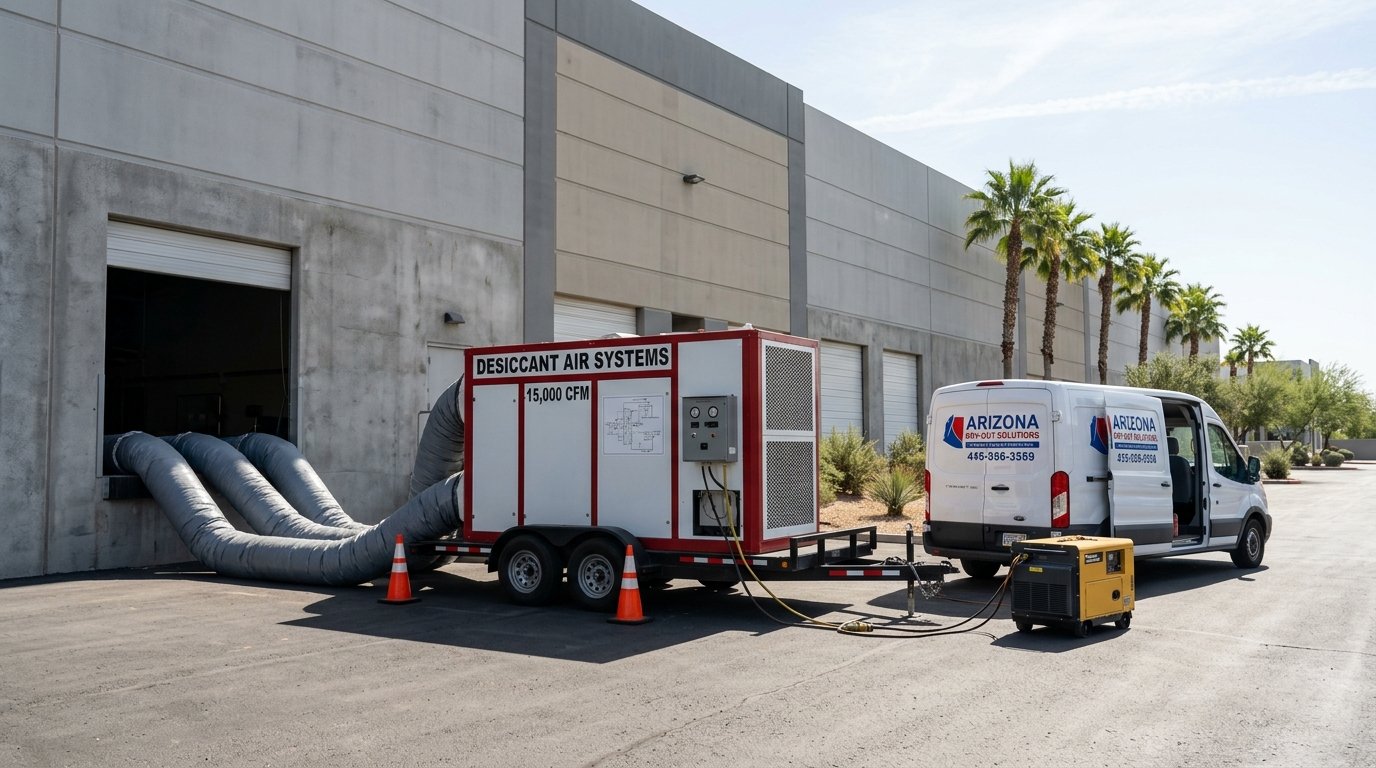
Consider the cubic geometry: a 150,000-square-foot warehouse in Tolleson or Goodyear with a 36-foot clear height contains 5.4 million cubic feet of air. Standard LGR units condense moisture by chilling air below its dew point. As relative humidity drops below 40%, condensation efficiency plummets. In contrast, industrial desiccant dehumidifiers use rotating honeycomb wheels impregnated with silica gel to chemically absorb water vapor directly from the air regardless of ambient temperature:
Performance Parameter
Trailer-Mounted Industrial Desiccant
Commercial Low-Grain Refrigerant (LGR)
Impact on Warehouse Restoration
Airflow Capacity
5,000 to 18,000+ CFM per mobile trailer
300 to 500 CFM per portable rolling unit
One trailer desiccant replaces 25 to 40 rolling units, eliminating floor clutter.
Supply Air Grain Depression
Down to 5 to 15 Grains Per Pound (GPP)
Down to 35 to 45 Grains Per Pound (GPP)
Desiccant generates extreme vapor pressure differentials that pull deep moisture from 8" concrete slabs.
Temperature Operational Range
Operates effectively from 0°F to 120°F
Severely drops efficiency below 65°F or above 90°F
Desiccants maintain continuous drying during intense Arizona summer heat or unheated winter storage.
Primary Failure Points in Arizona Industrial Logistics Facilities
In modern Class-A industrial logistics parks across the Phoenix West Valley (Goodyear, Buckeye, Tolleson, Glendale) and the East Valley (Mesa, Chandler, Gilbert), water intrusions stem from high-energy commercial utility failures:
Forklift ESFR Sprinkler Head Mast Strikes
The #1 cause of catastrophic warehouse flooding occurs when an operator elevates a turret truck or reach forklift mast into an Early Suppression Fast Response (ESFR) sprinkler head. Discharging at 60+ PSI, the severed head unleashes over 100 GPM of dark, black stagnant water laced with iron pipe scale, flooding 30,000 square feet of racking within 25 minutes.
Monsoon Parapet Roof Scupper Overflows
Desert monsoon microbursts drop 2.5 inches of rain within 40 minutes across sprawling flat metal warehouse roofs. When desert dust, tumbleweeds, or bird debris block parapet scuppers, water ponds up to 6 inches deep, exceeding structural live-load capacity and cascading through mechanical expansion joints directly onto inventory below.
Loading Dock Pit Sump Pump Failures
Sub-grade loading dock truck wells collect runoff from paved yard aprons. When electrical storms trip circuit breakers or sump pumps fail, dock wells fill like retention basins. Water breaches roll-up dock door seals, pouring into low-level staging zones and hydraulic dock leveler pits.
Chilled Water Loop & Ammonia Refrigeration Leaks
In cold storage facilities and automated manufacturing plants, heavy vibration shears overhead chilled glycol or water lines. Pressurized glycol water rapidly penetrates polyurethane insulated sandwich panels and destroys sensitive automated sorting electronics.
Large-Loss Desiccant PowerHigh-volume trailer-mounted desiccant dehumidifiers deliver up to 15,000 CFM of ultra-dry air, driving vapor pressure gradients that pull deep moisture out of thick industrial concrete subfloors.
In an industrial distribution loss, inventory preservation is the core economic priority. Corrugated fiberboard shipping cartons are hygroscopic materials that act like high-capacity sponges:
Inventory Damage Level
Physical Inspection Criteria
Salvage Action Protocol
Insurance Disposition Strategy
Direct Submersion (>2 inches water)
Bottom cartons visibly saturated; water line evident on product; cardboard de-plying.
Immediate condemnation; restock impossible due to structural failure and biological risk.
Full replacement value claim; inventory waste manifest; certificate of destruction required.
Capillary Wicking (0.5 to 2 inches water)
Pallet wood wet; moisture wicked up bottom 4–8 inches of carton; product internal seal intact.
Emergency depalletization: re-box dry product into new cartons; discard damp exterior shipping packaging.
Claim reimbursement for re-boxing labor, replacement cartons, and expedited freight under Extra Expense.
Elevated Ambient Humidity Exposure
No direct liquid water contact; packaging exposed to >80% RH for >24 hours; hygroscopic absorption.
Deploy industrial desiccant air streams directly into pallet racking aisles; test product moisture content.
Coverage under business interruption if pharmaceutical or food safety humidity thresholds were breached.
Palletized Inventory Triage and Salvage Assessment Framework.
When bottom tier cardboard cartons absorb water, their compressive strength drops by up to 85%. A standard 2,000-lb pallet loaded three or four tiers high will suddenly crush on one side, causing the entire stack to tilt violently against adjacent pallet racks. Never permit forklift operators to enter aisles with leaning, waterlogged pallets.Crews must use safety tethers and de-stack compromised pallets from top to bottom before floor clearance commences.
Warehouse floors are typically 6-inch to 10-inch unreinforced or fiber-reinforced industrial concrete slabs designed to support heavy point-loads from multi-tier pallet rack uprights and 12,000-lb forklift wheel loads. Concrete is porous: capillary networks draw standing water deep into the slab matrix.
Once surface standing water is removed, the slab remains saturated. If drying is halted prematurely:
Moisture Vapor Emission Rate (MVER) Spikes: As water evaporates upward, vapor pressure forces moisture through the surface. MVER rates exceeding 5 to 15 lbs / 1,000 sq ft / 24 hours will rapidly delaminate epoxy safety striping and protective sealers.
Efflorescence & Salt Crystallization: Water dissolves sub-base alkali salts, depositing white crystalline powder on the surface that creates slippery floor hazards and clogs sensitive optical automated guided vehicle (AGV) guidance sensors.
Forklift Tire Traction Loss: Damp concrete surfaces reduce tire friction coefficients by up to 60%, creating severe skidding and collision risks for heavy high-speed forklifts.
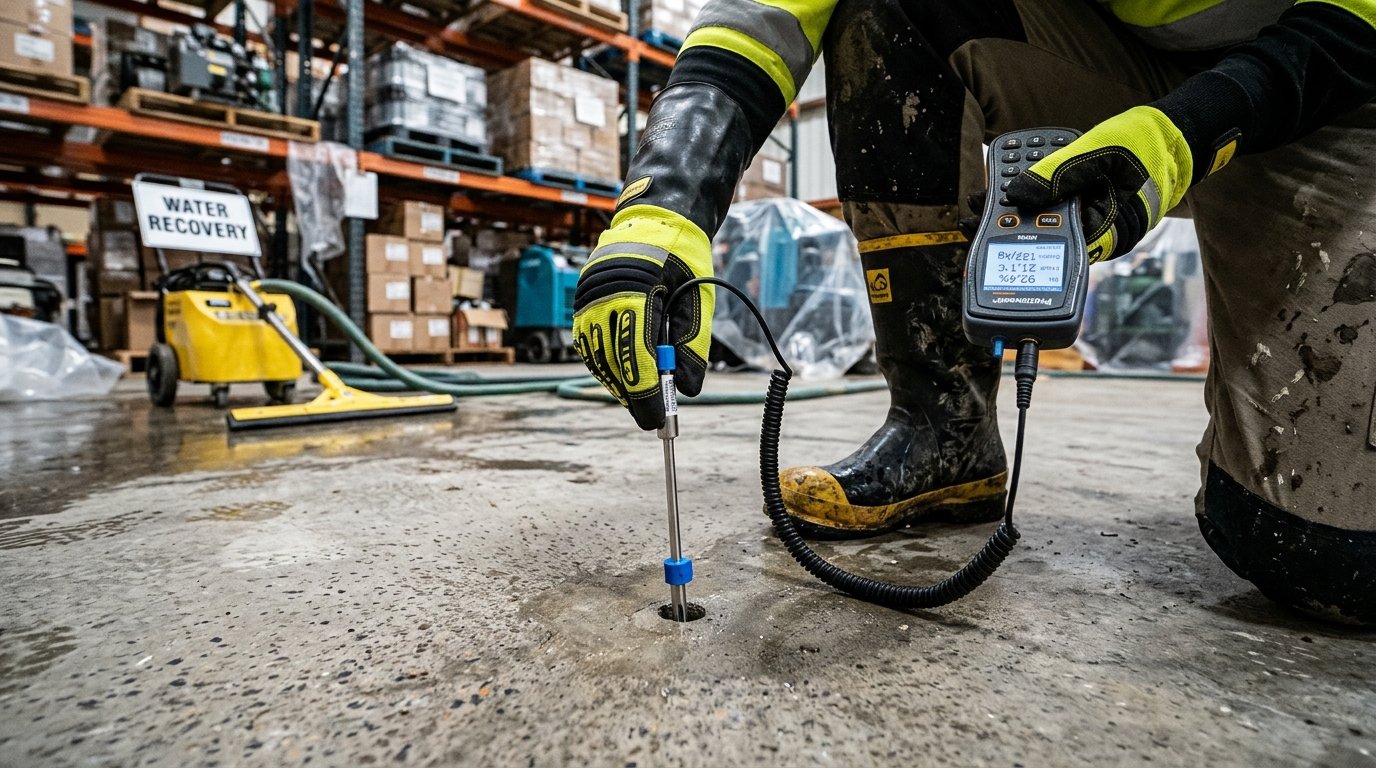
ASTM F2170 Slab RH TestingRestoration technicians measure deep internal slab equilibrium with ASTM F2170 in-situ probes, verifying relative humidity drops below 75% RH before re-coating or loading heavy inventory.
Professional industrial restorers verify complete slab equilibrium using ASTM F2170 standard in-situ relative humidity probes. Technicians drill core test holes into the slab at 40% depth, insert electronic relative humidity sensors, and monitor internal moisture until readings fall below 75% to 80% RH.
Industrial water damage claims involve complex multi-policy structures. Facility managers and risk directors must understand which policy responds to each facet of the disaster:
Insurance Policy Type
What It Covers
Critical Claim Considerations
Required Carrier Documentation
Commercial Property Policy
Physical building structure: roof deck, tilt-up concrete walls, electrical busways, dock doors.
Subject to large commercial deductibles ($25,000–$100,000); requires Xactimate commercial pricing.
Why Major Arizona 3PL & Logistics Hubs Maintain Commercial PSAs
In the logistics corridor between Phoenix Sky Harbor, the Loop 303 West Valley industrial zone, and the I-10 distribution spine, leading 3PL operators and corporate facility directors maintain an active Commercial Priority Service Agreement (PSA)with AZ Water Damage Restoration.
An industrial commercial PSA provides:
Guaranteed 45-Minute Emergency Response: Heavy-duty extraction and stabilization units rolling 24/7/365.
Pre-Staged Trailer Desiccant Allocation: Priority reservation of 5,000 to 15,000+ CFM desiccant units and temporary 480V diesel generators during widespread monsoon storm flooding events.
Pre-Negotiated Industrial Cooperative Rates: Pre-approved Xactimate rate schedules that eliminate emergency bidding delays and disputes with commercial insurance adjusters.
OSHA & Facility Safety Orientation On File: Technicians trained in industrial forklift aisle safety, lockout/tagout (LOTO), and high-bay scissor lift operations.
Related Technical Guides
Educational resources for Phoenix & Arizona property owners
Our rapid response units maintain staged equipment yards across Central Phoenix, the East Valley, the West Valley, Pinal County, and Greater Tucson for an average ~42-minute on-site arrival:
Why can't standard commercial dehumidifiers dry a high-bay industrial warehouse?
Cubic volume physics makes conventional residential and commercial Low-Grain Refrigerant (LGR) dehumidifiers ineffective in industrial facilities. A typical 100,000-square-foot distribution center with a 32-foot clear height contains over 3.2 million cubic feet of air. LGR units lose moisture removal efficiency as indoor relative humidity drops. Industrial restoration requires trailer-mounted desiccant dehumidifiers (rated between 5,000 and 15,000+ CFM) that use chemical silica gel wheels to deliver deep vapor pressure depression, driving air below 15 Grains Per Pound (GPP) to pull moisture from thick concrete slabs.
How much water does an accidental ESFR fire sprinkler head strike discharge?
Early Suppression Fast Response (ESFR) fire sprinkler systems are engineered to extinguish high-piled pallet rack fires with massive hydraulic flow. Operating at 50 to 75 PSI, a single sheared ESFR sprinkler head discharges between 100 and 125 gallons of water per minute. In the 20 to 30 minutes it typically takes on-site personnel to locate the riser control valve and drain the system, over 2,500 to 3,750 gallons of stagnant, black fire-system water floods the facility floor.
What happens to palletized inventory when a warehouse floor floods?
Corrugated cardboard exhibits powerful capillary wicking. Even in 1 inch of standing water, cardboard packaging wicks water vertically up to 12 to 18 inches within 4 hours. As bottom cartons absorb moisture, their stacking strength drops by up to 85%, causing multi-tier pallet racking loads to buckle and lean. Unstable pallets create catastrophic tip-over hazards for forklift operators and destroy wholesale consumer goods.
Why is concrete slab moisture vapor emission dangerous after water extraction?
Industrial slabs are 6 to 10 inches thick and can absorb tens of thousands of gallons of water during a flood. Once surface water is extracted, that moisture slowly travels back to the surface as Moisture Vapor Emission Rate (MVER). Elevated vapor emissions cause forklift drive tires to lose traction, delaminate epoxy aisle markings, corrode sensitive robotic sorting machinery, and create hidden mold colonization beneath shrink-wrapped inventory pallets.
How do restoration contractors maintain forklift traffic and supply chain operations during drying?
Large-loss industrial restorers use engineered logistics planning: (1) Canvas layflat ducting is suspended overhead from ceiling bar joists rather than laid across floors; (2) Power distribution cords utilize heavy-duty rubber cable crossover ramps rated for 10,000-lb forklift axle weights; and (3) Facility drying is zoned into phases, allowing order pickers and reach trucks to access clean picking aisles without interruption.
How quickly can emergency large-loss industrial equipment arrive in Phoenix, Goodyear, and Tolleson?
AZ Water Damage Restoration operates heavy-duty rapid-response commercial fleets stationed near major logistics corridors along I-10, Loop 101, Loop 202, and Loop 303. Initial emergency extraction and containment units arrive in an average of 42 minutes, with high-capacity trailer-mounted desiccant dehumidifiers and temporary power generators mobilized on-site within 2 to 4 hours.
IICRC-certified restoration technicians · Phoenix metro
Written and fact-checked by the licensed crew that runs the trucks — the same technicians who take moisture readings, set drying chambers to the IICRC S500 standard, and answer the phone at 2 a.m. across the Phoenix metro.
Licensed Arizona contractor — AZ ROC #331127 (KB-2)