Structural drying is more than just running fans. It is a precise psychrometric cycle of evaporation and dehumidification that saves homes from permanent damage.
Last updated:Reading time:18 min readStandards:IICRC S500 Verified
Structural Drying · How Professional Equipment Works · Phoenix metro
Table of contents▾
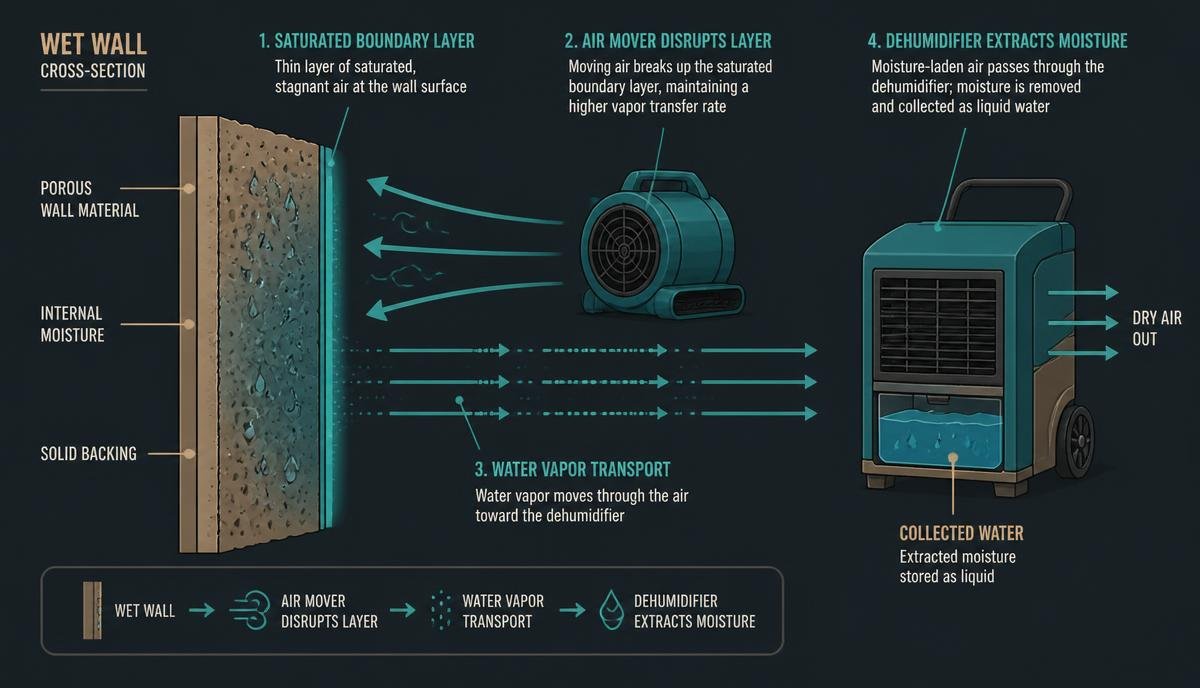
Structural drying works through a mechanical cycle of evaporation and dehumidification: air movers disrupt the saturated "boundary layer" of air at the surface of wet materials, while industrial-grade dehumidifiers extract that moisture from the environment to maintain the vapor pressure differential required for deep drying.
The Two-Part Science: Evaporation and Dehumidification
Successful structural drying is never about a single piece of equipment; it is about managing a loop. First, professional air movers force moisture out of saturated materials (evaporation). Second, industrial dehumidifiers remove that moisture from the air (dehumidification).
Neither step works effectively in isolation. If you run fans without a dehumidifier, you are simply moving moisture from your floor into your air, creating a "human terrarium" where mold thrives. If you run a dehumidifier without air movers, the moisture remains trapped deep inside your building materials.
A key concept here is the boundary layer: a thin, saturated film of still air that clings to any wet surface. This layer acts as a barrier, preventing further evaporation. Air movers are specifically designed to disturb this layer, allowing the drying process to continue.
The CycleAir movers break the saturated boundary layer at the surface; the dehumidifier removes the released vapor from the air.
Why Household Fans Don't Actually Dry Water Damage
The most common mistake homeowners make is assuming a few box fans or pedestal fans can handle a water loss. The difference isn't just "power"—it's the physics of airflow.
Equipment Type
Approx. CFM
Static Pressure
Primary Use
Household Box Fan
100–1,000
Minimal / None
Surface cooling only
Professional Air Mover
600–4,000+
High Capacity
Deep structural drying
CFM (Cubic Feet per Minute) and Static Pressure comparison between retail and professional gear.
Static pressure is the force required to push air through resistance. In a water damage scenario, that resistance includes wet carpet padding, subfloor gaps, and wall cavities. Household fans have almost zero static pressure; they can move air across a room, but they cannot move air into the materials that actually need drying.
Air Movers: Centrifugal vs. Axial
Restoration professionals typically bring two types of air movers to a job site. Understanding the difference is key to a fast dry time.
Airflow Pattern
Best Use Case
Primary Strength
Typical CFM
Centrifugal ('Snail')
Cabinets / Baseboards
Focused High Pressure
600–1,500
Axial (Large Volume)
Open Room / Large Space
Mass Circulation
2,000–4,000+
Choosing the right tool for specific structural geometry.
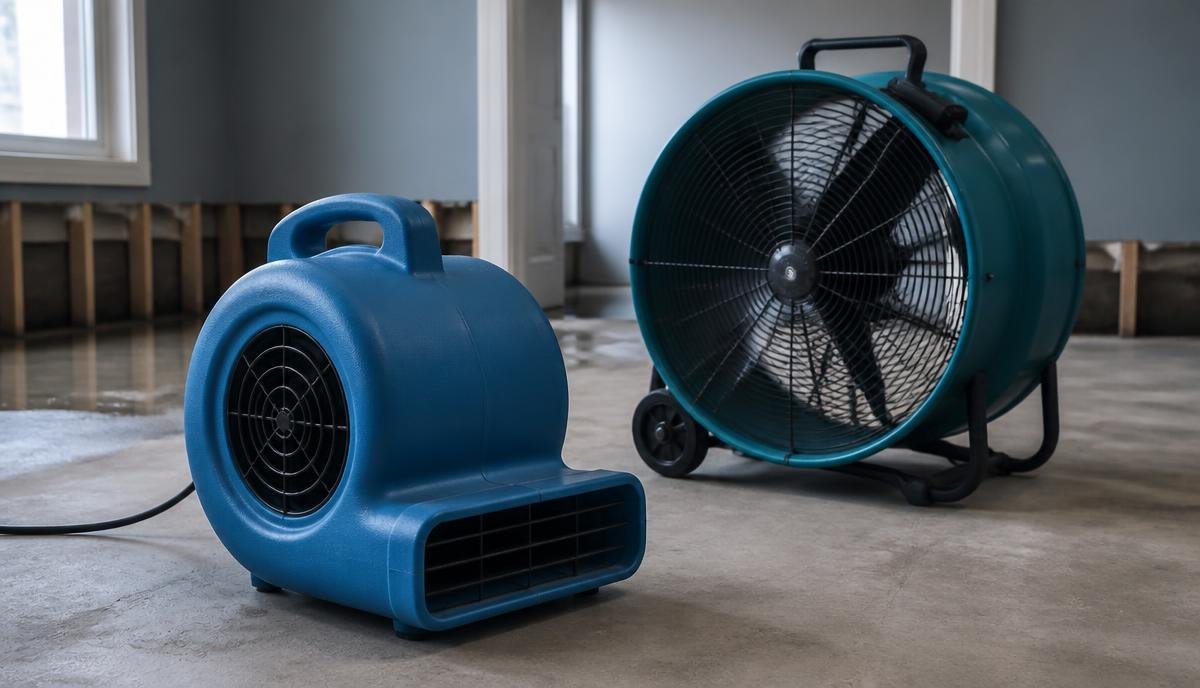
Centrifugal fans create a focused jet of air, ideal for targeting specific wet spots or pushing air into cavities. Axial fans move massive volumes of air for general circulation across an entire room. We typically use a combination of both to create a complete drying environment.
Air MovementA centrifugal 'snail' air mover (left) for focused pressure and an axial fan (right) for whole-room circulation.
Dehumidifiers: Not All the Same
If the air movers are the "engine" of evaporation, the dehumidifier is the "exhaust system" that removes the waste (moisture). There are three primary types used in the industry:
Refrigerant Dehumidifiers
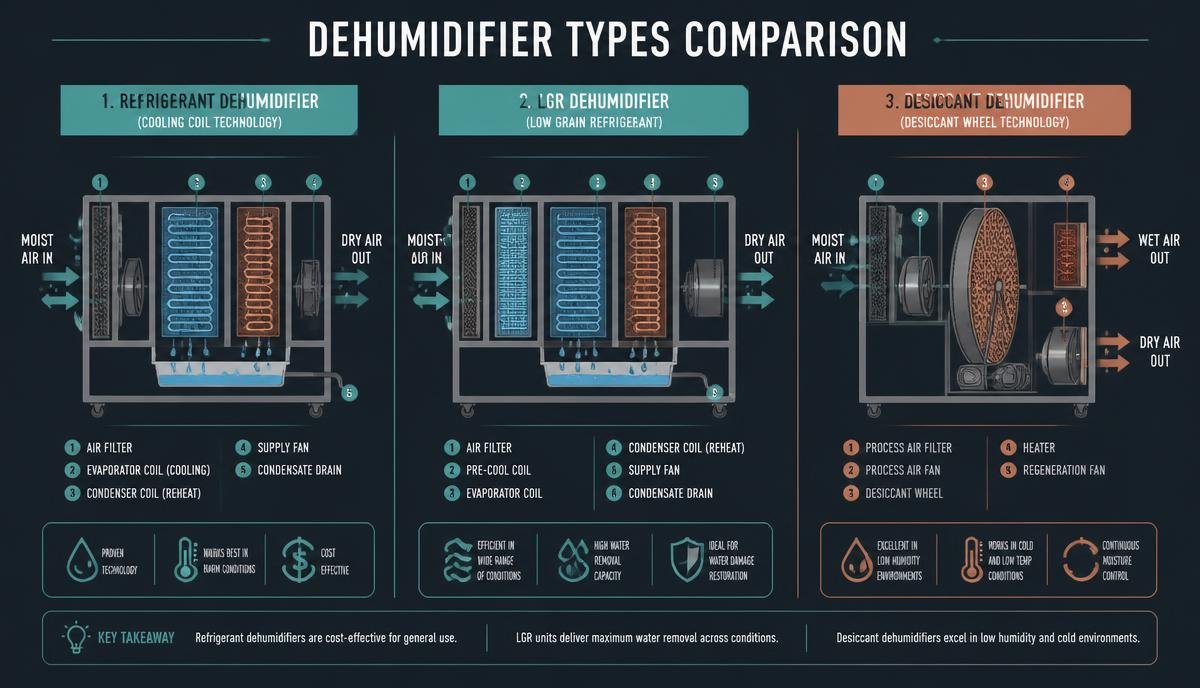
These work much like your air conditioner: they cool the air below its dew point (the temperature at which air becomes saturated), causing moisture to condense onto coils and drain away. They are highly efficient in typical residential conditions.
LGR (Low-Grain-Refrigerant) Dehumidifiers
LGR units are a more aggressive design. They pre-cool the air before it hits the condensing coils, allowing them to remove more moisture in lower-humidity environments. These are the gold standard for rapid structural drying.
Desiccant Dehumidifiers
These don't use refrigeration at all. Instead, they use a moisture-absorbing material (a desiccant) to pull water from the air. These are most effective in very cold temperatures or when extremely low humidity (ultra-deep drying) is required.
Type
How It Works
Best Use Case
Refrigerant
Cooling / Condensing
Standard residential humidity
LGR
Advanced Pre-Cooling
Rapid, high-volume drying
Desiccant
Absorbent Material
Cold climates or deep industrial dry
DehumidificationRefrigerant, LGR and desiccant units remove moisture in fundamentally different ways.
The Science Behind the Numbers: Psychrometrics
IICRC-certified technicians don't guess when a room is dry; they use psychrometrics—the science of thermodynamic properties of moist air. Here are the numbers that actually matter:
Dew Point: The temperature at which air can no longer hold its water vapor and begins to condense.
Relative Humidity (RH): How much moisture the air is holding relative to its maximum capacity at its current temperature.
Grain Depression: The difference in humidity between the air going into a dehumidifier and the air coming out. This is a direct measure of how well the machine is working.
Vapor Pressure Differential: The "pressure gradient" that drives moisture out of wet materials and into the drier air.
Temperature plays a critical role here. Raising the air temperature by just 10°F roughly doubles its moisture-holding capacity. This is why you'll often see our technicians targeting a working range of 70-90°F—it isn't just about heat, it's about increasing the air's ability to act as a sponge.
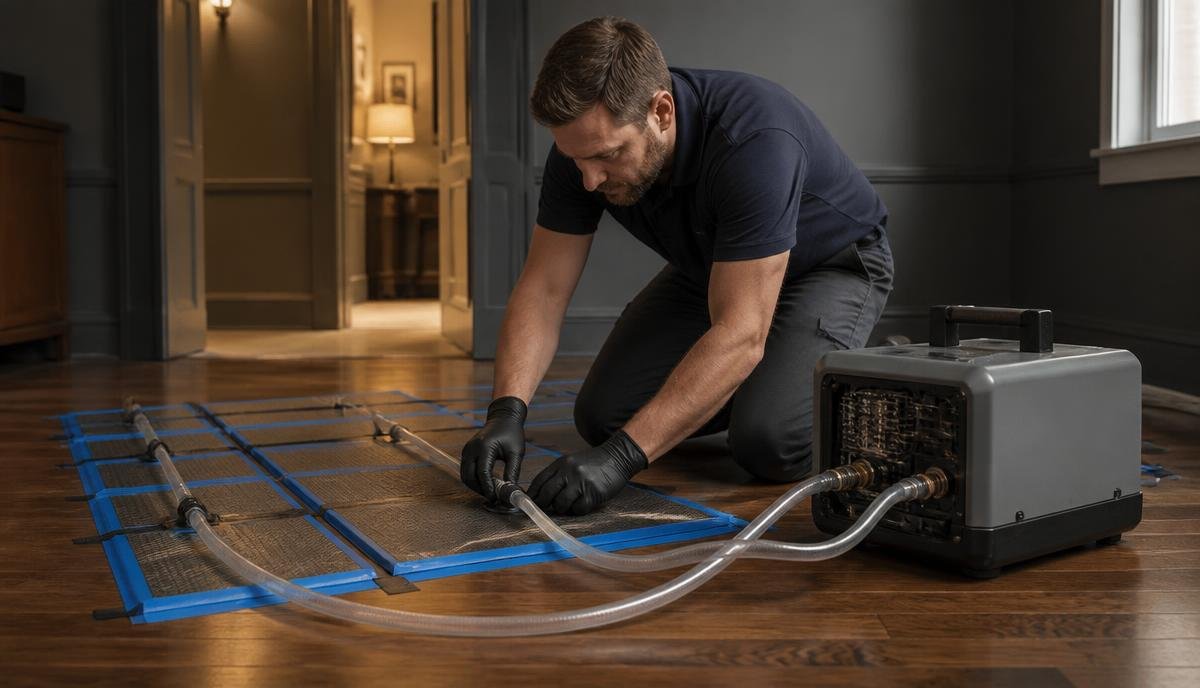
Standard fans can't reach moisture trapped behind a finished wall or under a solid hardwood floor. In these cases, we use specialty equipment like Injectidry systems. These use hoses and panels connected to small access points to push dry air directly into the cavity, often allowing us to save materials that would otherwise require demolition (see our complete guide on how to save water-damaged hardwood floors).
Specialty DryingMat-and-hose floor drying systems pull moisture straight out of hardwood, often avoiding demolition.
How Professionals Place Equipment: The Drying Vortex
Placement is a science. We arrange equipment to create a drying vortex—a continuous, circular flow of air that sweeps across every wet surface. Pointing a fan randomly at a wet spot is far less effective than creating a coordinated system.
We calculate the number of units needed based on room size, material saturation, and water category, governed by IICRC S500 standards. You can see how this fits into the broader project in our day-by-day restoration timeline.
Does Phoenix's Climate Change the Drying Strategy?
Yes. In the Arizona desert, we have a unique advantage: our naturally low ambient humidity.
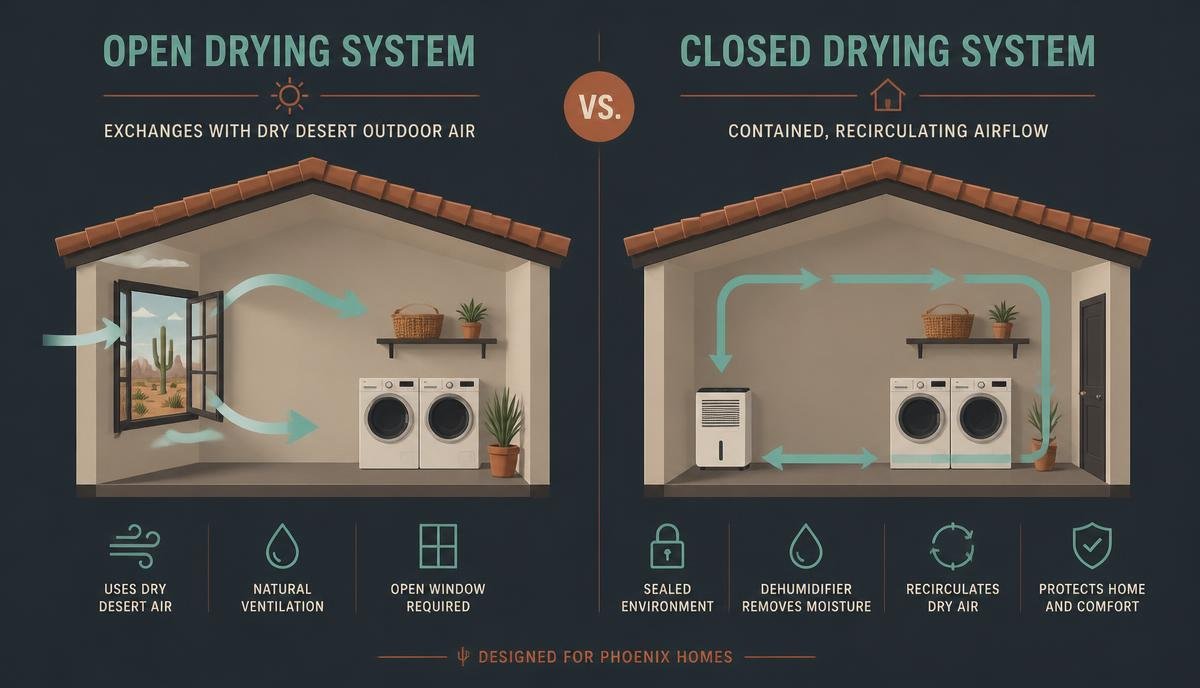
Open vs. Closed Drying Systems
An open system allows some air exchange with the outdoors. In Phoenix, outside of monsoon season, our outdoor air is often drier than the air inside a flooded home. For clean-water (Category 1) losses, we can sometimes use this to our advantage.
Why Monsoon Season Flips This Reasoning
During monsoon season, or whenever we deal with Category 2 or 3 (contaminated) water, a closed system is mandatory. Monsoon humidity works against us, and contaminated water requires strict containment. In these cases, we rely 100% on our industrial dehumidification suite.
Phoenix ClimateDry desert air can assist an open system; monsoon humidity and contaminated water demand a closed system.
How Professionals Know When a Room Is Fully Dry
We don't stop when a surface "feels" dry. We stop when the material reaches its dry standard. We take moisture readings from unaffected reference areas in your home (a "dry" wall in another room) and continue drying until the affected materials match those baseline readings.
Common Mistakes That Slow Down Drying
Aerosolizing Contaminants: Running fans before full water extraction is complete.
The Human Terrarium: Skipping the dehumidifier and running fans alone.
Electrical Overload: Plugging too much industrial equipment into residential circuits.
Early Removal: Taking equipment out because it "looks dry" before the moisture meters confirm it.
Key Takeaways
Loop Dynamics: You need both air movement (evaporation) and dehumidification (extraction).
Physics Matters: Static pressure is what dries building materials, not just wind speed.
Phoenix Advantage: Local climate affects whether an open or closed system is best.
Verified Dry: Only moisture meters—not your hands—can tell if a wall is truly dry.
Need Structural Drying in Phoenix?
AZ Water Damage Restoration provides 24/7 emergency response throughout the valley. We handle the documentation and the drying using IICRC-certified equipment. Our full restoration process covers everything from extraction to final rebuild.
Our rapid response units maintain staged equipment yards across Central Phoenix, the East Valley, the West Valley, Pinal County, and Greater Tucson for an average ~42-minute on-site arrival:
Structural drying uses a combination of high-volume air movement to speed up evaporation from wet materials and commercial-grade dehumidification to remove that moisture from the air, creating a dry-air cycle that pulls moisture out of the structure.
Why can't I just use household fans to dry water damage?
Household fans lack the static pressure required to push air into dense materials like saturated subfloor or wall cavities. They move air in an open room but cannot force moisture out of the structural components, and running them without a dehumidifier can simply increase humidity and mold risk.
What's the difference between air movers and regular fans?
Air movers are industrial equipment designed for high static pressure and specific airflow patterns, such as focused jets for floor drying or wide-pattern movement. Household fans generally don't move enough air (CFM) or overcome the resistance needed to dry a saturated structure.
How do professionals know when a room is fully dry?
Professionals use moisture meters to compare the moisture content of affected materials against the readings of similar, unaffected reference areas in your home, ensuring the materials return to a true 'dry standard' rather than relying on guesswork.
What is a drying vortex?
A drying vortex is a specialized equipment placement strategy where air movers are positioned to create a continuous, circular flow of air sweeping across every affected surface, maximizing the efficiency of the evaporation-dehumidification loop.
Does temperature affect how fast water damage dries?
Yes. Raising air temperature significantly increases the air's moisture-holding capacity. Professionals typically target a temperature range of 70-90°F during the active drying phase to optimize the drying rate without creating secondary damage.
About the author
AZ Water Damage Restoration Team
IICRC-certified restoration technicians · Phoenix metro
Written and fact-checked by the licensed crew that runs the trucks — the same technicians who take moisture readings, set drying chambers to the IICRC S500 standard, and answer the phone at 2 a.m. across the Phoenix metro.
Licensed Arizona contractor — AZ ROC #331127 (KB-2)