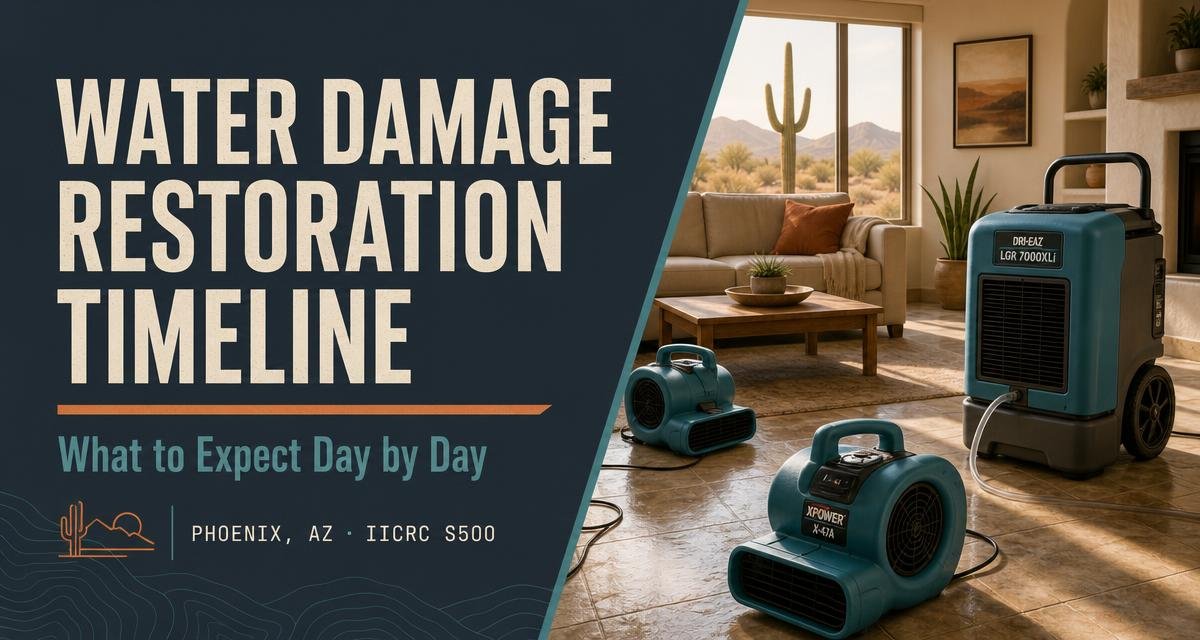
Drying usually takes three to five days. The full project usually takes one to six weeks. Here is exactly what happens on each of those days — and why the equipment keeps running after the floor feels dry.
Last updated:Reading time:12 minStandards:IICRC S500 Verified
Water Damage Restoration Timeline · Day by Day · Phoenix metro
Table of contents▾
Most water damage restoration projects follow the same arc: three to five days of structural drying, then one to six weeks of repairs. Minor to moderate damage is typically finished start to finish in one to three weeks; significant damage runs four to eight weeks or longer. Drying ends when moisture readings confirm the dry standard — not on a fixed date.
If you want the fundamentals first — what the process is, what the categories mean, what it costs — start with our full guide to what water damage restoration involves. This article assumes you already have the basics and want the practical, day-by-day detail.
The Short Answer: Timeline at a Glance
Every water loss is different, but the phases and their durations are remarkably consistent. Use this as your mental map for where you are in the project.
Phase
Typical duration
Emergency response & water extraction
Same day — first 2 to 8 hours on site
Active drying & dehumidification
3 to 5 days (7 to 10+ for dense materials)
Removal of unsalvageable materials
Day 1 to day 3, usually a few hours per area
Mold prevention & assessment
Concurrent with drying; +2 to 5 days if mold is found
Reconstruction & repairs
1 to 8+ weeks depending on scope
Final inspection & documentation
1 day, after final moisture readings pass
Typical total — minor to moderate damage
1 to 3 weeks
Typical total — significant damage
4 to 8+ weeks
Water damage restoration timeline at a glance
Day 1: Emergency Response, Inspection & Water Extraction
Day 1 is about stopping the loss and removing every gallon that can be physically removed. On a normal residential job, a crew is on site within the hour, and extraction, inspection, and equipment placement are all finished the same day.
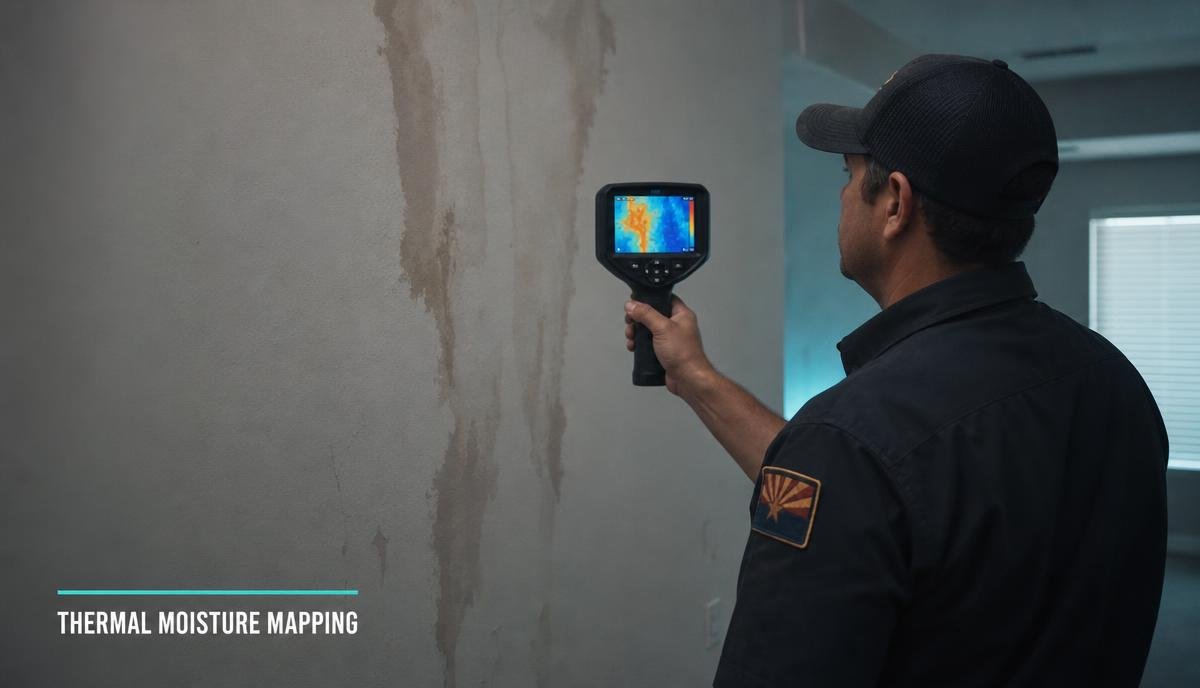
The first task is the source — a supply line, a slab leak, a failed water heater, a roof entry point. Nothing else matters until water stops arriving. From there, the technician performs moisture mapping: measuring the moisture content (the percentage of water by weight inside a material) across floors, walls, and framing to draw the real boundary of the loss, which is almost always wider than the wet spot you can see.
Thermal imaging — an infrared camera that reads surface temperature differences — flags cool patches where evaporating moisture sits behind drywall or under tile. It doesn't "see water," it sees the temperature signature water leaves, and every suspicious area is then confirmed with a meter.
Day 1 / Moisture mappingDay 1: thermal imaging plus meter readings define the true edge of the loss before any equipment is placed.
The technician also classifies the water. Category 1 is clean water from a supply line. Category 2 (gray water) carries contamination — washing machine discharge, dishwasher overflow. Category 3 (black water) is grossly contaminated: sewage, toilet backups beyond the trap, or floodwater. Category drives how much material can be saved, and Class 1 through 4 describes how much material is wet, which drives how much equipment the job needs.
Then extraction begins. Truck-mounted and portable units pull standing water and, just as importantly, the water absorbed into carpet, pad, and subfloor. Removing water mechanically is dramatically faster than evaporating it, so this step alone often decides whether the job dries in four days or eight. See our emergency extraction and mitigation service for how that first visit is scoped.
Days 1–5: Structural Drying & Dehumidification
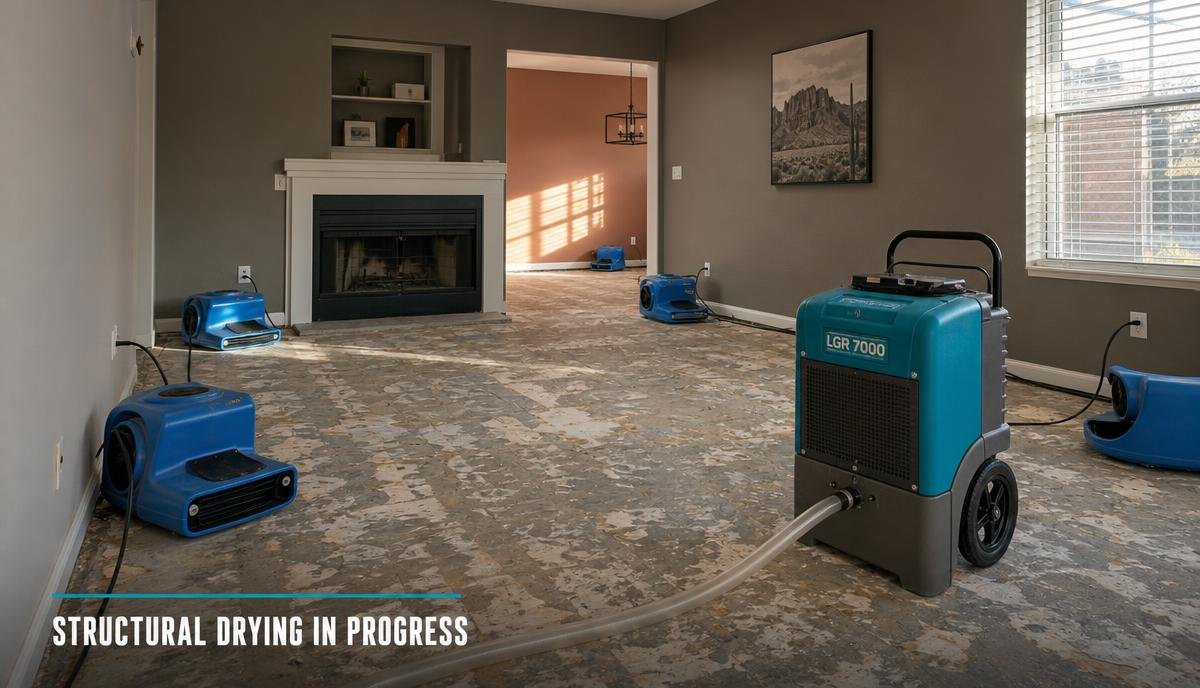
Structural drying is the heart of the water damage restoration process timeline, and it typically takes three to five days. It is a controlled evaporation process governed by psychrometry — the science of how air temperature, humidity, and airflow interact to move water out of materials and into the air, where a dehumidifier can remove it.
Days 1–5 / Structural dryingA drying chamber: air movers sweep the surface, LGR dehumidifiers pull the released moisture out of the air.
Day 1: Equipment Placement & Initial Evaporation
On day 1 the equipment is not drying your house yet — it is building the environment that will. Air movers are aimed at low angles to break the thin layer of saturated air clinging to wet surfaces, and LGR (low grain refrigerant) dehumidifiers begin pulling that released moisture out of the room air.
This is why materials still feel wet at the end of day 1 and why the room may feel warm and humid. Water has to leave the material before it can leave the building, and the first several hours are spent making the air dry enough for that transfer to happen quickly. Our structural drying and dehumidification workis documented from this point forward with daily psychrometric readings.
Days 2–3: Moisture Migration & Daily Monitoring
Days 2 and 3 are monitoring days: a technician returns each day, takes readings at the same marked points, adjusts equipment, and logs the trend. Progress is measured in numbers, not impressions.
Expect some readings to go up. As surface moisture leaves, water held deeper inside framing, subfloor, or a wall's bottom plate migrates outward toward the drier surface. A spot that read 18% on day 1 can read 21% on day 2. That is moisture migration doing exactly what it should — not a new leak, and not a sign the job is failing.
Daily visits also catch the surprises: a cabinet toe kick still holding water, insulation that isn't releasing, a hidden cavity that needs a directed air stream. Adjusting on day 2 is what keeps a five-day job from becoming a nine-day job.
Days 3–5: Approaching Dry Standard
Drying ends at the dry standard — the moisture content of the same material in an unaffected part of your home, established at the start of the job as the reference target. It is a comparison, not a universal number, which is why two homes can finish at different readings and both be correctly dry.
For wood framing in the Phoenix metro, that target generally lands somewhere around 8–14% moisture content, with drywall and subfloor tracking their own reference values. When readings hold at target across consecutive checks, equipment comes out and the final moisture log is added to the file — the document your adjuster and any future buyer's inspector will care about.
Factor
Faster timeline
Slower timeline
Water category
Category 1 clean water — most materials dry in place
Category 2 or 3 — cleaning, removal, and antimicrobial steps add days
Response time
Called within hours; water hadn't wicked far
Sat 24–72 hours; wicked into framing, insulation, and cabinetry
Materials affected
Tile, sealed concrete, painted drywall, carpet with removable pad
Monsoon season (July–September), high dew points fighting the dehumidifiers
Area & class
One room, Class 1 or 2 loss
Multiple rooms or Class 3–4 with saturated ceilings and cavities
What makes water damage drying time shorter or longer
Days 1–3: Removal of Unsalvageable Materials (If Needed)
Removal happens early — usually within the first 72 hours — because material that can't be dried is holding water against material that can. The rule is simple: if it can be dried back to standard within the drying window, it stays; if it can't, it goes.
Carpet pad — almost always removed. It acts like a sponge and rarely dries fast enough to save. The carpet above it can often be dried and re-stretched.
Flood-cut drywall — a straight horizontal cut, typically 12 to 24 inches above the water line, that opens the cavity so framing and insulation can dry and so wet drywall paper doesn't become a mold food source.
Saturated insulation — fiberglass and cellulose lose their structure and hold water; both are pulled and replaced.
Laminate and some engineered flooring — swells irreversibly once the core gets wet.
Anything touched by Category 3 water — porous materials in a sewage event are removed regardless of how wet they are.
Demolition sounds alarming mid-crisis, but a small flood cut on day 1 routinely prevents a full wall replacement — and weeks of added timeline — on day 30.
Mold Prevention & Assessment (Concurrent with Drying)
Mold prevention runs alongside drying, not after it. Mold can begin colonizing damp porous material within 24 to 48 hours, so the entire drying strategy is built around beating that window rather than reacting to it.
Where the water category calls for it, technicians apply an antimicrobial treatment — an EPA-registered product applied to affected surfaces to inhibit microbial growth while the structure dries. It is a preventive step, not a substitute for drying; nothing stays clean if it stays wet.
If mold is discovered mid-project — behind a cabinet, inside a cavity, on the back of drywall — it becomes a separate scope with its own steps: containment barriers, negative air with HEPA filtration, removal of affected material, and post-remediation verification. Plan on roughly two to five additional days for a contained area, more if it has spread into multiple cavities or the HVAC system. Here's what happens if mold is found during restoration.
How Phoenix's Climate Changes This Timeline
Phoenix genuinely dries faster than most of the country for most of the year — but that advantage reverses during monsoon season, and Arizona's bone-dry building materials create a risk that wetter climates don't have. All three are real, and any honest local water damage restoration timeline has to account for each.
Non-Monsoon Season: The Dry-Air Advantage
From roughly October through June, outdoor relative humidity in the Valley often sits between 10% and 30%. Dry ambient air means a steeper moisture gradient between wet material and the surrounding air, so evaporation is faster and dehumidifiers work with less resistance.
In practice, a loss that would take about seven days to dry in a humid climate frequently reaches dry standard here in four to five. That is a real advantage — it just isn't a year-round one.
Monsoon Season (July–September): When Drying Slows Down
During monsoon months, dew points climb and indoor humidity rises with them. Dehumidifiers have to work against much wetter incoming air, evaporation slows, and drying days that normally come off the schedule get added back on.
The bigger issue is the mold window. Warm, humid conditions can compress the usual 48-hour initiation window to something closer to 24 to 36 hours, which makes same-day response far more consequential in August than in February. Monsoon storms also expose the Valley's signature failure points: flat and low-slope roofs that pond water instead of shedding it, and slab-on-grade construction that spreads water sideways across an entire floor plate. See how monsoon season changes drying times across Phoenix and the neighborhoods we cover.
Why "Bone-Dry" Arizona Materials Are Actually High-Risk
Building materials that sit at very low moisture content for months absorb water fast and deep when they finally get wet. Drywall, wood framing, and untreated MDF trim in an Arizona home behave like a dry sponge — they pull water further into the assembly, and in less time, than the same materials in a climate where they're always partially conditioned.
That's the counterweight to the dry-air advantage: the air helps you at the drying stage, but the materials worked against you during the hours before anyone arrived. It is also why "it's dry here, it'll dry itself" is the most expensive assumption a Phoenix homeowner can make.
Weeks 1–6+: Reconstruction & Repairs
Reconstruction starts only after dry standard is confirmed, and it is the phase with the widest range — one to two weeks for a small job, four to eight weeks or more for a large one. Nothing gets closed up until the moisture log says the structure is dry.
Minor Repairs (1–2 Weeks)
Patching flood-cut drywall, replacing insulation and baseboards, texture matching, and repainting the affected wall or room. One or two trades, largely predictable scheduling.
Moderate Repairs (2–4 Weeks)
Multiple rooms, full flooring replacement, lower cabinetry, and sometimes a countertop that has to come off and go back on. Flooring lead times and cabinet fabrication drive the schedule more than the labor does.
Significant Repairs (4–8+ Weeks)
Structural framing repair, subfloor replacement, kitchen or bath rebuilds, or mold remediation overlapping the rebuild. Several trades have to be sequenced, and permitting can enter the picture on structural work.
What most often stretches this phase:
Scope approval and material selection — finalizing finish specifications and reconstruction scopes. Thorough day-1 thermal mapping and clear written scopes keep this moving smoothly.
Material and trade availability — discontinued tile, matching a 15-year-old flooring line, or cabinet lead times.
Pre-existing conditions found during demo — an older leak, prior unpermitted work, or existing mold nobody knew about.
Change orders — reasonable, but each one resets a portion of the schedule.
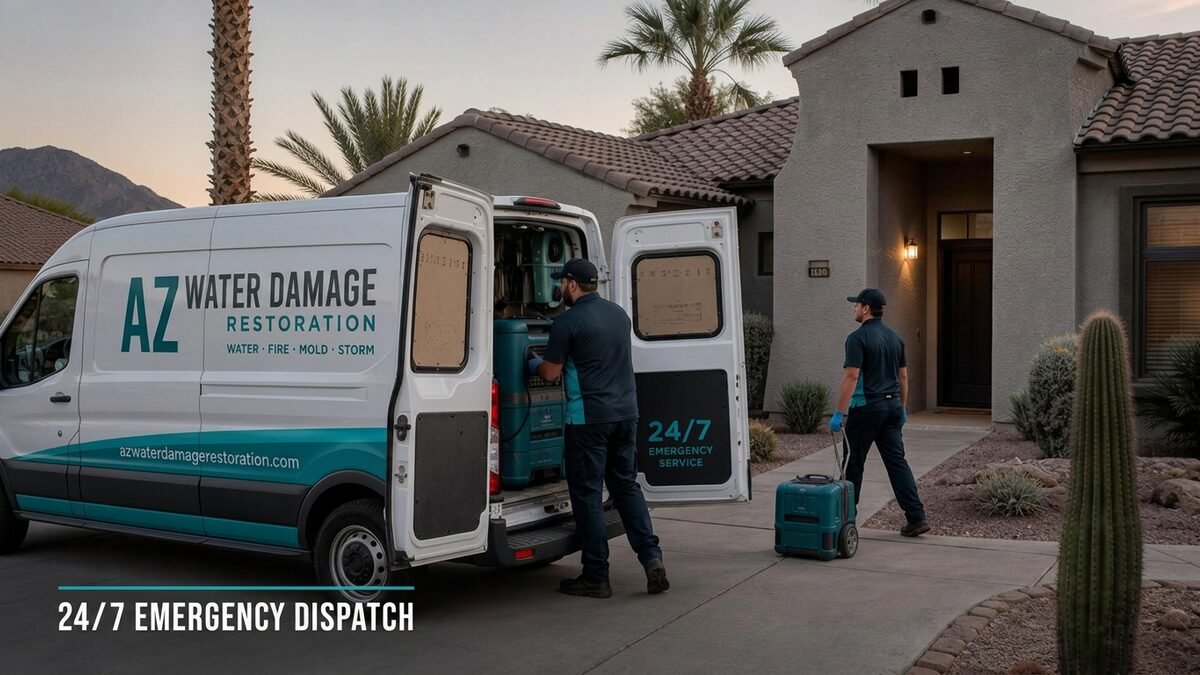
24/7 / Emergency responseResponse speed is the single biggest lever on the total timeline — every hour water sits widens the scope.
Can I Stay in My Home During Water Damage Restoration?
Most homeowners stay. For a Category 1 loss confined to one or two rooms, staying is generally fine — you'll deal with equipment noise, a warmer and louder house, and a few blocked-off areas for three to five days.
Temporary relocation is usually the better call when:
The loss is a Category 3 or sewage event, where contamination and containment make the space unsafe to occupy.
Mold remediation requires containment barriers and negative air across a living area.
The kitchen or your only bathroom is out of service.
Someone in the household has asthma, allergies, a compromised immune system, or respiratory illness — and infants and elderly family members deserve the same caution.
Power has to be shut off to affected circuits for an extended period.
If you do relocate temporarily, maintain clear communication with your project manager regarding drying milestone sign-offs so finish trades can be sequenced the exact day structural dry standard is certified.
What You Can Do to Keep the Timeline on Track
Key Takeaways
Drying takes three to five days on a typical residential loss; the whole project runs one to three weeks minor-to-moderate, four to eight-plus weeks for significant damage.
Day 1 is extraction, moisture mapping, and equipment placement. Days 2–3 are monitoring — rising readings are normal. Days 3–5 bring materials to dry standard.
Dry standard is a measured comparison to unaffected material, not a calendar date or a hand test.
Mold prevention runs concurrently; a mold discovery adds a separate two-to-five-day scope rather than restarting drying.
Phoenix's dry air can cut a seven-day dry to four or five — but monsoon humidity reverses it, and bone-dry materials absorb water aggressively.
Response speed is the one variable you fully control, and it has the largest effect on the total timeline.
Prefer to write it out? Send us the details and photos and a dispatcher will come back to you with a realistic schedule for your situation.
Related Technical Guides
Educational resources for Phoenix & Arizona property owners
Our rapid response units maintain staged equipment yards across Central Phoenix, the East Valley, the West Valley, Pinal County, and Greater Tucson for an average ~42-minute on-site arrival:
Structural drying typically takes three to five days, and the full project — including reconstruction — usually runs one to three weeks for minor to moderate damage and four to eight weeks or more for significant damage. The drying phase ends when moisture readings hit the documented dry standard, not on a fixed calendar date.
Why is the drying equipment still running after several days?
Because a surface that feels dry to your hand can still hold water inside the material. Air movers and dehumidifiers keep running until a moisture meter shows framing, subfloor, and drywall have returned to the dry standard set from unaffected areas of your home. Shutting equipment down early is the single most common cause of secondary damage and mold.
Can I stay in my home during water damage restoration?
For most Category 1 (clean water) losses confined to one or two rooms, yes — the main disruptions are equipment noise, warmth, and blocked-off areas. Temporary relocation is advisable for sewage or Category 3 events, extensive mold requiring containment, or when the kitchen or your only bathroom is out of service.
Mitigation (extraction and structural drying) typically takes 3 to 5 days. Timelines extend primarily if moisture penetrated subflooring or multiple wall cavities, if mold remediation containment is required, or if specialty replacement materials require longer procurement lead times.
Does mold discovery restart the restoration timeline?
It doesn't restart drying, but it adds a separate remediation scope on top of it — typically two to five extra days for a contained area, longer if it is inside wall cavities or HVAC. Containment barriers, HEPA filtration, and removal of affected material happen before reconstruction can begin.
How long does it take a basement or below-grade space to dry after flooding?
Below-grade and enclosed spaces usually take five to ten days rather than three to five, because there is little natural air exchange, concrete and masonry release moisture slowly, and water tends to sit longer before it is noticed. Basements are uncommon in the Phoenix metro, but the same rules apply to sunken rooms, garages, and casitas.
Does Phoenix's dry climate make restoration faster?
Usually, but not always. From October through June, ambient humidity around 10–30% helps dehumidifiers work efficiently and can shorten a seven-day humid-climate dry time to four or five days. During monsoon season, that advantage disappears, and materials that stay bone-dry year-round absorb water aggressively once they finally get wet.
Can I speed up drying by opening windows or running my own fans?
Household fans move air but remove no water, and opening windows only helps when outdoor air is drier than indoor air — which is not true during monsoon season or overnight cooling. The drying chamber your technicians build is a controlled psychrometric environment; opening it up usually slows the job down.
About the author
AZ Water Damage Restoration Team
IICRC-certified restoration technicians · Phoenix metro
Written and fact-checked by the licensed crew that runs the trucks — the same technicians who take moisture readings, set drying chambers to the IICRC S500 standard, and answer the phone at 2 a.m. across the Phoenix metro.
Licensed Arizona contractor — AZ ROC #331127 (KB-2)