Category 1, 2, or 3 isn't restoration jargon — it decides what gets saved, what gets cut out, and how fast someone has to act. Here's the whole classification system in plain language.
Last updated:Reading time:11 minStandards:IICRC S500 Verified
IICRC S500 water categories · Clean · Gray · Black · Phoenix metro
Table of contents▾
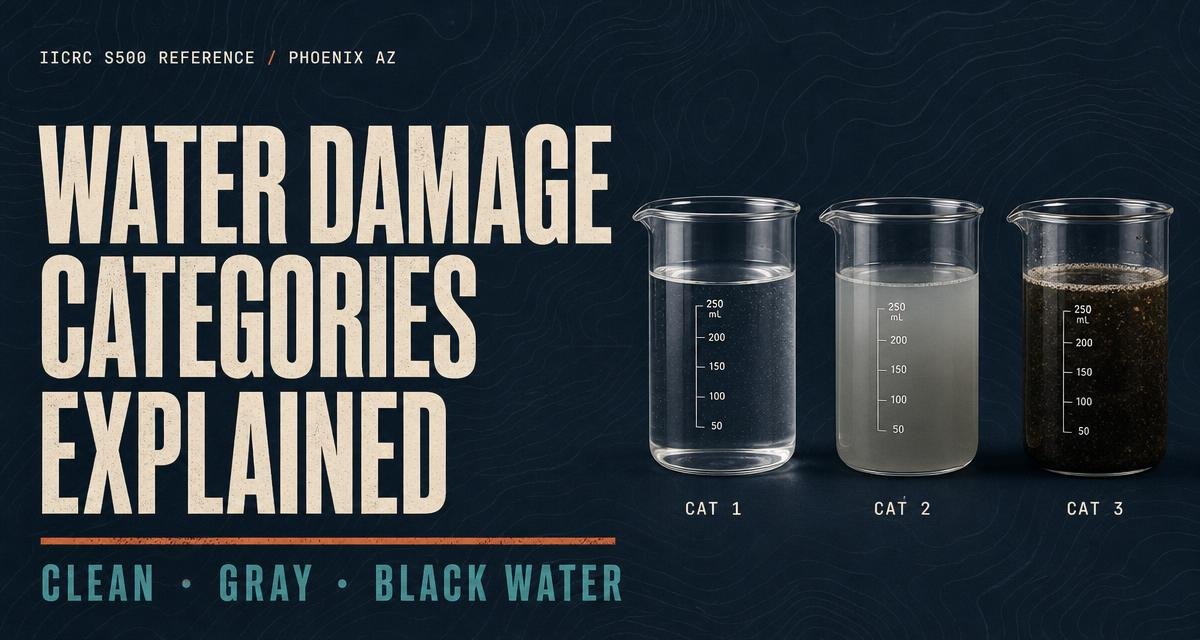
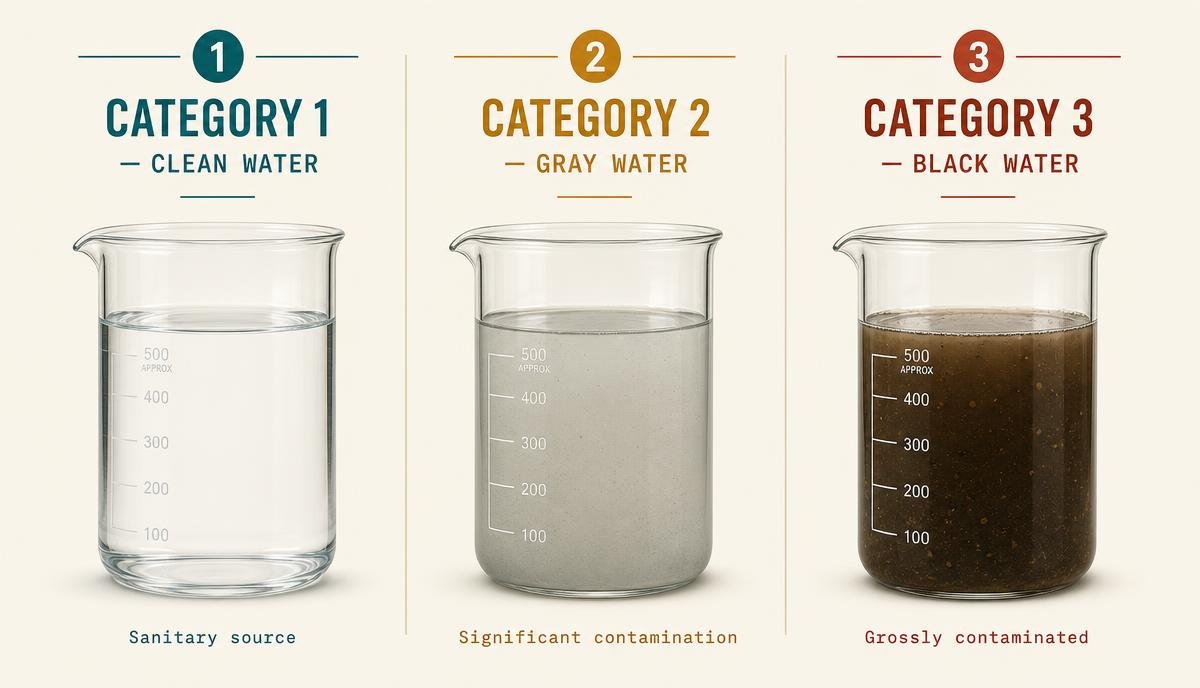
Water damage is classified into three categories under the IICRC S500 standard: Category 1 (clean water from a sanitary source), Category 2 (gray water with significant contamination), and Category 3 (black water that is grossly contaminated). The category describes how contaminated the water is — and it determines what can be dried, what must be removed, and what protective equipment the work requires.
The IICRC (Institute of Inspection, Cleaning and Restoration Certification) publishes S500, the industry standard for water damage restoration. Every job our technicians run starts with the same first step: determining the water category on site, before any equipment comes off the truck. If you want the wider picture of how the whole process works, start with our full guide to what water damage restoration involves. This article is the reference piece for the category system itself.
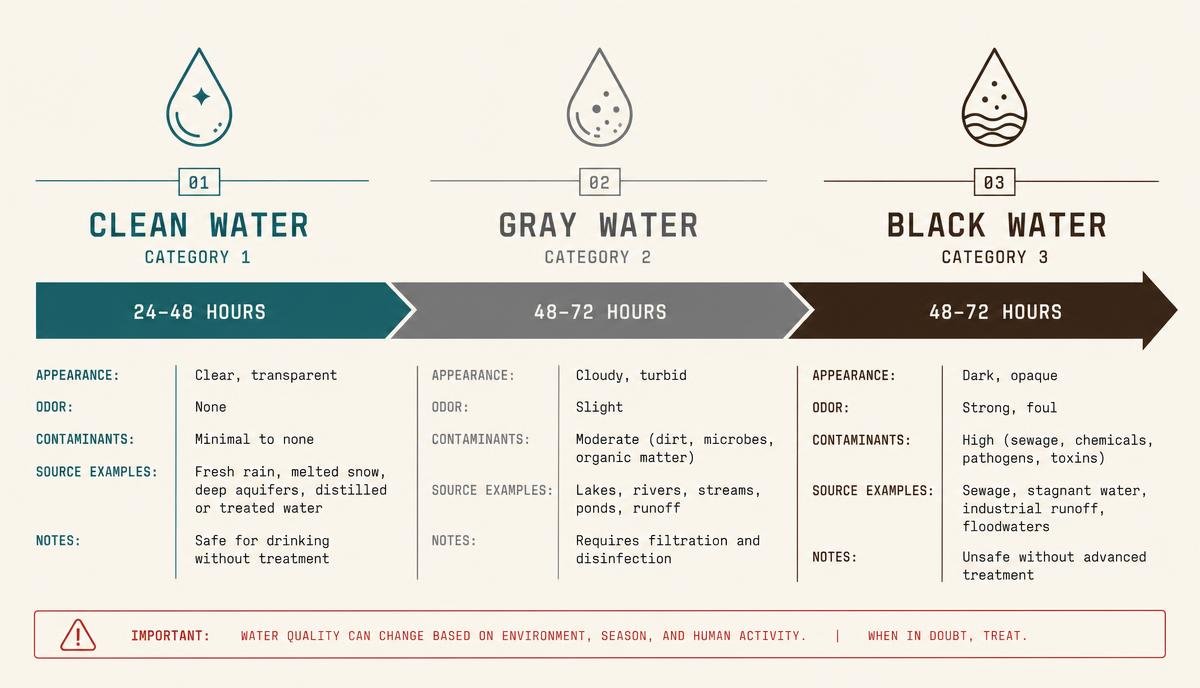
The Three Categories at a Glance
Categories 1, 2, and 3 move from clean to grossly contaminated, and every practical decision on a job — salvage, demolition, sanitizing, protective gear — follows from where the water lands on this scale.
Category
Common name
Typical sources
Risk level
Degradation timeline
Salvageable materials
Required PPE
Category 1
Clean water
Broken supply line or fitting, faucet leak, fire sprinkler discharge, toilet tank water (no waste), initial rainwater
No substantial risk if handled promptly
Becomes Category 2 in roughly 24–48 hours
Most porous materials dry in place; carpet usually saved, pad sometimes replaced
Gloves and safety glasses; standard work clothing
Category 2
Gray water
Washing machine overflow, dishwasher discharge, broken aquarium, hydrostatic seepage from outside, toilet overflow with urine but no feces, aged Category 1 water
Can cause discomfort or illness on contact or ingestion
Becomes Category 3 after roughly 48–72 hours of stagnation
Carpet pad removed; drywall usually flood cut 12–24 in.; insulation removed; hard surfaces cleaned and treated
Sewage backflow, toilet overflow containing feces, ground-source flooding and storm runoff, aged Category 2 water
Grossly contaminated; can cause serious illness
Terminal — no further category; risk rises with time
Porous materials removed; hard surfaces sanitized with EPA-registered antimicrobial; clearance testing often required
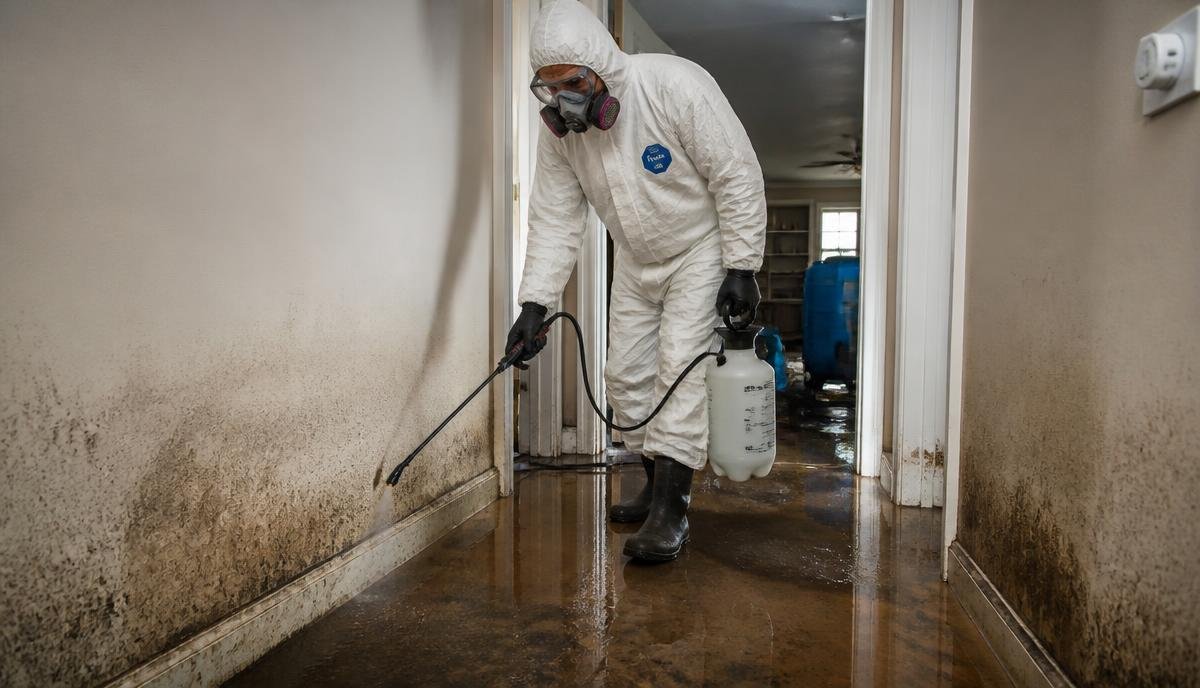
Full protective suit, respirator, splash goggles, chemical-resistant gloves and boots
IICRC S500 water damage categories — clean, gray, and black water compared
Reference / Category comparisonCategory is about contamination, not volume — a teacup of Category 3 water outranks a flooded room of Category 1.
Category 1: Clean Water
Category 1 water originates from a sanitary source and poses no substantial risk to people if it is addressed promptly. It is the water already inside your plumbing before it touches anything else.
Typical sources: a broken supply line or fitting, a failed faucet or angle stop, fire sprinkler discharge, water from a toilet tank (not the bowl), and rainwater at the moment it enters through a roof or window.
What can be saved. Most porous materials — carpet, drywall, framing, subfloor — can be dried in place when the response is fast. Carpet is usually salvaged; the pad is sometimes replaced because it holds water long enough to slow the whole dry down. Fast, metered drying is the entire ballgame here, and it is why immediate extraction and mitigation pays for itself.
Category 2: Gray Water
Category 2 water contains significant contamination and can cause discomfort or illness if someone contacts or ingests it. It is not sewage, but it is not something to squeegee around in bare feet either.
Typical sources: washing machine overflow, dishwasher discharge, a broken aquarium, hydrostatic seepage pushing in from outside soil, toilet overflow containing urine but no feces, and any Category 1 water that has aged past the clean-water window.
What can be saved. Carpet pad is porous and holds contaminants, so it is typically removed and discarded. Wet drywall usually gets a flood cut — the lower 12 to 24 inches of the wall is cut away above the waterline so the cavity can be cleaned, treated, and dried. Wet insulation is removed because it neither dries well nor cleans well. Antimicrobial treatment — an EPA-registered product applied to inhibit bacterial and fungal growth — is applied to the exposed framing and remaining hard surfaces.
PPE.PPE means personal protective equipment. For Category 2 work the minimum is coveralls, gloves, an N95 respirator, and eye protection.
Gray water that sits and stagnates keeps declining. After roughly 48 to 72 hours, bacterial amplification means the loss is handled as Category 3 — which changes the scope, and how water category affects your restoration cost is one of the largest single price drivers on any job.
Category 3: Black Water
Category 3 water is grossly contaminated and can cause serious illness. It may contain bacteria, viruses, parasites, chemicals, or decaying organic material, and it is never a DIY cleanup.
Typical sources: sewage backflow from a drain line or septic system, toilet overflow containing feces or water from beyond the trap, ground-source flooding such as river or storm runoff, and Category 2 water that has been left standing.
What can be saved. Porous materials — carpet, pad, drywall, insulation, particleboard, and most soft goods that were in contact with the water — are removed rather than cleaned, because contamination cannot be reliably extracted from a porous structure. Hard, non-porous surfaces are cleaned and sanitized with an EPA-registered antimicrobial, and post-remediation verification (clearance testing by an independent party) is often required before rebuilding begins. Our sewage and biohazard cleanup service guide details how those jobs are contained and documented.
PPE. Full protective suit, respirator, splash goggles, and chemical-resistant gloves and boots — plus containment barriers and negative air where the contaminated area adjoins clean living space.
Category 3 / PPECategory 3 work: full protective suit, respirator, splash goggles, chemical-resistant gloves and boots — no exceptions.
Is There a Category 4 Water Damage? (No — Here's the Confusion)
There is no Category 4 in the IICRC S500 standard. The category scale stops at 3, and anyone who tells you your loss is "Category 4" is using a term the standard does not contain.
People who use it almost always mean one of three things:
Class 4 — a real designation, but it belongs to the class scale, not the category scale. Class 4 means specialty drying for dense, low-permeance materials like hardwood, plaster, concrete, or stone.
A loss with additional regulated hazards — asbestos, lead paint, or other materials governed by separate regulations. Those change the abatement plan, not the water category.
Hurricane categories — a storm scale that has nothing to do with water contamination, and one that gets mixed in constantly in storm-prone regions.
Category vs. Class: Don't Confuse Them
Category describes what the water is. Class describes how much got wet and how hard it will be to dry. They are two separate scales, and a job carries one of each.
A concrete example: a burst copper supply line under a sink is unquestionably Category 1 clean water. If it runs all night and saturates 900 square feet of flooring, carpet, pad, and wall base, it is still Category 1 — but it is now a Class 3 or Class 4 drying project requiring far more equipment and days on site. Clean water, big job.
The reverse happens too: a small toilet backup affecting a single bathroom floor is Category 3 with a Class 1 drying footprint — tiny area, serious contamination, aggressive removal.
Scale
What it measures
Range
What it drives
Category
Contamination level of the water
1 (clean) to 3 (grossly contaminated)
Salvage vs. removal, sanitizing, PPE, containment
Class
Extent of saturation and drying difficulty
1 (minimal) to 4 (specialty drying)
Equipment count, drying strategy, days on site
Water damage category vs. class — two independent scales
We keep the full class breakdown in the day-by-day restoration timeline, where drying difficulty actually shows up as calendar days, so this article doesn't repeat it in depth.
How Fast Water Category Can Change
Water categories degrade on a clock. Clean Category 1 water is generally presumed to be Category 2 after 24 to 48 hours, and stagnant Category 2 water is generally treated as Category 3 after roughly 48 to 72 hours.
Nothing dramatic has to happen for that to occur. Warm standing water plus organic material — dust, drywall paper, carpet fibers, soil — is an incubator, and Phoenix indoor temperatures accelerate it. The same wall cavity that could have been dried in place on Monday becomes a flood cut on Wednesday.
Degradation / 24–72 hoursDegradation timeline: category is a function of source and time, and only one of those is still in your control.
Mold runs on a similar clock: given moisture and organic material, growth can begin within 24 to 48 hours, which is why a delayed response so often turns a drying job into a mold remediation project with containment and HEPA filtration on top of the original scope. Response speed is the single variable a homeowner actually controls, and it decides both the category and the cost.
Water Damage Categories in Phoenix & Arizona Homes
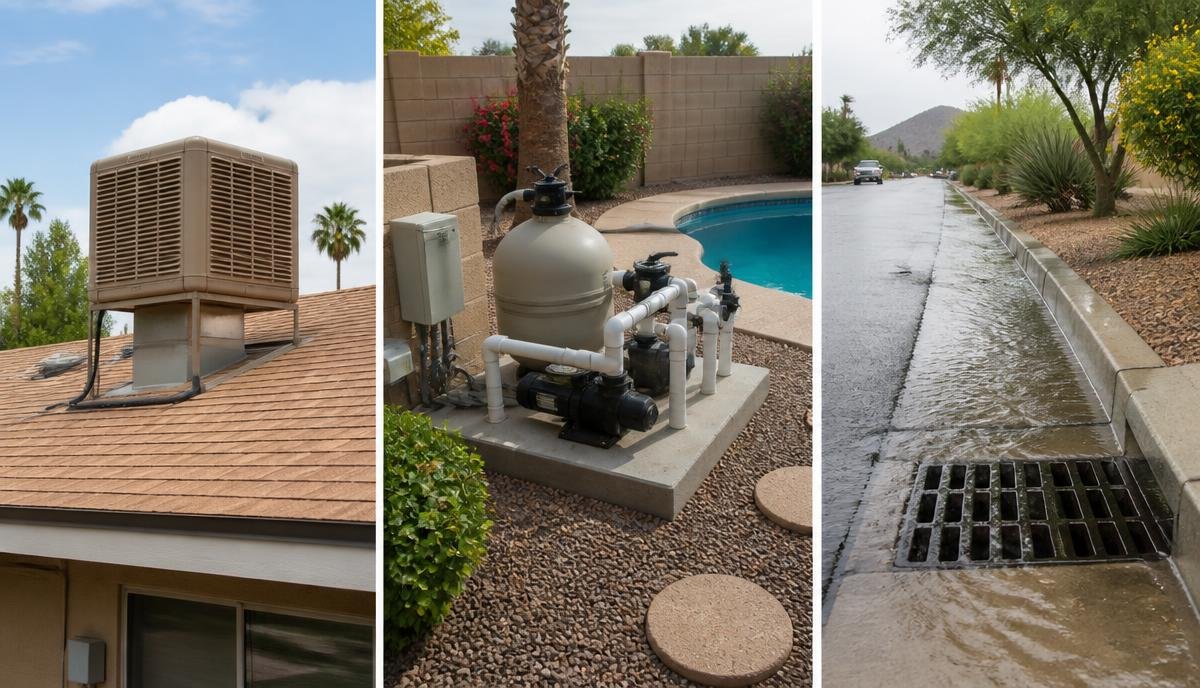
Arizona homes produce water sources most category guides never mention — pools and spas, evaporative coolers, monsoon runoff, and slab leaks that hide for weeks. Here is how each one is typically evaluated.
Is pool or spa overflow clean or gray water?
Pool and spa water generally starts as a relatively low-contaminant source, but it is not automatically Category 1. Sanitizer levels, bather load, standing time, and whatever the water crossed on its way indoors all matter, so the call is made on site rather than assumed from the source.
Is evaporative ("swamp") cooler discharge clean water?
Generally yes — cooler supply water comes from a sanitary line, so a failed float valve or split supply line usually starts as Category 1. What complicates it is location: cooler leaks travel down through ceilings and wall cavities, often unnoticed for days, and mineral scale and biological growth inside the unit's reservoir can push the discharge into Category 2 territory.
Is monsoon storm runoff automatically Category 3?
Not automatically — but ground-source water is always treated with elevated caution. Storm runoff that has moved across soil, streets, landscape chemicals, or a sewer system is commonly classified Category 2 or Category 3 depending on what it contacted, and standing floodwater in a home is handled as contaminated until an on-site assessment says otherwise. Monsoon and storm damage response in the Valley almost always begins with that determination.
How does an undetected slab leak's category change over time?
A slab leak starts as clean pressurized supply water, but it rarely stays that way, because it is hidden. Water that wicks up through concrete and sits under flooring for days or weeks picks up soil contact and biological growth, so by the time it surfaces as a warm spot, buckled flooring, or a spiking water bill, it is typically handled as Category 2 or worse.
Phoenix metro / Local sourcesArizona-specific sources: evaporative coolers, pool and spa systems, and monsoon runoff each land differently on the category scale.
These are the sources our crews see week to week across Phoenix and the surrounding communities — including Surprise, Goodyear, Avondale, Buckeye, Cave Creek, Carefree, Fountain Hills, Anthem, New River, and Laveen.
Why Water Category Matters for Your Estimate & Scope
Category is the foundation of an honest restoration estimate because it objectively defines what work is necessary. It sets which materials can be safely dried in place versus removed, whether antimicrobial treatment and HEPA containment are warranted, what PPE the crew must wear, and the required sanitization level.
That is why the determination gets documented with objective criteria, not arbitrary guesswork. Photos of the source and affected areas, calibrated moisture readings, notes on standing time, and IICRC S500 criteria are recorded on the first visit to provide property owners with a fully transparent, itemized written scope.
What to Do If You Suspect Gray or Black Water Damage
If you have any reason to think the water is Category 2 or Category 3, treat it as contaminated and stay out of it. The correct homeowner response is containment of people and pets, not cleanup.
Don't touch, wade through, or attempt to mop up the water.
Keep children, pets, and anyone immunocompromised out of the affected area entirely.
Don't run fans across contaminated water — it aerosolizes what's in it.
Don't attempt DIY cleanup, and don't try to salvage soaked carpet, pad, or drywall yourself.
Stop the source if you can do it safely, and shut off power to the affected area at the breaker if water is near outlets.
Avoid using affected fixtures, drains, or appliances until the system has been cleared.
Photograph everything from a safe distance before anything is moved or removed.
The IICRC S500 standard defines three water categories: Category 1 clean, Category 2 gray, Category 3 black. There is no Category 4.
Category measures contamination; class measures saturation and drying difficulty. A clean-water loss can still be a large, complex Class 4 job.
Category 1 generally becomes Category 2 within 24–48 hours; stagnant Category 2 becomes Category 3 within 48–72 hours.
Category 2 typically means pad removal, a 12–24 inch flood cut, and antimicrobial treatment. Category 3 means porous materials come out and hard surfaces are sanitized.
Arizona sources are their own conversation: cooler discharge usually starts clean, pool water needs evaluation, monsoon runoff is treated with caution, and hidden slab leaks degrade with time.
Category drives claim scope — an accurate, documented determination on day one is what keeps the file defensible.
Our rapid response units maintain staged equipment yards across Central Phoenix, the East Valley, the West Valley, Pinal County, and Greater Tucson for an average ~42-minute on-site arrival:
The IICRC S500 standard defines three categories. Category 1 is clean water from a sanitary source, such as a broken supply line. Category 2 is gray water carrying significant contamination, such as washing machine or dishwasher discharge. Category 3 is black water that is grossly contaminated, such as sewage backflow or ground-source flooding. There is no Category 4.
What's the difference between water damage category and class?
Category describes what the water is — how contaminated it is. Class describes how much material got wet and how difficult it will be to dry. They are independent: a clean Category 1 supply-line break that soaks an entire floor can still be a Class 3 or Class 4 drying job.
No. The IICRC S500 standard recognizes only Categories 1, 2, and 3. People who say "Category 4" usually mean Class 4 — specialty drying for dense materials like hardwood, plaster, or concrete — or a loss involving separately regulated hazards such as asbestos or lead, or they are thinking of hurricane categories.
How long before clean water becomes contaminated?
Clean Category 1 water is generally presumed to have degraded to Category 2 within 24 to 48 hours, and stagnant Category 2 water is generally treated as Category 3 after roughly 48 to 72 hours. Contact with soil, dirty building materials, or organic debris can push water down a category immediately, regardless of the clock.
Can carpet or drywall be saved after gray or black water damage?
After Category 2 water, carpet can sometimes be cleaned and dried while the pad is discarded, and drywall usually needs a flood cut — removal of the lower 12 to 24 inches — with antimicrobial treatment of the open cavity. After Category 3 water, porous materials including carpet, pad, drywall, and insulation are removed rather than cleaned.
How does water category impact restoration costs and protocols?
Water category dictates the safety protocol: which porous materials can be dried in place versus removed, whether antimicrobial agents and containment barriers are required, and the level of PPE needed. Higher contamination categories require more specialized sanitization, driving the itemized scope of work.
Is monsoon floodwater automatically Category 3?
Not automatically, but ground-source floodwater is treated with elevated caution. Storm runoff that has crossed soil, streets, landscaping chemicals, or a sewer system is typically classified Category 2 or Category 3 after an on-site assessment of where the water came from and what it touched.
Both usually start as relatively low-contaminant sources, and cooler discharge is normally treated as clean water at the moment of release. Neither stays that way: pool chemistry, standing time, and contact with flooring, soil, or wall cavities can move either source into Category 2, so the category is always determined on site rather than assumed from the source alone.
About the author
AZ Water Damage Restoration Team
IICRC-certified restoration technicians · Phoenix metro
Written and fact-checked by the licensed crew that runs the trucks — the same technicians who take moisture readings, set drying chambers to the IICRC S500 standard, and answer the phone at 2 a.m. across the Phoenix metro.
Licensed Arizona contractor — AZ ROC #331127 (KB-2)