While water damage and mold damage frequently occur together, they are distinct challenges with different scientific causes, restoration protocols, health risks, and insurance implications. Learn how to tell them apart, why the 24–48 hour window matters, and how to protect your property and your insurance claim.
Last updated:Reading time:13 minStandards:IICRC S500 Verified
The core difference between water damage and mold damage is that water damage is physical saturation caused by liquid moisture, whereas mold damage is a living biological infection that feeds on damp organic materials. Water damage occurs instantly when a pipe bursts or appliance leaks, while mold damage takes 24 to 48 hours to germinate. Crucially for homeowners, standard insurance policies typically cover sudden water damage, but impose strict caps ($1,000–$10,000) or complete exclusions on mold remediation if moisture was left unaddressed.
The Core Difference: Physical Saturation vs. Biological Colonization
Property owners frequently use the terms “water damage” and “mold damage” interchangeably. However, in building science and insurance law, they represent two completely different stages of property deterioration:
1. What is Water Damage? (Physics & Hydraulic Wicking)
Water damage is the physical wetting, swelling, and hydraulic intrusion of water into structural building materials. It is governed internationally by the ANSI/IICRC S500 Standard for Professional Water Damage Restoration.
When a pipe splits or a water heater fails, liquid water migrates rapidly via gravity and capillary action. Drywall absorbs water vertically like a wick, carpet padding turns into a sponge, and wood baseboards cup and swell. The damage at this initial stage is purely physical: softened gypsum, corroded fasteners, stained ceilings, and weakened adhesives. Water damage can happen in seconds and is treated using industrial psychrometric drying equipment.
2. What is Mold Damage? (Biology & Microbial Digestion)
Mold damage is a secondary biological consequence that occurs when damp organic substrates remain wet long enough for microscopic fungal spores to germinate, multiply, and digest building materials. It is governed by the ANSI/IICRC S520 Standard for Professional Mold Remediation.
Molds are living fungi. When dormant spores meet cellulose (the paper facing of drywall, wood studs, or subflooring) in the presence of moisture, they sprout root-like filaments called hyphae. These hyphae secrete digestive enzymes that actively break down wood fibers, destroying the material from within while releasing millions of airborne spores, mycotoxins, and volatile organic chemicals (MVOCs) into your breathing air.
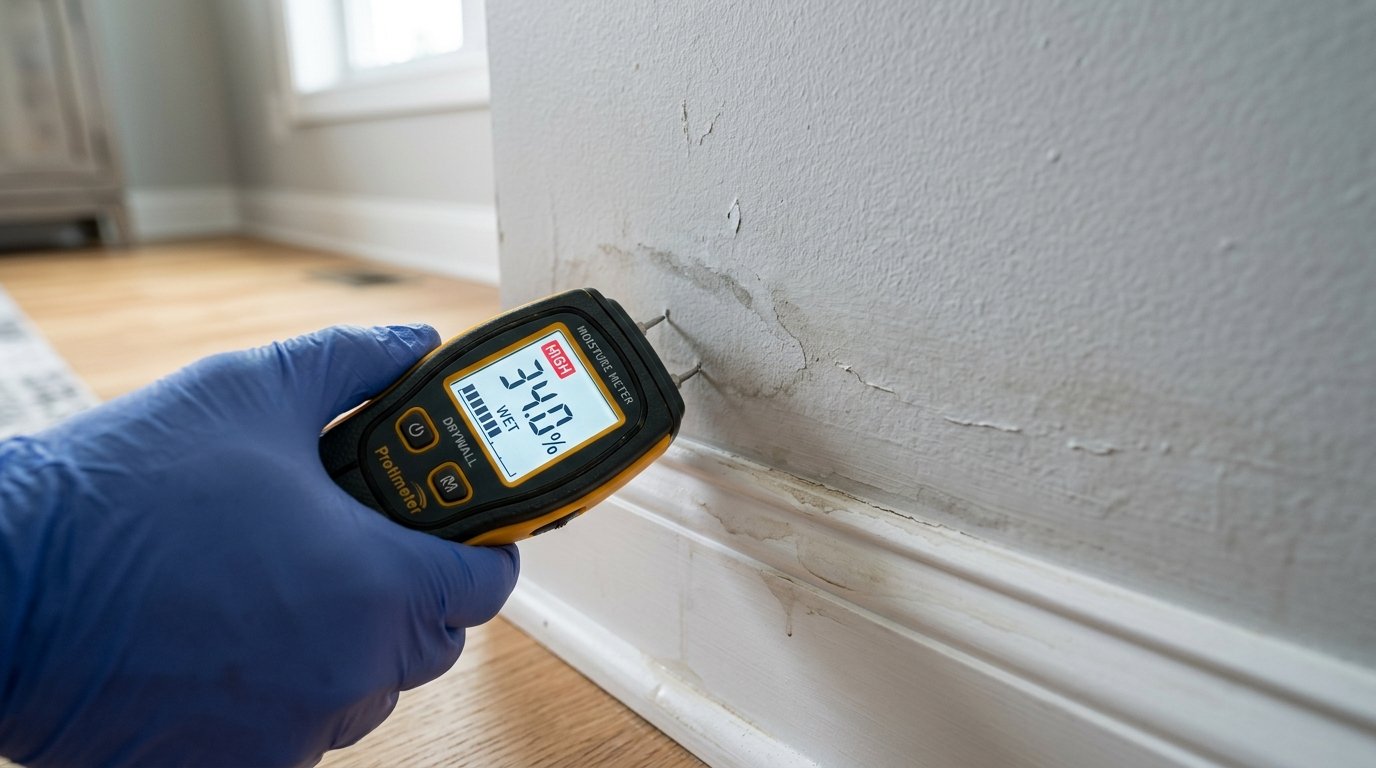
Physical SaturationA moisture meter reading of 34% indicates active water damage. If dried within 24–48 hours, biological mold damage can be prevented entirely.
Comprehensive Comparison: Water Damage vs. Mold Damage
Use this side-by-side comparison table to understand how these two property threats differ across every critical dimension:
Feature / Dimension
Water Damage (IICRC S500)
Mold Damage (IICRC S520)
Primary Cause
Liquid water from plumbing bursts, appliance leaks, rain, or runoff
Living fungal colonies feeding on damp organic cellulose materials
Onset Timeline
Instantaneous (seconds to minutes from initial leak)
Secondary consequence (germination in 24–48h; visible in 3–7 days)
Extraction, high-velocity air movers, commercial LGR dehumidifiers
Sealed plastic containment, negative-air HEPA scrubbers, material excision
Material Salvageability
High if dried within 24h (materials dry in place)
Low for porous goods (drywall and insulation must be cut and replaced)
Insurance Coverage
Generally covered if 'sudden and accidental' (HO-3 policy)
Frequently capped ($1k–$10k) or excluded if deemed gradual seepage
Average Cost Range
$1,200 to $3,800 (standard residential mitigation)
$2,500 to $7,500+ (containment, remediation & reconstruction)
Technical, operational, and financial comparison: water damage vs. mold damage
The Transition Timeline: How Water Damage Becomes Mold Damage
Every mold problem began as an unaddressed water problem. The transition from clean physical saturation to biological contamination follows a rigid scientific timeline:
The First 24 Hours (The Golden Window): You are dealing strictly with water damage. Materials are saturated, but spores have not germinated. Calling a professional water damage restoration company during this window allows technicians to extract water, set up dehumidifiers, and save your drywall without invasive demolition.
24 to 48 Hours (The Tipping Point): Fungal spores absorb moisture and sprout microscopic hyphae. Clean water degrades into Category 2 gray water as dust and building residues dissolve. As detailed in our guide on how long does it take for mold to grow after water damage, biological colonization has officially begun.
72+ Hours (Full Mold Infestation): Colonies reach maturity. High-speed fans can no longer be used because blowing uncontained air will spread millions of newly formed spores into your living room and ductwork. The project transitions into mandatory certified mold remediation.
How to Identify What You Have (Visual & Olfactory Signs)
Diagnosing whether you are facing early water damage, active mold colonization, or both requires evaluating visual, tactile, and olfactory clues:
Signs of Pure Water Damage:
Paint Blisters: Latex wall paint stretches like a balloon, holding pockets of trapped liquid water behind it.
Ceiling Rings: Concentric brown or yellowish water rings expanding outward on ceiling drywall.
Floor Warping: Hardwood planks cupping at the edges, or laminate flooring swelling at seam joints.
Cool to the Touch: Damp areas feel distinctly colder than surrounding dry surfaces due to active evaporative cooling.
Signs of Mold Damage:
The Pungent MVOC Smell: A sharp, earthy, rotten-wood odor that persists even after surface water is mopped up.
Surface Discoloration: Irregular clusters of black, dark green, brown, or fuzzy white speckles that smear when rubbed with a damp paper towel.
Softened, Crumbly Drywall: Gypsum board that has lost its structural integrity because fungal hyphae have digested the paper binder.
Occupant Health Symptoms: Family members experiencing sudden nasal congestion, coughing, or red eyes that improve when leaving the house. Review our clinical breakdown of the health risks of untreated water damage for detailed symptom profiles.
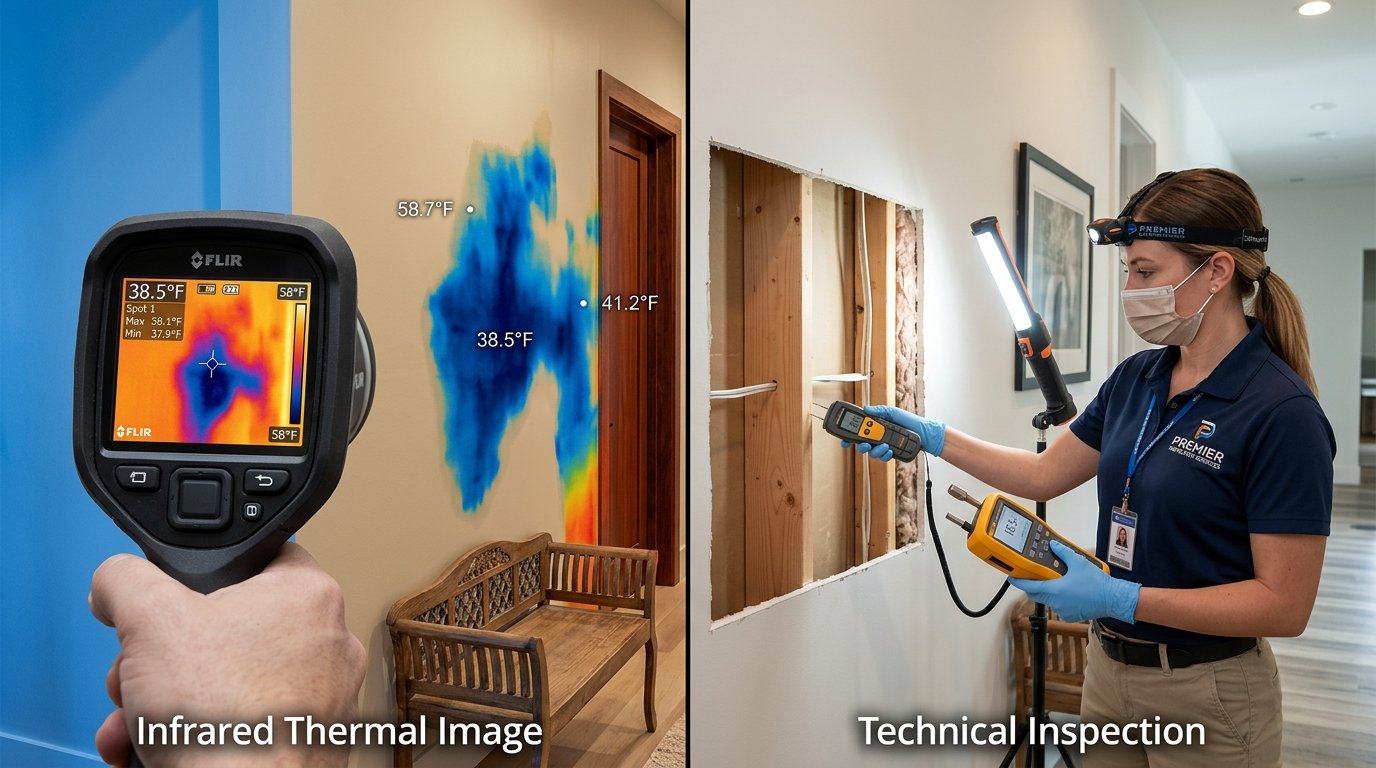
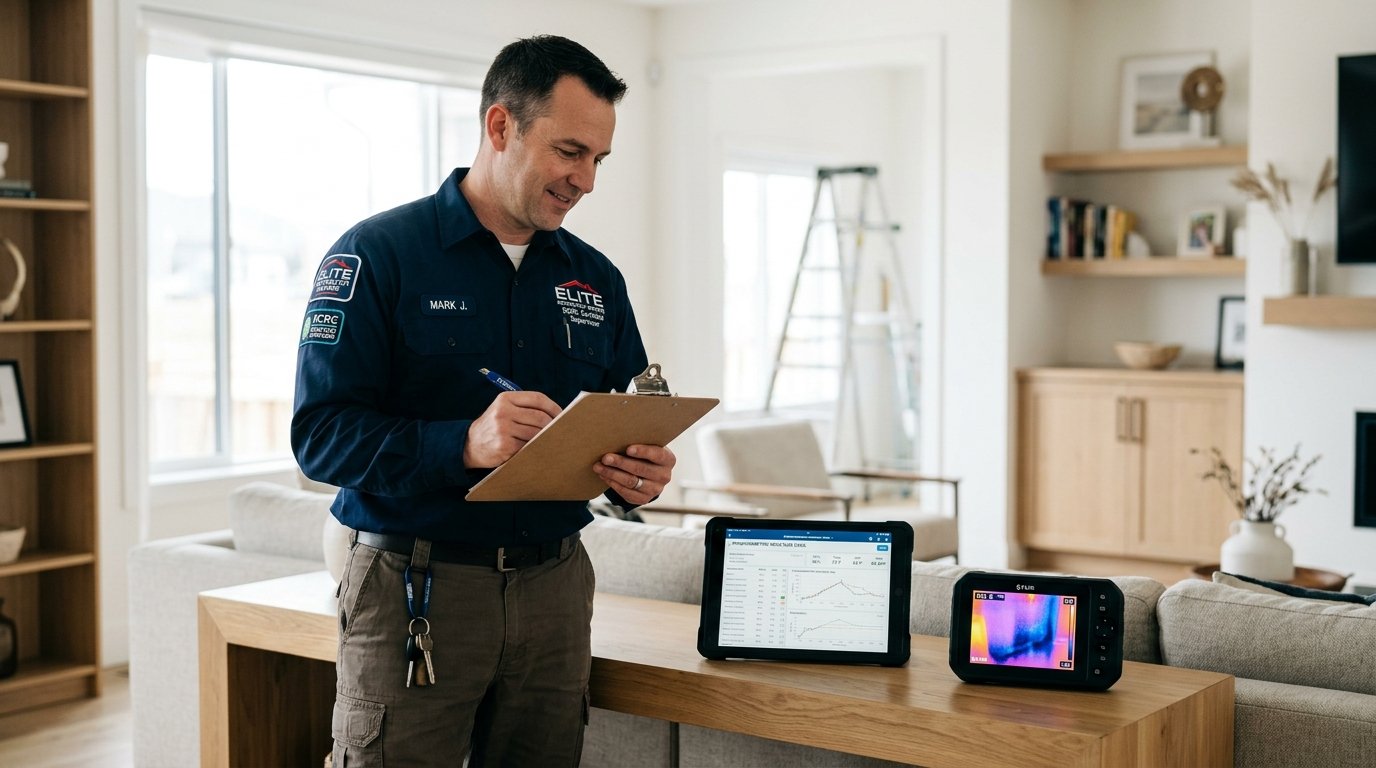
Insurance DocumentationThorough psychrometric drying logs and infrared photos prove to your insurance adjuster that water damage was addressed immediately.
Insurance Coverage: The Crucial Policy Distinction Every Homeowner Must Know
Understanding the legal and contractual difference between water and mold is the difference between a fully approved $15,000 claim and an outright denial.
1. “Sudden and Accidental” Water Damage is Covered
Standard homeowner insurance policies (HO-3 and HO-5 forms) are written to protect against unforeseen catastrophic events. If an upstairs copper supply pipe ruptures, an ice maker hose snaps, or a water heater tank ruptures, insurance almost universally pays for:
Emergency water extraction and industrial structural drying
Removal of wet carpet padding and unsalvageable drywall
Reconstruction, painting, and flooring replacement to restore pre-loss condition
2. Why Insurers Restrict or Deny Mold Claims
Insurance adjusters view mold as a symptom of time and neglect. Because mold takes days or weeks to spread, carriers argue that any substantial mold growth indicates a slow, ongoing leak that the homeowner should have noticed and repaired.
In response to nationwide litigation over mold in the early 2000s, almost all major insurance underwriters added strict Mold Limitations and Exclusions:
Sub-Limits ($1,000 to $10,000): Even if your overall policy coverage is $400,000, your policy may limit mold remediation payout to just $5,000 total.
The Maintenance Exclusion: If the insurer can prove mold originated from a slow shower pan leak or roof flashing issue that existed for months, they will deny both the water damage and the mold repair under the “wear, tear, and gradual seepage” exclusion.
How Restoration Protocols Differ: Drying vs. Remediation
If you hire a restoration company, the technical procedures deployed will depend entirely on whether your home has simple water damage or active mold contamination:
Water Mitigation Protocol (IICRC S500 Standard):
Thermal Moisture Mapping: Technicians inspect the structure using infrared thermal imaging inspection tools and pin meters to establish the boundary of moisture migration.
Physical Extraction: Industrial ride-on or portable extraction units pull 90%+ of standing water out of carpets and subfloors.
Open Evaporative Drying: High-velocity centrifugal air movers blow high-speed air across wet surfaces to break the boundary layer, while commercial Low-Grain Refrigerant (LGR) dehumidifiers condense water vapor out of the air. No plastic containment is needed because no spores are present.
Mold Remediation Protocol (IICRC S520 Standard):
Airlock Containment: The affected room is completely sealed off from the rest of the home using 6-mil polyethylene plastic sheeting with zipper airlocks.
Negative Air Pressure: Commercial HEPA air scrubbers draw air from inside the containment zone and exhaust it outside. This creates negative pressure, ensuring zero spores can leak into unaffected bedrooms or living spaces.
Controlled Excision: Contaminated drywall is cut cleanly 12 to 24 inches beyond visible growth and double-bagged in 6-mil poly bags before being carried out of the home.
Antimicrobial Encapsulation: Remaining framing studs are HEPA-vacuumed, scrubbed with EPA-registered botanical antimicrobials, and sealed with mold-resistant elastomeric coatings.
Cost Comparison: Water Mitigation vs. Mold Remediation
The financial penalty for delaying water cleanup is severe. When clean water damage is caught early, restoration costs remain manageable because structural materials are dried in place. Once biological mold colonizes the space, specialized safety protocols, containment, and mandatory demolition drive costs up:
Damage Scenario
Typical Scope of Work
Average Cost Range (Arizona)
Early Water Mitigation (< 24h)
Water extraction, 3–4 days of LGR dehumidification & air movers; 0 drywall demolition
Water is Physics, Mold is Biology: Water damage is physical liquid absorption; mold damage is a living fungal colony digesting your home’s cellulose framing and drywall.
24 to 48 Hours is Your Deadline: Clean water damage turns into biological mold growth within two days. Immediate extraction protects your health and your property.
Insurance Treats Them Differently: Policies cover sudden water damage but severely restrict or cap mold coverage. Fast mitigation documents your compliance with your policy’s duty to mitigate.
Different Standards, Different Tools: Water drying uses high airflow and dehumidifiers; mold remediation requires sealed plastic containment and negative-air HEPA filtration.
Waiting Multiplies Costs: A $1,500 water dry-out can easily balloon into a $6,000+ mold remediation and reconstruction project if ignored.
What is the fundamental difference between water damage and mold damage?
Water damage is the physical, hydraulic saturation of building materials caused by liquid water (e.g., burst pipes, appliance leaks, roof intrusion), governed by the IICRC S500 standard. Mold damage is a secondary biological consequence caused by living fungal organisms consuming organic cellulose (drywall paper, wood framing, carpet fibers), governed by the IICRC S520 standard. Water damage can exist without mold, but mold damage cannot exist without an underlying moisture source.
Does homeowners insurance cover both water damage and mold damage?
Standard homeowner insurance policies (HO-3) generally cover sudden and accidental water damage (like an abrupt burst pipe or water heater rupture). However, insurers treat mold damage with strict skepticism. Most policies either exclude mold entirely or cap mold remediation coverage between $1,000 and $10,000. If an adjuster determines mold resulted from long-term, gradual seepage or deferred maintenance, the entire claim may be denied.
How quickly does water damage turn into mold damage?
Fungal spores hydrate and begin germinating within 24 to 48 hours of contacting wet cellulose materials under typical indoor temperatures (70°F to 85°F). In hot Arizona summers, where unconditioned attics and wall cavities exceed 90°F, germination and colony formation can accelerate into active growth within 24 to 36 hours. Prompt extraction within the first 24 hours stops this transition completely.
Can you have mold damage without visible standing water?
Yes. Mold frequently flourishes in concealed microclimates where relative humidity exceeds 60% or where slow, hidden leaks exist—such as behind bathroom vanities, under luxury vinyl plank (LVP) flooring, or in attic air conditioning ductwork. In these scenarios, homeowners smell a persistent musty odor long before any visible water damage appears.
Why do insurance companies often deny mold claims but pay water claims?
Insurance policies are designed to cover sudden, unforeseen catastrophic accidents. Water damage from a sudden frozen pipe or ruptured washer hose is clearly sudden. Mold, biologically, requires 24 to 72+ hours of persistent moisture to colonize. Insurers often argue that the presence of mature mold proves the homeowner had an ongoing leak that was neglected, classifying it as uninsurable 'gradual damage.'
Which is more expensive to repair: water damage or mold damage?
Mold damage is almost always significantly more expensive. Standard Category 1 water mitigation typically ranges from $1,200 to $3,500 because materials can be dried in place. Once mold develops, costs escalate to $2,500–$7,500+ due to required plastic containment barriers, third-party clearance testing, hazardous material disposal, and post-remediation drywall reconstruction.
Can water-damaged drywall always be dried, or must it be replaced?
If drywall was wetted by clean Category 1 water and dried under commercial dehumidification within 24 to 48 hours without losing structural rigidity, it can often be dried in place and saved. However, if drywall remains wet past 48 hours, is saturated by contaminated Category 2 or 3 water, or shows visible fungal hyphae, building codes and IICRC standards mandate that the lower saturated portion be cleanly excised and replaced.
IICRC-certified restoration technicians · Phoenix metro
Written and fact-checked by the licensed crew that runs the trucks — the same technicians who take moisture readings, set drying chambers to the IICRC S500 standard, and answer the phone at 2 a.m. across the Phoenix metro.
Licensed Arizona contractor — AZ ROC #331127 (KB-2)