When water breaches your home, the physical damage on floors and drywall is only half the battle. Within hours, water intrusion unleashes an invisible airborne assault: fungal bioaerosols, volatile MVOC gases, and bacterial endotoxins. Discover the science of post-water damage indoor air quality, the dangers of HVAC cross-contamination, and how certified engineering controls restore clean, breathable air.
Last updated:Reading time:15 minStandards:IICRC S500 Verified
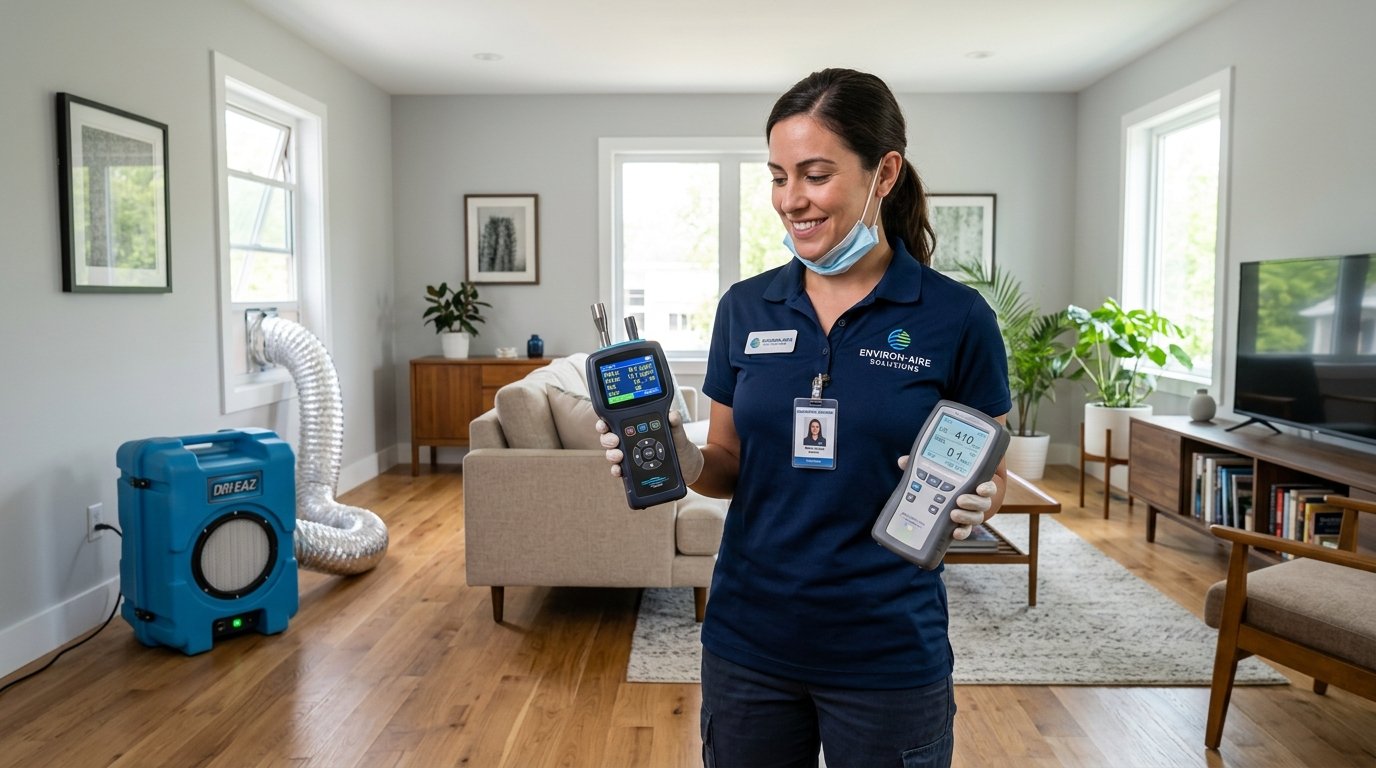
Indoor Air Quality Engineering: Critical containment barriers, true HEPA filtration, and negative air pressure isolate airborne bioaerosols during water damage remediation.
Table of contents▾
Water damage severely degrades indoor air quality within 24 to 48 hours by releasing millions of microscopic fungal spores (Aspergillus, Penicillium, Stachybotrys), foul-smelling Microbial Volatile Organic Compounds (MVOCs), and bacterial endotoxins into the breathing zone. Running ceiling fans or central air conditioning without containment spreads these toxic bioaerosols throughout your entire home’s ductwork. Restoring safe air quality requires strict adherence to IICRC S520 standards: establishing critical negative-air containment barriers, deploying commercial HEPA 500 air scrubbers, sanitizing HVAC systems, and verifying clean air through independent third-party laboratory clearance testing.
When a pipe bursts, a water heater ruptures, or a roof leaks during a monsoon storm, most homeowners focus entirely on what they can see: soggy carpets, ruined baseboards, and pooling water.
However, the most dangerous threat to your family’s health is completely invisible. The moment liquid water saturates porous building materials—gypsum drywall, fiberglass insulation, subflooring, and carpet padding—it initiates a rapid biological and chemical chain reaction that transforms your home’s air into a hazardous respiratory cocktail.
In Arizona’s arid climate, this hazard is amplified. While our outdoor air is dry, modern desert homes are engineered with tight thermal envelopes designed to keep air conditioning inside. When a major water loss occurs indoors, trapped humidity spikes above 80%–90% inside closed rooms. In as little as 24 to 48 hours, active microbial growth takes hold, releasing billions of microscopic bioaerosols that circulate through the breathing zone.
This comprehensive guide explains the four primary airborne contaminants unleashed by water damage, how central air conditioning systems cause whole-home cross-contamination, and the professional engineering controls required to restore pristine indoor air quality.
The 4 Invisible Airborne Threats Unleashed by Water Damage
Indoor air quality degradation is not just about “mold.” A water loss releases multiple classes of biological and chemical particulates:
1. Fungal Bioaerosols & Microscopic Mold Spores
Fungal spores exist naturally in outdoor air at background levels. However, when indoor building materials remain wet for more than 24 hours, dormant spores germinate, sending out root-like hyphae that feed on cellulose. As colonies mature, they produce reproductive structures that discharge millions of airborne spores into the room.
Aspergillus / Penicillium: The most common indoor contaminants following clean and grey water leaks. Spores are tiny (2 to 5 microns) and remain suspended in air currents for hours, penetrating deep into human lung alveoli.
Stachybotrys chartarum: The infamous greenish-black mold that colonizes constantly wet, cellulose-rich drywall and subflooring after severe leaks. It produces heavy clusters of spores coated with potent trichothecene mycotoxins.
Fungal Fragments: Sub-micron broken pieces of dried mold structures that are easily inhaled and carry equal or greater allergenic potency than intact spores. Learn more in our mold growth timeline after water damage.
2. Microbial Volatile Organic Compounds (MVOCs)
Have you ever walked into a water-damaged room and immediately noticed an offensive, pungent “musty earthy” smell? You are not smelling mold spores—you are smelling Microbial Volatile Organic Compounds (MVOCs).
MVOCs are complex chemical gases (including alcohols, ketones, aldehydes, and aromatic hydrocarbons like geosmin and 1-octen-3-ol) produced as metabolic waste products while microorganisms digest wet building materials. Because they are true gases rather than particles, MVOCs easily penetrate drywall, seep into furniture fabrics, and bypass standard particle filters. Inhaling high concentrations of MVOCs causes headaches, nausea, dizziness, and nasal burning.
3. Bacterial Endotoxins & Biofilms
When water intrusion involves Category 2 (grey water from dishwashers or washing machines) or Category 3 (black water from sewage backups or groundwater floods), bacteria flourish at an alarming rate.
As Gram-negative bacteria multiply and die, their cell walls break down, releasing lipopolysaccharide endotoxins. When wet materials dry or are disturbed by air movement, these endotoxins become airborne. Inhalation of endotoxins triggers severe inflammatory responses in human airways, causing symptoms mimicking acute influenza, chest tightness, and fever (often termed “Humidifier Fever”).
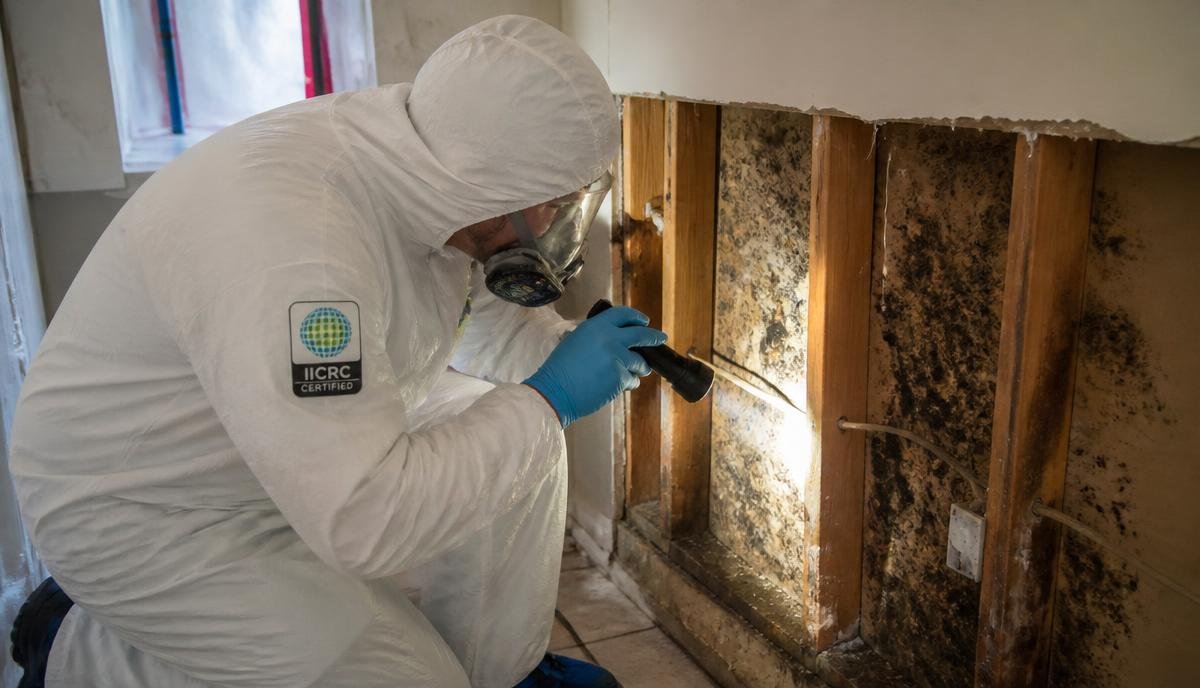
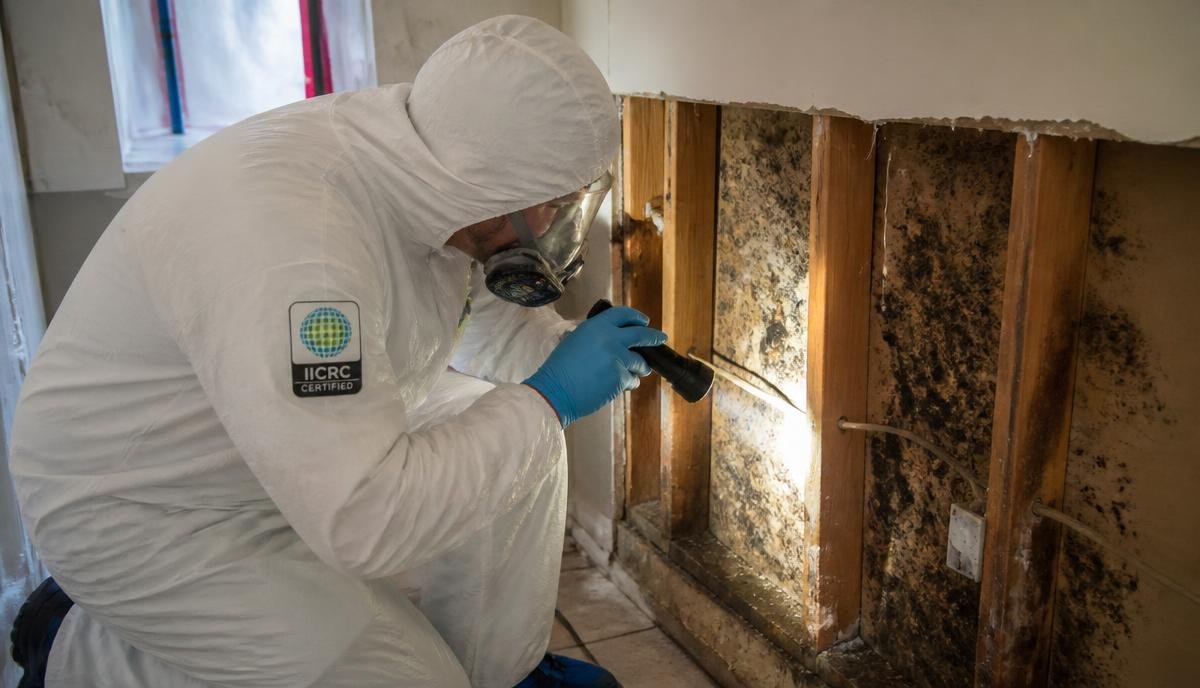
Safety protocol: When investigating contaminated indoor air quality, certified technicians wear P100 half-face respirators and Tyvek suits to prevent exposure to concentrated bioaerosols.
4. Particulate Matter (PM2.5 & PM10) from Demolition
When untrained homeowners or amateur contractors rip out water-damaged baseboards and drywall with hammers and pry bars without containment, they generate massive clouds of fine particulate matter.
This dust contains pulverized gypsum, crystalline silica, synthetic fiberglass needle fibers, and rodent dander accumulated inside wall cavities. When combined with aerosolized mold spores, breathing this dust can cause severe bronchial irritation and long-term pulmonary damage.
The HVAC Multiplier: How Central AC Spreads Contamination
In Arizona homes, central forced-air air conditioning is essential. However, during a water damage event, your HVAC system becomes the primary vector for whole-home cross-contamination.
When a leak occurs in a single room (such as a master bathroom pipe burst):
Return Air Ingestion: The powerful return air intake draws hundreds of cubic feet of damp, spore-laden air from the affected room into the central ductwork.
Coil Condensation Incubation: Spores pass over the cold, wet evaporator coils inside the air handler, where condensation provides moisture for colonies to grow directly on coil fins and fiberglass duct board.
Whole-Home Distribution: The blower fan propels millions of spores through supply registers into clean, unaffected bedrooms, nurseries, and living areas.
The Golden Rule: The moment significant water damage is discovered, immediately shut off your thermostat. Never use your central air conditioning to “dry out” a flooded room.
Pre-mist wetting before removal + continuous negative air exhaust.
Air quality engineering: Certified specialists operate under strict negative-air pressure and source containment to prevent millions of airborne bioaerosols from migrating into living areas.
Engineering Controls: How Professionals Restore Clean Air (IICRC S520)
Cleaning contaminated indoor air requires advanced physics and engineering controls outlined in the IICRC S520 Standard for Professional Mold Remediation:
1. Critical Physical Containment Chambers
Before any wet drywall is cut or carpet pulled, technicians isolate the work zone. Using heavy-duty 6-mil flame-retardant polyethylene sheeting and telescoping spring-loaded poles (ZipWall), they seal doorways, hallways, and HVAC vents. Commercial self-adhesive heavy-duty zippers create airtight entry airlocks, preventing spores from escaping into living quarters.
2. Continuous Negative Air Pressure
Containment walls alone are not enough—air will slip through the tiniest seam. To create an absolute barrier, technicians establish negative air pressure (-5 to -10 Pascals) using a manometer.
An industrial HEPA air scrubber is placed inside the containment zone, with its exhaust duct routed outside the home through a window. By continually sucking air out of the room, clean air from the rest of the house is pulled inward through any microscopic gaps, making it physically impossible for contaminated air to drift into unaffected bedrooms.
3. Commercial HEPA 500 Air Scrubbers
True HEPA (High-Efficiency Particulate Air) filtration is the gold standard of air purification. Certified air scrubbers (such as the Dri-Eaz DefendAir HEPA 500) process 500 cubic feet of air per minute:
Stage 1 Pre-Filter: Captures coarse dust, pet hair, and large debris.
Stage 2 Secondary Filter: Traps smaller particulates down to 1 micron.
Stage 3 Activated Carbon Filter: Adsorbs gaseous MVOC odors and volatile chemical compounds at the molecular level.
Stage 4 Certified True HEPA Filter: Captures 99.97% of all microscopic particles down to 0.3 microns—including individual fungal spores, mold fragments, and bacteria.
Technicians calculate equipment requirements to ensure a minimum of 4 to 8 Air Changes per Hour (ACH), scrubbing the room’s entire air volume clean every 8 to 15 minutes.
Independent Air Quality Testing & Post-Remediation Verification (PRV)
How do you know when your indoor air is truly safe to breathe again? You verify it with objective science.
1. Spore Trap Air Sampling (Air-O-Cell)
A certified Indoor Environmental Professional (IEP) takes comparative air samples using calibrated vacuum pumps and spore trap cassettes. A 75-liter air sample is drawn across a sticky glass slide:
Outdoor Baseline Control: Establishes the natural background fungal ecology in your neighborhood.
Indoor Control Room: Confirms that unaffected living areas remain uncompromised.
Contained Work Zone: Measures the concentration of airborne spores and fungal fragments.
Under IICRC S520 guidelines, a restoration project passes clearance only when an accredited third-party laboratory confirms that:
Total indoor spore counts are statistically lower than or comparable to outdoor baseline readings.
The rank order of fungal species indoors reflects normal outdoor ecology (e.g., Cladosporium dominates, not toxic water-damage indicators).
Water-indicator molds (such as Stachybotrys, Chaetomium, and Trichoderma) are either completely absent or below the laboratory’s limit of detection.
To ensure total objectivity and avoid conflicts of interest, the remediation contractor doing the cleanup should never conduct the clearance testing. Testing should always be performed by an independent third-party IEP. Learn more in our certified mold remediation protocols.
Homeowner Action Plan: Protecting Your Air During a Water Emergency
If water has intruded into your home, follow this immediate protocol to protect your family’s breathing air:
Shut Off the Thermostat Immediately: Turn your central AC or heating system to OFF to stop contaminated air from circulating through ductwork.
Never Run Box Fans or Ceiling Fans: Do not attempt to dry wet drywall with household fans. High-velocity air shears spores off surfaces, aerosolizing millions of pathogens into the air.
Isolate the Affected Room: Close interior doors. Seal the bottom gap with a rolled damp towel and tape plastic sheeting over HVAC supply vents in the room.
Protect Vulnerable Family Members: Relocate infants, elderly relatives, and anyone with asthma or respiratory allergies away from the affected area immediately.
Call 24/7 IICRC-Certified Emergency Restoration: Contact our emergency dispatch at (602) 755-0251. We deploy within 45 minutes across the Phoenix Valley with commercial HEPA 500 air scrubbers, containment barriers, and truck-mounted water extractors to restore safe air quality before mold colonizes.
Key Takeaways
Air Degrades Within 24–48 Hours: Trapped humidity allows fungal colonies to germinate and discharge millions of microscopic spores into your breathing air.
Kill the AC: Central HVAC systems suck in spores and distribute contamination to every room in the home. Turn off the thermostat immediately.
Musty Odors Are Gases: The damp odor comes from Microbial VOCs—chemical gases that bypass standard air filters and trigger headaches and nausea.
HEPA Scrubbers + Negative Air Are Mandatory: True HEPA filtration (99.97% @ 0.3 microns) paired with negative air pressure is the only proven method to capture airborne bioaerosols safely.
Verify with Independent Clearance: Always insist on third-party laboratory clearance testing (PRV) before containment barriers are removed.
How quickly does water damage affect indoor air quality in a home?
Indoor air quality begins deteriorating within minutes of water intrusion. Elevated relative humidity triggers the release of microscopic volatile organic compounds (MVOCs) from wet building materials. Within 24 to 48 hours, active fungal colonization begins on damp drywall and wood framing, releasing millions of airborne mold spores, fungal fragments, and mycotoxins into your breathing zone.
Why shouldn't I turn on ceiling fans or the central AC to dry out water damage?
Turning on household ceiling fans, box fans, or central HVAC systems is one of the most dangerous mistakes a homeowner can make. High-velocity uncontained airflow shears fungal spores and bacterial endotoxins off wet surfaces and launches them into the air. Your HVAC return air vents then suck in these bioaerosols and circulate them through ductwork into every bedroom in the house, transforming a localized one-room leak into a whole-home contamination crisis.
What causes the strong musty odor after water damage occurs?
The classic 'musty basement' or 'wet dog' odor is caused by Microbial Volatile Organic Compounds (MVOCs). These are chemical gases—such as geosmin, 1-octen-3-ol, and terpenes—released as metabolic byproducts when mold and bacteria actively digest damp organic building materials like drywall paper, wood framing, and carpet backing. MVOCs readily penetrate drywall and upholstery and cannot be removed by standard air fresheners.
What is an air scrubber, and how is it different from a standard home air purifier?
A commercial air scrubber (such as a DefendAir HEPA 500) is an industrial negative-air filtration machine engineered to exchange 500 cubic feet of air per minute (CFM). Unlike consumer purifiers that merely recirculate air in a small bedroom, commercial scrubbers feature certified 99.97% DOP HEPA filters capturing particulates down to 0.3 microns, multi-stage activated carbon vapor adsorption filters, and exhaust duct ports to create negative air pressure chambers that prevent airborne contaminants from escaping the containment zone.
What are the health symptoms of poor indoor air quality after water intrusion?
Inhaling water-damaged bioaerosols triggers symptoms ranging from upper respiratory irritation (sneezing, coughing, throat irritation, nasal congestion) to itchy watery eyes, skin rashes, and severe headaches. In sensitive individuals—including young children, the elderly, asthmatics, and immunocompromised patients—exposure to fungal spores and endotoxins can provoke debilitating asthma attacks, chronic sinusitis, and hypersensitivity pneumonitis.
How do certified professionals test indoor air quality after water damage?
Professionals perform non-viable spore trap air sampling using calibrated vacuum pumps and Air-O-Cell cassettes. Samples are drawn at 15 liters per minute for 5 to 10 minutes in affected rooms, unaffected control rooms, and outdoors. An accredited third-party AIHA-certified laboratory analyzes the cassettes under microscopic magnification, reporting exact fungal spore counts per cubic meter (spores/m³) and identifying specific genera (e.g., Aspergillus, Penicillium, Stachybotrys).
What is Post-Remediation Verification (PRV) or clearance testing?
Post-Remediation Verification (PRV), commonly called clearance testing, is the final objective inspection conducted by an independent certified Indoor Environmental Professional (IEP) after structural drying and remediation are complete. The IEP performs a white-glove visual inspection and takes final spore trap air samples. To achieve clearance under IICRC S520, indoor spore counts must be statistically lower than or comparable to outdoor baseline air, with zero presence of toxic indicator molds.
Does homeowners insurance cover indoor air quality testing and air scrubbing?
Yes, when part of a covered sudden and accidental water damage claim, insurance carriers routinely reimburse the cost of HEPA air scrubbers, containment barriers, and third-party clearance air testing under standard structural dwelling coverage (Coverage A). However, if water damage was neglected over months, or if your policy carries a strict mold sub-limit ($1,000–$10,000), reimbursement for secondary air quality testing may be capped.
IICRC-certified restoration technicians · Phoenix metro
Written and fact-checked by the licensed crew that runs the trucks — the same technicians who take moisture readings, set drying chambers to the IICRC S500 standard, and answer the phone at 2 a.m. across the Phoenix metro.
Licensed Arizona contractor — AZ ROC #331127 (KB-2)