Stopping a leak at the source is the single most important step in preventing catastrophic property loss. Follow this guide to find your main shutoff valve fast and operate it safely, even if it's stuck.
Last updated:Reading time:9 minStandards:IICRC S500 Verified
How to Shut Off Your Water Main · Emergency Response · Phoenix, AZ
Table of contents▾
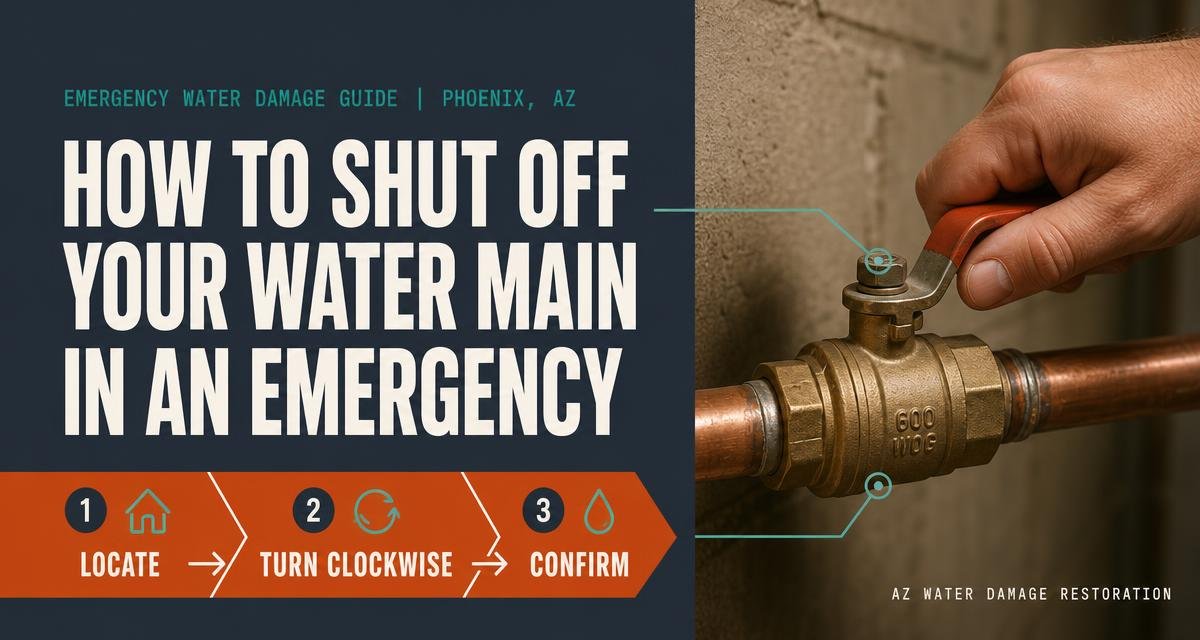
To shut off your water main in an emergency, follow these three steps: Locate the valve (usually in the garage or at the street), identify the type (gate vs. ball valve), and turn it clockwise to close it. If the valve is stuck, do not force it; apply penetrating oil and call a professional.
Find Your Main Shutoff Valve Fast
When a pipe bursts or a fixture fails, you don't have time to search. In most Phoenix-area homes, the lack of a basement means the main shutoff valve is located in one of three predictable spots.
Where It's Usually Located in a Phoenix-Area Home
Because the vast majority of homes in Phoenix, Surprise, and Scottsdale are built on concrete slab foundations, you won't find your water main in a basement. Instead, look in these locations:
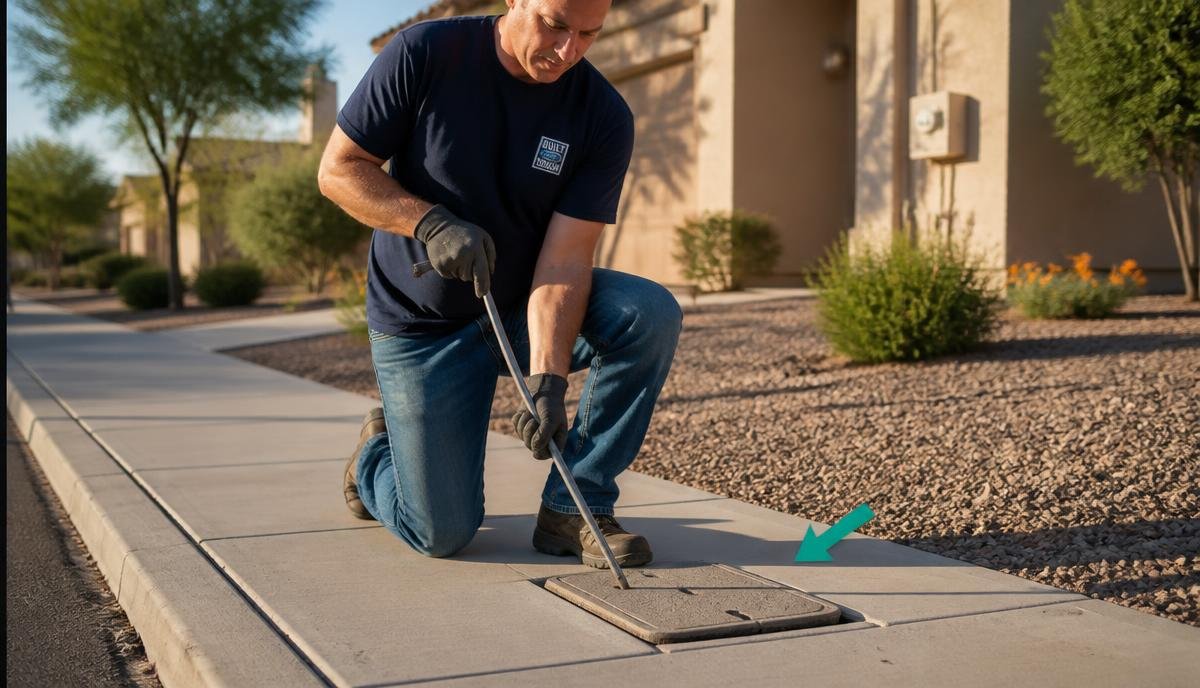
The Meter Box: Located near the street or sidewalk at the front of your property. Look for a rectangular plastic or concrete lid at ground level.
The Garage: Often located near the water heater or where the main line enters the home from the street.
Exterior Wall: Usually near the front hose bib (outdoor faucet). This is common in older Phoenix builds.
A small percentage of Arizona homes, particularly in the foothills of Mesa, Chandler, or Anthem, may have crawlspaces. In these cases, the valve is typically located near the front foundation wall or directly adjacent to the water heater.
Which Valve Is Yours? (Ownership and Legality)
If you are looking inside the street-side meter box, you will likely see two valves. It is critical to know the difference:
The House Side: The valve on the side of the meter closest to your home belongs to you. This is your primary emergency shutoff.
The Street Side: The valve on the side closest to the street, as well as the meter itself, belong to the utility provider.
Legal Warning: You should only operate the house-side valve. Attempting to turn off the utility's valve without authorization can result in fines or damage that you will be held responsible for. If your side of the valve is broken, contact your water provider immediately.
Step 1The street-side meter box holds two valves — only the house-side valve is yours to operate.
How to Turn Off a Gate Valve vs. a Ball Valve
Different homes use different mechanical designs for shutoff. Identifying yours dictates how you operate it.
Valve Type
How to Identify It
How to Close It
Ball Valve
A straight lever handle.
Turn 90 degrees crosswise to the pipe.
Gate Valve
A round, wheel-like handle.
Turn clockwise multiple times until it stops.
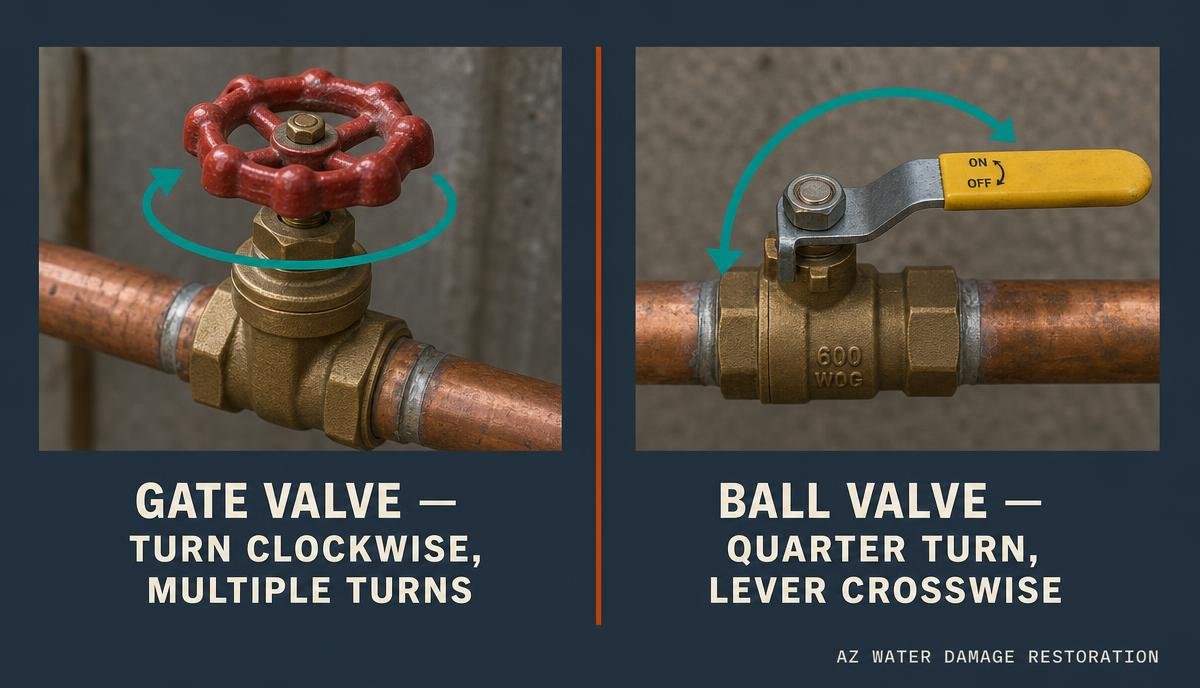
Ball Valves: These are common in newer construction. When the lever is parallel to the pipe, the water is ON. To turn it OFF, rotate it one-quarter turn until the lever sits perpendicular to the pipe.
Gate Valves: These are older and function like a screw. You must turn the round handle clockwise (right) several full rotations until it seats firmly. Because these rely on internal metal-to-metal contact, they are more prone to leaking or seizing over time.
Valve typesGate valves need several clockwise turns; ball valves close with a single quarter turn.
If the Valve Is Stuck
In an emergency, finding a seized valve is a nightmare scenario. If you turn the handle and it won't budge, follow this sequence:
Don't Force It: Using a wrench or excessive force on a corroded valve can snap the stem, leading to a massive flood that you cannot stop.
Apply Penetrating Oil: Spray a product like WD-40 or PB Blaster directly onto the valve stem where it enters the body.
Wait: Give the oil 10 minutes to penetrate the mineral deposits.
Steady Pressure: Try to turn it again using firm, even pressure. If it still won't move, stop immediately.
If the valve is completely seized, you must call a 24/7 restoration or plumbing professional to handle the emergency. Forcing the issue will only make the situation worse.
Why Phoenix Valves Get Stuck More Often Than Most
If you've lived in the Valley for a summer, you know our water is unique. Phoenix's municipal water is exceptionally hard—averaging between 12 and 17 grains per gallon. This is among the highest mineral content in the nation.
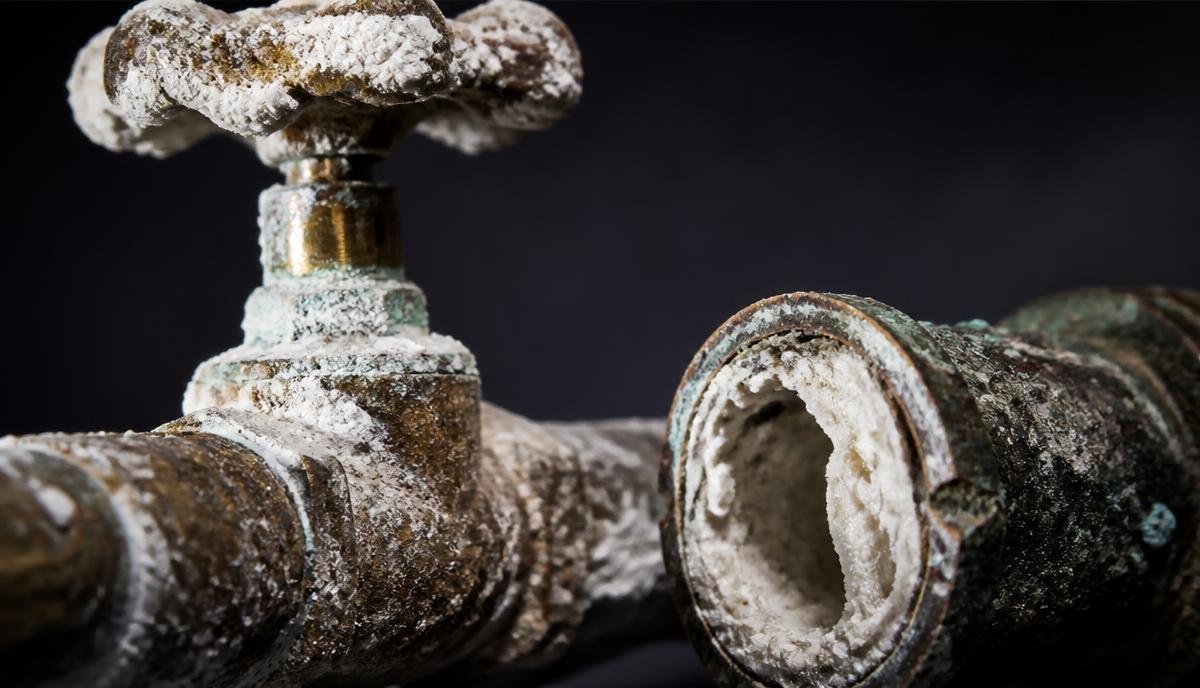
Over time, calcium and magnesium deposits build up inside the valve body and on the brass stem. In Phoenix, this problem is compounded by extreme heat. During the summer, ground temperatures inside street-side meter boxes can reach 140°F. This intense heat accelerates the chemical process that binds mineral deposits to the metal surfaces, effectively "cementing" the valve in the open position.
While valves located in shaded garages fare slightly better, they are still exposed to the same mineral-heavy water. Regular maintenance is the only way to prevent this seizure. For specialized assistance with localized water issues, visit our Phoenix Service Page.
Hard waterPhoenix hard water leaves calcium scale that cements valve stems in the open position.
Test Your Valve Before You Need It
The absolute best time to find out your valve is stuck is right now, while there is no water running across your floor.
Take Action Today: Go to your main shutoff and turn it off and back on one time. If you feel resistance or observe heavy mineral scaling around the valve body, schedule a licensed residential plumber like AquaVo Plumbing to replace the aging gate valve with a modern quarter-turn ball valve before an unexpected leak strikes. Once you've confirmed it works smoothly, we recommend tagging the valve with brightly colored tape so it is easy to spot in a dark garage or meter box when you are under stress.
After You've Shut Off the Water
Closing the main valve stops new water from entering, but there is still pressure and volume trapped in your home's pipes.
Go to the lowest point in your house (usually a backyard hose bib or a laundry sink) and turn on the faucet. This drains the remaining water out of the system and away from the leak. You should also flush your toilets once to empty the tanks.
Our rapid response units maintain staged equipment yards across Central Phoenix, the East Valley, the West Valley, Pinal County, and Greater Tucson for an average ~42-minute on-site arrival:
In most Phoenix homes, the main shutoff is in a meter box at the street, in the garage near the water heater, or on an exterior wall near the front hose bib. Because most Arizona homes are built on concrete slabs, you won't typically find them in a basement.
Which direction do you turn a water shutoff valve to close it?
Turn the valve clockwise to close it ('Righty-Tighty'). For a ball valve with a lever handle, turn it 90 degrees until the handle sits crosswise (perpendicular) to the pipe. For a gate valve with a round handle, turn it several times clockwise until it stops.
What do I do if my water shutoff valve is stuck?
Apply a small amount of penetrating oil to the valve stem and wait 10 minutes. Try to move it with steady, even pressure, but never force it. If it remains stuck, call a professional, as forcing a corroded valve can cause it to break entirely.
Can I shut off the valve at the city water meter myself?
You can operate the valve on the house-side of the meter. However, the valve on the street-side and the meter itself belong to the utility provider. If that side needs service, you must contact your local Phoenix-area water utility.
Should I test my water shutoff valve before an emergency?
Yes. You should test your valve at least once a year. Phoenix's hard water creates mineral deposits that can 'cement' a valve in place over time; testing it ensures it will actually work when you have an active leak.
Why do shutoff valves in Phoenix get stuck more often?
Phoenix has some of the hardest municipal water in the U.S. (12-17 grains per gallon). This mineral content, combined with ground temperatures that can reach 140°F in street-side meter boxes, accelerates the corrosion and scaling that binds valves shut.
About the author
AZ Water Damage Restoration Team
IICRC-certified restoration technicians · Phoenix metro
Written and fact-checked by the licensed crew that runs the trucks — the same technicians who take moisture readings, set drying chambers to the IICRC S500 standard, and answer the phone at 2 a.m. across the Phoenix metro.
Licensed Arizona contractor — AZ ROC #331127 (KB-2)