An authoritative, engineering-grade homeowner's guide to managing active roof leaks, emergency tarping, attic moisture extraction, ceiling collapse prevention, and total structural restoration in the Arizona desert climate.
Last updated:Reading time:16 minStandards:IICRC S500 Verified
Roof Leak Repair: A Homeowner's Guide 2026 · Emergency Tarping & Structural Drying · Phoenix Metro
Table of contents▾
When a roof leaks, the immediate priority is stopping interior structural damage and relieving hydraulic weight from water pooling on ceiling drywall. In Arizona's intense desert climate, roof leaks behave differently than in humid states: degraded underlayment beneath intact concrete tiles, monsoon microburst wind-shear, and parapet scupper damming are the primary culprits. Professional restoration requires a two-phase protocol: immediate emergency roof tarping and structural dry-out under IICRC S500 standards, followed by permanent exterior roofing repairs.
The 5-Step Emergency Triage When a Roof Is Actively Leaking
During severe monsoon downpours or winter Pacific storm fronts across the Salt River Valley, water entering through a compromised roof moves rapidly. It navigates roof rafters, saturates thick layers of attic insulation, spreads horizontally across drywall seams, and builds pressure above your living spaces.
Taking the correct actions in the first 30 minutes prevents structural collapse and limits reconstruction costs by thousands of dollars.
1
Catch and Contain Interior Runoff
Place deep plastic buckets or storage totes beneath the primary drip. Spread thick canvas drop cloths or plastic sheeting across surrounding flooring to catch splashing water and protect nearby baseboards, carpets, and hardwood.
2
Perform Ceiling Pinhole Pressure Relief
If water has created a bulge or blister in the ceiling drywall, do not let it pool. Place a bucket underneath and puncture a clean hole in the center with a screwdriver or nail. This drains the accumulated water in a controlled stream rather than allowing 50–100 lbs of water weight to rip down entire 8-foot drywall sheets.
3
Isolate Electrical Breakers
Water traveling through ceilings frequently pools inside recessed lighting cans, smoke detectors, and ceiling fan junction boxes. With dry footwear and dry hands, turn off the circuit breaker feeding the affected room immediately. Never touch a light switch or fixture dripping with water.
4
Clear Assets & Elevate Contents
Move electronics, area rugs, documents, and soft furnishings out of the fall zone. Place wood furniture legs on aluminum foil or plastic blocks to prevent wood stain bleeding and moisture absorption.
5
Dispatch 24/7 Emergency Tarping & Mitigation
Call our 24/7 storm damage restoration hotline for emergency roof tarping and industrial moisture extraction. Never climb onto a wet, slippery tile roof during an active storm.
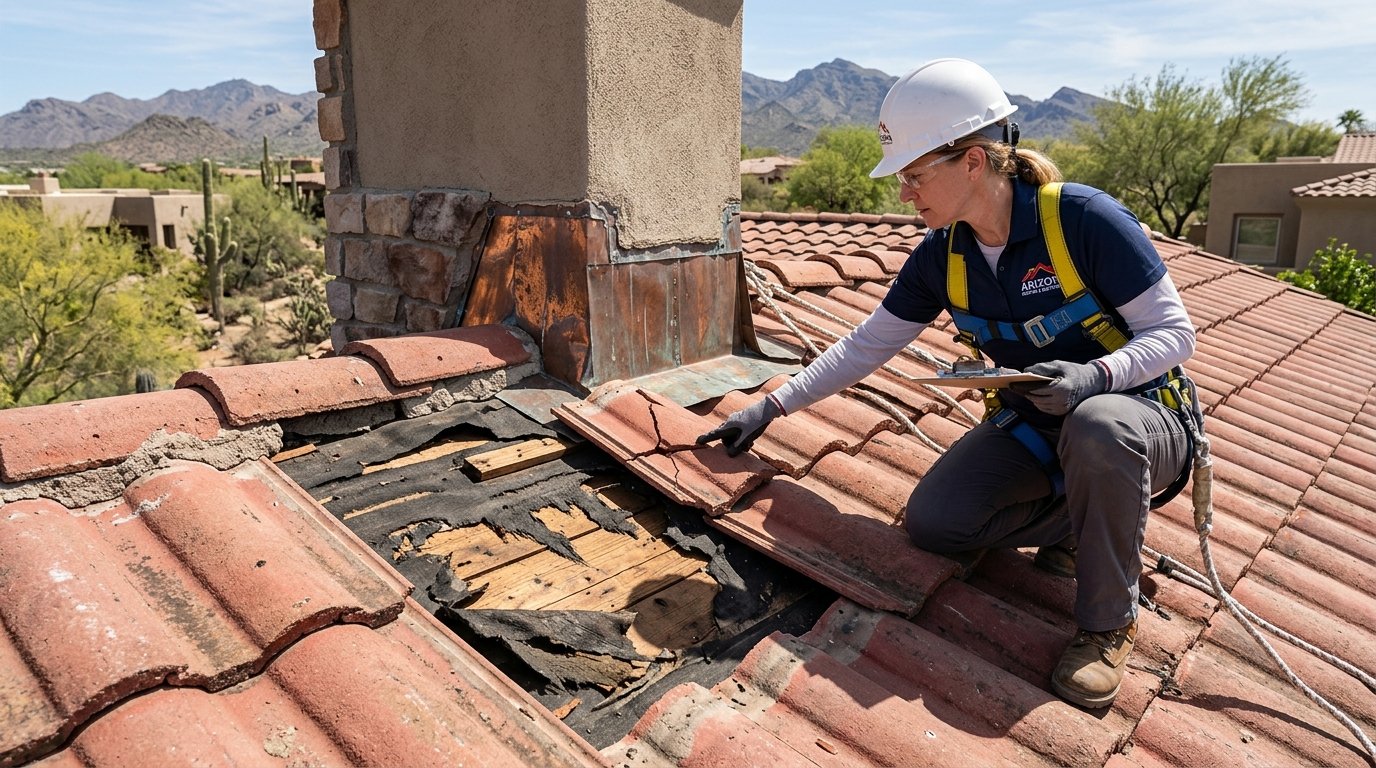
Inspection / Tile & DeckingUnderlayment degradation beneath concrete and clay tiles is the #1 hidden cause of attic leaks in Phoenix homes — often unnoticed until interior ceiling drywall sags.
Why Arizona Roofs Leak Differently (The Desert Climate Dilemma)
Arizona architecture is uniquely adapted to desert heat, but those same design features create specialized vulnerability points when violent monsoon storms strike. Understanding how your roof system is built helps identify where and why moisture penetrates.
1. The Tile Roof Underlayment "Bake & Crack" Cycle
More than 70% of homes built in Scottsdale, Mesa, Chandler, and Gilbert feature concrete S-tile or flat clay tile roofing.
The concrete tiles themselves are nearly indestructible and shed bulk water, but they are water-shedding, not waterproof. The true waterproof barrier is the underlayment sheet nailed directly to the plywood roof deck underneath.
In Phoenix summers, ambient temperatures exceeding 115°F create attic and sub-tile temperatures ranging from 150°F to 175°F. Over 12 to 18 years, standard organic 30# asphalt-saturated felt dries out, loses its volatile oils, curls, and becomes brittle as potato chips. When a summer microburst blows rain horizontally beneath the tile laps, water immediately reaches cracked, perforated felt and saturates the OSB roof decking.
2. Flat Foam / BUR Roofs and Blocked Scuppers
Contemporary homes in Central Phoenix, Arcadia, and Paradise Valley frequently use flat spray polyurethane foam (SPF) or built-up gravel roofs surrounded by parapet walls.
During haboob dust storms, desert dust and tree debris clog the narrow scupper drainage boxes along the parapet edges. When a torrential 2-inch cloudburst follows, water ponds 4 to 6 inches deep on the roof deck. The hydrostatic weight exploits seams in flashing, HVAC curb mounts, and vent pipes, resulting in sudden ceiling flooding across living rooms and kitchens.
3. Evaporative Cooler Chases and Attic AC Lines
Older homes in Glendale, Peoria, and Tempe often have rooftop evaporative cooler ducts or air handling equipment mounted in attic trusses. When roof flashing around cooler duct chases deteriorates, or when secondary condensate lines back up during humid monsoon weather, homeowners experience severe ceiling leaks that mimic roof breaches.
Roof System Type
Common Arizona Failure Mode
Average Lifespan
Emergency Triage Method
Concrete / Clay Tile
Battered underlayment felt cracks beneath intact tiles; valley debris dams
12–18 yrs (underlayment)
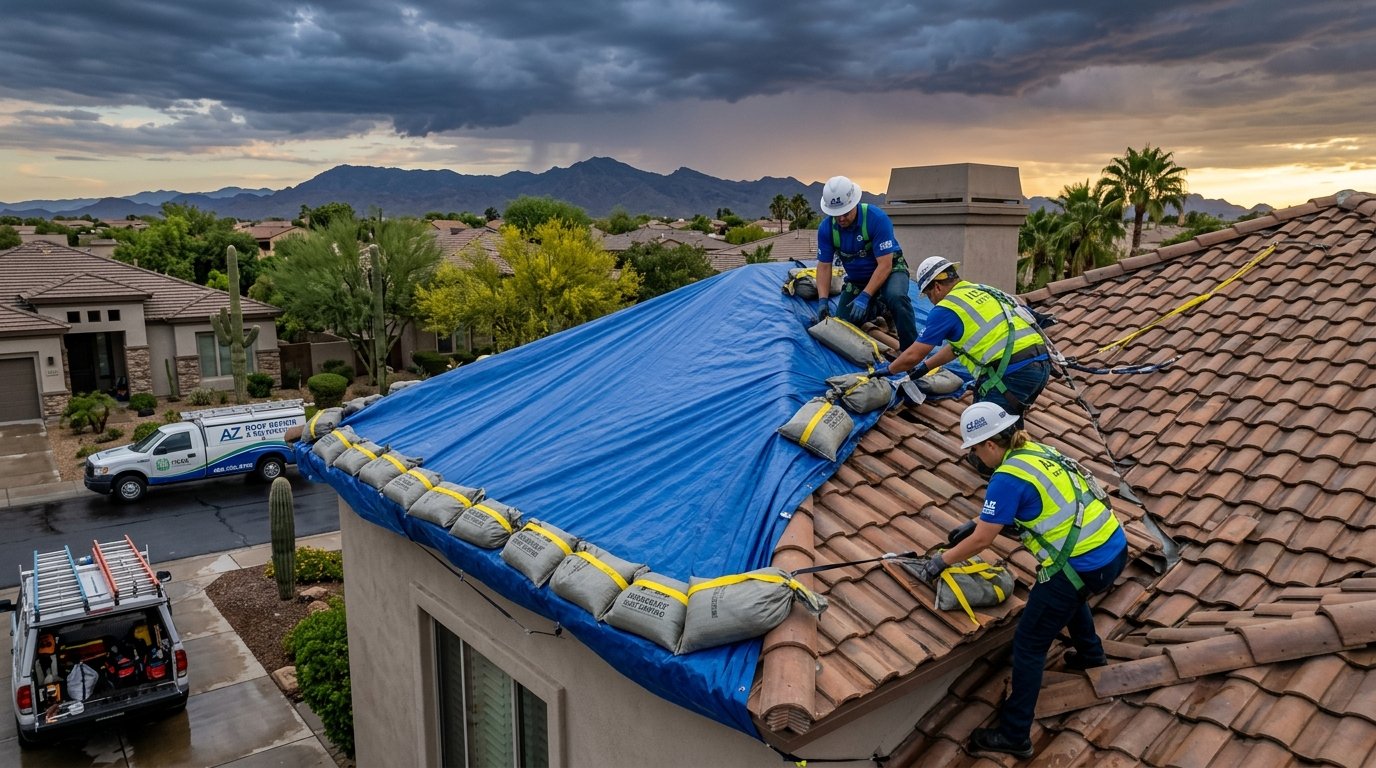
Non-destructive sandbag tarping over ridgelines and valleys
Flat Foam (SPF) / BUR
Scupper clogs cause 4–6" ponding; UV degradation blisters coatings
10–15 yrs (recoat)
Scupper clearing + weighted membrane seal over low points
Full surface tarping anchored with furring strips and sandbags
Parapet Wall & Flashing
Thermal expansion cracks stucco copings and metal reglet counter-flashing
10–15 yrs
Parapet cap wrap and elastomeric seal over mechanical curbs
Arizona Roof Types, Failure Modes, and Emergency Triage Protocols
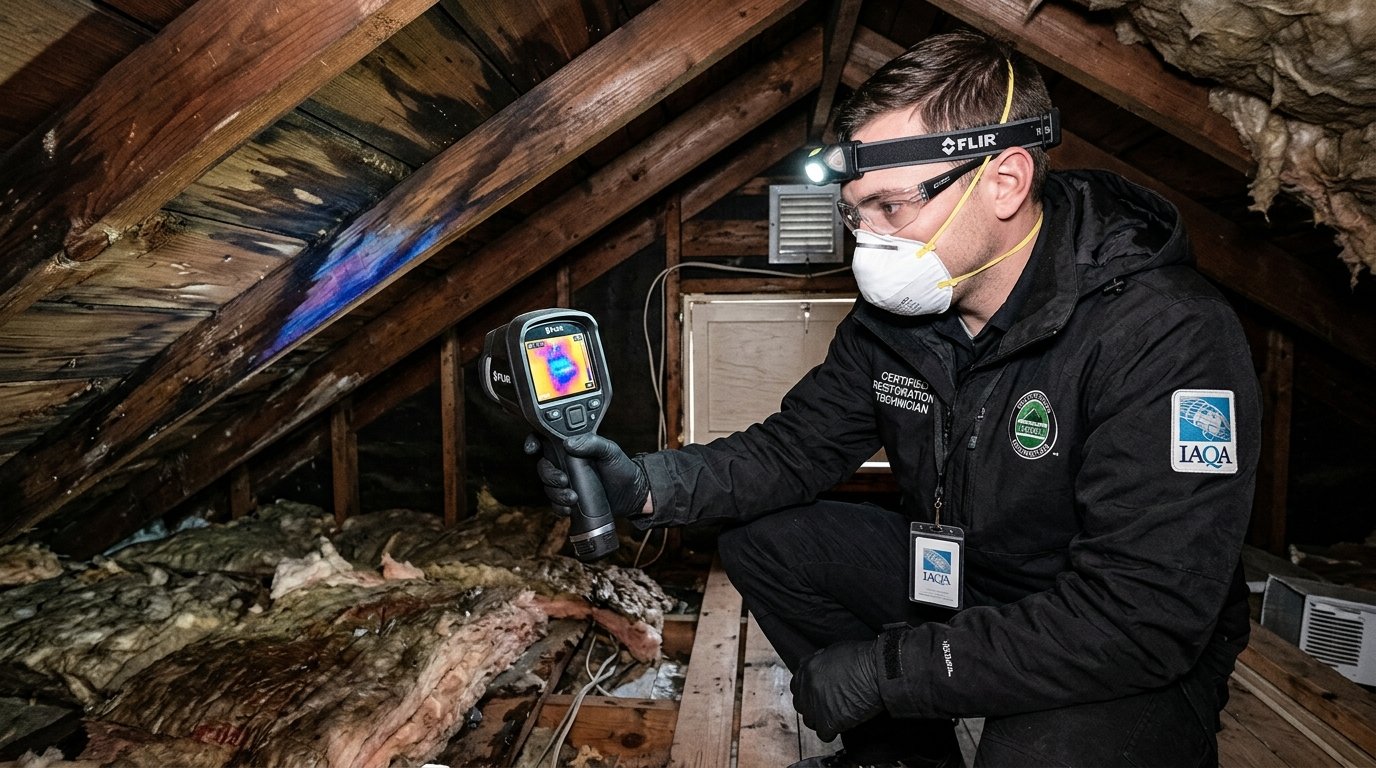
Diagnostics / Attic Thermal MappingInfrared thermal imaging maps saturated attic insulation and framing before moisture migrates into living spaces or sparks rapid fungal spore growth in extreme heat.
The Hidden Hazard: Saturated Attic Insulation
The most dangerous aspect of a roof leak is not the visible stain on the ceiling — it is the hundreds of pounds of water trapped silently in the attic.
Modern Arizona homes have 10 to 14 inches of blown-in cellulose or fiberglass insulation (R-38 to R-49 rating). This insulation is engineered to resist thermal transfer, but when exposed to water, it acts like a giant, dense sponge.
Under the IICRC S500 Standard for Professional Water Damage Restoration, saturated blown-in insulation must be extracted using high-powered HEPA-filtered vacuum hoses directed outside the building. Once the insulation is cleared, technicians can directly dry the ceiling joists, truss chords, and drywall backing.
Roofing Contractor vs. Water Damage Restoration: Who Does What?
Homeowners experiencing their first roof leak often ask: "Should I call a roofer or a restoration company?"
The answer is: you need both, but you need them at different stages of the emergency.
Restoration Factor
Water Damage Restoration Company
Roofing Contractor
Primary Mission
Stop incoming water with emergency tarping, extract attic water, dry structural wood, prevent mold, rebuild interior drywall & ceilings
Diagnose exterior roof failure, replace broken tiles/shingles, install new underlayment or replace entire roof system
Emergency Response Time
30–60 minutes 24/7 dispatch across the Phoenix metro
Typically 2 to 7 days for an inspection appointment
IICRC WRT / ASD / AMRT Certified + AZ ROC General Restoration
AZ ROC Roofing Specialty License (CR-42 / R-42)
Restoration Company vs. Roofing Contractor Responsibilities
Calling our emergency team first ensures that active rainwater is stopped immediately with wind-rated tarping, wet insulation is cleared, and industrial dehumidification begins before mold establishes. Once the interior is stabilized and dry, your roofing contractor can complete permanent exterior repairs on a completely dry roof deck.
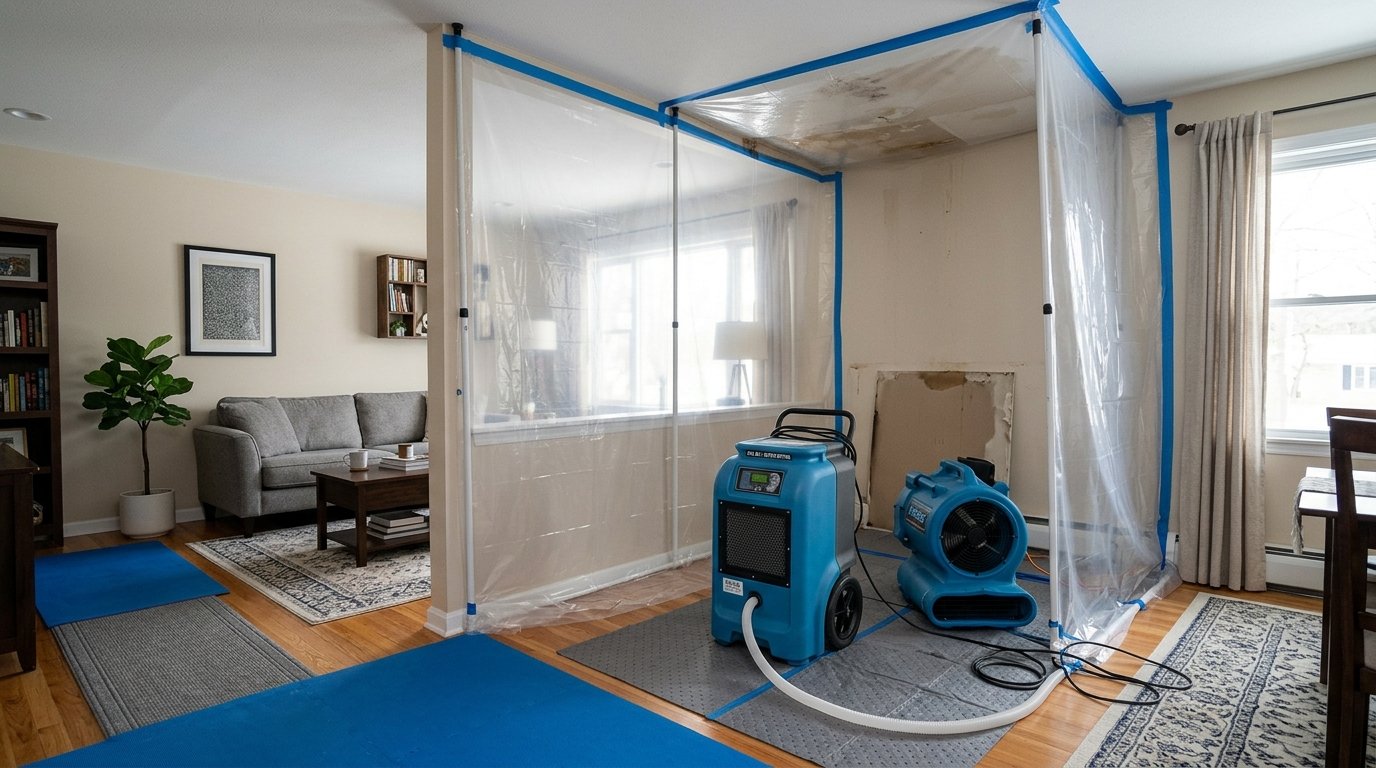
Mitigation / Structural DryingContainment barriers and industrial LGR dehumidification dry structural ceiling rafters down to the regional equilibrium moisture content (<12% WME).
The IICRC S500 Structural Drying Process for Ceiling Leaks
Simply pointing a box fan at a water stain will not dry structural 2x6 ceiling rafters or prevent secondary microbial growth. Professional restoration follows the scientific principles of psychrometric structural drying.
1. Non-Invasive Infrared Moisture Mapping
Technicians scan ceilings, perimeter walls, and attic cavities with FLIR infrared thermal cameras. Water evaporating from porous building materials causes evaporative cooling, which shows up as distinct temperature anomalies on the thermal camera. Pin and pinless moisture meters confirm exact Wood Moisture Equivalent (WME) percentages without unnecessary demolition.
2. Clean Containment Chamber Isolation
To prevent attic dust, fiberglass particles, and potential mold spores from circulating into living spaces, technicians build zippered polyethylene containment barriers. High-efficiency particulate air (HEPA 500) air scrubbers maintain negative pressure, ensuring indoor air quality remains pristine for your family.
3. Low-Grain Refrigerant (LGR) Dehumidification
Commercial LGR dehumidifiers pull ambient air down below 30 grains per pound (GPP) of moisture, creating an aggressive vapor pressure differential. Moisture trapped inside structural trusses and ceiling framing is drawn into the dry air and condensed into drain lines.
4. Daily Psychrometric Logging to Verified Dry Standard
Every 24 hours, technicians record relative humidity, ambient temperature, GPP, and material moisture percentages. Equipment remains running until wood framing reaches Arizona's baseline dry standard (typically 8% to 12% moisture content). You receive a complete, itemized Certificate of Dryness for your insurance records.
Roof Leak Water Damage Cost Matrix (2026 Arizona Pricing)
We believe in complete pricing transparency. Every restoration project begins with an upfront, itemized written scope based on actual moisture square footage and equipment hours.
Restoration Scope Item
Average Cost Range (Phoenix Metro)
Key Pricing Variables
Emergency Roof Tarping & Board-Up
$450 – $1,400
Roof pitch, height, square footage of tarp, sandbag perimeter vs. screw-down anchors
Attic Wet Insulation Vacuum Extraction
$1,100 – $2,800
Attic square footage, cellulose vs. fiberglass, depth of insulation, access hatch location
Structural Drying & Dehumidification
$1,200 – $4,500
Number of LGR dehumidifiers, axial air movers, HEPA scrubbers, equipment run days (typically 3–5 days)
Antimicrobial Sanitization Treatment
$350 – $850
EPA-registered botanical disinfectant applied to exposed joists, decking, and wall cavities
Ceiling Drywall & Texture Reconstruction
$800 – $3,200
Square footage of drywall replacement, insulation re-blow, tape, mud, skip-trowel/orange peel texture match, primer & paint
Exterior Permanent Roof Repair (by Roofer)
$500 – $4,200
Tile lift and reset, new synthetic underlayment, valley metal replacement, or parapet coating
2026 Estimated Cost Ranges for Roof Leak Mitigation & Restoration in Arizona
Navigating Homeowners Insurance for Roof Leak Damage
Understanding how insurance carriers handle roof leak claims in Arizona is essential to preventing denied claims:
What Is Typically Covered (Sudden & Accidental Damage)
Monsoon microburst winds ripping off roof tiles, hail impact puncturing flat roof coatings, tree limbs puncturing decking, and the resulting interior water damage to ceilings, insulation, flooring, and personal property are standard covered perils.
What May Be Excluded (Wear, Tear & Age)
The exterior cost of replacing a 20-year-old dried-out tile underlayment is often considered regular homeowner maintenance. However, even if the exterior roof repair is not covered, the interior sudden water damage resulting from a storm event is frequently covered.
How We Protect Your Claim
Our technicians compile date-stamped infrared thermal imaging, moisture meter mapping, initial loss photos, and daily psychrometric dry-out logs formatted to industry standards. We provide this documentation directly to you and your adjuster to justify all emergency mitigation line items.
Common Arizona Roof Leak Myths Debunked
Common Homeowner Myth
Scientific Reality & Industry Standard
"If the rain stopped and the ceiling is dry to the touch, the leak resolved itself."
Water trapped in attic insulation and ceiling joists remains damp for weeks in dark attic cavities, quietly cultivating mold colonies above your living space.
"I can spray stain-blocking primer over the ceiling water ring to fix it."
Painting over a wet substrate traps moisture inside the drywall core, resulting in bubbling paint, drywall rot, and mold growth behind the paint film.
"Bleach will kill the mold on my ceiling joists."
Bleach cannot penetrate porous wood framing and adds 90% water to the surface. Professional remediation uses EPA-registered botanical antimicrobials and mechanical HEPA sanding.
"I should wait for my roofer to inspect the roof before calling a restoration company."
Roofers rarely offer same-day emergency dry-out. Waiting 3–5 days allows moisture to spread, turning a simple Category 1 drying job into a major Category 3 mold remediation project.
Arizona Roof Leak Misconceptions vs. Restoration Facts
Valley-Wide Rapid Dispatch for Roof Leaks & Storm Damage
When monsoon microbursts and heavy storms sweep across Maricopa County, our fully stocked mobile restoration units are staged along major Valley freeway corridors for rapid 30- to 45-minute emergency response:
What should I do first when my roof is actively leaking?
Immediately contain the interior runoff: place a bucket beneath the drip, move furniture and electronics away, and perform a pinhole relief on bulging ceiling drywall with a screwdriver or nail to drain trapped water safely before the drywall collapses under hydraulic weight. Then call for emergency roof tarping and structural moisture extraction.
Why do tile roofs leak in Arizona if the concrete tiles are not broken?
Tile roofs in Phoenix rarely fail from the concrete or clay tiles themselves. The failure occurs in the organic 30# asphalt felt underlayment beneath the tiles. Arizona's 115°F summer heat bakes attics up to 160°F, turning the underlayment brittle and cracked within 12 to 18 years. When wind-driven monsoon rains push under the tiles, water leaks directly onto the plywood decking.
How much does roof leak repair and water damage restoration cost in 2026?
Exterior roof repairs typically range from $450 to $2,800 depending on whether it's a minor tile reset, valley flashing repair, or partial underlayment replacement. Interior water damage mitigation and attic structural drying typically range from $1,200 to $4,500. Saturated attic insulation removal and replacement adds $1,100 to $2,500.
Who should I call first: a roofer or a water damage restoration company?
If water is entering the home, pooling in the attic, or saturating the ceiling, call an IICRC-certified water damage restoration company first. Restoration technicians secure emergency tarping within 60 minutes to stop incoming water, extract attic moisture, and stabilize sagging drywall. Roofers typically take 3 to 7 days to schedule permanent repairs and do not dry interior framing or remediate mold.
Can wet attic insulation dry out on its own in the desert heat?
No. Saturated blown-in cellulose and fiberglass insulation acts like a giant sponge, trapping moisture against ceiling joists and drywall. The extreme attic heat combined with trapped moisture accelerates fungal spore germination within 24 to 48 hours. Saturated insulation must be vacuum-extracted under negative pressure and replaced.
Does homeowners insurance cover roof leak water damage?
Homeowners insurance typically covers interior water damage resulting from sudden, accidental storm damage, microburst wind lift, or hail impact. However, insurance carriers frequently deny claims if the roof leak is attributed to long-term wear and tear or deferred underlayment maintenance. Comprehensive moisture logs and thermal imaging reports from an IICRC restorer are vital for your claim file.
How do I know if my ceiling drywall needs to be removed after a roof leak?
If drywall has sagged more than 3/8 inch, contains Category 2 or 3 contaminants from attic rodent droppings, or retains moisture above 16% Wood Moisture Equivalent (WME) after 48 hours of industrial dehumidification, the IICRC S500 standard mandates controlled removal to prevent mold growth.
What is emergency roof tarping and how long does it last?
Emergency roof tarping is a heavy-duty, UV-resistant waterproof membrane secured over damaged tiles, shingles, or flat roof sections using non-destructive sandbag anchors or furring strips. A professionally installed emergency tarp provides watertight storm protection for 30 to 90 days while permanent roof repairs are scheduled.
About the author
AZ Water Damage Restoration Team
IICRC-certified restoration technicians · Phoenix metro
Written and fact-checked by the licensed crew that runs the trucks — the same technicians who take moisture readings, set drying chambers to the IICRC S500 standard, and answer the phone at 2 a.m. across the Phoenix metro.
Licensed Arizona contractor — AZ ROC #331127 (KB-2)