The complete Arizona homeowner guide to summer monsoon preparation: prevent roof collapses from scupper silt dams, stop flash floods across caliche hardpan, protect AC systems from haboob dust, and safeguard your foundation from 70 mph microbursts.
Last updated:Reading time:16 minStandards:IICRC S500 Verified
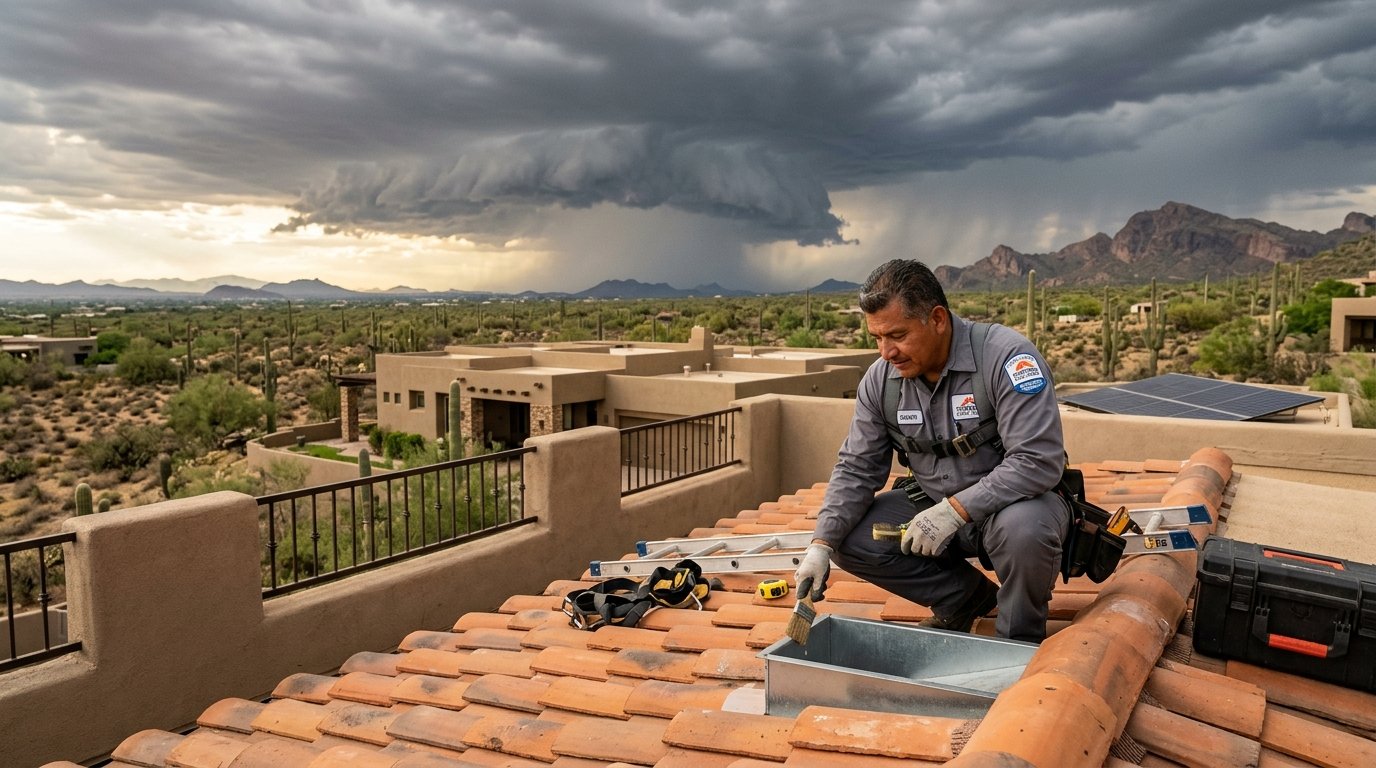
Rooftop monsoon defense: Clearing silt dams from parapet scuppers and inspecting tile underlayment before severe convective storm cells strike Phoenix.
Table of contents▾
Quick Summary: 5 Mandatory Pre-Monsoon Directives Before July 1
The Arizona monsoon season (June 15 – September 30) unleashes a violent meteorological trifecta: 70+ mph microburst winds, blinding haboob dust storms, and flash downpours dumping 2+ inches of rain in under an hour onto impermeable caliche desert soil. To prevent catastrophic structural water damage, every desert property owner must execute five non-negotiable safeguards:
Clear Roof Scuppers & Valleys: Remove haboob silt and tree pods to prevent 11-ton ponding dead loads on flat roofs.
Service HVAC Condensate & Coils: Flush primary drain lines with vinegar and test secondary pan float switches.
Grade Perimeter Swales: Maintain a 6-inch drop over 10 feet away from concrete stem walls to channel sheet flow away.
Prune Brittle Desert Canopies: Thin mesquite, palo verde, and eucalyptus branches 10+ feet back from the roofline.
Pre-Stage Flood Sandbags: Keep 10–15 pre-filled sandbags ready to seal low-threshold patio sliding glass doors.
In the Valley of the Sun, summer is not merely characterized by 115°F scorching heat—it is divided into two distinct meteorological chapters: the bone-dry early summer (May through mid-June) and the violent, humid North American Monsoon (mid-June through late September). For homeowners in Phoenix, Scottsdale, Mesa, and across Maricopa County, monsoon storms represent the single greatest annual threat of sudden, catastrophic water losses.
Unlike gentle continuous Midwestern or coastal rain systems, desert storms strike with explosive intensity. When tropical moisture surges northward from the Gulf of California and collides with superheated desert air, severe thunderstorm cells trigger localized downbursts. Within fifteen minutes, high-velocity winds can dislodge roof tiles, haboob dust storms choke drainage scuppers, and flash floods submerge exterior door thresholds. Preparing your home beforehand is the only proven method to stop preventable structural destruction.
1. The Anatomy of an Arizona Monsoon: Why Desert Storms Inflict Severe Damage
To properly defend your home, you must understand the unique physical mechanics of the Sonoran Desert monsoon. Standard building practices designed for temperate climates frequently fail under the combined environmental stresses of Arizona summers:
Microbursts & Downbursts
Intense rain-cooled air rushes toward the ground at speeds exceeding 60 to 80 mph. When this column strikes the earth, it radiates outward in violent horizontal wind shears. This forces rain laterally beneath concrete roof tiles, drives water through window weep holes, and snaps mature desert trees directly onto roofs.
Haboobs (Dust Walls)
Miles ahead of the thunderstorm, microburst outflows loft loose topsoil into a towering wall of dust 5,000 to 8,000 feet tall. This fine, abrasive silt packs tightly into rooftop scuppers, valleys, AC condenser coils, and exterior weep screeds, creating a dense mechanical blockage right before the cloudburst arrives.
Caliche Soil & Sheet Flow
Arizona's desert soil is dense clay underlain by impervious caliche (natural concrete-like limestone hardpan). Because water cannot percolate downward into the parched earth, intense cloudbursts produce 100% immediate surface runoff, inundating foundations and patio door tracks in minutes.
Monsoon storm dynamics: Arizona summer microbursts dump intense cloudbursts within minutes, requiring cleared roof drainage and pre-graded property channels to avert catastrophic water intrusion.
2. The Roof Defense Protocol: Tiles, Parapet Scuppers, and Foam Systems
Your roof is your home's primary shield against monsoon violence. Over 70% of monsoon water damage claims originate from roof compromises. In Arizona, roof architecture falls into two predominant styles—concrete/clay tile and flat parapet roofs—each with distinct vulnerability points.
A. Tile Roofs: Why Intact Tiles Still Leak
Many Arizona homeowners look up at their roof from the street, see perfectly aligned, unbroken concrete tiles, and assume their roof is 100% watertight. This is a dangerous misconception. Concrete and clay tiles are strictly water-shedding sun screens designed to reflect solar radiation; they are not sealed against pressurized water.
The true waterproof membrane is the underlying layer of organic asphalt felt (ASTM D226 Type II 30#) or modified bitumen/SBS synthetic underlayment nailed to the plywood sheathing. Under Arizona's extreme summer sun, attic temperatures consistently reach 140°F to 160°F. Within 12 to 18 years, this relentless thermal baking cooks out the petroleum oils in organic felt, causing it to become brittle, blistered, and cracked. When microburst winds blow monsoon rain horizontally uphill beneath the tile overlaps, the water hits dry, cracked felt and flows directly into your attic insulation and drywall ceilings.
Inspect Valley Metal: Valleys collect immense runoff volumes. Clear built-up desert grit, eucalyptus leaves, and bird nests that act as natural dams, forcing water sideways over the metal flashing lip.
Check Flashing Collars: Inspect rubber pipe boots around plumbing vent stacks and AC refrigerant line penetrations. Desert UV radiation dry-rots rubber collars in 3 to 5 years, leaving an open 1/2-inch gap for rainwater to enter attic chases.
Re-align Slipped Tiles: High winds from previous microbursts can slide tiles out of their interlocking channels, directly exposing the delicate underlayment to sun and rain.
B. Flat & Parapet Roofs: The 11-Ton Scupper Silt Dam Catastrophe
Southwestern Santa Fe, Pueblo revival, and modern contemporary homes commonly feature flat roofs surrounded by raised exterior parapet walls. Water drains off these roofs exclusively through openings in the parapet walls called scuppers, which feed into exterior collector boxes (conductor heads) and downspouts.
The Physics of Rooftop Water Weight: Structural Sagging & Collapse
Water weighs 8.34 pounds per gallon, or roughly 5.2 pounds per square foot per inch of depth. If haboob dust and tree litter plug your 4-inch scuppers, rainwater cannot escape:
1 inch of standing water over a 1,500 sq ft flat roof = 7,800 lbs (3.9 tons)
2 inches of standing water over a 1,500 sq ft flat roof = 15,600 lbs (7.8 tons)
3 inches of standing water over a 1,500 sq ft flat roof = 23,400 lbs (11.7 tons)
Most residential roof joists are engineered for a live load of only 20 lbs per square foot. When scuppers clog, the immense dead weight causes roof trusses to deflect downward, creating an ever-deepening bowl that collects more water until the ceiling catastrophically caves into the living room below.
Before July 1st, ascend to your flat roof (or hire an IICRC-certified technician) and physically clear every scupper throat. Remove all accumulated bird debris, dried mud, and desert weed growth. Ensure the secondary emergency overflow scuppers (located 2 inches above the primary scuppers) are completely unobstructed.
3. Ground-Level Flood Defense: Caliche Soil, Swales, and Stem Walls
While roof leaks penetrate from above, flash flooding attacks from below. Most homes across Maricopa and Pima counties are constructed on monolithic concrete slab-on-grade foundations with low perimeter stem walls. If your yard grading channels water toward the house rather than away, a 45-minute cloudburst will flood your interior flooring.
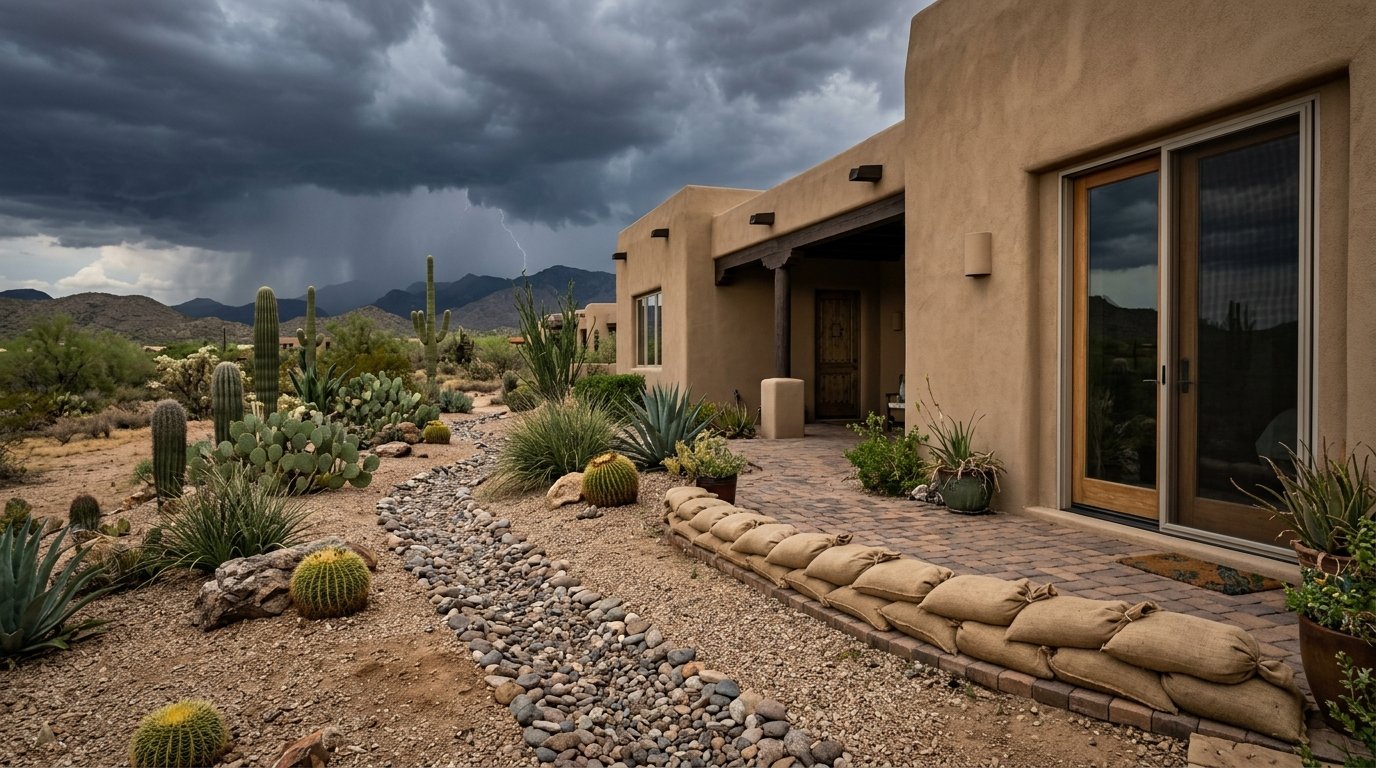
Ground flood preparation: Pre-staging sandbags along low-threshold patio sliding glass doors and maintaining clean gravel drainage swales to redirect desert sheet runoff away from concrete stem walls.
A. Overcoming Desert Soil Impermeability
In wet climates, grass and porous loamy topsoil absorb significant rainfall before surface ponding begins. In Arizona, baking desert heat turns topsoil into a rock-hard crust. Beneath the crust lies caliche—a sedimentary rock-like cementation of calcium carbonate that completely blocks vertical drainage. As a result, storm water behaves identically to water hitting an asphalt parking lot: it immediately gathers into high-velocity sheet flows.
The 6-in-10 Positive Slope Rule
Per International Residential Code (IRC R401.3) and Arizona building standards, ground immediately adjacent to foundation stem walls must slope downward a minimum of 6 inches within the first 10 feet (a 5% slope). Inspect your perimeter: if years of decorative rock installation or settling have created a flat or negative slope, water will pool against stucco and penetrate through the weep screed.
Flushing French Drains & Swales
Dry riverbed drainage swales and subterranean French drains collect silt, gravel, and fallen desert pods all spring. Use a garden hose or high-pressure drain bladder to flush subterranean corrugated pipes before the first storm. If grates are buried under river rock, unearth them so surface water enters freely.
B. Sliding Patio Doors: The #1 Ground-Level Entry Point
Nearly every Arizona home features large sliding glass doors leading to covered rear patios. In heavy monsoon winds, rain hits the vertical glass and cascades into the aluminum bottom track. Standard door tracks feature tiny exterior weep holes with plastic flutter baffles to allow tracked water to drain outside.
During springtime dust storms, these weep holes become plugged with fine desert silt and dog hair. When a downpour hits, the door track fills with water in under three minutes, overflowing the interior sill track lip and soaking into carpet, hardwood, or luxury vinyl plank (LVP) flooring.
Vacuum Track Weep Holes: Use a crevice tool and stiff toothbrush to thoroughly clean all debris from the sliding door track. Pour a cup of water into the track to confirm it discharges freely outside onto the patio slab.
Inspect Weatherstripping: Replace dried, cracked mohair or vinyl weatherstripping along the interlocking door stiles to prevent microburst wind pressure from pushing water through closed doors.
Stage Sandbags or Flood Barriers: If your patio slab lacks a 2-inch drop from the interior finished floor, store heavy-duty poly sandbags or reusable water-activated hydrabarriers in the garage for instant deployment.
4. Mechanical, Electrical & HVAC Storm Hardening
When an Arizona monsoon strikes, your HVAC and electrical systems face extreme hazards. High temperatures (frequently exceeding 110°F immediately preceding storm outbreaks) combine with lightning strikes, microburst windblown dust, and intense electrical grid voltage swings.
Condenser Coil Cleaning After Haboobs
When a haboob passes over your property, the outdoor condenser unit's fan draws thousands of cubic feet of airborne dust through the delicate aluminum cooling fins. This coats the coils in an insulating blanket of grime, driving head pressures dangerously high. Once the storm passes, gently rinse the outdoor condenser fins with a low-pressure garden hose from the top down. Never use a high-pressure washer, which bends the fragile aluminum fins and permanently chokes airflow.
Attic Condensate Pan & Float Switch Safety
During humid monsoon weeks, an air handler removes 10 to 15 gallons of moisture daily from indoor air. Operating inside a 140°F attic, warm condensate water fosters thick bacterial sludge (zooglea algae). If the 3/4-inch PVC drain line clogs, water overflows into the secondary metal drain pan. Homeowners must physically verify that the secondary pan is clean, rust-free, and equipped with a functional electronic inline float switch that automatically cuts power to the AC unit before water overflows the pan edge and destroys ceiling drywall.
Arizona's desert basin experiences tens of thousands of cloud-to-ground lightning strikes each monsoon season. Lightning strikes to nearby utility transformers cause catastrophic voltage spikes that fry electronic control boards in HVAC systems, variable-speed pool pumps, and smart home appliances. Installing a Type 2 Whole-Home Surge Protection Device (SPD) at your main electrical breaker panel costs under $350 and prevents thousands in equipment damage. Furthermore, if your home has a basement or sunken living room with an electric sump pump, install a dedicated 12V marine battery backup to ensure continuous water pumping when monsoon winds sever municipal power.
5. Landscape, Tree Canopy & Swimming Pool Safeguards
Outdoor exterior amenities—including mature desert shade trees, shade sails, and swimming pools—can quickly become destructive liabilities during a severe microburst.
A. Thinning Desert Tree Canopies (The "Wind Sail" Effect)
Species such as Chilean Mesquite, Blue Palo Verde, African Sumac, and Eucalyptus grow rapidly in Arizona residential settings. Because homeowners typically water them with surface drip emitters, these trees develop shallow, horizontal root systems rather than deep taproots.
When an unpruned, dense canopy encounters 70 mph microburst winds during a heavy rain event that softens the soil, the canopy acts like a giant ship's sail. The immense lateral force either snaps heavy overhanging limbs directly through roof decking or uproots the entire tree across fences, patio covers, and air conditioning units.
Crown Thinning: Hire an ISA-certified arborist before June 15 to perform structural crown thinning. Removing 20% to 25% of interior crossing branches allows microburst winds to blow freely through the tree canopy without generating dangerous aerodynamic drag.
Establish 10-Foot Roof Clearance: Prune all branches back at least 10 feet from rooflines and exterior stucco walls to eliminate branch scraping and falling limb impacts.
B. Swimming Pool Water Management
Nearly half of all suburban Phoenix properties feature a backyard swimming pool. During a localized monsoon cell dropping 2.5 inches of rain in 45 minutes, an already-full pool will rapidly overflow its perimeter coping. Because pool decking is frequently poured with minimal slope back toward the home, pool overflow water can easily submerge patio door sills.
Lower Pool Level 4 to 6 Inches: When the National Weather Service issues a Severe Thunderstorm or Flash Flood Watch, use your pool pump's waste or backwash setting to lower the water level 4 to 6 inches below the tile line. This creates an immediate retention reservoir for storm runoff.
Disable Auto-Fill Valves: Turn off the manual ball valve on your pool auto-fill supply line so the pool does not automatically top itself off right before a downpour.
Turn Off Filtration Systems During Haboobs: Shut down pool pump timers when a haboob approaches to prevent drawing massive quantities of fine desert silt into the sand or DE filter grids, which can burn out pump impellers.
Use this technical engineering matrix to evaluate every structural component of your Arizona home, identify failure indicators, and execute pre-storm hardening:
Perform professional crown thinning (20–25% canopy reduction), clear 10 feet back from structures.
If tree contacts power lines, stay 35 feet away and call SRP/APS immediately. Tarp punctured roofs.
Step-by-Step Pre-Monsoon Preparation Checklist for Arizona Homeowners
Follow this chronological timeline to thoroughly harden your property before storm clouds gather on the horizon:
1
May 1 – May 31: Early Summer Mechanical & Roof Audit
Before outdoor temperatures reach 110°F, conduct a complete rooftop inspection. For tile roofs, inspect valleys, replace cracked tiles, and check flashing seals around vents and chimneys. For flat roofs, physically clear all scupper drains and downspout heads. Service your HVAC system: pour 1 cup of distilled white vinegar into the condensate cleanout, check the secondary emergency drain pan, and test the inline safety float switch.
2
June 1 – June 14: Landscape, Trees & Foundation Drainage
Prune desert trees (mesquite, palo verde, ironwood, eucalyptus) away from the house, maintaining at least a 10-foot clearance from roofs and service drops. Thin out dense tree crowns to let microburst winds pass through. Inspect foundation grading: ensure soil drops 6 inches over the first 10 feet. Clear gravel swales and catch basins of debris, leaves, and weed accumulation.
3
June 15 – July 1: Window Weep Holes, Weatherstripping & Flood Supplies
Vacuum all exterior sliding glass door and window sill tracks. Clean out weeping ports and test with water. Purchase 10 to 15 sandbags from your local fire station or home improvement store and pre-fill them with coarse sand; store them dry in your garage. Check your main water shutoff valve to ensure it rotates smoothly without binding in case exterior storm damage ruptures outdoor plumbing lines.
4
Day-of-Storm / Severe Weather Alert Protocol
When the National Weather Service issues a Severe Thunderstorm or Flash Flood Watch: take down fabric shade sails, close and latch patio umbrellas, bring lightweight potted plants and patio cushions indoors, and backwash or lower pool water levels 4 to 6 inches below the coping. If your patio has flooded during previous monsoons, position pre-staged sandbags snugly along the exterior sliding door track.
Once the storm passes, safely inspect the property. Look for fallen tree branches on roofs, inspect ceilings for discoloration or bowing drywall, and check whether flat roof scuppers are actively draining or ponded. If water entered your home, shut off electrical circuits in affected rooms, take clear photos of the damage, and immediately call an IICRC-certified restoration company to begin commercial extraction before microbial growth begins at 24 hours.
When does the Arizona summer monsoon season officially start and end?
The National Weather Service (NWS) defines the Arizona monsoon season as running from June 15 through September 30. However, the most severe, destructive storms typically cluster between mid-July and late August, when extreme daytime heat creates violent convective storm cells carrying microburst winds, haboob dust walls, and torrential rainfall.
Why do concrete tile roofs leak during monsoons even if no tiles are broken?
Concrete and clay tiles are designed as a decorative, water-shedding sun shield—they are not waterproof. The true waterproof barrier is the organic asphalt felt or synthetic SBS underlayment installed directly onto the roof decking. In the desert, 140°F–160°F attic heat bakes the volatile oils out of underlayment within 12 to 18 years, leaving it brittle and cracked. When 60+ mph monsoon microbursts drive rain horizontally beneath tile overlaps, water penetrates directly into attic insulation and drywall.
What is a rooftop scupper silt dam and why is it dangerous on flat roofs?
On Southwestern Santa Fe or modern flat-parapet roofs, scuppers and downspouts are the only drainage exits. Before monsoon rains arrive, massive haboob dust storms coat roofs with fine desert silt. When the first rain falls, this silt washes into scupper openings alongside mesquite leaves and bird debris, forming an impermeable 'silt dam.' Water pools rapidly on the roof; just 3 inches of standing water across a 1,500 sq ft flat roof adds over 23,400 pounds (11.7 tons) of dead weight, risking sudden roof deck collapse.
Why does desert soil create instant flash flooding around home foundations?
Arizona desert soil contains dense, cemented calcium carbonate layers known as caliche, as well as sun-baked clay hardpan. This ground has virtually zero initial water absorption capacity, behaving like poured concrete during a storm. When a monsoon cell drops 1.5 to 3 inches of rain per hour, 100% of the precipitation becomes overland sheet flow, quickly overwhelming foundation swales and submerging patio door thresholds.
How does haboob dust damage air conditioning units during monsoon season?
A haboob carries dense plumes of particulate dust and agricultural grit up to 8,000 feet high. This fine particulate gets sucked into outdoor condenser fins, forming a thermal insulation blanket that restricts airflow. This spikes compressor head pressures, leading to blown motor capacitors or frozen evaporator coils. When the unit thaws, gallons of condensation overwhelm the secondary drip pan, causing ceiling cave-ins.
Does standard homeowners insurance cover monsoon flash flood damage?
No. Standard homeowners insurance policies (HO-3) strictly exclude damage caused by rising surface water, groundwater intrusion, or exterior flood runoff entering through doors or walls. That requires a separate National Flood Insurance Program (NFIP) policy or private flood rider. However, if microburst winds tear off roof tiles or break a window and rain enters directly through that storm-created opening, the resulting interior water damage is typically covered under standard windstorm provisions.
What trees pose the greatest microburst risk to Phoenix homes?
Fast-growing desert trees such as Chilean Mesquites, Palo Verdes, African Sumacs, and mature Eucalyptus trees are the most dangerous. In residential yards, surface drip irrigation causes them to develop wide but shallow root plates. When 60–80 mph microburst downdrafts strike during rain-softened soil conditions, top-heavy canopies act as sails, uprooting trees into roofs, crushing AC units, and severing electrical service drops.
What emergency steps should I take immediately after water enters my home during a storm?
First, prioritize safety: shut off the electrical breaker to the flooded rooms if standing water threatens outlets, and never touch electrical panels while standing in water. Second, photograph all active water intrusion, pooling water, and structural damage before touching anything. Third, move valuables, rugs, and furniture onto dry areas or elevate them on aluminum foil. Fourth, call an IICRC-certified 24/7 disaster restoration contractor immediately to extract water before mold germinates at 24 hours.
IICRC-certified restoration technicians · Phoenix metro
Written and fact-checked by the licensed crew that runs the trucks — the same technicians who take moisture readings, set drying chambers to the IICRC S500 standard, and answer the phone at 2 a.m. across the Phoenix metro.
Licensed Arizona contractor — AZ ROC #331127 (KB-2)