Arizona roofs face a brutal environmental gauntlet: 150°F+ attic heat that bakes asphalt underlayment, followed by violent 50 mph monsoon microbursts and winter soaking rains. Use this seasonal maintenance checklist to stop roof leaks before they saturate your ceilings.
Last updated:Reading time:14 minStandards:IICRC S500 Verified
In the Arizona desert, roof leaks are prevented through rigorous seasonal maintenance aligned with our four distinct weather phases: Spring pre-monsoon audits, Summer active storm defense, Fall silt-dam clearance, and Winter soaking rain inspection. Because concrete tiles outlive the organic asphalt underlayment underneath by decades, 90% of Arizona tile roof leaks stem from heat-baked, brittle felt cracking under thermal expansion or debris-clogged valleys creating “silt dams.” Inspecting scuppers, valleys, and flashings twice annually prevents catastrophic drywall collapse, soaked attic insulation, and toxic mold growth.
In the Sonoran Desert, a roof does not just shelter your home from rain—it withstands one of the most punishing thermal environments on Earth. Between May and September, rooftop temperatures regularly exceed 150°F to 175°F under direct ultraviolet solar radiation. This extreme heat causes severe expansion and contraction cycles that stress sheet metal flashings, degrade elastomeric sealants, and literally bake the organic waterproofing oils out of asphalt underlayment.
Then, without warning, the summer monsoon arrives. In the span of forty-five minutes, a severe microburst can unleash 2 inches of wind-driven rain propelled by 60-mile-per-hour gusts. If your tile valleys are obstructed by desert dust dams, your scuppers are clogged with palo verde pods, or your underlayment has developed hairline thermal fractures, hundreds of gallons of rainwater will bypass the roofline and pour into your attic insulation.
This guide provides Arizona property owners with an actionable, season-by-season maintenance checklist designed to identify and eliminate roofing vulnerabilities before the first drop of rain hits your ceiling.
The Master Arizona Seasonal Roof Maintenance Checklist
Plumbing systems and roofing components require proactive attention timed to Arizona’s specific weather cycles. Use this matrix to schedule your annual maintenance:
Season & Window
Primary Desert Threat
Critical Checklist Tasks
Inspection Method
Spring (March – May) Pre-Monsoon Preparation
Intense heat onset; dried debris and bird nests in valleys and scupper drains.
Clear all valleys of accumulated dust; reseal pipe jack boots; trim tree canopies 10 ft away; perform attic underside daylight check.
Ground binoculars + interior attic walkthrough before 9 AM.
Inspect roof after every major dust storm; check scuppers for blockages; verify flat roof ponding drains within 48 hours; check ceilings for yellow water rings.
Monitor low-slope ponding zones; inspect chimney and skylight flashing for cold-temperature contraction leaks; ensure attic exhaust vents remain unobstructed.
Attic inspection during continuous rain events.
Vulnerability zones: Sheet metal valleys, parapet wall scuppers, and plumbing vent flashings accumulate windblown desert silt. When blocked, storm runoff backs up beneath tile laps.
Spring Checklist (March – May): Pre-Monsoon Deep Audit
Spring is the most critical maintenance window for Arizona homeowners. Taking proactive measures before the triple-digit summer heat arrives will ensure your roof is structurally watertight when the first monsoon storm strikes in early July:
1. Eliminate Silt Dams in Tile Valleys & Scuppers
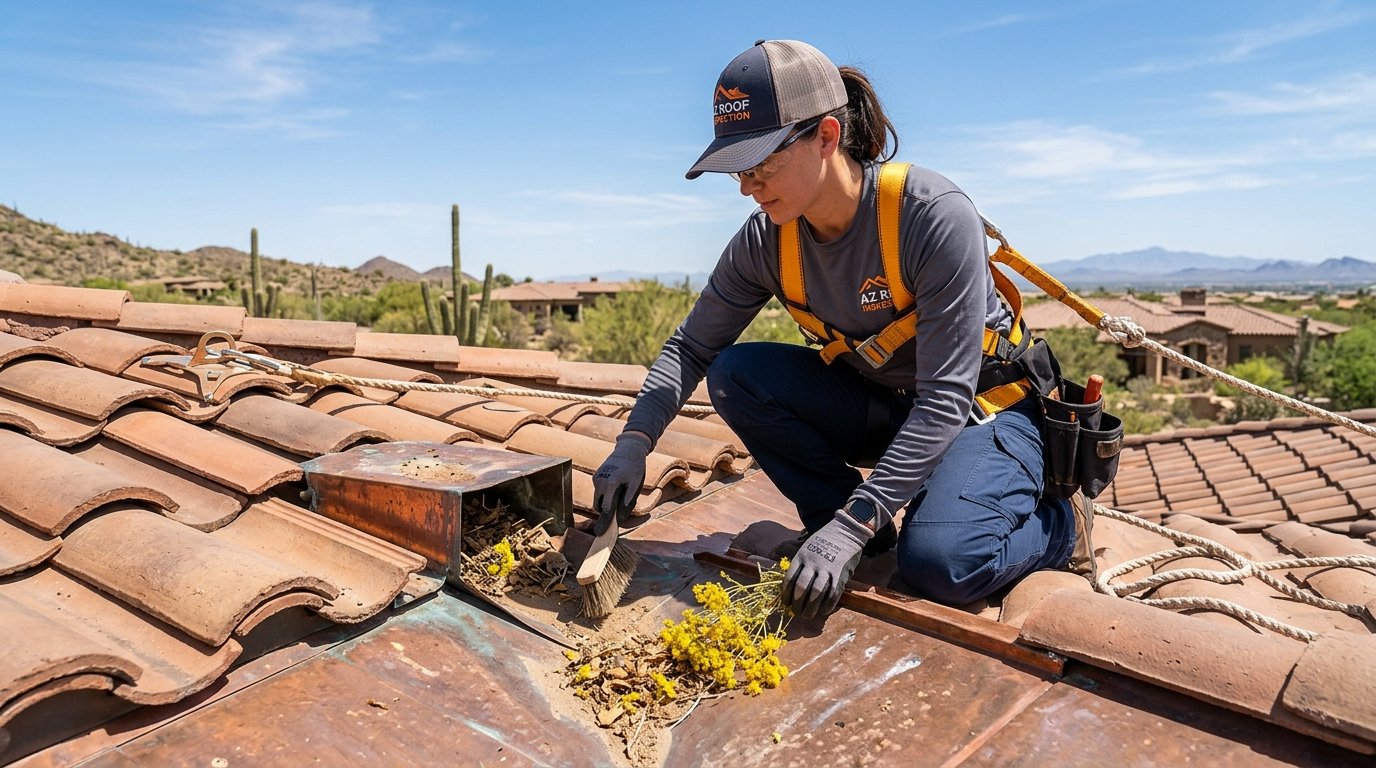
The sheet metal valleys where two roof slopes meet are designed to channel hundreds of gallons of runoff per minute directly to the eaves. During our dry, dusty springs, desert winds deposit heavy layers of fine dirt and dead foliage under the tile overlaps along these valleys.
Over time, this material forms a concrete-like “silt dam.” When rain hits the roof, water cannot discharge freely down the metal channel. It pools against the silt dam, turns sideways, flows over the metal valley flange, and dumps directly onto the raw underlayment. Use a leaf blower or hire a roof maintenance crew to lift perimeter cut tiles and wash away all compacted silt.
2. Audit Plumbing Vents, AC Jack Boots & Skylight Flashing
Every single penetration through your roof deck—plumbing vent stacks, HVAC refrigerant line jacks, kitchen exhaust vents, solar stanchions, and skylights—is sealed with sheet metal flashing and a rubber or mastic collar. In Arizona, the intense ultraviolet rays dry out neoprene vent collars in just3 to 5 years, causing them to split and shrink away from the pipe.
Inspect every flashing boot. Replace dried neoprene collars with high-temp silicone flashings, and reseal all perimeter counter-flashing with commercial-grade polyurethane sealant (such as Sikaflex or Tremco). Never use cheap asphalt roof cement, which cracks and bubbles under 115°F heat in a single summer.
3. Conduct an Attic Underside & Daylight Inspection
Before attic temperatures reach dangerous 140°F+ levels in June, climb into your attic space with a powerful flashlight. Turn off all lights and look up at the underside of the roof decking:
Daylight Penetrations: If you see points of daylight around vents, chimneys, or valleys, driving monsoon rain will easily follow that exact path.
Water Staining on Trusses: Look for dark water trails, white mineral crusts (efflorescence), or rusted connector plates on wooden roof trusses.
Insulation Compaction: Blown-in fiberglass or cellulose insulation that looks crusty, matted, or discolored indicates previous hidden water entry. Learn how damp attics breed hidden fungi in our attic mold causes and prevention guide.
Summer Checklist (June – September): Active Monsoon Defense
Between July and September, the North American Monsoon brings violent thunderstorms characterized by sudden haboobs, lightning strikes, and microbursts with sustained winds over 50 mph. Active vigilance during this season is mandatory:
1. Aggressive Tree Canopy Trimming
Desert native trees like Palo Verde, Mesquite, and Ironwood possess brittle wood that splinters easily during summer microbursts. Furthermore, invasive Eucalyptus and Aleppo Pines drop enormous heavy limbs when wind speeds exceed 40 mph.
Trim all tree canopies so that branches are at least 8 to 10 feet away from your roofline. Branches scraping across concrete tiles during high winds will crack tiles and puncture underlayment, while falling limbs can cause structural deck collapse.
2. Flat Roof Ponding & Parapet Drainage Triage
Many homes in Phoenix, Scottsdale, and Paradise Valley feature flat spray foam (SPF) or modified bitumen roofs behind decorative parapet walls. Parapet walls discharge water through rectangular scupper holes.
The 48-Hour Ponding Rule: If water stands in puddles deeper than 1/2 inch on your flat roof for more than 48 hours following a storm, your roof has structural sag or clogged drainage. Standing water under 110°F summer temperatures creates an intense “solar magnifying glass” effect that rapidly rots foam coatings and dissolves asphalt seams. Clean scupper leaf-guards after every major storm.
3. Post-Microburst Attic Moisture Triage
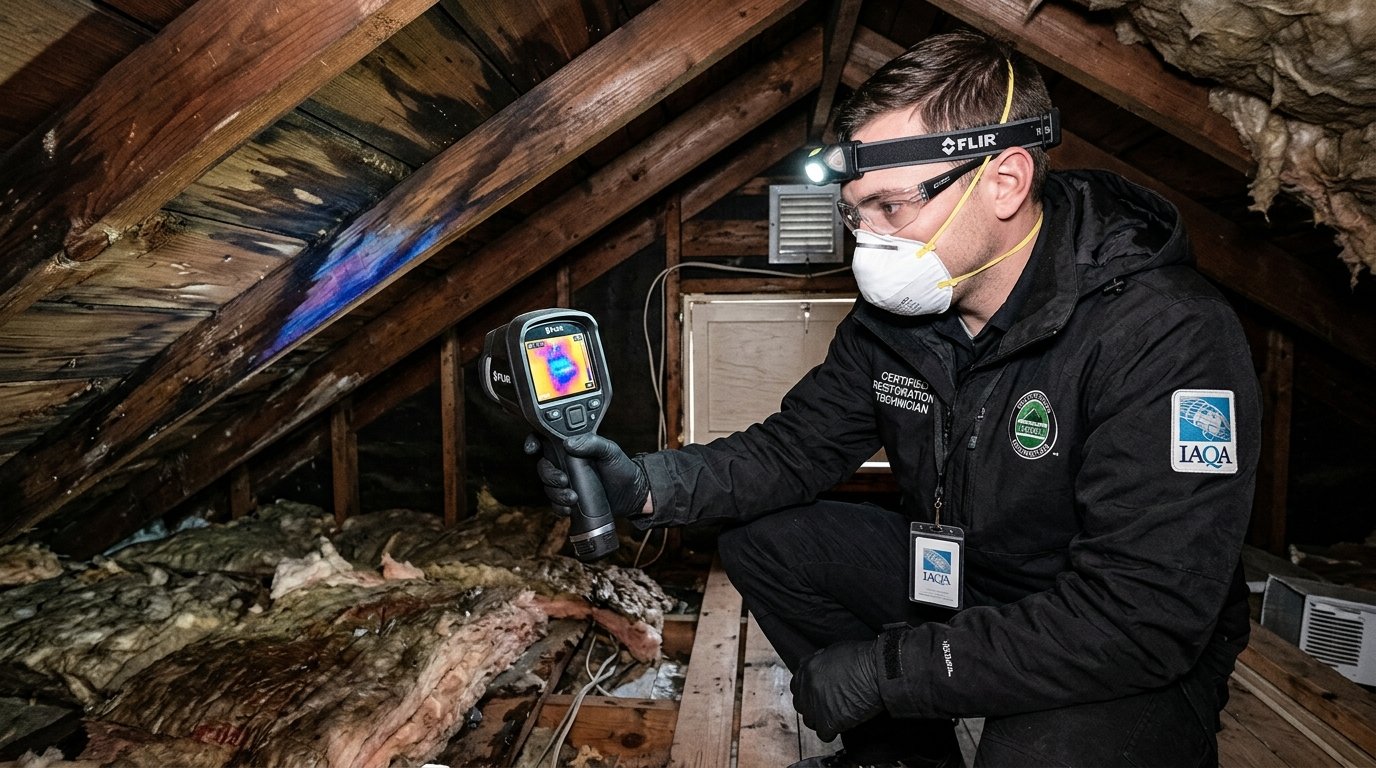
Following any severe thunderstorm, do not simply look at your ceiling. Modern drywall can hold massive amounts of water before staining or sagging. Enter your attic or request non-destructive infrared thermal imaging moisture detection to identify water trapped in insulation blankets before fungal colonization occurs at the 24- to 48-hour mark.
Scientific detection: High-resolution infrared thermography identifies cold thermal anomalies where storm water has saturated attic insulation, long before a visible brown ring appears on your ceiling.
Fall Checklist (October – November): Post-Monsoon Recovery
Once the monsoon season dissipates in late September, your roof has just survived its most stressful testing period. Fall is the ideal time to repair storm damage and prepare for winter rain:
1. Identify and Reset “Chattered” & Slipped Tiles
During high-wind events, concrete tiles on the windward side of ridges, hips, and rakes vibrate and bounce violently against each other—a phenomenon known in the roofing industry as tile chatter. This vibration snaps off tile alignment lugs, chips interlocking side channels, and causes tiles to slip downward out of alignment.
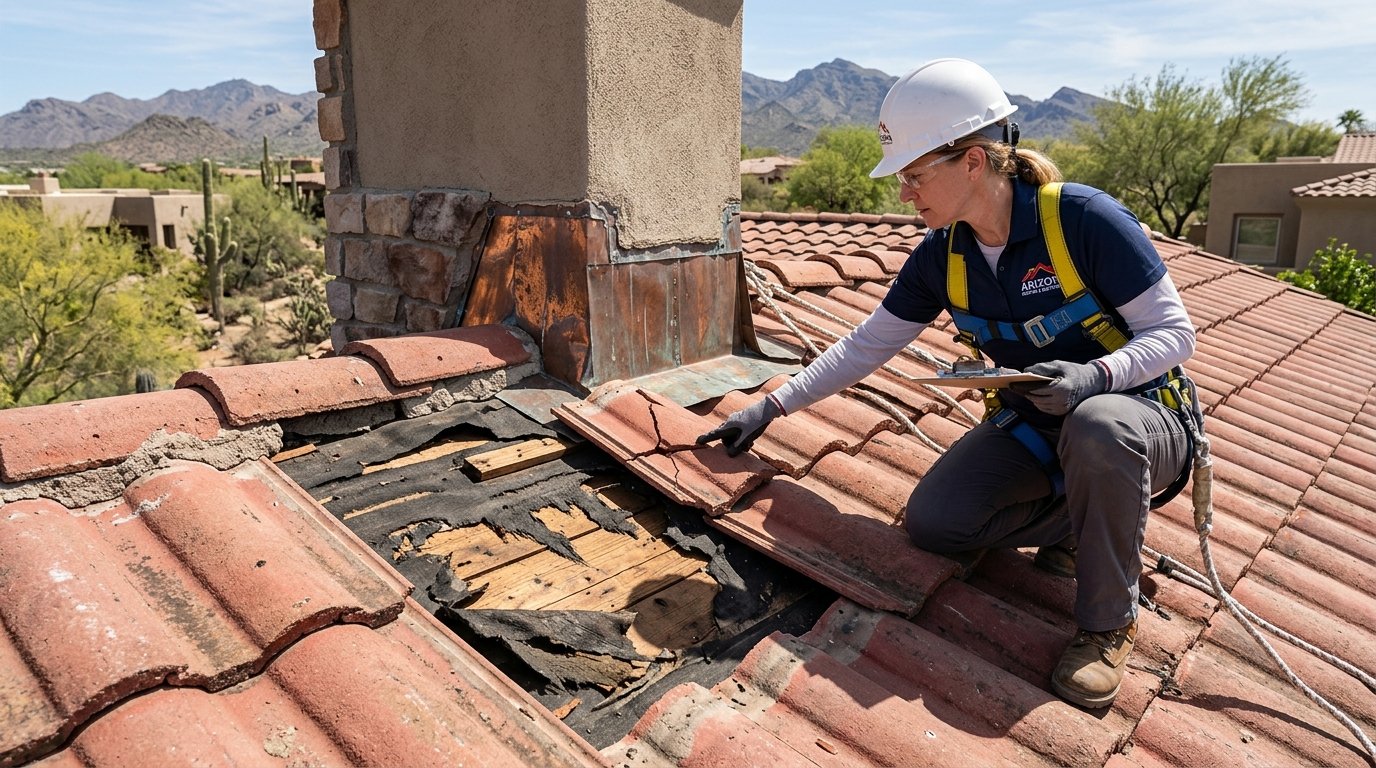
Even a single slipped tile exposes a 6- to 12-inch strip of delicate asphalt felt underlayment directly to UV radiation. In Arizona, raw felt exposed to sunlight will bake and disintegrate within 30 to 60 days. Have a professional roofer inspect the roof and properly re-anchor slipped tiles with copper hurricane clips or code-approved tile adhesive.
2. Repair Cracked Ridge and Hip Mortar Caps
The peak ridge and angled hip lines of Spanish barrel tile roofs are capped with mortar mixed with coloring pigment. Because the wooden roof framing expands and contracts at a different rate than concrete, this mortar cap develops hairline fractures, spalls, and dislodges over time.
Rain driven by wind will penetrate cracked mortar and flow straight into the roof apex. Inspect your ridges in October and point-trowel all cracked mortar joints with flexible, fiber-reinforced elastomeric roofing mortar.
Unlike fast-moving summer monsoons that dump rain and pass in 30 minutes, Arizona’s winter storms originate from Pacific atmospheric rivers. These systems bring steady, soaking cold rains that last for12 to 36 continuous hours:
Saturation Risk: Continuous drizzle saturates tile bodies completely. If your underlayment has minor pinholes or hairline age cracks, soaking water will slowly seep through and pool on ceiling drywall.
Thermal Contraction Leaks: Overnight temperatures dropping into the 20s and 30s cause sheet metal flashings around chimneys and skylights to contract, widening seam gaps.
Attic Moisture & Condensation: Warm, humid air rising from living areas into cold attics can condense against cold plywood roof sheathing if attic soffit vents are blocked by insulation. Verify that your ridge and soffit vents provide continuous cross-ventilation.
The Underlayment Reality: Why Arizona Tiles Outlive Their Waterproofing
The greatest misconception among Arizona homeowners is that a concrete tile roof lasts 50 years. The concrete or clay tiles themselves will last 50+ years, but the underlayment underneath does NOT.
When homes in Phoenix, Mesa, Scottsdale, and Gilbert were built during the 1990s and 2000s, builders almost exclusively installed standard Type 30# organic asphalt-saturated felt. In the Midwest, felt lasts 30 years. In Arizona, where unconditioned attics reach 160°F and tiles heat to 170°F, the volatile organic oils in the asphalt oxidize and bake away.
By year 15 to 18, the felt underneath your tiles is as brittle as a dried potato chip. Walking on the roof snaps it; wind-blown rain penetrates it; normal thermal movement tears it. If your home was built between 1995 and 2012 and has never had a “tile R&R” (remove and replace underlayment), your roof is on borrowed time.
Early Warning Signs of a Developing Roof Leak Inside Your Home
Do not wait for a gallon of brown water to crash through your ceiling. Look for these subtle precursors:
Faint Concentric Ceiling Rings: Subtle yellowish or tan halo rings on textured drywall indicate that water reached the ceiling, evaporated, and deposited mineral salts. Learn how to date stains in our guide to old vs. new ceiling water stains.
Pencil-Head Dark Spots: Small circular dark spots on ceiling drywall are caused by corrosion on metal drywall screws or nails that have become wet from damp insulation above.
Peeling or Blistered Paint: Water pooling on the top side of drywall stretches latex ceiling paint into rubbery, water-filled blisters.
Musty Odors After Rain: A persistent earthy, damp smell in hallways or bedrooms 24 hours after a storm indicates active microbial colonization inside wet attic cellulose or fiberglass.
Emergency Storm Breach Protocol: What to Do If Water Penetrates
If wind-driven rain breaches your roof during an active Arizona thunderstorm, execute this immediate containment protocol:
Contain Floor Runoff: Position buckets or plastic storage bins beneath active drips. Cover expensive furniture and electronics with plastic tarps or garbage bags.
Perform Controlled Pinhole Relief: If ceiling drywall is sagging or forming a paint blister, do not let hydraulic weight build up. Take a screwdriver, awl, or nail and puncture the center of the lowest bulge to direct water into a bucket. This prevents an explosive ceiling collapse that ruins flooring and furniture.
Kill Electrical Breakers: If water is tracking down wall cavities near electrical switches, ceiling fans, or light fixtures, switch off circuit breakers for those rooms immediately.
Call 24/7 Professional Restoration: Contact our emergency response team. We deploy within 45 minutes across the Phoenix Valley to secure emergency storm roof tarping, extract attic water, remove saturated insulation, and place industrial structural drying equipment.
Key Takeaways
Prevention Beats Restoration: Clearing silt dams, inspecting vent boots, and checking scupper drains twice annually costs a fraction of an emergency ceiling collapse repair.
Tiles Don’t Stop Water, Underlayment Does: Concrete tiles last 50 years, but organic felt underlayment bakes out in 12 to 18 years under Arizona desert heat.
Stay Off the Roof: Walking on brittle desert tiles creates fractures and rips underlayment. Inspect from ground level with binoculars or hire a licensed specialist.
Audit Before July: Complete your valley clearing, tree trimming, and attic inspections by May before summer monsoons arrive.
Act Within 24–48 Hours: Saturated attic insulation in 120°F summer heat accelerates mold spore germination within 48 hours. Professional extraction and structural drying are mandatory.
How often should an Arizona tile roof be professionally inspected?
Tile roofs in Arizona should receive a comprehensive professional inspection at least once every two years, and annually once the roof passes 10 years of age. In addition, homeowners should conduct a ground-level binocular audit and an interior attic inspection twice a year: once in spring (April–May) before monsoon season begins, and once in late fall (October–November) following summer storm activity.
Why do tile roofs leak in Arizona if the concrete tiles are completely intact?
Concrete and clay tiles are merely the 'armor'—they are not waterproof. The true waterproof barrier is the organic asphalt felt or synthetic SBS membrane installed directly over the plywood roof decking beneath the tiles. Arizona's relentless summer sun drives attic temperatures to 150°F–170°F, which literally bakes the organic volatile oils out of asphalt underlayment. After 12 to 18 years, the felt turns crumbly, brittle, and cracked. When wind-driven monsoon rains blow beneath the tiles, water flows directly through the deteriorated underlayment and penetrates the plywood decking.
Can I safely walk on my concrete tile roof to inspect for leaks?
We strongly advise homeowners against walking on tile roofs. Concrete and Spanish clay barrel tiles are extremely brittle, especially on older roofs exposed to decades of UV radiation. Stepping on the center of a tile or near the lower lip will easily crack the tile or pinch the delicate underlayment beneath, creating new leaks that did not exist before. Always use binoculars from ground level or hire an OSHA-compliant licensed roofing or restoration inspector.
How do I know if my flat foam roof or parapet scuppers are failing?
Flat foam (SPF) and modified bitumen roofs common on Southwestern contemporary and commercial homes fail primarily through UV degradation and clogged drainage. Key signs of failure include bird pecks in the elastomeric coating exposing yellow polyurethane foam, blistered or spongy spots underfoot, cracked mastic around scupper drains, and standing water (ponding) that remains longer than 48 hours after rain has stopped.
What is a 'silt dam' and how does it cause monsoon roof leaks?
In the desert, haboobs (intense dust storms) blow tons of fine silt and organic tree debris (like mesquite pods and eucalyptus leaves) across rooftops. This debris settles in tile valleys, under tile eaves, and behind flashing pans. Over time, rainwater compacts this silt into an impermeable barrier known as a 'silt dam.' When a torrential monsoon downpour occurs, water cannot exit down the valley; it backs up sideways, flows under the tile laps, and submerges nail penetrations in the underlayment.
How long does roof underlayment last in the Phoenix desert heat?
Standard builder-grade 30# organic asphalt felt typically lasts only 12 to 18 years in the Phoenix Valley due to intense thermal cycling and attic baking. Upgraded SBS (styrene-butadiene-styrene) rubberized modified bitumen underlayments and high-temperature dual-layer synthetics offer significantly greater heat resistance, often lasting 25 to 35 years.
Does homeowners insurance pay for roof maintenance or underlayment replacement?
No. Homeowners insurance strictly excludes routine maintenance, gradual wear and tear, and aged underlayment replacement. However, if a sudden monsoon microburst rips tiles off your roof, blows a tree limb onto the structure, or drives wind-blown hail that breaches the waterproof barrier, the resulting interior water extraction, ceiling drying, and structural repairs are covered under standard HO-3 policies.
What should I do immediately if water starts dripping from my ceiling during a storm?
First, place a sturdy bucket beneath the drip to protect floors. Second, look for a bulging or sagging blister of paint on the ceiling drywall and perform a controlled pinhole relief: puncture the center of the blister with a screwdriver or nail to drain the trapped water into the bucket before the heavy water accumulation collapses the entire drywall panel. Third, call an emergency 24/7 restoration team for immediate interior extraction and roof tarping.
IICRC-certified restoration technicians · Phoenix metro
Written and fact-checked by the licensed crew that runs the trucks — the same technicians who take moisture readings, set drying chambers to the IICRC S500 standard, and answer the phone at 2 a.m. across the Phoenix metro.
Licensed Arizona contractor — AZ ROC #331127 (KB-2)