Spotting a discoloration or yellow ring on your ceiling triggers immediate panic. Is water actively pooling above your drywall right now, or is it an old, dry water mark from years ago? Learn the exact physical tests, moisture thresholds, ring pattern diagnostics, and infrared thermal methods to know for sure.
Last updated:Reading time:13 minStandards:IICRC S500 Verified
Ceiling Stain Diagnostics: Thermal Imaging & Digital Moisture Verification · Phoenix Metro
Table of contents▾
To determine if a ceiling stain is new (active) or old (historical), check three primary factors: surface temperature/tactile moisture, expansion over time, and moisture meter readings. An active stain feels cool or damp to the touch, expands beyond a traced pencil line within hours or days, and registers above 16% Wood Moisture Equivalent (WME) on a digital moisture meter. An old, dormant stain feels bone dry and firm, maintains a static boundary, and reads below 12% WME. However, multiple concentric dark rings indicate a recurring intermittent leak that reactivates during rainstorms or summer AC cooling cycles.
The 5-Step Diagnostic Protocol (How to Test at Home)
Whether you just bought a home in Scottsdale with existing blemishes or noticed a fresh mark in your Chandler living room, follow this systematic homeowner diagnostic protocol:
1
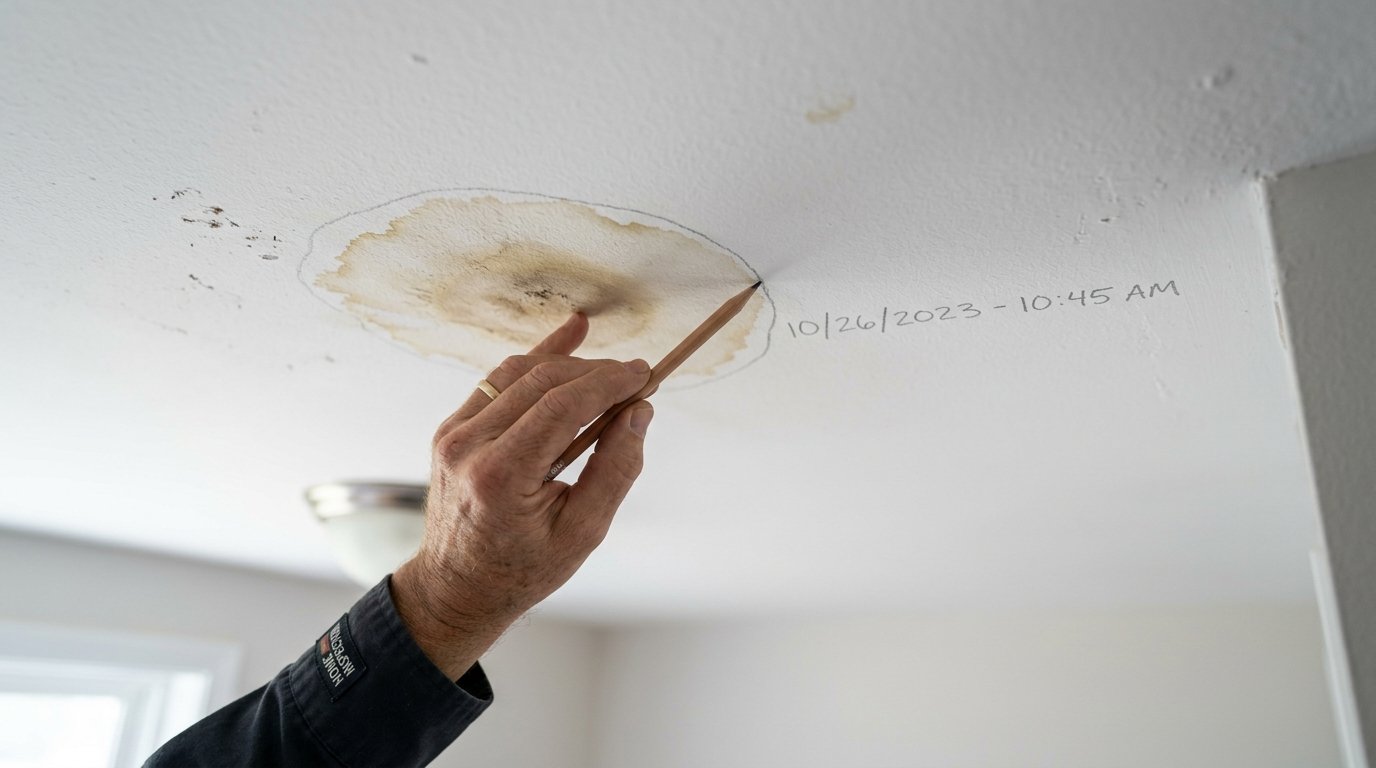
The Pencil Trace & Timestamp Test
Take a regular #2 pencil and lightly trace the outer perimeter of the water spot. Write the exact date and time directly next to the line. Check the spot every 3 to 6 hours, especially after running upstairs appliances or during an Arizona monsoon downpour. If the stain pushes past your line, water is actively entering the structure.
2
The Physical Texture & Firmness Test
With clean, dry fingertips, gently press the center of the discoloration. Dry historical stains feel solid, rigid, and chalky — indistinguishable from undamaged drywall. Active stains feel cool, soft, spongy, or slightly damp, and pressing lightly may leave an indentation in softened gypsum plaster.
3
Check for Paint Blistering or Drywall Sagging
Latex paint is an elastomeric polymer that creates an airtight, waterproof seal. When fresh water breaches the drywall, paint stretches downward into a flexible water blister rather than letting water drip through. If you observe a sagging bulge, place a bucket underneath and puncture the center with a nail to safely drain the water reservoir.
4
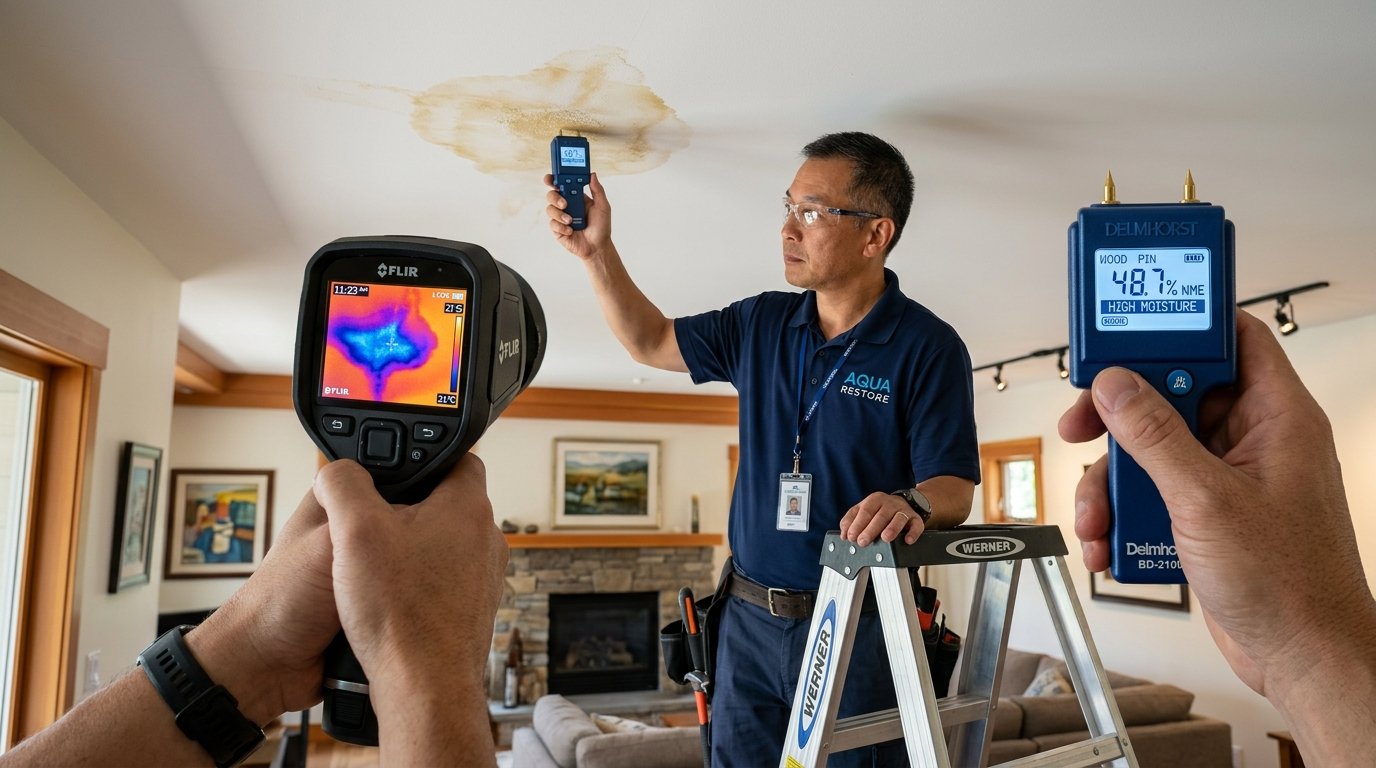
Digital Moisture Meter & Thermal Scan
A pinless moisture meter or FLIR thermal imaging camera gives 100% conclusive proof. Dry Arizona drywall naturally rests between 5% and 11% Wood Moisture Equivalent (WME). Anything above 16% indicates active saturation. On a thermal camera, evaporating water creates an immediate dark blue cold pocket.
5
Attic Cavity & Insulation Inspection
If the ceiling is accessible from an attic, climb up safely and inspect the area directly above the stain. Wet fiberglass or cellulose insulation acts like a waterlogged sponge. Look for standing water in AC condensate secondary pans, rust streaks on supply plumbing, or sunlight penetrating compromised roof tile underlayment.
Diagnostic Method / Perimeter TrackingThe Pencil Outline Test: Tracing the perimeter with a date and time is the fastest homeowner method to verify whether a water stain is actively expanding or completely dormant.
The visual anatomy of a ceiling stain tells a detailed forensic story of when, how often, and what type of water created the damage.
Light Yellow / Amber Translucent Spot
Diagnosis: Fresh water intrusion (Category 1). Clean tap water or recent condensation that has saturated the drywall paper within the past 1 to 7 days. The gypsum core is currently wet or recently dried once without severe mineral oxidation.
Dark Brown / Rusty Perimeter Ring
Diagnosis: Older, dried water intrusion. As water slowly evaporated, it carried dissolved dirt, drywall surfactants, and wood tannins outward. Dark reddish-brown tones suggest the water contacted rusting drywall screws or steel truss plates.
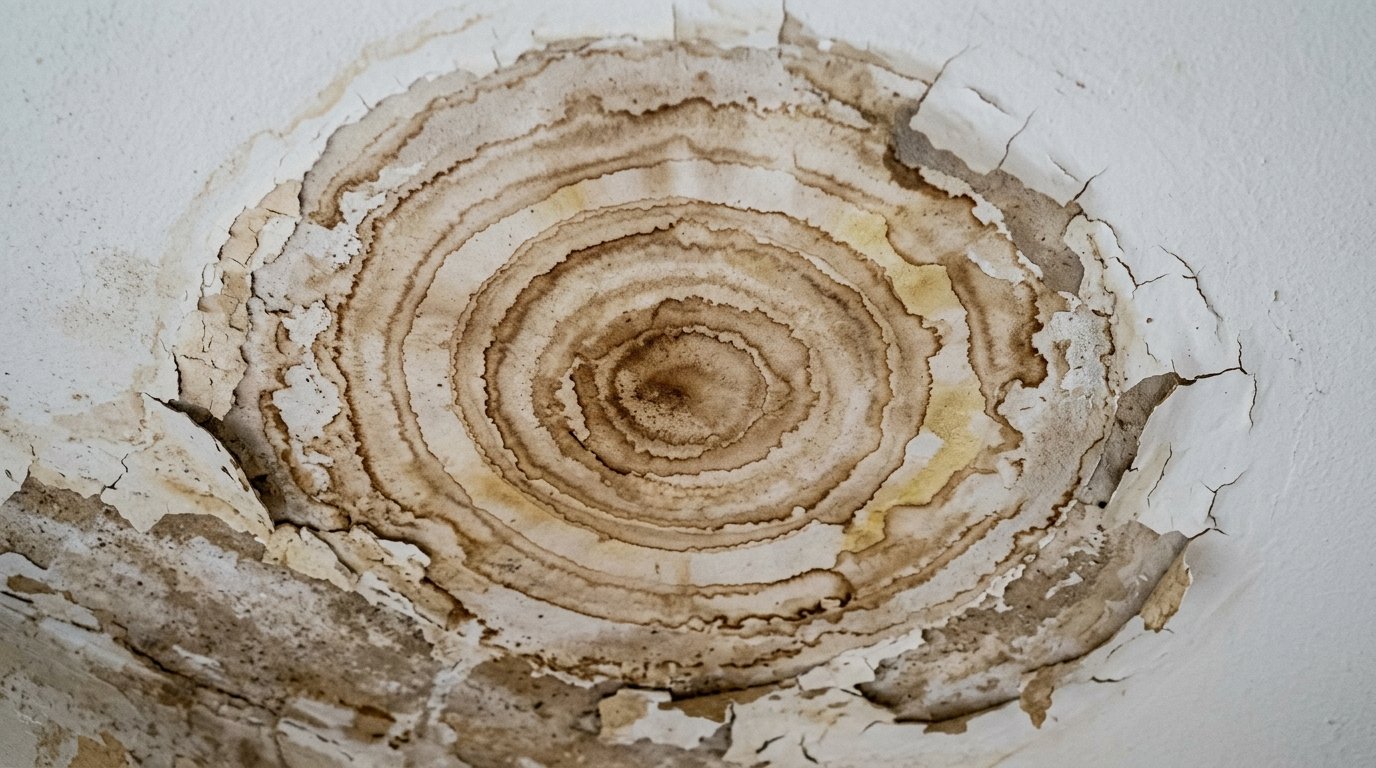
Multiple Concentric "Tree Rings"
Diagnosis: Chronic, recurring intermittent leak. Each distinct ring represents an independent wetting and drying cycle. Extremely common with seasonal roof leaks, intermittent shower drain leaks, or AC condensate pan overflows during summer heatwaves.
Chalky White Salt / Efflorescence Crust
Diagnosis: Slow, long-term evaporation. Hard water in Phoenix contains high concentrations of calcium and magnesium. As water evaporates repeatedly over months, it leaves behind a crusty, powdery white mineral deposit on the plaster.
Visual Forensics / Concentric RingsForensic Ring Analysis: Concentric tide marks resemble tree rings, confirming that water has penetrated, evaporated, and penetrated again over multiple historical cycles.
Technical Comparison Matrix: New vs. Old vs. Intermittent
Here is how professional IICRC-certified restoration technicians categorize ceiling water stains during structural moisture investigations:
Diagnostic Parameter
New / Active Water Stain
Old / Dormant Historical Stain
Chronic Intermittent Stain
Moisture Content (WME %)
> 16% to 100% (High active moisture)
< 12% (Dry regional equilibrium)
Spikes during rain/AC usage; drops between events
Tactile & Physical Feel
Cool, damp, soft, spongy, or pillowing
Firm, rigid, chalky, indistinguishable from dry wall
Fungal colonization on wood trusses & paper backing
Electrical Hazard Risk
High (Water inside lighting cans/fan boxes)
Low (Wiring is dry, but check for past corrosion)
Moderate to High (Corroded wire splices)
Diagnostic Matrix: Differentiating Active Water Intrusion from Dormant Historical Ceiling Stains
The Science of Thermal Imaging: Why FLIR Cameras Reveal Hidden Leaks
Human eyes can only see surface discoloration, but water often travels 10 to 15 feet along ceiling joists and plumbing pipes before finding a drywall seam to penetrate. Infrared thermal cameras do not see moisture directly — they detect microscopic surface temperature differentials caused by evaporative cooling and thermal mass.
As liquid water evaporates from drywall and framing wood, it absorbs ambient thermal energy, lowering the surface temperature by 2°F to 8°F compared to surrounding dry drywall. On an infrared display, this active evaporation appears as a vivid blue or purple thermal pool:
If the stain is active: The camera immediately highlights the true moisture boundary, showing water spreading invisibly behind ceiling sheets and into wall cavities.
If the stain is old and dry: The discolored area displays the exact same ambient temperature as the surrounding ceiling, verifying zero active evaporation.
Insurance Implications: "Sudden & Accidental" vs. "Long-Term Neglect"
Whether your ceiling water damage is classified as new or old has massive financial implications for your homeowner insurance claim in Arizona:
Covered: Sudden & Accidental Discharges (New Damage)
Standard HO-3 and commercial property insurance policies cover water damage that is sudden, unexpected, and accidental. Examples include a sudden burst upstairs toilet supply line, a washing machine hose rupture, a tub overflow, or storm winds ripping off roof tiles during a monsoon microburst.
Excluded: Continuous, Repeated, or Neglected Leaks (Old Damage)
Policies routinely contain continuous seepage clauses excluding water leaks occurring over a period of weeks, months, or years. If an insurance adjuster sees extensive drywall rot, dark concentric rings, and heavy black mold, they may argue the leak was a long-term maintenance failure and deny the claim.
How Professional Documentation Protects Your Claim: When our team performs an emergency inspection, we generate comprehensive date-stamped infrared moisture maps, digital psychrometric logs, and photo documentation establishing the sudden origin of the loss for your adjuster.
Can You Just Paint Over an Old Ceiling Stain? (The 3 Rules)
If your tests confirm that the ceiling stain is completely dry and inactive, you may want to paint it. Before grabbing a paintbrush, follow these three essential restoration rules:
Verify Moisture Equilibrium First: Test multiple points across the stain with a moisture meter. The reading must be below 12% WME for at least 72 hours. Painting over even mild moisture locks water inside the drywall, leading to core rot and mold.
Always Apply an Oil-Based or Shellac Stain-Blocking Primer: Never apply standard latex ceiling paint directly over a water stain. Water-soluble tannins and mineral salts will immediately dissolve into the water-based paint and bleed through within days. You must apply a dedicated stain blocker such as Zinsser BIN (Shellac-based) or Kilz Original (Oil-based) first.
Check for Structural Sagging & Fastener Pull: If the drywall sags more than 1/4 inch or the gypsum feels soft when pushed, cosmetic painting will not fix it. The weakened sheet must be cut out and replaced with fresh drywall to avoid future ceiling collapse.
Need Help Diagnosing an Overhead Leak? 24/7 Valley-Wide Response
Do not let a mysterious ceiling stain turn into a collapsed ceiling or an attic mold outbreak. Our IICRC-certified restoration specialists provide rapid, non-invasive thermal imaging and moisture mapping across the entire Phoenix metropolitan area:
How can I tell if a ceiling water stain is actively leaking right now?
Perform three quick tests: (1) Touch: Active stains feel cool, damp, or spongy to the touch, or cause latex paint to stretch like a soft water balloon; (2) Pencil test: Trace a light pencil line around the outer edge and write the date/time — if water spreads past the line within hours or days, the leak is active; (3) Moisture meter: A pinless or pin-type moisture meter reading above 16% Wood Moisture Equivalent (WME) indicates active moisture, whereas dry historical stains read below 12%.
Why do some ceiling stains have multiple dark brown rings?
Multiple concentric rings (often called 'tide marks' or 'tree rings') indicate a chronic, recurring leak that wets and dries repeatedly. Each time water breaches the ceiling and evaporates, dissolved minerals, dirt, and drywall surfactant migrate to the outer evaporation boundary and deposit a dark pigment line. This pattern is common with seasonal Arizona monsoon roof leaks, intermittent shower pan cracks, or cyclic attic AC condensate pan overflows.
Can an old, dry ceiling stain suddenly become active again?
Yes. In Arizona, many roof leaks only show activity during severe monsoon downpours or winter rains months apart. Similarly, an attic air conditioning condensate drain line may only overflow on 110°F+ summer afternoons when the cooling system runs continuously. A stain may remain bone dry for 8 months and suddenly reactivate during the next weather or cooling event.
Will homeowners insurance cover a ceiling stain if it's considered 'old damage'?
Insurance policies generally cover 'sudden and accidental' water discharges (such as a burst upstairs supply line or storm-damaged roof tiles), but exclude damage resulting from long-term, continuous, or neglected maintenance (such as slow grout leaks over several months). Documenting the timeline with professional infrared thermal imaging reports and psychrometric moisture logs helps substantiate a sudden loss for your insurance adjuster.
Is it safe to paint over an old ceiling stain if it feels dry?
Only after verifying with a calibrated moisture meter that the drywall and joist framing behind it are below 12% WME. If residual moisture is trapped behind fresh paint, it will trigger hidden mold growth and cause the paint to bubble or peel. When ready to paint, you must use an oil-based or shellac-based stain-blocking primer (like Zinsser BIN or Kilz Original) — standard water-based latex primer will reactivate the water-soluble tannins and bleed through.
How does infrared thermal imaging prove whether a ceiling stain is new or old?
Active water undergoes evaporative cooling and possesses high thermal mass, creating a distinct cool blue/purple temperature differential on a FLIR thermal camera. A dry, historical stain has no active evaporation and displays a uniform thermal signature matching the surrounding ceiling temperature.
What causes a ceiling stain to turn yellow vs. dark brown?
Fresh or clean water (Category 1) passing quickly through gypsum produces a light yellow or tan discoloration. Dark brown, ringed, or rusty stains occur when water has lingered long enough to oxidize metal drywall screws and corner beads, leach tannins from attic wood joists, or carry organic matter and dust from attic insulation.
When does water-damaged ceiling drywall need to be replaced instead of dried?
Under IICRC S500 standards, ceiling drywall must be cut out and replaced if: (1) It sags more than 1/4 inch or pulls through fastener screws; (2) The water is contaminated Category 2 or 3 (sewage, toilet overflow, stagnant AC sludge, or bird droppings from the roof); or (3) Visible mold spores have colonized the paper backing (which occurs within 24 to 48 hours in Arizona's warm climate).
IICRC-certified restoration technicians · Phoenix metro
Written and fact-checked by the licensed crew that runs the trucks — the same technicians who take moisture readings, set drying chambers to the IICRC S500 standard, and answer the phone at 2 a.m. across the Phoenix metro.
Licensed Arizona contractor — AZ ROC #331127 (KB-2)