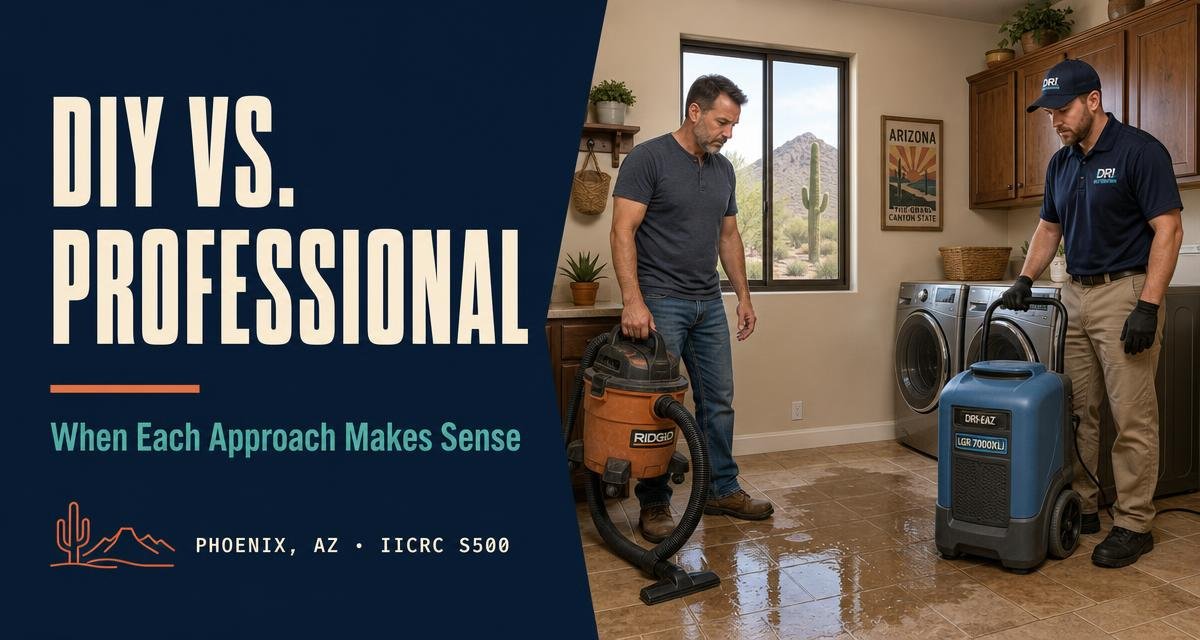
Should you handle the water yourself or call in the experts? For Phoenix homeowners, the answer depends on four specific criteria: category, size, location, and time.
Last updated:Reading time:15 min readStandards:IICRC S500 Verified
DIY vs. Professional · Restoration Decision Guide · Phoenix, AZ
Table of contents▾
DIY water damage restoration is only reasonable for Category 1 (clean) water affecting less than 100 square feet of hard surfaces, provided you can respond within 24 hours. If sewage is involved, if water reached drywall or subfloors, professional structural extraction and LGR dehumidification are mandatory to prevent mold and structural rot.
The Real Question Isn't "Can I?" — It's "Can I Do It Well Enough?"
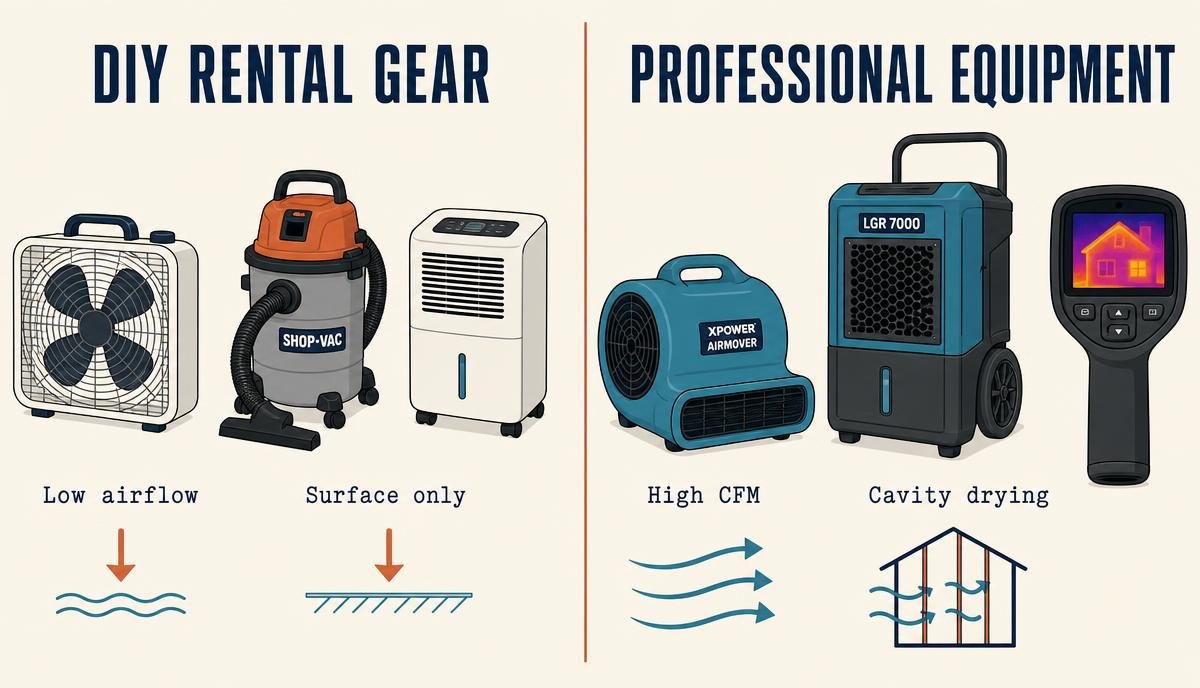
Most homeowners own a wet/dry shop vac and a few box fans. Technically, you can suck up standing water and move air. But restoration isn't just about cleaning up the water you can see; it's about eliminating the moisture you can't.
DIY cleanup is almost always cheaper upfront. However, the true cost of DIY restoration often surfaces weeks or months later in the form of rotted baseboards, buckling hardwood, or active mold colonies growing behind newly painted drywall. In the Phoenix desert, where heat accelerates bacterial growth in trapped moisture, the margin for error is slim.
When DIY Cleanup Is Reasonable
You don't always need to call a professional for every spilled bucket or minor appliance leak. DIY cleanup is a valid choice if all of the following criteria are met:
Category 1 Water Only: The source is clean (a broken supply line, an appliance overflow, or rainwater). If the water touched the floor after passing through soil, sewage, or a roof, it is no longer Category 1. See our full breakdown of water damage categories.
Small Surface Area: The affected area is limited to roughly 50-100 square feet.
Hard Surfaces Only: The water stayed on tile, linoleum, or sealed concrete. If water reached the carpet pad, drywall, or the cavity behind your cabinets, DIY drying is rarely successful.
Immediate Response: You can begin extraction and drying within 24 hours of the event.
Direct Surface Access: The water did not wick behind baseboards, into insulation, or beneath glued/nailed flooring where household fans cannot reach.
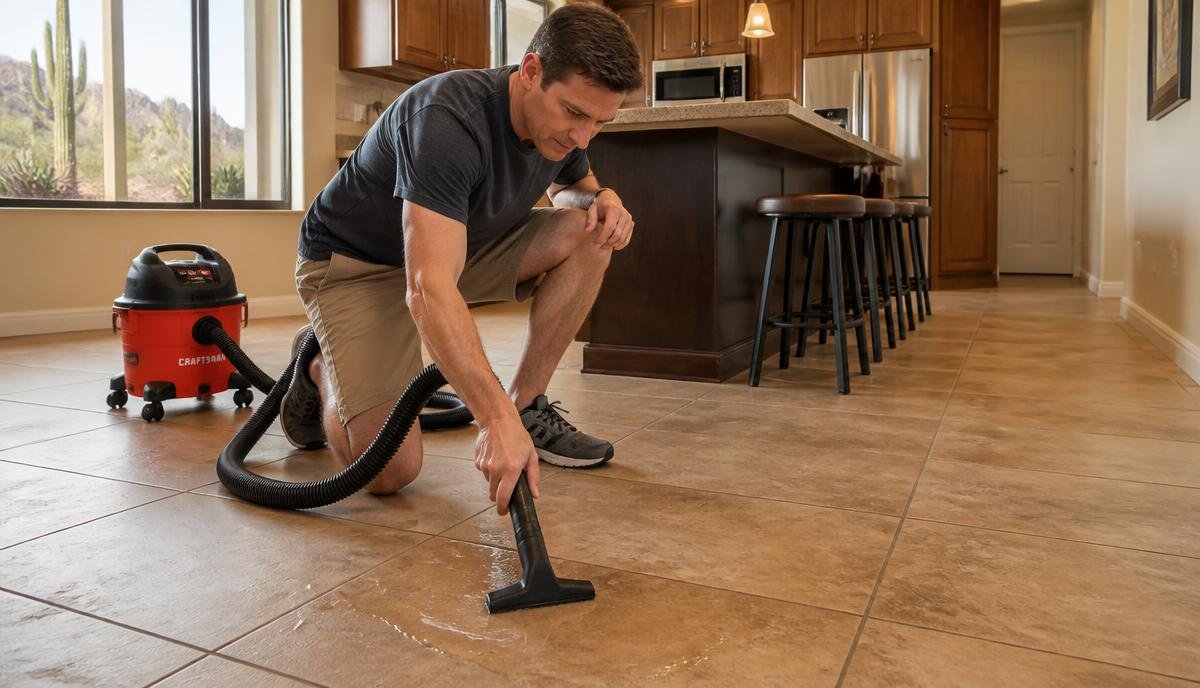
DIY ScenarioDIY cleanup is reasonable for small, clean-water spills on non-porous surfaces like tile.
When to Call a Professional (Non-Negotiable)
In these scenarios, attempting a DIY fix isn't just difficult—it's dangerous to your home's structure and your family's health. You must call a professional if:
Category 2 or 3 Water: This includes sewage backups, toilet overflows with fecal matter, or "black water" from rising outdoor floods. These carry serious pathogens and bacteria.
Porous Materials Affected: Water has wicked into drywall, insulation, or wood subflooring. These materials act like sponges and cannot be dried with household fans.
HVAC Involvement: Water or high humidity has entered your air ducts, risking a house-wide mold breakout.
Unknown Source: You see water but don't know where it's coming from. In Phoenix, this is often the signature of a slab leak.
Source Requires Mechanical Plumbing Repair: A ruptured supply line, failed pressure reducing valve (PRV), or leaking angle stop requires a licensed plumber (such as AquaVo Plumbing) to isolate and replace the faulty hardware before drying begins.
Over 24 Hours Have Passed: The clock is ticking on mold growth. After 48 hours, even clean water begins to degrade into Category 2.
What DIY Restoration Actually Requires
If you decide to proceed yourself, a mop and a bucket won't cut it. You need to rent or buy equipment that approximates a professional setup.
Equipment
Realistic DIY Cost (Rental/Purchase)
Why You Need It
Submersible Pump
$150 - $300
For standing water deeper than 1 inch
Commercial Dehumidifier
$70 - $120 / day
To pull moisture out of the air (essential)
High-Velocity Air Movers
$30 - $50 / day per unit
To force evaporation from surfaces
Moisture Meter
$50 - $400
To verify the material is actually dry
PPE (N95, Gloves, Eyes)
$40 - $80
Safety from contaminants and cleaning chemicals
Estimated costs for professional-grade equipment rentals in the Phoenix metro area.
Remember that labor is a hidden cost. You will need to check moisture readings daily and reposition air movers every few hours for 3 to 5 days. If you miss a spot, the savings disappear when you have to hire a mold remediator later.
Cost Comparison: DIY vs. Professional by Damage Size
The "savings" of DIY restoration decrease as the scope of the damage increases. Here is a comparison based on average Arizona restoration rates.
Scenario
DIY Estimate (Equip + Materials)
Professional Estimate
Small Area (Cat 1, Tile)
$200 - $500
$600 - $1,200
Medium Area (1 Room, Carpet/Drywall)
$800 - $1,500
$2,000 - $4,500
Large Area / Multi-Room
$2,500+
$5,000 - $15,000+
DIY vs. Professional cost comparison for direct residential mitigation in Arizona.
For large-scale losses, professional restoration includes specialized labor, moisture mapping, and upfront itemized pricing, eliminating the risk of costly secondary demolition or hidden mold outbreaks that frequently occur after failed DIY attempts.
The Hidden Risk: "It Feels Dry" Doesn't Mean It's Dry
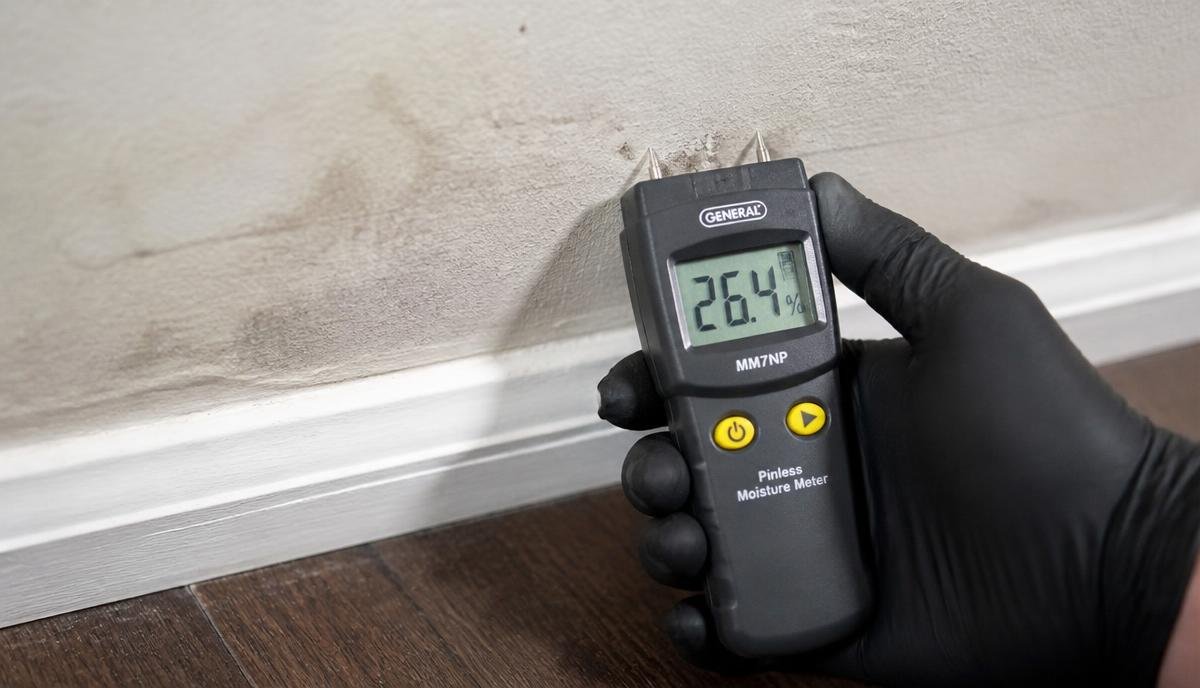
This is the most dangerous trap in restoration. Human skin is a poor judge of moisture content. A wall can feel bone-dry to your hand while holding a 25% moisture content inside the gypsum core.
Mold begins to colonize when moisture levels stay above 16%. If you stop your fans when the wall "feels" dry but hasn't reached its dry standard, you are essentially sealing mold into your home. This is why we use commercial psychrometric equipment to track grain depression and vapor pressure.
Technical VerificationA wall can feel dry to the touch while harboring enough moisture to trigger a mold colony.
Why DIY Assessment Is Especially Risky in Phoenix
Arizona homeowners face two specific challenges that make DIY restoration particularly unreliable compared to other parts of the country.
Phoenix's Dry Climate Makes Mold a Red Flag
In humid climates like Florida or Houston, a small amount of baseline mold is common. In Phoenix's arid desert climate, indoor mold growth is genuinely rare. This means that if you see mold in a Phoenix home, it is a high-confidence signal that there is a significant, active moisture problem. You cannot simply wipe it away and hope for the best; in this climate, mold only grows when something is fundamentally wrong with the structure's drying capacity.
Slab Leaks Hide Where DIY Can't Reach
Unlike East Coast homes with basements or crawlspaces, most Phoenix homes sit on concrete slabs with plumbing embedded in or beneath the concrete. When a pipe fails, the water doesn't drip down into a basement—it spreads horizontally under your flooring.
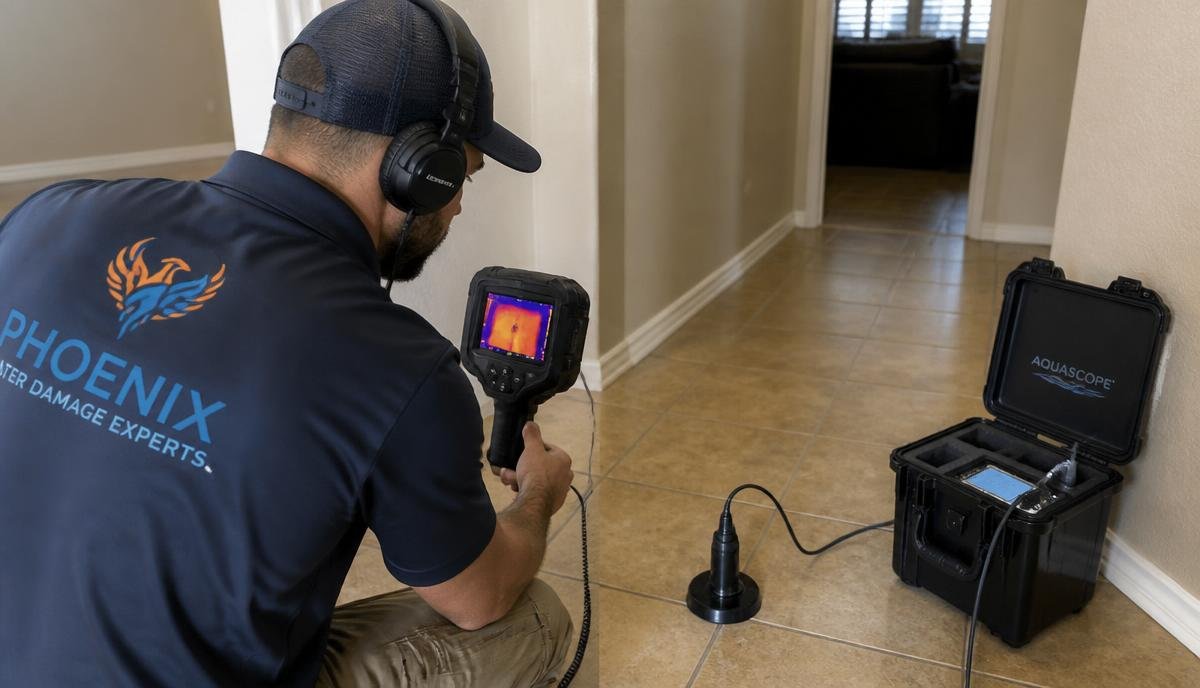
We strongly advise against DIY diagnosis for slab leaks. Homeowners who try to find a leak by breaking concrete or using consumer-grade thermal cameras often cause thousands of dollars in unnecessary damage without ever finding the pipe. We use specialized sonic equipment to pinpoint leaks through the slab, a service we provide on our Phoenix service page.
Professional OnlySonic leak detection pinpoints hidden plumbing failures without destroying your floors.
The Middle Path: DIY Initial Response, Professional Verification
You don't have to choose between doing nothing and doing everything yourself. Many of our clients take a "Two-Stage" approach:
Stage 1 (DIY): Safely extract what you can with a shop vac, move furniture, and set up whatever fans you have to stop the water from sitting stagnant.
Stage 2 (Professional): Call us to perform a Free Inspection. We will use professional meters to tell you exactly how far the water traveled and whether your DIY efforts are working. If they are, we'll tell you. If not, we can take over before mold sets in.
Why Professional Moisture Mapping Protects You
Building materials look dry long before they actually reach an equilibrium dry standard. If you handle cleanup yourself without calibrated pinless meters, moisture trapped inside wall plates and sill plates can incubate mold spores in as little as 24 to 48 hours.
What You Can Safely Do While You Decide (or While You Wait)
Regardless of whether you hire a pro, do these five things immediately:
Stop the Water: Shut off the main valve if the leak is ongoing.
Cut the Power: If water is near outlets or light fixtures, turn off the breakers.
Protect Valuables: Move furniture, rugs, and electronics to a dry area.
Document Everything: Take high-resolution photos and video before you touch a single drop of water.
Avoid Hazards: Do not walk through water if you suspect it contains sewage or if you see downed wires.
Capability GapThe difference in air volume and pressure makes industrial equipment 4x faster at drying structural wood.
Key Takeaways
DIY restoration is a high-risk, low-reward gamble for anything beyond a minor, clean spill on a tile floor. In Phoenix, the risks of hidden slab leaks and trapped moisture in a desert climate make professional verification the only way to guarantee a mold-free home.
Related Technical Guides
Educational resources for Phoenix & Arizona property owners
Our rapid response units maintain staged equipment yards across Central Phoenix, the East Valley, the West Valley, Pinal County, and Greater Tucson for an average ~42-minute on-site arrival:
Can I clean up water damage myself, or do I need a professional?
You can typically handle clean-water (Category 1) spills under 100 square feet yourself if the water stayed on hard surfaces and was addressed within 24 hours. However, a professional is required if sewage is involved, if water reached drywall or subflooring, or if the source is a hidden slab leak common in Phoenix homes.
When does DIY water damage cleanup make sense?
DIY cleanup makes sense for minor, surface-level incidents like a clean appliance overflow or rainwater on tile. It is reasonable only when there is zero risk of moisture being trapped in wall cavities, baseboards, or subfloors.
Is it safe to DIY clean up gray or black water?
No. Category 2 (gray) and Category 3 (black/sewage) water contain bacteria, viruses, and chemical contaminants that require professional-grade PPE and antimicrobial treatments. Attempting to DIY these categories risks serious illness and cross-contamination of your home's HVAC system.
How do I know if my DIY drying was truly successful?
Dry-to-the-touch surfaces can still hold 20%+ moisture trapped inside drywall framing or subfloors. Only calibrated thermal imaging and pinless moisture meters comparing readings to an unaffected baseline can verify structural dry standard.
Can water damage look dry but still cause mold?
Yes. Building materials like drywall and wood can feel completely dry to the touch while maintaining a moisture content of 20% or higher. Mold typically begins to grow when moisture levels exceed 16%, meaning materials that 'feel' dry can still harbor active fungal growth behind walls.
Is it safe to DIY-diagnose a suspected slab leak in Phoenix?
No. Because Phoenix homes sit on concrete slabs, leaks spread horizontally beneath the floor. Attempting to DIY-diagnose by breaking concrete or using consumer-grade thermal cameras often leads to costly misdiagnosis. Professional sonic leak detection is required to pinpoint the source without unnecessary damage.
About the author
AZ Water Damage Restoration Team
IICRC-certified restoration technicians · Phoenix metro
Written and fact-checked by the licensed crew that runs the trucks — the same technicians who take moisture readings, set drying chambers to the IICRC S500 standard, and answer the phone at 2 a.m. across the Phoenix metro.
Licensed Arizona contractor — AZ ROC #331127 (KB-2)