Household appliances account for more than 50% of all indoor residential water damage claims. In Arizona's harsh climate—where extreme municipal water pressure, hyper-mineralized water, and desert heat degrade components—appliance failures happen faster and hit harder. Protect your home with this definitive room-by-room prevention guide.
Last updated:Reading time:15 minStandards:IICRC S500 Verified
Appliance leaks cause over half of all residential water damage claims in Arizona, driven by a toxic cocktail of high municipal water pressure (90–130+ PSI), mineral scale calcification (250–350+ PPM TDS), and desert heat that bakes rubber hoses and plastic fittings. Preventing catastrophic flooding requires a disciplined room-by-room maintenance protocol: replacing rubber washing machine and plastic ice maker lines with commercial braided stainless steel every 5 years, installing overflow catch pans beneath water heaters and laundry machines, placing wireless smart leak pucks beneath hidden failure points, and maintaining household water pressure between 50 and 70 PSI.
When homeowners think of flood risks, they often imagine severe monsoon rainstorms or bursting sewer mains. In reality, the single most dangerous flood hazard in your home is sitting quietly in your kitchen, laundry room, or utility closet. According to the Insurance Institute for Business & Home Safety (IBHS), plumbing supply failures on household appliances cause over $3.5 billion in annual property losses nationwide.
In Arizona, the problem is substantially worse. The Sonoran Desert exerts extreme environmental stresses on plumbing systems. Our tap water contains hundreds of parts per million of abrasive mineral salts that encrust solenoid valves, while municipal pumping surges place immense hydraulic strain on thin-walled plastic fittings. A standard 1/2-inch supply line or cracked water heater tank can unleash 8 to 15 gallons of pressurized water every minute, transforming your home into a swimming pool in hours.
This comprehensive engineering guide breaks down the hidden failure points of every major water-connected appliance in your home, organized room by room, and provides proven, actionable maintenance protocols to eliminate leaks before they destroy your flooring, cabinetry, and structural framing.
Room 1: The Kitchen (Dishwashers, Ice Makers & RO Systems)
The kitchen is the heart of the home—and the site of the most expensive water damage restorations. Because kitchen plumbing is concealed behind cabinetry and beneath appliances, leaks frequently drip unnoticed for weeks, rotting particleboard cabinet boxes, warping expensive hardwood or luxury vinyl plank (LVP) flooring, and breeding hidden black mold colonies.
1. Dishwashers: Solenoid Valves & Supply Lines
Over 90% of catastrophic dishwasher floods originate from two components: a cracked plastic water inlet solenoid valve or a deteriorated hot water supply line. In Arizona, hard water calcium encrusts the internal solenoid plunger, causing it to stick open or fracture under pressure.
Upgrade to Braided Stainless Steel: Never use plastic supply lines. Install a commercial-grade braided stainless steel line with solid brass compression nuts.
Install an Under-Dishwasher Pan: Slide a low-profile polypropylene drip pan beneath the unit with a forward-sloping lip that channels any future leak out past the toe-kick panel where it is immediately visible.
Inspect Kickplate Cavities Annually: Remove the front toe-kick cover every 6 months to check for mineral crusts or damp insulation. Learn how to save saturated cabinets in our dishwasher leak prevention and cabinet restoration guide.
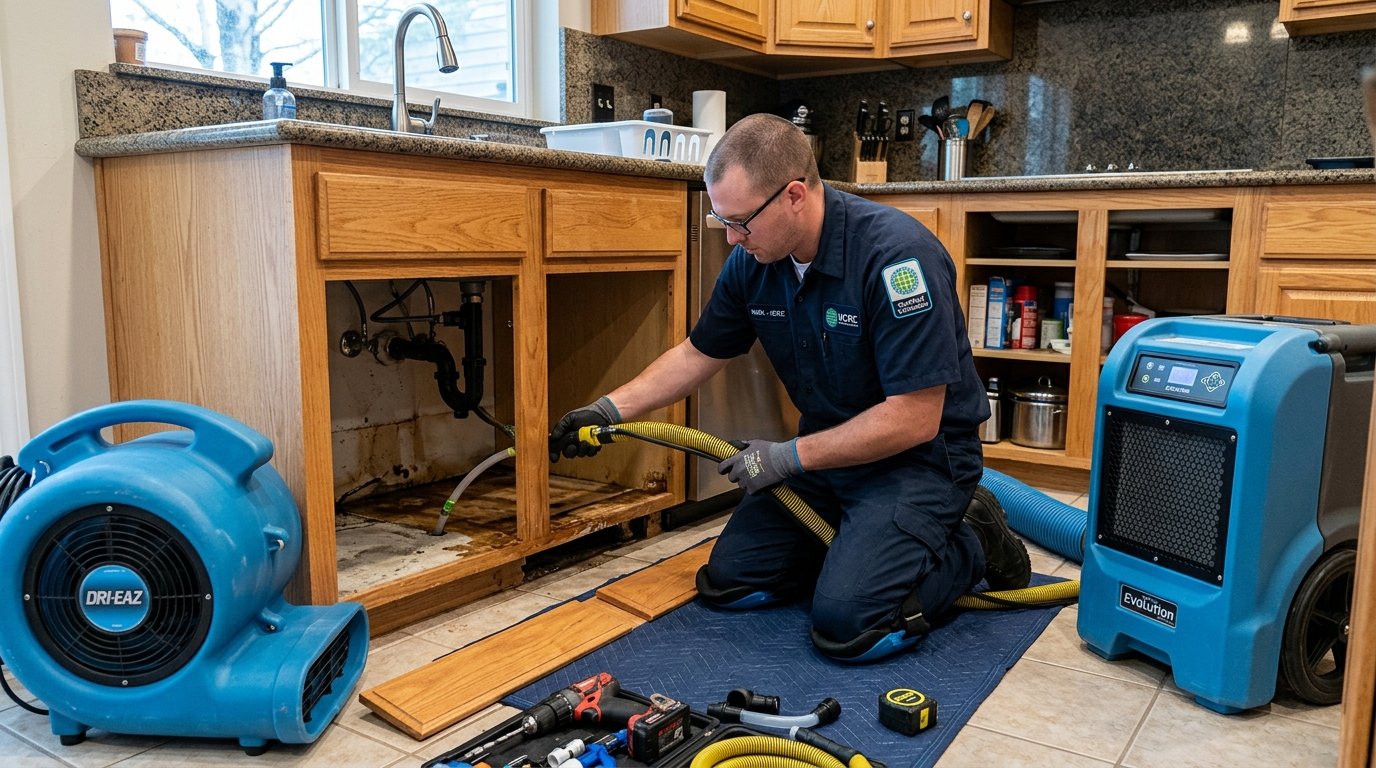
Hidden kitchen hazard: Dishwasher leaks originate behind toe-kick panels from cracked solenoid valves or failed supply lines, migrating beneath custom cabinetry before pooling on floor tiles.
2. Refrigerator Ice Makers & Water Dispensers
Standard builder installation kits include a roll of 1/4-inch white polyethylene plastic tubing. In Arizona’s dry climate, this plastic becomes brittle, develops stress fractures, or is pinched and punctured when the refrigerator is pushed back against the wall.
Replace plastic tubing immediately with a braided stainless steel ice maker supply lineor coiled soft-temper copper tubing. Ensure the shutoff valve in the wall box is a modern quarter-turn brass ball valve rather than an obsolete saddle-piercing needle valve, which notoriously corrodes and fails to shut off in an emergency. For complete maintenance protocols, read our refrigerator ice maker line leak guide.
3. Under-Sink Reverse Osmosis (RO) Units
Because Arizona tap water is hyper-mineralized, most Valley homes utilize an under-sink Reverse Osmosis (RO) system. These units contain multiple pressurized plastic filter sumps, push-connect fittings (John Guest fittings), and a pressurized water storage bladder tank.
Install a Pressure Regulating Valve: High city pressure can split plastic filter housings. Install an in-line pressure limiter set to 50–60 PSI directly before the RO manifold.
Replace Filter Housings Every 5 Years: Plastic sumps suffer plastic fatigue from continuous cycling. Replace the housings every five years to prevent catastrophic bursting.
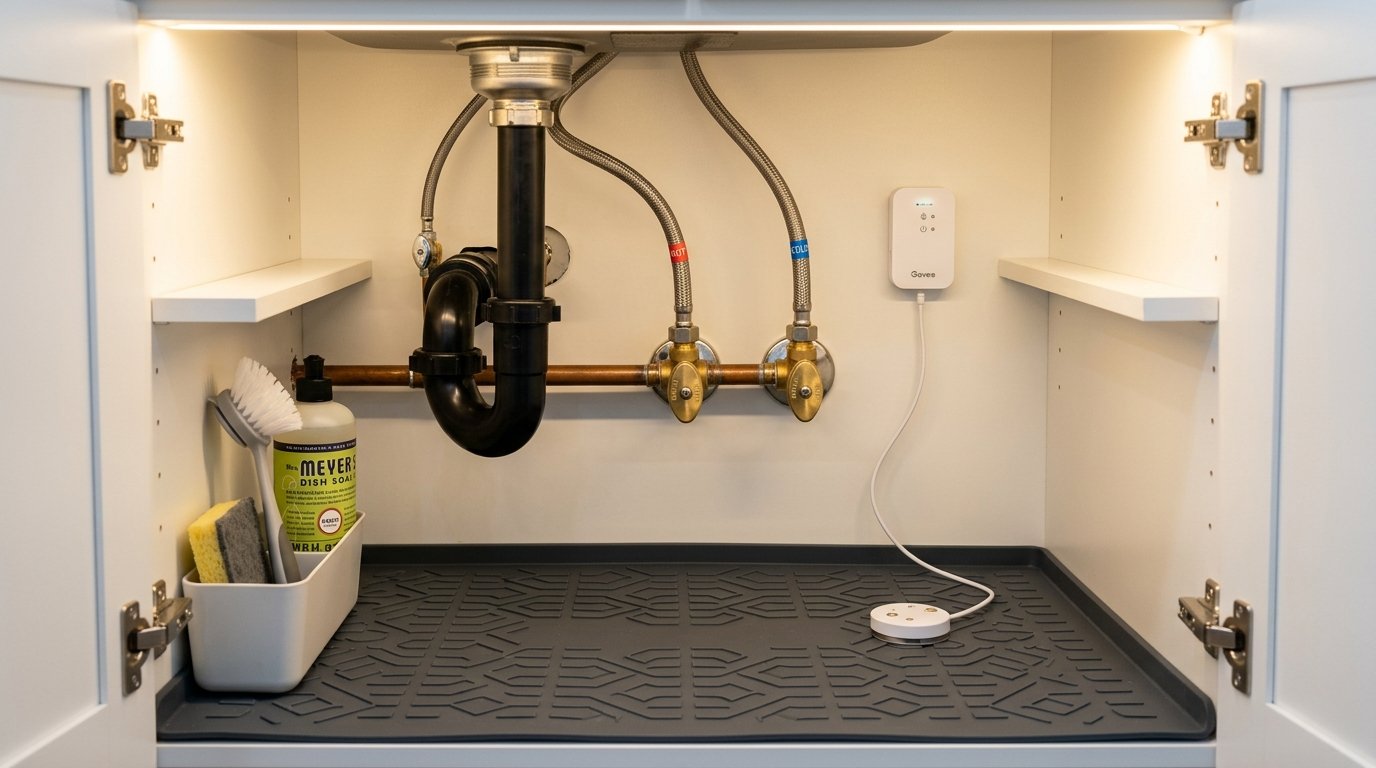
Use an Automatic Leak-Stop Pad: Place a mechanical leak-stop valve (such as a shut-off pad with an expanding compressed cellulose tablet) beneath the unit. If a fitting leaks, the tablet expands and instantly mechanically shuts off the incoming water supply.
Room 2: The Laundry Room (Washing Machines & Steam Dryers)
Washing machine failures rank as the #1 source of catastrophic residential water damage claims. Because washing machine hoses remain under constant, full line pressure (50–100+ PSI) 24 hours a day, a ruptured hose operates like an open fire hydrant, releasing up to 600 gallons of water in an hour.
1. The 5-Year Hose Replacement Rule
Standard black rubber washing machine hoses dry-rot rapidly in Arizona’s low-humidity climate. The rubber loses elasticity, develops internal blisters, and ruptures violently at the crimped metal coupling.
Upgrade to Braided Stainless Steel: Install commercial braided stainless hoses rated for 1,500+ PSI burst pressure.
Enforce the 5-Year Rule: Replace both hot and cold hoses every 5 years without exception. Write the installation date directly on the hose collar with a permanent marker.
Install a Secondary Drain Pan: Ensure your washing machine sits inside a heavy-duty metal or reinforced plastic catch pan with a direct drain line connected to a floor drain or the exterior of the home. Learn more in our complete washing machine leak prevention guide.
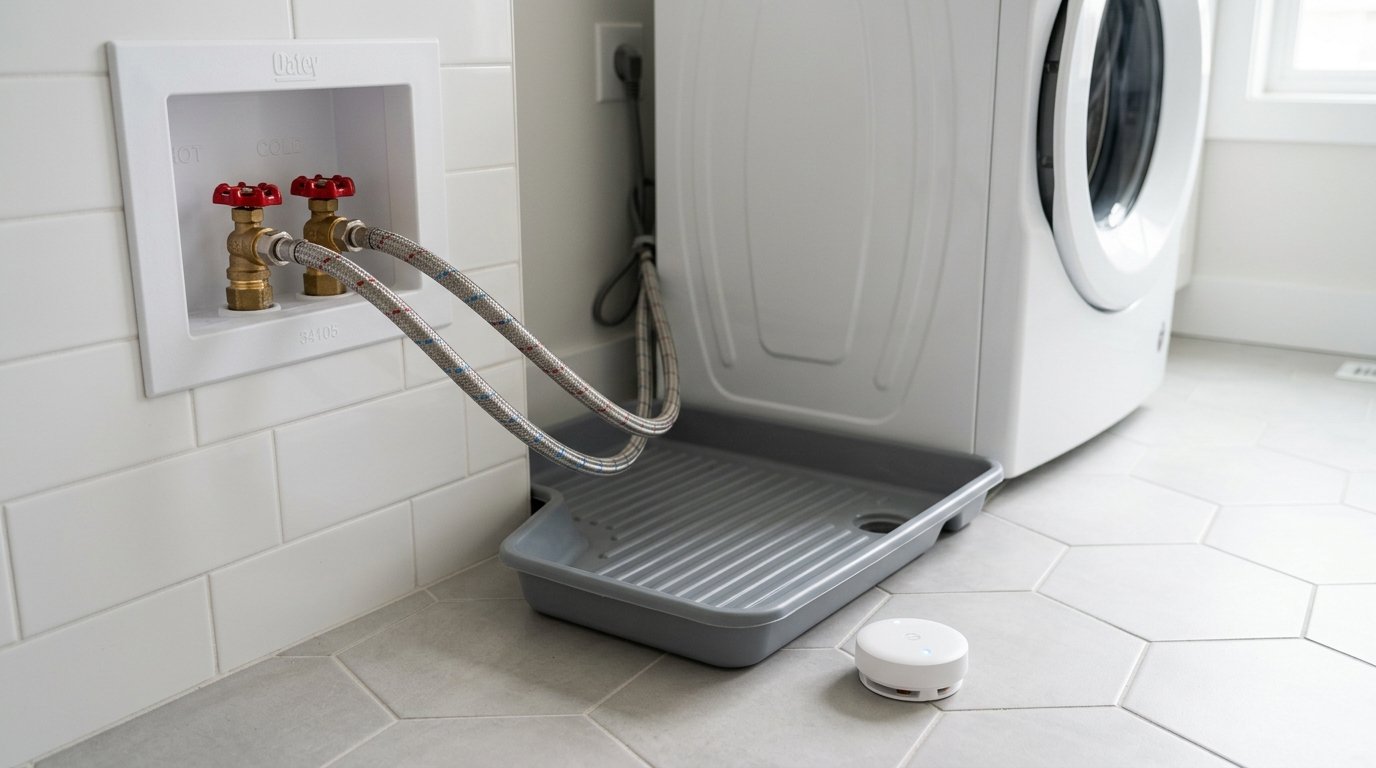
Multi-point laundry defense: Installing an emergency drip pan combined with a smart Wi-Fi leak detection puck stops laundry room water catastrophes before water reaches drywall.
2. Steam Dryers & Drain Standpipes
Modern clothes dryers with steam refresh cycles require a dedicated cold water connection, usually tapped off the washing machine spigot using a brass Y-splitter. Ensure this splitter is solid forged brass (never plastic) and use a reinforced braided line. In addition, inspect your 2-inch drain standpipe annually to ensure lint buildup does not trigger a backflow overflow during the machine’s high-speed drain cycle.
Mechanical utility rooms house high-volume water vessels that operate under continuous pressure and high temperatures, making them prime candidates for massive structural flooding.
1. Water Heaters: Flushing & Thermal Expansion
Arizona’s aggressive hard water deposits inches of calcium carbonate sediment at the bottom of water heater tanks. This causes thermal hotspots, tank bottom metal fatigue, and sudden seam ruptures.
Annual Sediment Flush: Flush the water heater annually through the bottom drain valve to evacuate mineral scale.
Test the T&P Relief Valve: Lift the test lever on the Temperature & Pressure (T&P) relief valve annually to verify that water discharges freely and the valve reseats without dripping.
Maintain the Thermal Expansion Tank: Verify that your potable expansion tank is pre-charged to match incoming household water pressure, preventing dangerous 150+ PSI thermal spikes. Read our water heater leak warning signs and emergency protocol.
2. Water Softeners & Whole-Home Filtration
Ion-exchange water softeners contain high-pressure resin tanks, brine tanks, and motorized control valves. During nighttime regeneration cycles, thousands of gallons of water pass through the unit.
Check the Brine Tank Safety Float: Inspect the safety float assembly inside the brine well to ensure it shuts off water flow if the brine valve fails.
Maintain the Drain Air Gap: Ensure the softener drain line discharges through a code-compliant physical air gap into the sewer standpipe, preventing municipal sewage from siphoning back into your drinking water.
Room 4: Bathrooms (Toilets, Angle Stops & Bidets)
Bathrooms account for frequent, high-volume floods that quickly penetrate ceilings of rooms below:
Toilet Fill Valve Supply Lines: Replace all rigid plastic or corrugated lines with braided stainless steel lines featuring forged metal hex nuts. Never hand-tighten a brittle plastic nut that can crack under vibration.
Upgrade to Quarter-Turn Ball Valves: Replace old multi-turn compression angle stops with quarter-turn brass ball valves. Multi-turn valves use rubber packing washers that dry-rot in desert heat and leak around the stem when operated.
Bidet Attachment T-Valves: Many aftermarket bidet sprayers use thin plastic T-valves that split under full household pressure. Always install solid brass T-diverters with a dedicated shutoff valve.
Toilet Wax Rings: If a toilet rocks or shifts when sat upon, the wax ring seal is broken, allowing wastewater to seep under tiles during every flush. Re-seat the toilet immediately with a reinforced rubber gasket or extra-thick wax ring.
During triple-digit Arizona summers, central air conditioning units run for 16 to 20 hours a day, extracting 5 to 15 gallons of water per day from indoor air.
If the primary 3/4-inch PVC condensate drain line clogs with algae, desert dust, or mold sludge, condensate backs up and overflows the internal drain pan. If the secondary catch pan lacks an operational float switch, gallons of water pour into attic insulation and collapse the ceiling below.
Install an Inline Float Switch: Equip the secondary drain pan and primary drain line with a magnetic float switch (such as a Safe-T-Switch) that automatically cuts power to the AC condenser if water rises.
Monthly Vinegar Flush: Pour 1 cup of distilled white vinegar down the primary condensate T-pipe once a month during the summer to dissolve algae and bacterial slime. Learn more in our attic mold and HVAC condensation guide.
Room-by-Room Appliance Leak Risk Matrix
Use this reference table to evaluate the plumbing connections in your home and plan necessary upgrades:
Secondary catch pan + inline magnetic float switch + monthly vinegar flush.
Annual Inspection
Whole-Home Technological Defense: Smart Shutoff Systems
While replacing lines every five years reduces risk, human error and material defects can still trigger sudden failures. Modern smart plumbing technology provides an automated, fail-safe barrier:
Smart Water Shutoff Valves (Flo by Moen / Phyn Plus): Installed directly on your main water meter riser, these devices use micro-turbine or ultrasonic flow sensors to monitor water usage. If an appliance hose bursts, the system senses the continuous high-volume flow and automatically commands a motorized ball valve to shut off the entire water supply within 15 to 30 seconds.
Wireless Moisture Puck Sensors: Place battery-powered smart sensors directly on the floor beneath dishwashers, washing machines, water heaters, and under-sink RO units. When moisture bridges the two metal contact pins, the puck emits an 85 dB audible alarm and signals the main valve to close.
Calibrate Your PRV to 55–65 PSI: Keep household static water pressure strictly below 75 PSI. Excessive municipal pressure is the single greatest catalyst for appliance failures.
Emergency Protocol: What to Do If an Appliance Leaks
If an appliance bursts or begins leaking rapidly, take these four immediate steps:
Shut Off the Water Supply: Turn the local isolation valve behind the appliance clockwise. If the valve is stuck, corroded, or leaking, immediately run to your home’s main shutoff valve (on the exterior wall or at the street curb meter box) and turn off the entire water supply. For complete instructions, consult our emergency water main shutoff guide.
Cut Electrical Power: If standing water is pooling around electrical cords, dishwashers, or washing machines, switch off the appropriate circuit breakers at your main electrical panel before entering the area.
Dispatch 24/7 IICRC-Certified Emergency Restoration: Contact our emergency response team at (602) 755-0251. We deploy within 45 minutes across Phoenix, Scottsdale, and the Valley with truck-mounted vacuum extractors, cavity drying systems, and commercial LGR dehumidifiers to dry cabinets and flooring in place.
Document the Loss for Insurance: Take detailed photos and videos of the failed appliance hose, water marks on baseboards, and damaged personal property before any demolition begins.
Key Takeaways
Appliances Cause 50%+ of Claims: Washing machines, water heaters, and dishwashers are the primary source of catastrophic indoor residential floods in Arizona.
Enforce the 5-Year Rule: Replace all rubber washing machine hoses and plastic supply lines with braided stainless steel lines every 5 years.
Install Catch Pans: Secondary overflow pans with dedicated drain lines beneath washing machines and water heaters prevent thousands in structural damage.
Deploy Smart Moisture Pucks: Inexpensive wireless moisture sensors beneath appliances provide the earliest warning before water migrates under flooring.
Act Within 24–48 Hours: Rapid professional extraction and cavity drying save custom cabinets and hardwood flooring while preventing toxic mold colonization.
Why do household appliances leak more frequently in Arizona than other states?
Appliances fail faster in Arizona due to three combined environmental factors: (1) Extreme water hardness (250–350+ PPM TDS) that clogs solenoid valves and corrodes heating elements; (2) High municipal water pressure surges (90–130+ PSI) that stress delicate internal plastic components; and (3) Intense ambient desert heat that dries out rubber gaskets, O-rings, and plastic water lines, causing them to crack and split under normal operating pressure.
How often should washing machine and dishwasher supply hoses be replaced?
Flexible supply lines should be replaced every 3 to 5 years, regardless of how clean they appear on the outside. In Arizona, black rubber hoses and semi-rigid plastic lines oxidize rapidly under municipal chlorine and chloramines. Always replace them with commercial-grade braided stainless steel lines featuring solid brass compression nuts rather than cheap plastic wing nuts.
What type of ice maker water line is safest to prevent refrigerator leaks?
Braided stainless steel tubing or coiled soft-temper copper tubing (1/4-inch OD) with brass compression fittings are the only safe choices. Never use the thin, semi-rigid white polyethylene plastic tubing that comes standard with many DIY refrigerator installation kits. In the desert, that plastic becomes brittle after 3 to 5 years, developing hairline pinholes or snapping entirely behind the refrigerator where leaks go unnoticed for weeks.
Why do water heaters burst without warning in Phoenix and Scottsdale?
Water heaters in the Phoenix Valley have an average lifespan of only 6 to 10 years (compared to 12 to 15 years nationally). Dissolved calcium carbonate settles at the bottom of the tank, forming a thick, insulating mineral barrier over the burner. This causes the bottom steel to overheat, fatigue, and crack. In addition, when cold incoming water expands upon heating in a closed plumbing system without a functioning thermal expansion tank, pressure spikes can exceed 150 PSI, blowing out tank seams.
Does homeowners insurance cover water damage from a leaking appliance?
Yes, standard homeowners insurance policies (HO-3) almost universally cover sudden and accidental water discharges resulting from ruptured hoses, cracked solenoid valves, or tank ruptures. However, insurance adjusters frequently deny claims if they discover evidence of long-term, gradual seepage that the homeowner ignored (such as rotted subfloors with extensive fungal colonization that developed over several months). Immediate professional mitigation and timestamped moisture logs are vital for claim approval.
Can water-damaged kitchen cabinets be dried and saved without replacement?
Yes, provided certified restoration technicians begin drying within 24 to 48 hours. By removing cabinet toe-kicks and deploying high-pressure structural cavity injection systems (such as Injectidry) paired with commercial Low-Grain Refrigerant (LGR) dehumidifiers, dry heated air can be forced beneath cabinet boxes to extract trapped moisture without removing expensive granite or quartz countertops.
What is a smart whole-home automatic water shutoff valve, and does it lower insurance premiums?
A smart shutoff valve (such as Flo by Moen, Phyn Plus, or StreamLabs) is installed directly on your main water supply line. Using ultrasonic sensors, it monitors household water flow down to a single drop per minute. If an appliance hose ruptures or water runs continuously, it automatically closes a motorized brass ball valve within 15 to 30 seconds. Major insurance carriers offer annual premium discounts of 5% to 15% for homes protected by these devices.
What should I do immediately if an appliance bursts while I am at home?
Execute four immediate steps: (1) Shut off the dedicated local fixture valve (angle stop) beneath the sink, behind the toilet, or behind the washing machine; (2) If the local valve is frozen or leaking, shut off the home's main water supply valve immediately; (3) Turn off electrical circuit breakers for the flooded room if water is near outlets; (4) Call an IICRC-certified 24/7 restoration team to begin industrial water extraction before mold spores colonize at the 24-hour mark.
IICRC-certified restoration technicians · Phoenix metro
Written and fact-checked by the licensed crew that runs the trucks — the same technicians who take moisture readings, set drying chambers to the IICRC S500 standard, and answer the phone at 2 a.m. across the Phoenix metro.
Licensed Arizona contractor — AZ ROC #331127 (KB-2)