A single ruptured residential pipe can unleash 8 to 15 gallons of pressurized water every minute. Learn why high municipal water pressure, failing PRVs, hard water pitting corrosion, and desert cold snaps burst Arizona pipes—and how to safeguard your home.
Last updated:Reading time:14 minStandards:IICRC S500 Verified
Plumbing Integrity · Water Pressure Regulation · Desert Freeze Protection
Table of contents▾
In Arizona, burst pipes are year-round emergencies driven predominantly by high municipal water pressure (90–130+ PSI), failing Pressure Reducing Valves (PRVs), and hard water pitting corrosion, rather than winter freezes alone. Over 70% of catastrophic residential pipe ruptures in Phoenix, Scottsdale, and Mesa occur during the summer due to peak city pumping surges and closed-loop thermal expansion. Testing your water pressure annually to verify it stays between 50 and 70 PSI, replacing PRVs every 5 to 8 years, and upgrading plastic flex lines to braided stainless steel are the single most effective steps to prevent tens of thousands of dollars in water damage.
A single ruptured copper pipe, split flex hose, or blown water heater tank can flood a home with over 500 to 1,000 gallons of water in less than an hour. Water rapidly travels beneath baseboards, wicks up drywall, saturates subfloors, and migrates into sub-slab concrete foundations. Left unmitigated for even 24 to 48 hours, aggressive mold spores germinate, triggering structural decay and hazardous indoor air contamination.
Homeowners moving to Arizona from colder northern states often assume that desert living eliminates the risk of plumbing disasters. In reality, the unique environmental and infrastructural conditions of the Sonoran Desert—extreme municipal pressure fluctuations, calcifying hard water, expansive bentonite clay soils, and uninsulated outdoor plumbing—create a constant, hidden assault on your home’s pipes.
This comprehensive homeowner guide breaks down the five primary causes of pipe failure in Arizona, details seven field-tested prevention protocols, and explains the emergency steps to take if a pipe bursts in your home.
The 5 Arizona-Specific Causes of Catastrophic Burst Pipes
Understanding why pipes rupture in the desert is essential for prioritizing preventive maintenance. Unlike cold-climate states where frozen water expands outward against pipe walls, Arizona plumbing failures are driven by a distinct combination of mechanical stress and chemical aggression:
1. Extreme Municipal Pressure Surges & Failing PRVs
To supply water across sprawling desert elevations and satisfy peak morning irrigation demands, municipal water utilities across Phoenix, Scottsdale, Mesa, Chandler, and Glendale pump water through city mains at pressures exceeding 90 to 130+ PSI. Building codes mandate a Pressure Reducing Valve (PRV) on residential mains to throttle this incoming pressure down to a safe 50–70 PSI.
However, intense desert ground heat and mineral scaling degrade the internal rubber diaphragm and brass spring inside the PRV within 5 to 8 years. When a PRV quietly fails open, full city pressure slams directly into household plumbing. Weak plastic toilet fill valves shatter, washing machine hoses blister, and water heaters rupture at the seams.
2. Aggressive Hard Water & Copper Pitting Corrosion
Arizona municipal water originates from the Colorado River and Salt River Project (SRP) reservoirs, containing high levels of dissolved calcium, magnesium, sulfates, and chlorides, with total dissolved solids (TDS) regularly measuring between 250 and 350+ PPM. This alkaline chemistry forms hard calcium carbonate scale inside pipes.
Underneath uneven mineral scale deposits, electrochemical micro-cells form, accelerated by municipal disinfectant chloramines. This causes localized type 1 pitting corrosion—microscopic cavities that eat through Type M copper pipe walls. These pinholes quietly erode the metal until a routine pressure surge blows out the compromised pipe section.
3. Closed Plumbing Loops & Severe Thermal Expansion
When a PRV or backflow check valve is installed, it converts your home into a “closed plumbing system.” Water can enter from the city main, but it cannot push backward into the street. When your water heater warms 50 gallons of water from 60°F to 125°F, the water physically expands by approximately 2% in volume.
Because liquid water cannot be compressed, this expansion spikes system pressure inside closed pipes up to 120–150 PSI every time the water heater fires. Without a properly pressurized thermal expansion tank to absorb this shock, repeated pressure cycling causes metal fatigue, splitting solder joints and rupturing appliance flex lines.
4. Expansive Clay Soils & Foundation Movement
A large percentage of homes built across the Valley of the Sun sit on post-tension concrete slabs poured over expansive clay soil. During the bone-dry summer months, desert clay shrinks and cracks. When intense monsoon storms arrive in July and August, moisture saturates the soil, causing it to swell upward with thousands of pounds of hydrostatic pressure.
This seasonal shifting flexes concrete slabs and applies shearing forces to under-slab copper plumbing lines. Soft copper lines rubbing against coarse aggregate or trapped beneath shifting footings develop friction wear and catastrophic under-slab ruptures. Learn more about non-invasive detection in our slab leak water damage restoration guide.
While desert winters are mild, overnight radiational cooling under cloudless skies regularly pushes temperatures down to 25°F–30°F for multiple consecutive nights between late December and early February.
Arizona homes feature unique architecture: water mains, pressure vacuum breakers (PVBs), reduced pressure zone assemblies (RPZs), and hose bibbs are installed outdoors above ground on the side of the house without exterior wall insulation. In addition, unconditioned attics can drop below freezing, threatening PEX and copper distribution lines running above ceilings.
The table below details the most common residential plumbing components in Arizona homes, their desert-specific failure triggers, and the recommended preventative action:
Plumbing Component
Arizona Risk Driver
Warning Signs of Failure
Preventative Solution
Pressure Reducing Valve (PRV)
Hard water calcification and summer heat ruin internal rubber diaphragms.
Water hammer, leaking toilet fill valves, pressure > 80 PSI.
Test annually; replace every 5–8 years.
Under-Slab Copper Lines
Expansive clay soils, post-tension slab movement, and alkaline soil corrosion.
Warm floor spots, spinning water meter, hiss sound in walls.
Overhead PEX repipe or non-invasive reroute.
Washing Machine Rubber Hoses
Desert dry rot, chlorine degradation, constant 80+ PSI line pressure.
Upgrade to braided stainless steel; replace every 5 yrs.
Exterior Backflow Assembly (PVB/RPZ)
Overnight freezing temperatures (25–30°F) during December/January cold snaps.
Cracked brass bell housing, spray during winter morning thaw.
Install thermal insulating wrap and insulated cover box.
Water Heater Tank & Flex Lines
Thermal expansion spikes up to 150 PSI without an expansion tank.
T&P valve weeping water, groaning sounds, bulging bottom pan.
Install potable expansion tank matched to incoming PSI.
Plastic Toilet & Faucet Supply Lines
Rigid plastic nuts crack under thermal stress and aggressive chloramines.
Hairline stress fractures, white calcium crust around nuts.
Install braided stainless lines with metal hex nuts.
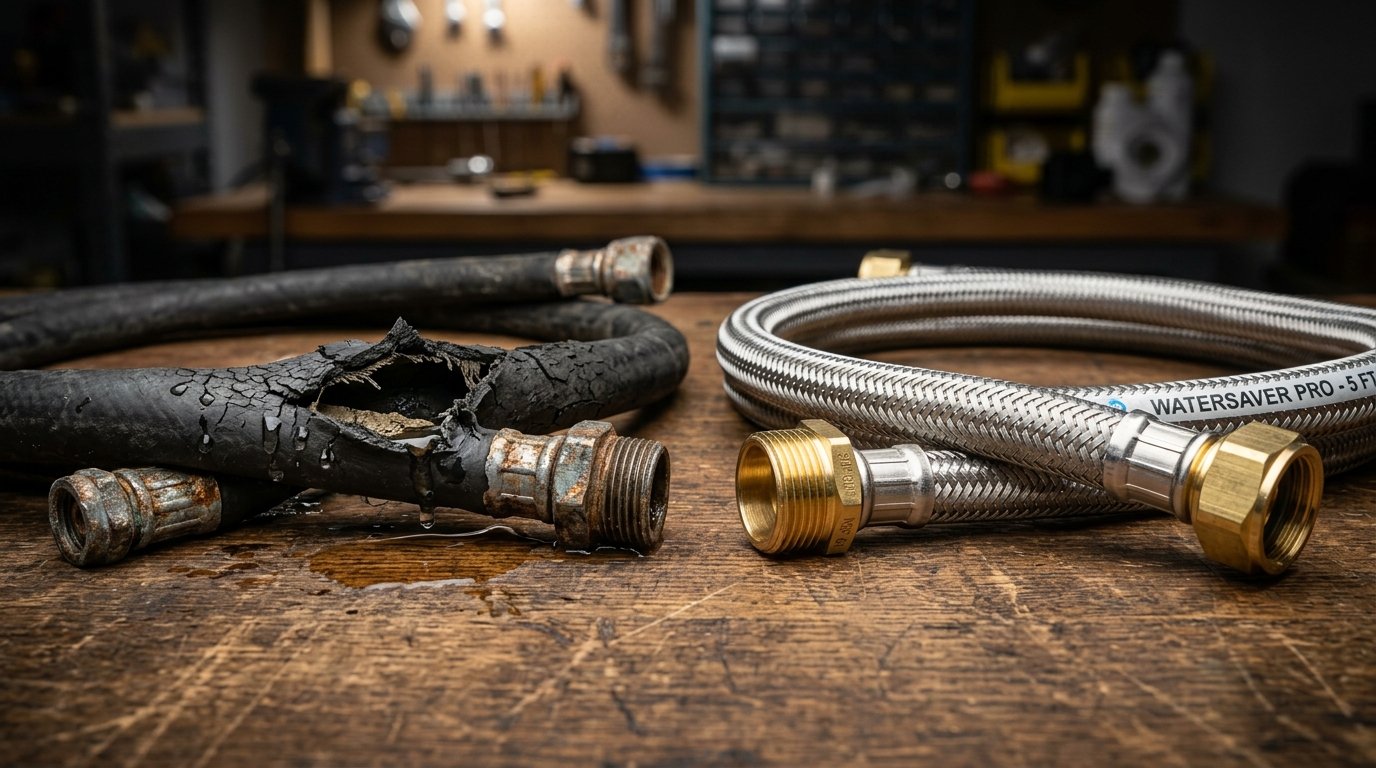
Preventable disaster: Black rubber hoses dry rot rapidly in desert heat and can burst without warning under normal water pressure. Braided stainless steel supply lines provide a durable burst-proof barrier.
7 Proven Prevention Strategies for Arizona Homeowners
Catastrophic plumbing failures rarely happen without warning. Implementing these seven proactive maintenance protocols will dramatically reduce your risk of dealing with an emergency pipe burst:
1. Test Your Water Pressure Twice Per Year (Maintain 50–65 PSI)
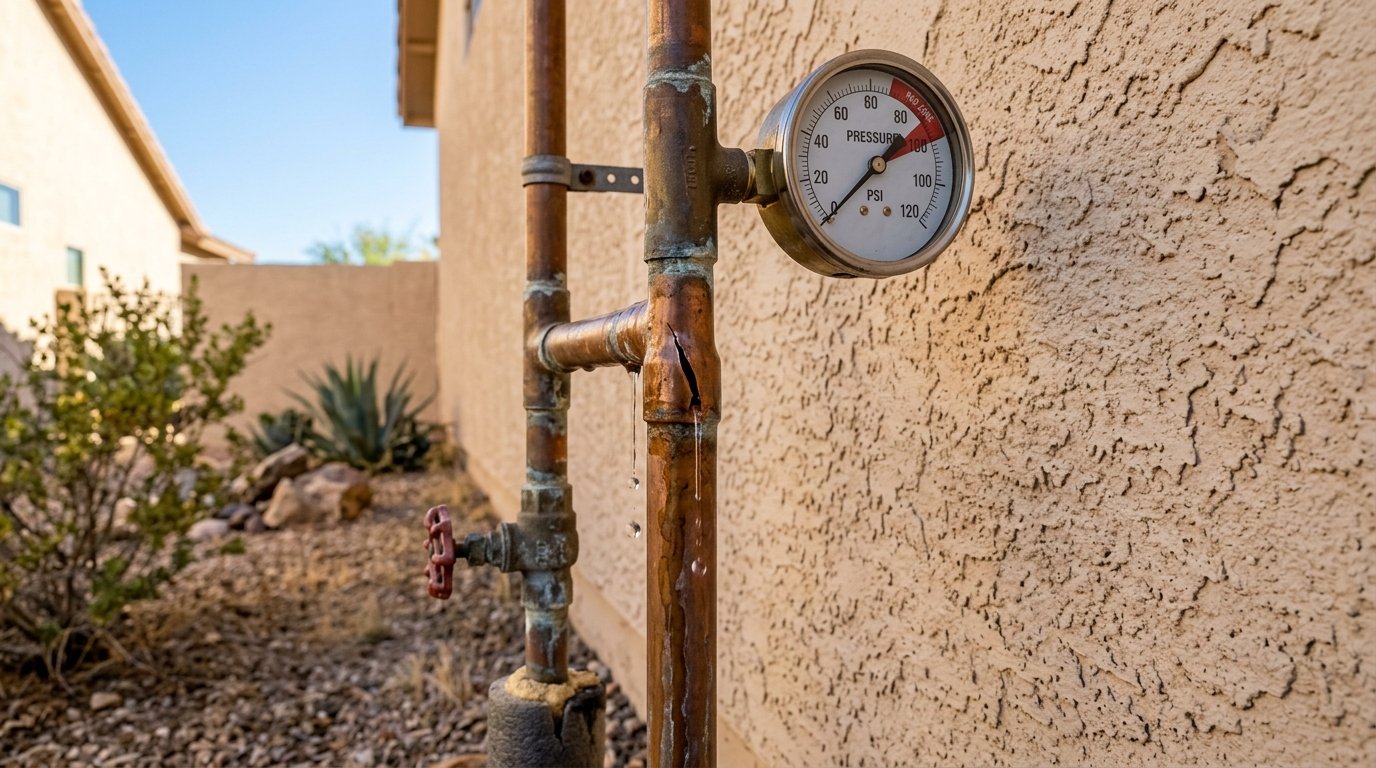
Purchase an inexpensive 0–160 PSI pressure test gauge with a female hose bibb connection from any home improvement store. Screw the gauge directly onto an unsoftened outdoor garden spigot or washing machine cold supply bibb. Turn the faucet fully on while all indoor fixtures remain off.
The Rule of 75: If your static reading is higher than 75 PSI, your plumbing system is at immediate risk. Sustained pressures above 80 PSI weaken copper fittings, stress soldered elbows, and blow apart flexible appliance hoses. If pressure is elevated, your PRV requires immediate recalibration or replacement.
2. Inspect and Replace Your Pressure Reducing Valve (Every 5–8 Years)
Located on your main water riser where the supply enters the house or garage, the bell-shaped brass PRV is the frontline guardian of your home’s pipes. Arizona’s hyper-mineralized water and desert heat cause internal PRV diaphragms to stiffen, tear, and calcify.
Do not wait for a PRV to burst your water heater before replacing it. If your valve has been in service for more than six years, or if turning the adjustment nut no longer reduces gauge pressure, hire a licensed plumber to install a lead-free brass replacement such as a Wilkins 70XL or Watts LF25AUB.
3. Install and Pre-Charge a Thermal Expansion Tank
If your home has a PRV, backflow preventer, or check valve, local plumbing codes strictly require a potable water thermal expansion tank installed on the cold supply line feeding your water heater. This tank contains a flexible rubber bladder separated by pressurized air.
When water heats and expands, it pushes safely into the tank’s air cushion instead of hammering against pipe walls. Ensure the tank’s air valve is pre-charged to match your home’s incoming static water pressure (e.g., 60 PSI air pre-charge for 60 PSI water pressure). Expansion tanks last 4 to 6 years; if tapping the top half sounds hollow while the bottom sounds dull and metallic, the bladder has ruptured and needs replacement.
4. Replace All Rubber and Plastic Supply Lines with Braided Stainless Steel
Standard black rubber washing machine hoses and cheap plastic toilet riser tubes account for over 40% of catastrophic indoor flood claims. In Arizona’s dry, chlorinated water conditions, rubber oxidizes rapidly, developing micro-cracks and sudden blisters that blow out while homeowners are away:
Replace washing machine hoses with commercial-grade braided stainless steel hoses rated for 1,500+ PSI burst pressure.
Swap all plastic toilet supply lines for stainless braided lines with metal, hand-tightened nuts rather than brittle plastic wing nuts.
Upgrade refrigerator ice maker lines from brittle white 1/4-inch polyethylene tubing to stainless steel braided lines or heavy-duty copper.
Replace dishwasher flex lines every 5 years with high-temp braided stainless steel lines.
5. Winterize Outdoor Hose Bibbs and Backflow Assemblies (Dec–Feb)
Do not let Arizona’s daytime sunshine fool you. When Arctic cold fronts dip into the Southwest, nighttime desert temperatures plummet into the mid-20s. Protect vulnerable exterior plumbing by mid-November:
Disconnect all garden hoses: Leaving a connected hose traps water inside the spigot body, cracking the brass bibb inside the wall cavity during a freeze.
Install foam spigot covers: Place insulated styrofoam or thermal fabric domes over all outdoor hose bibbs.
Insulate backflow preventers: Wrap your exterior brass Pressure Vacuum Breaker (PVB) or RPZ assembly with fiberglass insulation tape and secure a heavy-duty weatherproof insulating blanket (freeze pouch) over the entire unit.
Open indoor cabinets: During hard freeze warnings, open vanity and kitchen cabinet doors on exterior walls to circulate warm interior air around plumbing.
6. Mitigate Hard Water Scale to Stop Copper Pinhole Leaks
Arizona’s 250–350+ PPM mineral content steadily corrodes copper piping through scale-induced pitting. Installing an ion-exchange water softener or whole-home catalytic filtration system eliminates aggressive scale formation, maintaining smooth laminar water flow and extending the lifespan of your plumbing and appliances by decades.
If your home was constructed between 1980 and 2005 with thin-wall Type M copper, consider having a certified restoration specialist perform non-destructive infrared thermal moisture detection to locate concealed pinhole leaks before a catastrophic blowout occurs.
7. Install Smart Whole-Home Automatic Water Shutoff Systems
The ultimate defense against catastrophic water damage is a smart, automated shutoff valve (such as Flo by Moen, Phyn Plus, or StreamLabs). These devices are installed directly on your main water line and use ultrasonic sensors or micro-turbine meters to monitor pressure and flow rates down to a single drop per minute.
If a pipe bursts while you are sleeping or away from home, the system detects the abnormal flow rate and automatically commands a motorized brass ball valve to shut off the entire water supply within 15 to 30 seconds. In addition, major insurance carriers offer substantial homeowners premium discounts (5% to 15%) for homes equipped with automatic leak shutoff technology.
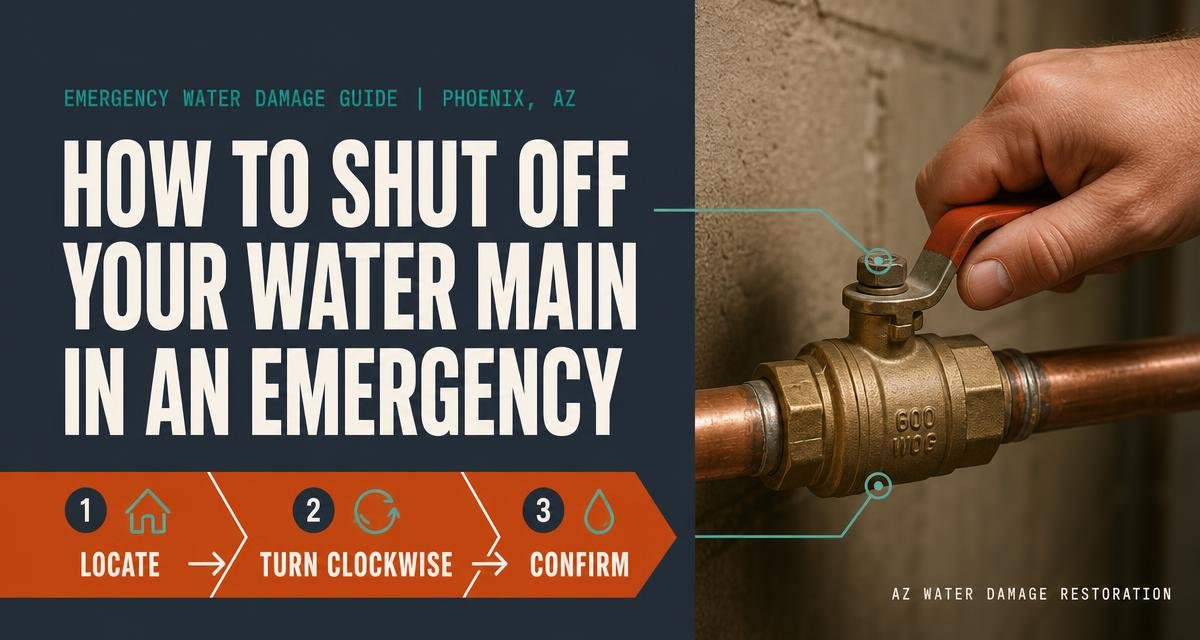
Emergency triage protocol: Locating, turning, and confirming your main shutoff valve stops pressurized flooding in under 60 seconds.
Early Warning Signs of an Imminent Pipe Rupture
Plumbing systems under extreme mechanical and chemical stress exhibit clear physical warning signs before completely fracturing. If you observe any of the following symptoms, take immediate action:
Loud Banging or Clunking (Water Hammer): When faucets or sprinkler valves close abruptly and your walls vibrate with a loud metallic shudder, water velocity is too high or air chambers are waterlogged. This kinetic shock repeatedly hammers soldered elbows until they fail.
Blue-Green Crust or White Chalk (Verdigris): Inspect exposed copper pipes around your water heater and under sinks. A crusty blue-green patina or chalky white mineral buildup around soldered joints indicates active micro-seepage and pitting corrosion that will soon blow out.
Spinning Water Meter Dial: Turn off all household taps, ice makers, and pool autofills. Open your municipal water meter box at the street curb. If the small low-flow indicator triangle or digital flow rate is actively moving, pressurized water is escaping somewhere inside your structure.
Warm Floor Tiles or Damp Baseboards (Slab Leaks): Walking barefoot across your tile floor and discovering an isolated warm section is the textbook symptom of a ruptured hot water copper line beneath your foundation slab.
Emergency Protocol: What to Do If a Pipe Bursts Right Now
If a pipe ruptures, every minute of delay multiplies the extent of structural demolition required. Execute this five-step emergency protocol immediately:
Shut Off the Main Water Valve Immediately: Run directly to your main water shutoff riser (exterior wall, garage, or city meter box) and turn the handle clockwise or perpendicular to the pipe. For complete instructions, consult our guide on how to shut off your water main in an emergency.
Depressurize and Drain Remaining Water: Open the lowest outdoor garden spigot and indoor faucets to drain trapped water away from your living spaces.
Turn Off Electricity to Affected Zones: If floodwater is pooling near baseboard outlets or electrical equipment, switch off main breakers for those circuits to eliminate electrocution risks.
Dispatch 24/7 IICRC-Certified Water Mitigation: Call an emergency restoration crew immediately. Professional extraction technicians use truck-mounted vacuum units, cavity drying systems, and commercial desiccant dehumidifiers to dry structures before mold colonizes at the 24- to 48-hour mark. Learn more about the critical timing in our first 24 hours after water damage protocol.
Document Everything for Insurance: Take extensive photos and videos of standing water, the ruptured pipe, damaged furniture, and wet drywall before any demolition begins. Review our homeowners insurance coverage guide to ensure your claim is fully documented and approved.
Regional Plumbing Dynamics Across the Valley of the Sun
Plumbing infrastructure and environmental risks vary significantly across Maricopa County communities:
Phoenix & Central Valley: Historic neighborhoods in Central Phoenix, Arcadia, and Encanto often feature original 1950s–1970s galvanized iron and early copper lines that easily burst under high municipal pressure. See our dedicated Phoenix water damage restoration services.
Scottsdale & Paradise Valley: Elevation changes along McDowell Mountain and Camelback slopes require massive municipal pumping pressures (often 110–130+ PSI). Luxury homes with multi-zone recirculating hot water loops suffer accelerated copper erosion if PRVs fail. See our Scottsdale water damage restoration services.
East Valley (Mesa, Gilbert, Chandler): Expansive agricultural clay soils experience dramatic seasonal swelling, placing immense shearing strain on under-slab copper lines.
West Valley (Glendale, Peoria, Surprise): Master-planned communities built during the 1990s and 2000s are currently reaching the 20- to 30-year mark where original water heaters, plastic supply lines, and factory PRVs simultaneously reach end-of-life failure.
Key Takeaways
High Pressure Kills Plumbing: In Arizona, high municipal water pressure (90–130+ PSI) causes more burst pipes than winter freezes. Keep residential pressure between 50 and 70 PSI.
PRVs Have an Expiration Date: Desert heat and hard water degrade Pressure Reducing Valves every 5 to 8 years. Test yours semi-annually with an inexpensive gauge.
Thermal Expansion is Real: Closed plumbing loops with a PRV require a properly pre-charged thermal expansion tank above the water heater to absorb pressure surges up to 150 PSI.
Ditch Rubber & Plastic: Upgrade all washing machine hoses, toilet risers, and ice maker lines to braided stainless steel to eliminate the most common source of home flooding.
Winterize Before December: Insulate outdoor backflow preventers (PVBs/RPZs) and disconnect garden hoses before desert nighttime frosts drop into the mid-20s.
Why do pipes burst in Arizona during the summer when there is no freezing weather?
Unlike cold-climate states where freezing ice expansion causes 95% of pipe ruptures, Arizona pipes frequently burst during scorching summer months due to extreme municipal water pressure surges and thermal expansion. Municipalities in Phoenix, Scottsdale, and Mesa pump water at 90 to 130+ PSI to meet peak air conditioning and irrigation demands. When an aging Pressure Reducing Valve (PRV) fails, this intense pressure slams directly into residential plumbing, instantly rupturing degraded plastic supply lines, water heater tanks, and weak copper solder joints.
What is safe water pressure for a home in Phoenix, Arizona?
Residential water pressure in Arizona should strictly remain between 50 and 70 PSI (pounds per square inch). Any pressure exceeding 80 PSI violates uniform plumbing codes and voids manufacturer warranties on appliances like water heaters, dishwashers, and washing machines. Sustained pressure over 80 PSI stretches copper wall thickness and places immense strain on fixture valves.
How do I know if my Pressure Reducing Valve (PRV) has failed?
Key symptoms of a failed PRV include sudden banging noises in your walls when faucets close (water hammer), vibrating pipes, erratic water flow from showerheads, leaking toilet fill valves, or a pressure reading above 75–80 PSI on an inexpensive hose-bibb pressure gauge. In the Arizona desert, extreme heat and mineral buildup degrade PRV rubber diaphragms every 5 to 8 years.
At what temperature do pipes freeze and burst in the Arizona desert?
Pipes in the Phoenix Valley and Tucson metro areas begin freezing when ambient temperatures drop below 32°F (0°C) for four or more consecutive hours, typically during December and January cold snaps. Exterior backflow preventers (PVBs/RPZs) and uninsulated outdoor hose bibbs are particularly vulnerable because desert building practices rarely recess plumbing into interior insulated walls.
How does Arizona's hard water contribute to pipe bursts?
Tap water across Maricopa County contains 250 to 350+ parts per million (PPM) of dissolved calcium, magnesium, and mineral salts. In combination with municipal chlorine disinfectants, this aggressive mineral chemistry triggers pitting corrosion inside Type M copper tubing. Over time, microscopic pinholes form under scale deposits, weakening the pipe wall until normal line surges blow the metal open.
What is an expansion tank, and why is it mandatory with a PRV?
When a Pressure Reducing Valve or backflow preventer is installed on your main water line, it creates a 'closed plumbing loop.' When your water heater warms incoming cold water, the water expands in volume (thermal expansion). Without an air-cushioned thermal expansion tank installed above the water heater, this trapped pressure can spike beyond 140 PSI, triggering the temperature-and-pressure (T&P) relief valve or rupturing the weakest pipe joint.
How often should washing machine and toilet supply lines be replaced?
Flexible supply lines should be replaced every 3 to 5 years, regardless of visual appearance. In Arizona, black rubber hoses and rigid plastic PEX lines dry out and oxidize rapidly under desert heat and chlorine exposure. Always replace them with commercial-grade braided stainless steel supply lines featuring solid brass compression nuts.
Does homeowners insurance cover water damage from a burst pipe?
Yes, standard homeowners insurance policies (HO-3) almost universally cover sudden and accidental water damage caused by a burst pipe, including emergency water extraction, industrial structural drying, and structural repairs. However, insurers will deny claims if they prove the leak was a slow, gradual drip you ignored, or if you failed to exercise your mandatory duty to mitigate immediately after the rupture.
IICRC-certified restoration technicians · Phoenix metro
Written and fact-checked by the licensed crew that runs the trucks — the same technicians who take moisture readings, set drying chambers to the IICRC S500 standard, and answer the phone at 2 a.m. across the Phoenix metro.
Licensed Arizona contractor — AZ ROC #331127 (KB-2)