How to assess, dry, and restore water-damaged drywall, bubbling wall paint, warped baseboards, and saturated stud cavities. Covers the 2-foot flood cut rule, cavity injection drying, and mold prevention.
Last updated:Reading time:15 minStandards:IICRC S500 Verified
Drywall Restoration: Moisture Mapping, Stud Cavity Dehumidification, and the 2-Foot Flood Cut Rule
Table of contents▾
Quick Answer: Can Water-Damaged Drywall Be Repaired?
It depends on moisture duration, water category, and gypsum integrity. Drywall can be dried in place if the water was clean (Category 1), has been wet for less than 24 to 48 hours, has not lost structural rigidity, and has no wet insulation trapped behind it.
When replacement is required: If the drywall feels soft or spongy to the touch, has visible mold colonies, is contaminated by sewage/gray water, or has saturated fiberglass batt insulation inside the wall cavity, professional IICRC S500 standards mandate executing a 2-foot flood cut.
Drywall (sheetrock) is the skin of your home. Composed of a porous gypsum rock core wrapped in recycled cellulose paper facings, drywall is an excellent building material for thermal and acoustic insulation—but it is exceptionally vulnerable to water.
When a pipe bursts, an upstairs toilet overflows, or an air conditioning condensate line backs up, water doesn’t just roll down the face of the wall. Because gypsum and paper are capillary sponges, they pull moisture upward against gravity (wicking) while allowing water to cascade down inside the concealed wall cavity.
In this guide, we review how to identify hidden moisture inside walls, when drywall can be dried non-destructively vs. when it must be removed, the science behind the 2-foot flood cut, and how to permanently repair wall water damage.
Signs of Water Damage on Walls and Baseboards
Water damage on drywall presents in several distinct stages. Recognizing these symptoms early allows you to act before mold colonizes or drywall crumbles:
Bubbling & Blistering Paint
Latex and acrylic interior paints cure into a thin, flexible plastic sheet. When water enters the wall cavity from behind or wicks up from a slab, it attempts to evaporate into the room. Blocked by the paint film, the moisture forms liquid blisters or balloon-like bubbles.
Swollen or Warped Baseboards
In Arizona tract homes, baseboards are almost universally manufactured from MDF (pressed wood fiber). When a plumbing leak pools on the slab, MDF absorbs moisture instantly, swelling to twice its original thickness and pulling away from the drywall.
Soft, Spongy, or Sagging Sheetrock
When gypsum plaster absorbs more than 1% moisture by weight, its crystalline bond dissolves. Performing a gentle press with your thumb: if the drywall deflects, feels doughy, or your fingernail easily pierces the paper, the structural core has failed permanently.
Discoloration & Tide Marks
Concentric yellowish-brown rings (“tide marks”) develop along wall seams and baseboards as dissolved minerals and wood tannins migrate toward the drying boundary during repeated evaporation cycles.
How Professionals Measure Drywall Moisture
You cannot determine whether drywall is dry simply by touching it. In Arizona’s dry desert air, the surface paper can feel completely dry to the touch within hours, while the gypsum core and 2x4 framing behind it remain saturated at 40%+ moisture content.
Restoration technicians use three diagnostic tools to establish an accurate moisture profile:
1
Non-Invasive Moisture Scanners (Capacitance Meters): Emit radio frequencies up to 3/4-inch deep into the wall assembly to detect moisture pockets without leaving pinholes in paint or wallpaper.
2
Pin-Type Resistance Meters: Two sharp steel probes are pressed through the paint into the gypsum core. Drywall is considered dry when readings drop below 12% to 15% Wood Moisture Equivalent (WME). Readings above 17% require active drying.
3
FLIR Infrared Thermal Cameras: Evaporating water cools the surface of building materials. Infrared imaging highlights wet wall cavities in dark blue/purple hues, clearly outlining the moisture perimeter behind baseboards and kitchen cabinets.
The 2-Foot Flood Cut: Why and When It’s Required
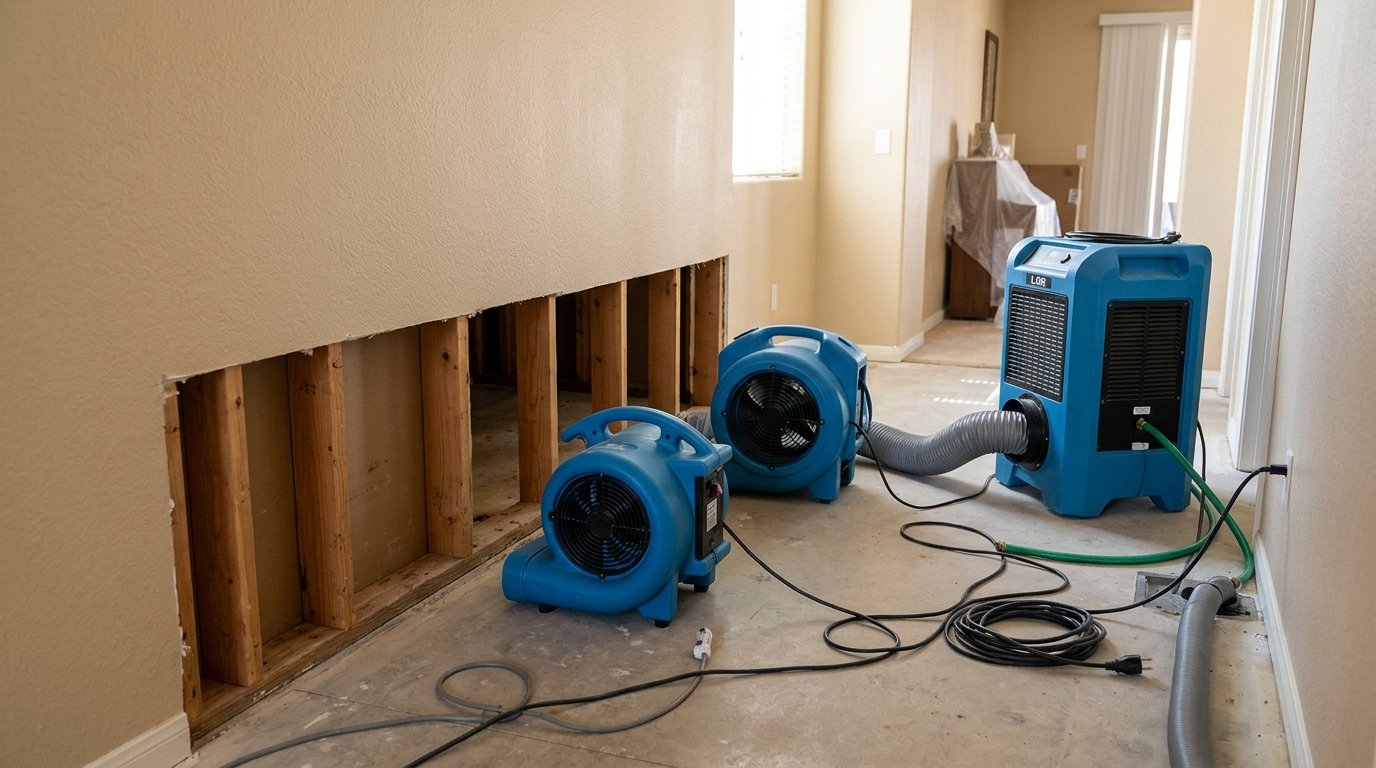
Homeowners are often surprised when a restoration contractor uses a rotary cutter to slice drywall exactly two feet off the floor around the perimeter of a flooded room. This is known as a “flood cut.”
Why Exactly 24 Inches?
The 2-foot height is standard across IICRC S500 restoration guidelines for three crucial reasons:
Capillary Wicking Headroom: When water pools 2 inches deep on a floor, it routinely wicks 8 to 14 inches up the cellulose drywall paper. Cutting 12 to 24 inches above the moisture line ensures no hidden damp paper is left behind.
Insulation Removal: Exterior walls and bathroom partition walls contain fiberglass batt insulation. When wet, fiberglass collapses, loses all R-value, and holds moisture against wooden framing indefinitely. The flood cut allows technicians to extract all wet insulation.
Standard Building Material Dimensions: Sheetrock is manufactured in 4-foot by 8-foot (48"x96") sheets. Cutting walls at exactly 24 inches (2 feet) allows drywall installers to slice standard 4x8 sheets lengthwise in half, producing two seamless 24-inch patches with zero waste and fewer joints to tape and sand.
Drying Walls in Place: High-Pressure Cavity Injection
When water is clean (Category 1) and caught within the first 24 hours, cutting drywall is not always necessary. Certified restoration specialists utilize advanced cavity injection drying systems:
Technicians carefully pop off the vinyl or wood baseboards. Behind where the baseboard sits, they drill tiny 5/8-inch ports into the bottom plate. High-pressure air delivery hoses (like an Injectidry or Dri-Eaz AirWolf unit) are inserted into each stud bay.
The system forces super-dry, heated dehumidifier air directly into the stud cavities, creating positive air pressure that pushes moist air out through ceiling fixtures and electrical outlets. Once the wall assembly achieves dry standard (typically 48–72 hours), the tiny holes are sealed, the baseboards are re-installed, and the wall looks as though nothing ever happened—saving thousands in drywall hanging and painting bills.
The Step-by-Step Drywall Repair Protocol
If your drywall has suffered structural breakdown and requires replacement, our licensed crews follow this comprehensive protocol:
1. Containment & Negative Air
Polyethylene zipper barrier walls and HEPA air scrubbers are installed to prevent dust, insulation fibers, and fungal spores from entering clean bedrooms and living areas.
2. Precision Flood Cut & Debris Removal
Using an oscillating multi-tool set to a 5/8-inch depth stop (to avoid nicking electrical wiring or copper plumbing inside the wall), the lower 24 inches of drywall and saturated insulation are cleanly removed.
3. Framing Decontamination & Drying
Exposed 2x4 studs and bottom plates are treated with an EPA-registered botanical antimicrobial wash. Industrial LGR dehumidifiers and axial air movers dry the wood framing until moisture meters verify <12% WME.
4. Insulation Replacement & Sheetrock Hanging
New unfaced fiberglass batt or mineral wool insulation is installed. Fresh moisture-resistant drywall (greenboard or purple board) is fastened with corrosion-resistant drywall screws into the center of the studs.
5. Taping, 3-Coat Mudding & Texture Match
The horizontal seam is taped with fiberglass mesh. Three successive coats of lightweight joint compound are applied and feathered 12 inches across the joint. Our master drywall finishers match your existing wall texture (light orange peel, heavy knockdown, or smooth Level 5).
6. Stain-Blocking Primer & Finish Paint
A dedicated shellac or oil-based stain-blocking primer (like Zinsser B-I-N or Kilz Max) is applied to prevent any residual water tannins from bleeding through, followed by two coats of premium interior latex paint.
Drywall Water Damage Repair Costs in Phoenix, AZ
Drywall restoration pricing is determined by square footage, whether insulation is present, and the level of finish texture required:
Repair Scope
Average Cost
What’s Included
Small Patch (up to 2'x2')
\$350 – \$650
Single small plumbing cutout, backing wood, 3 coats of mud, texture match, spot prime & paint.
Single Room Flood Cut (10'x12' Room)
\$1,400 – \$2,800
24" flood cut across 44 linear feet, insulation removal, framing antimicrobial, hanging, taping, texturing, baseboards.
Multi-Room / Hallway Flood Cut
\$3,200 – \$6,500
80–150 linear feet of wall cuts, door trim replacement, structural cavity drying, corner bead replacement, whole-wall repaint.
Cavity In-Place Drying (No Demo)
\$800 – \$1,800
Baseboard removal, precision micro-ports, 3 days of high-pressure cavity injection drying, baseboard reinstallation.
Key Takeaways for Homeowners
Never paint over bubbling paint without verifying the gypsum core is <12% moisture.
Swollen MDF baseboards must be removed immediately to allow the bottom plate to breathe.
If caught within 24 hours, cavity injection drying can save your drywall from being torn out.
In Arizona's heat, mold grows behind wet sheetrock in 24–48 hours—dispatch mitigation fast.
Can water-damaged drywall be saved or must it be replaced?
Drywall can often be saved if the water was clean (Category 1, like a fresh supply line), has been wet for less than 24 to 48 hours, has not lost its structural integrity (not soft, crumbly, or sagging), and reads below 16% moisture content after commercial dehumidification. However, if drywall is contaminated by gray/black water, has swollen or crumbled, or has trapped insulation behind it, it must be removed.
Bubbling, blistering, or peeling paint on drywall is a definitive sign of active or recent moisture trapped behind the paint film. Because latex paint forms a waterproof rubbery barrier, water seeping through the porous gypsum core cannot evaporate forward. Instead, it pushes the paint outward into liquid-filled blisters or hollow air pockets. Never simply scrape and repaint bubbling paint without testing the drywall with a moisture meter.
What is the 2-foot flood cut rule for drywall?
Under the IICRC S500 standard for professional water restoration, when standing water contaminates a wall or when water wicks upward, technicians cut and remove the drywall 12 to 24 inches above the highest measurable water or moisture line. This ensures all wet cavity insulation is removed, allows airflow across damp structural studs, and provides a clean, even joint for hanging standard 4x8 replacement sheetrock.
Why do baseboards warp and pull away from the wall after water damage?
Most modern Arizona homes use MDF (Medium-Density Fiberboard) baseboards rather than solid pine. MDF acts like a sponge when exposed to water, absorbing moisture rapidly, expanding to twice its original thickness, and warping off the drywall. Because MDF permanently degrades and disintegrates once saturated, wet MDF baseboards cannot be restored and must be removed and replaced.
How do professionals dry the inside of a wall without tearing it down?
Restoration specialists use specialized 'cavity injection drying systems' (such as Injectidry). Technicians pop off the baseboards and drill small 5/8-inch holes in the drywall behind where the baseboard sits. Flexible tubes connect to high-pressure air manifolds that blast warm, dry, low-humidity air directly into the stud cavities, evaporating trapped moisture without damaging visible wall surfaces.
How much does it cost to repair water-damaged drywall?
Minor surface patch repairs and repainting for a small 2x2 area typically cost $300 to $650. Moderate repairs involving a 2-foot flood cut along a single room with baseboard replacement and texturing run $1,200 to $2,500. Whole-house flood cuts or multi-room containment drying combined with full drywall hanging and matching orange peel or knockdown texture range from $3,500 to $8,000+.
How quickly does mold grow behind water-damaged drywall in Arizona?
In Arizona's warm climate, mold spores (including Aspergillus, Penicillium, and Stachybotrys) can begin germinating behind wet drywall in dark, warm wall cavities in as little as 24 to 48 hours. This is why immediate moisture extraction and professional psychrometric dehumidification are critical within the first day of a leak.
About the author
AZ Water Damage Restoration Team
IICRC-certified restoration technicians · Phoenix metro
Written and fact-checked by the licensed crew that runs the trucks — the same technicians who take moisture readings, set drying chambers to the IICRC S500 standard, and answer the phone at 2 a.m. across the Phoenix metro.
Licensed Arizona contractor — AZ ROC #331127 (KB-2)