The complete guide to restoring wet carpet and padding after a plumbing leak or flood: Category 1 vs 2/3 water rules, high-volume weighted extraction, delamination risks, concrete slab drying, and mold prevention.
Last updated:Reading time:14 minStandards:IICRC S500 Verified
Carpet Water Restoration: High-Volume Extraction, Padding Salvage Criteria, and Psychrometric Slab Drying
Table of contents▾
Quick Answer: Can Water-Damaged Carpet Be Saved?
Yes, if the water is clean and extracted within 24 to 48 hours. In Category 1 losses (clean water from burst pipes, sinks, or water heaters), professional weighted extraction and structural drying can salvage 95% of synthetic carpets.
When carpet must be tossed: If water came from an overflowing toilet with feces, outdoor flash flooding, or sewage (Category 3), or if water sat stagnating for more than 48 hours, carpet and padding are biohazards that cannot be sanitized and must be replaced. In almost all losses, the padding beneath the carpet should be replaced even if the carpet is saved.
Walking across a plush bedroom or living room carpet only to hear a squelching sound and feel icy water soak into your socks is a sinking feeling every homeowner dreads. Because carpet sits at the lowest physical elevation in a home, water from burst pipes, water heaters, dishwashers, and slab leaks inevitably pools into carpeting.
Homeowners facing flooded carpet are immediately confronted with a major dilemma: Can this carpet be dried and saved, or does the entire room need to be ripped out to the bare concrete?
The answer comes down to three factors: the category of water, how many hours it has been wet, and whether delamination has begun.
Can Your Carpet Be Saved? The Water Category Rule
Under the IICRC S500 standard (the recognized benchmark for professional water damage restoration), carpet salvageability is strictly dictated by the source of water:
Category 1: Clean Water95% Salvage Rate
Burst Supply Lines, Faucets, Water Heaters
Water from a broken supply pipe, clean bathtub overflow, or drinking water line carries no immediate pathogens. Carpet can be dried and fully saved if extraction and dehumidification begin within 24 to 48 hours. In many clean water losses, even high-density padding can be dried in place using specialized injection drying.
Category 2: Gray WaterCarpet Salvageable / Pad Replaced
Dishwashers, Washing Machines, Sump Overflows
Contains soap residues, detergents, skin cells, and dissolved chemicals. Carpet padding must be removed and discarded because it traps contaminants. However, the carpet itself can usually be salvaged if disinfected on both sides with EPA-registered hospital-grade antimicrobial treatments and dried rapidly.
Category 3: Black WaterMandatory Disposal
Sewage Backups, Toilet Traps, Monsoon Runoff
Grossly contaminated with pathogenic bacteria, viruses, parasites, and toxic chemicals. Carpet and padding MUST be removed and safely discarded as biohazardous waste. Attempting to shampoo or dry sewage-soaked carpet leaves active E. coli, salmonella, and fungal spores embedded in the fibers.
The Hidden Culprit: Why Carpet Padding Is Replaced
Many homeowners wonder why a restoration contractor recommends tearing out the carpet padding even when the carpet face looks in decent condition.
Carpet padding is typically made from rebond foam—scraps of shredded polyurethane foam held together with an adhesive binder. Rebond is effectively an open-cell sponge. While nylon carpet fibers are non-porous and shed water relatively easily, rebond padding traps liquid inside millions of microscopic air pockets.
Three Reasons Saturated Padding Must Go:
Disintegration under weight: Wet polyurethane foam breaks down under the weight of foot traffic, forming an oily, sticky sludge that permanently stains the concrete subfloor.
Fungal incubation: Sandwiched between a damp cold concrete slab and dense carpet backing, wet padding provides the ideal dark, humid environment for mold colonies to blossom within 24 to 48 hours.
Cost economy: Replacement 8lb carpet padding costs only \$0.45 to \$0.85 per square foot. Spending 4 days trying to dry contaminated pad costs far more in electricity and equipment rental than simply replacing it with fresh, sanitary padding.
Carpet Delamination: The Permanent Destroyer
The biggest mechanical threat to water-damaged carpet is delamination.
Modern tufted carpets are constructed with two backings: a primary backing where the yarn tufts are looped, and a secondary polypropylene backing that gives the carpet dimensional stability. These two layers are glued together with a synthetic styrene-butadiene latex adhesive.
When carpet remains submerged in water for more than 24 to 48 hours, this latex glue softens and undergoes chemical hydrolysis. If anyone walks heavily on waterlogged carpet or drags heavy furniture across it while wet, the secondary backing peels away from the face fabric.
How to Test for Delamination:
Pinch the carpet face and the backing between your thumb and forefinger and gently rub them in opposing directions. If you feel the layers sliding independently or hear a crunchy, tearing sensation of crumbling dried latex, the carpet has delaminated. Delaminated carpet cannot be restretched; it will permanently wrinkle and shed fibers and must be replaced.
The Science of Weighted Extraction & “Floating” Carpet
Homeowners frequently try to use a standard 5-gallon wet/dry shop vac to clean wet carpet. While a shop vac will pick up standing puddles, it lacks the downward pressure to compress the pile.
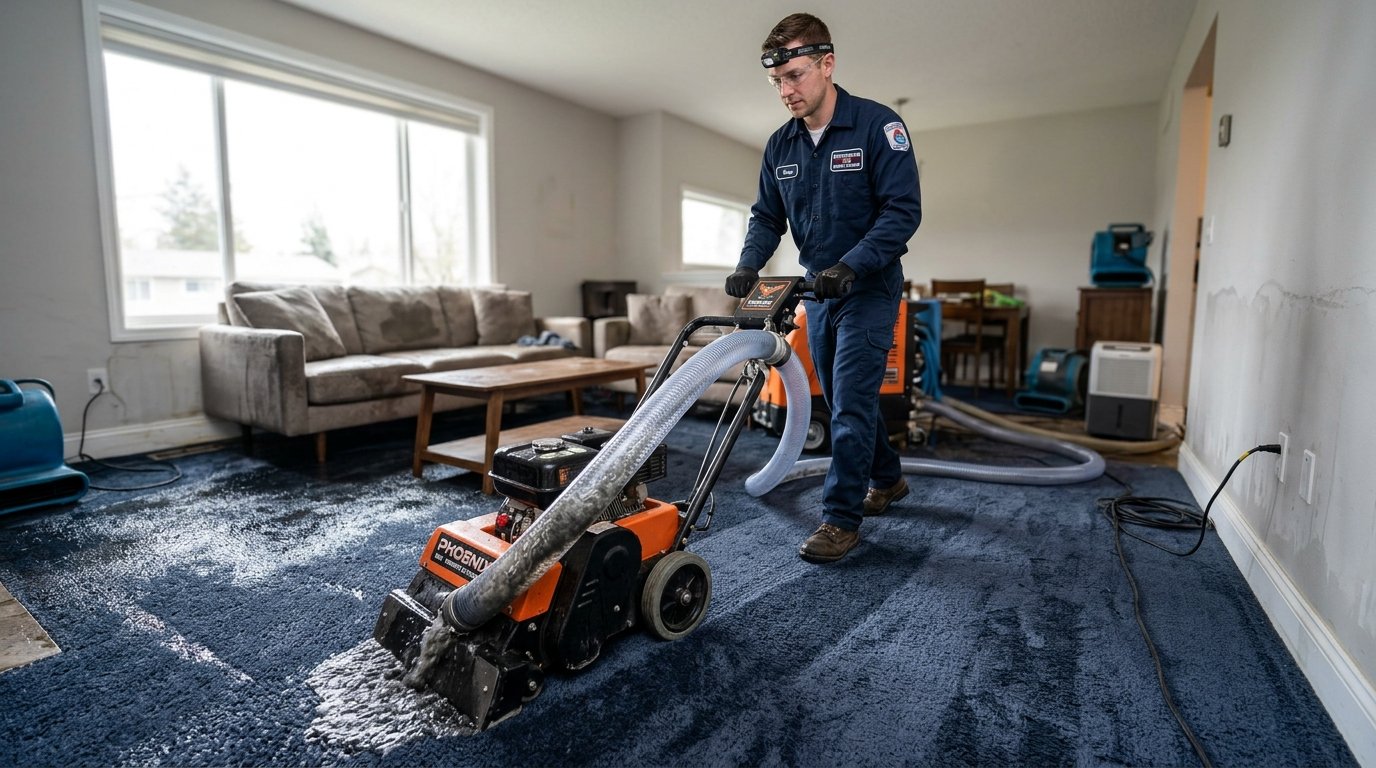
Professional restoration contractors use weighted extraction rovers (such as the Hydro-X or Dri-Eaz Rover). The technician stands on the wheeled extraction machine, applying 180 to 250 lbs of downward gravitational force as powerful truck-mounted vacuum blowers draw water directly through the carpet backing and pad. This removes up to 90% of trapped liquid in a single pass.
Floating the Carpet
Once the pad is removed and the concrete slab sanitized, technicians employ a technique known as “floating”:
The edges of the carpet are left attached to tack strips on two walls.
The snout of a high-velocity centrifugal air mover is inserted beneath the free edge of the carpet.
The air mover creates a high-pressure cushion of air, inflating the carpet like a dome.
High-velocity laminar airflow passes simultaneously across the carpet backing and the concrete slab, accelerating evaporation by 400%.
Commercial LGR (Low Grain Refrigerant) dehumidifiers capture the evaporated water vapor from the room air, draining 20+ gallons of liquid per day directly down a household drain.
Arizona Concrete Slabs: The Hidden Moisture Trap
Because Arizona homes rarely have wood basements or crawlspaces, almost all carpeting is laid directly over a poured monolithic concrete slab.
Concrete is porous and acts as a massive moisture sponge. When carpet is flooded, concrete absorbs hundreds of pints of water into its capillary network. Even after carpet feels dry to the hand, a damp slab will continue releasing water vapor upward (known as Moisture Vapor Emission Rate or MVER).
If new padding and carpet are reinstalled before the concrete slab has reached an equilibrium moisture content below 75% to 80% relative humidity, that rising vapor will re-saturate the new pad, creating musty odors and black mold spots 3 to 6 weeks later. Professional restoration contractors always verify slab moisture with non-destructive impedance meters before re-tacking carpet.
Cost Comparison: Drying & Salvaging vs. Full Replacement
Restoring clean-water carpet is almost always dramatically cheaper than full flooring replacement:
Scope of Work
Average Cost
Time Required
Best For
Professional Extraction & In-Place Drying
\$600 – \$1,200
2 to 3 days
Clean Category 1 water caught within 24 hours. Minimal disruption.
Pad Replacement, Floating & Restretching
\$1,100 – \$2,200
3 to 4 days
Category 2 water or deep soak. Carpet saved; fresh sanitary pad installed.
Full Carpet & Pad Tear-Out & Replacement
\$3,200 – \$7,500+
1 to 2 weeks
Category 3 sewage, storm floods, delaminated carpet, or mold growth.
Summary: Action Steps for Wet Carpet
Extract immediately: Call for high-powered weighted truck-mounted extraction within 24 hours.
Do not walk on wet carpet: Minimize foot traffic to prevent tearing the water-softened latex backing.
Never ignore the pad: Expect to replace the padding in almost all moderate-to-severe leaks.
Dry the concrete slab: Ensure the slab is thoroughly dehumidified before re-stretching carpet.
Yes, under specific conditions. If the water came from a clean source (Category 1, such as a burst supply line or broken water heater), has been wet for less than 48 hours, and has not delaminated (separated from its backing), the carpet can usually be extracted, treated with antimicrobials, and dried in place. However, if the water is Category 3 (sewage, floodwater) or was wet for more than 48–72 hours, the carpet must be discarded.
Does carpet padding always have to be replaced after water damage?
In 90%+ of water damage losses, yes. Carpet padding is made from open-cell polyurethane bonded foam (rebond pad) that acts like a gigantic sponge. While synthetic carpet fibers (nylon/polyester) can dry quickly, wet padding traps millions of trapped water droplets and organic debris against the concrete slab or subfloor. In Category 2 or 3 water losses, replacing the pad is mandatory under IICRC S500 standards.
How do you dry wet carpet after a flood?
1) Extract standing water immediately using commercial high-vacuum weighted extractors (household shop vacuums remove less than 20% of trapped water). 2) Pull back carpet corners and remove the saturated padding. 3) Treat both sides of the carpet and the concrete slab with an EPA-registered antimicrobial disinfectant. 4) 'Float' the carpet by placing high-velocity centrifugal air movers underneath the carpet while running commercial LGR dehumidifiers to purge moisture from the air. 5) Install new pad, restretch, and re-tack the carpet.
What is carpet delamination from water damage?
Tufted carpets consist of face yarns woven into a primary backing, which is bonded to a secondary backing using a water-soluble synthetic latex adhesive. When soaked in water for extended periods, this latex adhesive dissolves and breaks down. The two backings separate, causing the carpet to wrinkle, bubble, and shed fibers permanently. Delaminated carpet cannot be restretched and must be replaced.
How quickly will mold grow in wet carpet in Arizona?
In Arizona's warm climate, fungal spores can colonize the moist, dark space between wet carpet backing and the concrete slab in 24 to 48 hours. Once mold penetrates the carpet's secondary latex backing, it cannot be safely sanitized, creating persistent musty odors and airborne health hazards.
Can I use household fans and a shop vac to dry flooded carpet myself?
A standard wet/dry shop vac only pulls surface water; it lacks the down-force suction required to pull water out of dense carpet piles and sub-slab pores. Regular household oscillating fans simply circulate humid air around the room without lowering ambient moisture. Without commercial LGR dehumidifiers removing 15 to 30 gallons of vapor from the air per day, trapped moisture will inevitably migrate into baseboards and drywall, causing secondary mold.
How much does it cost to dry and restore water-damaged carpet?
Professional extraction, antimicrobial sanitization, pad replacement, and structural drying typically cost $800 to $1,800 for a single room, or $1,500 to $3,800 for multi-room areas. By comparison, completely tearing out and replacing quality carpet and pad often costs $3,500 to $7,000+, making professional drying extremely cost-effective.
IICRC-certified restoration technicians · Phoenix metro
Written and fact-checked by the licensed crew that runs the trucks — the same technicians who take moisture readings, set drying chambers to the IICRC S500 standard, and answer the phone at 2 a.m. across the Phoenix metro.
Licensed Arizona contractor — AZ ROC #331127 (KB-2)